
GRE Exam Hub
How to Use NYT Connections as a Pomodoro Study Break
Learn how to use the daily NYT Connections puzzle as a structured 5-minute Pomodoro study break that resets your focus without the time-loss of social media. The article explains why the puzzle's solve time, built-in hard stop, and semantic memory demands make it an effective cognitive reset for exam prep.
- gre
- mcat
- asvab
- sat
- act
- digital-adaptive
- official-material
- section-strategy
- test-date-timeline
Your Pomodoro timer ends. You have five minutes, a test date that is not moving, and the familiar bargain forming in your head: just open the phone for a second.
That second is the problem. Most students do not need another lecture about taking breaks. They need a break that actually gives the next study block back to them. Purdue Global cites research that 75% of students perform better with breaks, but it also warns that phone breaks are not the kind that reliably recharge you.[1] The danger is not that a five-minute scroll is immoral. It is that it is rarely five minutes.
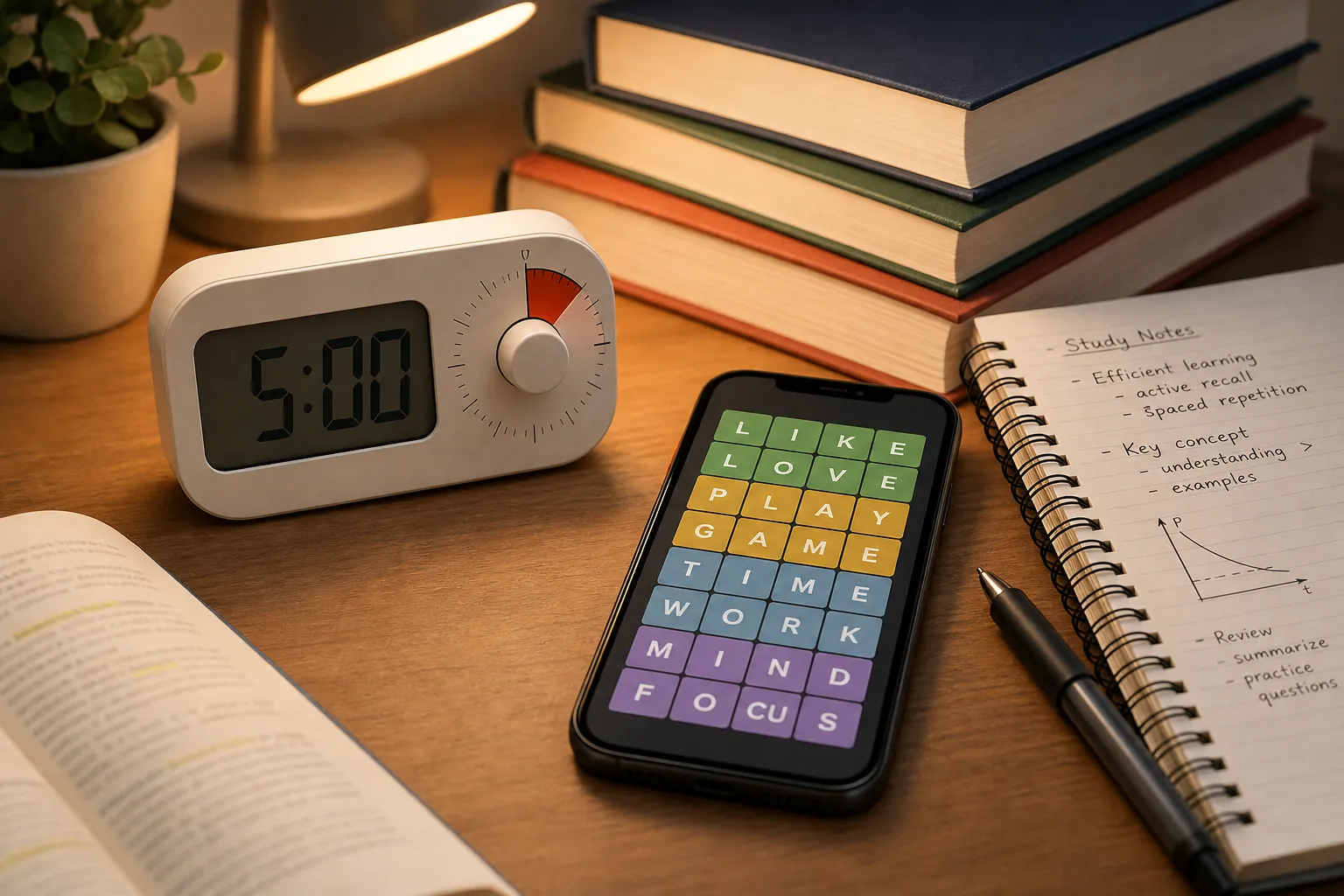
NYT Connections can be a better default because it has three traits that exam-prep breaks badly need: it is short, it has a built-in endpoint, and it changes the mental channel without pretending to be another study task. Used tightly, the daily puzzle works as a bounded reset between GRE quant sets, MCAT content review, SAT reading practice, or ACT pacing drills.
Why Connections fits a Pomodoro break
A useful study break has to be easy to start and easy to stop. Connections is unusually strong on the second part. The game ends when you find all four groups, and it also ends after four mistakes. That mistake limit matters because it takes the stopping decision away from your tired brain. You are not negotiating with yourself for one more refresh, one more reel, or one more comment thread.
The time fit is promising, though it needs to be stated carefully. Self-reported solve-time estimates around Connections commonly fall in the 1–5 minute range, which lines up with the short-break slot many students use in a Pomodoro cycle. That is not official New York Times solve-time data. The more formal public numbers still come through Reddit-shaped evidence: WordsRated analyzed about 60,000 Reddit-shared results, a sample that may overrepresent engaged players rather than casual or struggling ones.[2]
Even with that caveat, the results are useful for setting expectations. In the WordsRated analysis, 57% of players solved without any mistakes in four guesses, the average skill score was 88.08, and the fail rate was 9.1%.[2] Those numbers do not prove that Connections improves studying. They do suggest that, for people who already understand the game, the daily puzzle usually does not become a long frustration loop.
| Break requirement | How Connections handles it |
|---|---|
| Short | Self-reported solve estimates commonly sit around 1–5 minutes, though this is not official NYT timing data. |
| Repeatable | There is one main daily puzzle, so the break can be attached to the same study slot each day. |
| Easy to stop | The puzzle ends after four solved groups or four mistakes. |
| Mentally different | It asks for semantic grouping, not another pass through formulas, flashcards, or passage questions. |
The useful reset is semantic, not academic
Connections is active enough to keep the break from feeling like a blank stare, but it is not exam review. That distinction is the whole point.
A student coming off a study block may have spent 25 or 50 minutes retrieving amino acid properties, drilling quadratic transformations, reviewing grammar rules, or forcing themselves through dense reading-comprehension explanations. Connections asks for a different kind of retrieval: which words share a meaning, which ones complete a phrase, which group is built around usage rather than definition, which apparent match is a trap.
Muraki and Pexman describe the game in terms of semantic memory: the network of word meanings, associations, categories, idioms, and shared features that lets players move flexibly among possible groupings.[3] That makes Connections a reasonable mental gear shift after rote memorization or formula recall. It is still thinking, but it is not the same thinking.
WordsRated’s category breakdown supports that reading of the game. In its analysis, 43.5% of groups were definition or synonym categories, while 38.2% were idioms or usage categories.[2] Together, those categories account for more than four-fifths of the groups in the dataset. The puzzle’s work is usually not specialized trivia; it is flexible meaning navigation.
That is why it should not be sold to an anxious student as a secret vocabulary course. If an SAT student sees a useful word, fine. If a GRE student notices a synonym family, also fine. But the break has failed if it becomes another obligation to extract academic value from every square. Connections does not teach the Krebs cycle, repair weak algebra, or replace spaced repetition. Its best use here is narrower and more believable: a low-stakes shift away from the exact kind of strain the previous block required.
The five-minute Connections protocol
The protocol is deliberately plain. The less ceremony around the break, the less opportunity there is for the break to become its own project.
- When the study timer ends, stand up or shift posture first. Do not open a feed while deciding what to do.
- Open today’s NYT Connections puzzle at the start of the five-minute break.
- Try to solve it within the break. If you solve it, stop. If you hit four mistakes, stop.
- Do not check hints, explanations, comments, archives, streak discussions, or another NYT game during this break.
- When the timer ends, return to the next study block immediately, even if one group is still unsolved.
The hard part is not opening the puzzle. The hard part is protecting the return. If the five-minute break turns into hints, screenshots, debates over the purple category, and then a second game, it has become the same kind of time-loss machine you were trying to avoid.
Use restraint with guesses
Connections rewards quick pattern recognition, but the four-mistake limit punishes careless certainty. A good break does not need a full solving seminar, but two small habits help keep the puzzle inside the five-minute window.
- Before submitting four words that seem obvious, scan for a possible fifth. If a fifth word also fits, you may be looking at a red herring rather than a clean group.
- Use a notebook-style approach if the grid feels noisy: jot possible groups in the margin of your study paper, then submit only when one set has a clear boundary.
- Save guesses for groups you can name. “These four feel related” is weaker than “these are all words before ‘board’” or “these are all synonyms for hesitate.”
Those tactics are not about becoming an elite player. They are about preventing the one thing that ruins this as a study break: spending the whole interval burning guesses, getting irritated, and then carrying that irritation into the next passage set or problem drill.
Why social media is a weaker default
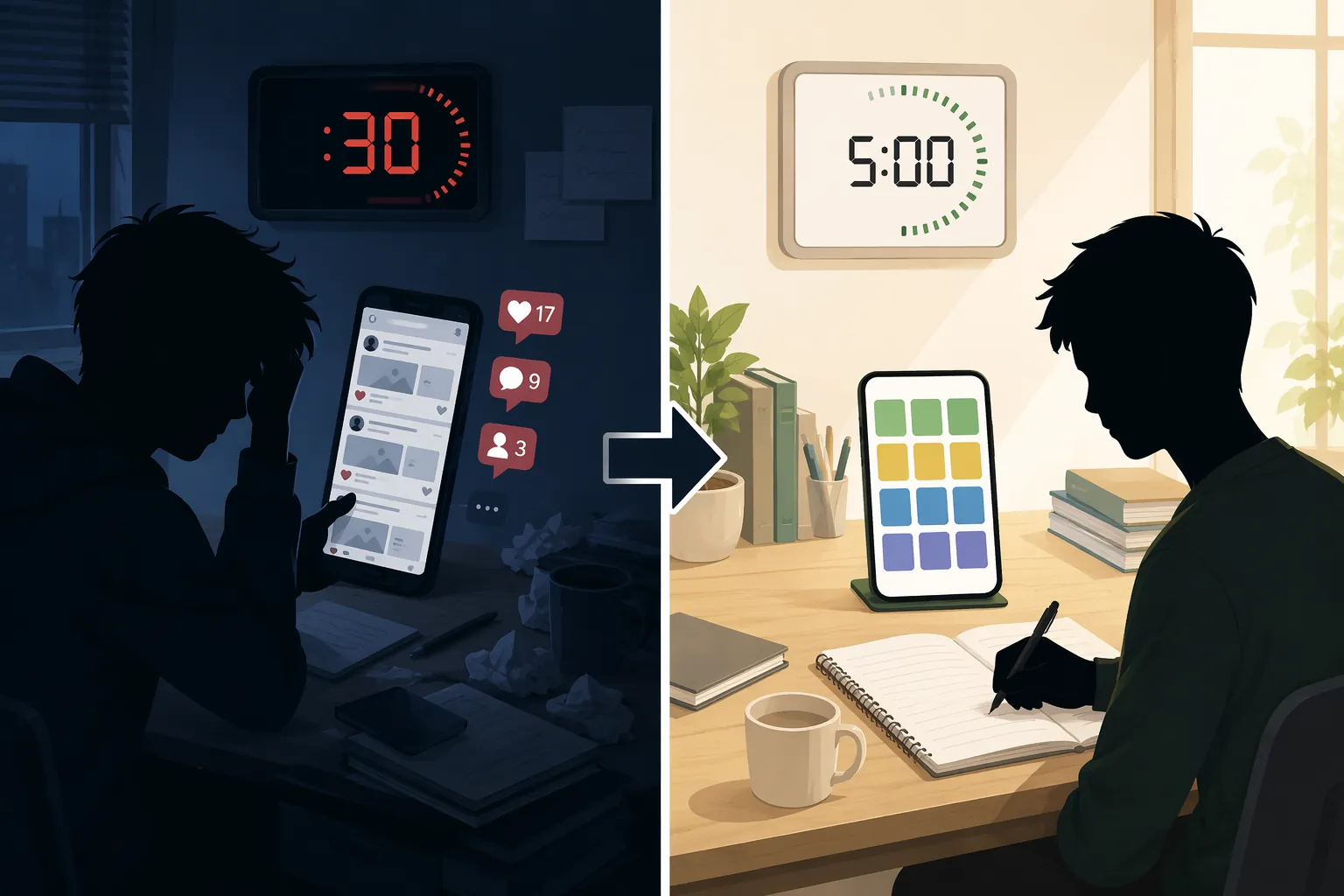
A social-media break asks for almost no initiation energy, which is why it wins when you are tired. It also usually has no natural endpoint. The feed is designed to keep becoming slightly new. After a hard study block, that matters: the student who meant to rest is now making dozens of tiny continuation decisions while the next block waits.
Connections has its own temptations: streaks, share grids, archives, hints, and adjacent games. But the core daily puzzle is finite. That gives you something social media does not: a built-in stopping point that can cooperate with the timer instead of fighting it.
This is also why the puzzle should be opened directly, not through a wandering phone routine. If the path to Connections runs through notifications, messages, and an app drawer full of distractions, the break has already become less controlled. Put the puzzle where you can reach it cleanly, or use a browser bookmark that does not require passing through a feed.
Where it belongs in an exam-prep day
Use Connections after a study block that is mentally narrow: flashcards, formula review, dense content memorization, timed quant drills, or grammar repetition. It is less useful after a block that was already loose and verbal, such as browsing explanations, reorganizing notes, or rereading strategy articles. The cleaner the contrast, the better the reset.
For GRE prep, it can sit after a vocabulary or quant block. For MCAT prep, it can follow content review without pretending to be science reinforcement. For SAT or ACT prep, it can separate two timed sections so the second one does not feel like a continuous extension of the first. The puzzle is the hinge between blocks, not the centerpiece of the study plan.
Students already seem to understand this use informally. A Baylor Lariat piece described New York Times games as “the perfect study break,” which is useful campus color, not proof of effectiveness.[4] The stronger case for Connections is not that students like it. It is that its structure makes the break easier to contain.
Keep the claim honest
There is no controlled study showing that NYT Connections, specifically, improves GRE, MCAT, SAT, or ACT outcomes as a Pomodoro break. The argument is practical and bounded: the puzzle appears to fit the break window, it ends by design, and it uses semantic grouping rather than the same content-recall mode that dominates much of exam prep.
The public performance numbers also need humility. WordsRated’s analysis is large, but it is based on Reddit-shared results, so it may tilt toward players who are more engaged, more successful, or more likely to post.[2] A student brand-new to Connections may need longer at first. A student who hates wordplay may find the puzzle irritating rather than refreshing. In either case, the rule is simple: if the break does not return you cleanly to studying, choose a different break.
That different break can be physical, sensory, or silent. Take a short walk, stretch, refill water, look away from screens, or use another tightly bounded activity. Connections earns its place only when it stays small.
The rule that makes it work
Use one daily puzzle. Use one five-minute break. Solve or fail. Then go back.
Under that rule, NYT Connections is a good Pomodoro study break strategy: short enough for the slot, structured enough to stop, and mentally different enough to feel like a reset without becoming fake studying. The moment it expands into hints, streak maintenance, archives, or “just one more” game, it no longer has the feature that made it useful.
References
- 12 Study Break Ideas to Refresh Your Mind, Purdue Global
- NYT Connections Statistics, WordsRated
- NYT Connections: Tips to improve your game through the science of semantic memory, The Conversation
- New York Times games are the perfect study break, Baylor Lariat, September 12, 2024
Related exhibits & inventory
Verified outcomes
Planners
No planner filed for this exam yet
A downloadable timeline template for this exam hasn't been published yet.
Tool verdicts
AI-tool cautions
No AI tools tested for this exam yet
No hands-on AI-accuracy logs have been filed for this exam.
Questions about this plan
Ask a question about a specific section, timeline, or citation in this plan — or flag something that needs correcting.
Comments
Join the discussion with an anonymous comment.