
GRE, MCAT, SAT, ACT Exam Hub
What NISAR's Hummingbird Teaches About Pareidolia and Ice
The viral NISAR hummingbird image from Antarctica is not a bird—it's a perfect case study for understanding pareidolia, radar polarimetry, and glacial dynamics. This article unpacks all three layers so students can see how a single news event connects to concepts tested on the SAT, ACT, GRE, and MCAT.
- gre
- mcat
- asvab
- sat
- act
- digital-adaptive
- official-material
- section-strategy
- test-date-timeline
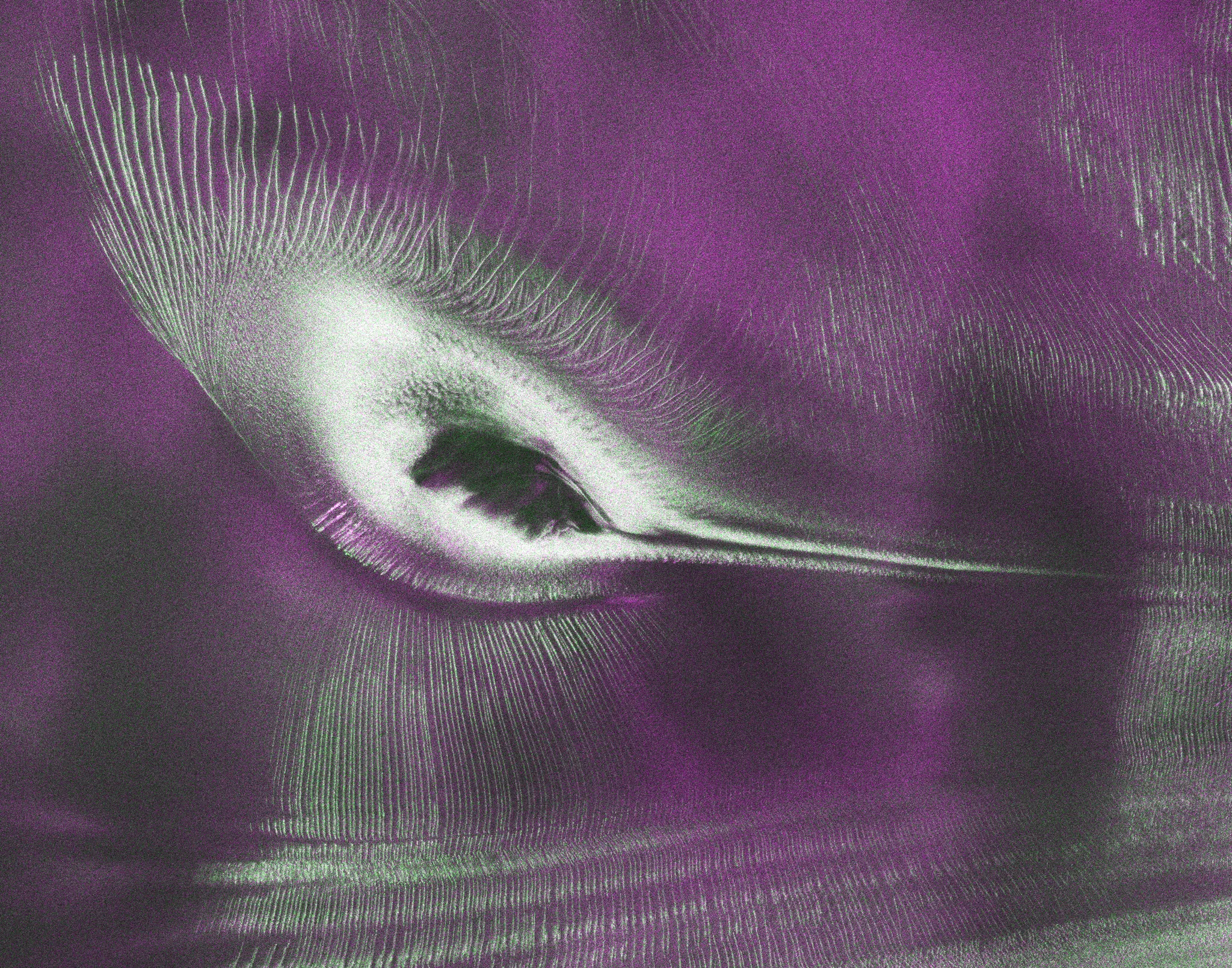
At first glance, the Antarctica image looks almost too charming to be satellite data: a green hummingbird, wings spread, hovering over magenta ice. That first glance is not wrong as a first glance. It is just incomplete. The “bird” in the viral NISAR image is not an animal, not a drawing, and not a natural-color photograph. It is a false-color radar image of Nunatak Zaterjavshijsja, a mountain peak sticking through the Antarctic ice sheet, with fractured ice around it arranged in a shape that the human brain is very happy to read as a hummingbird. NASA’s Jet Propulsion Laboratory shared the image on July 21, 2026; the data itself was captured in August 2025 during NISAR commissioning.[1]
That makes it a useful image for students because the easy answer—“it’s pareidolia”—is true, but too thin. The more exam-useful answer has three layers: the brain supplies the hummingbird, the radar supplies the color-coded signal, and the glacier supplies the physical pattern that made the illusion possible.
The Hummingbird Is a Perception, Not a Creature
Pareidolia is the tendency to perceive a meaningful pattern, often a face or familiar object, in ambiguous visual information. NASA has used the term for many space and planetary images, including famous examples where people see faces, animals, or human-made shapes in rocks, clouds, craters, and cosmic structures.[2] The NISAR case is especially fun because it is not the usual face-on-Mars example. It is animal-shaped pareidolia: a bird-like outline built from wings, head, body, and tail that seem to snap into place once someone points them out.
That quick snap matters. In a 2009 magnetoencephalography study, researchers found that the brain’s fusiform face area responded to face-like patterns at about 165 milliseconds, not far behind the roughly 130 milliseconds reported for real faces.[3] That finding should not be stretched too far here. A hummingbird outline is not a face, and the study does not prove that every animal-shaped illusion uses the same neural timing or mechanism. Still, it gives students a concrete way to understand why pattern recognition can feel immediate rather than deliberate. The brain is not waiting for a written label before it begins sorting visual input into familiar categories.
In reading terms, this is the difference between recognition and interpretation. Recognition says, “That looks like a hummingbird.” Interpretation asks, “What evidence produced that appearance, and what kind of evidence is it?” On the SAT, ACT, GRE, or MCAT, students make the same jump with passages. A paragraph looks like it is arguing one thing because it uses a familiar word or tone; a graph looks like it proves a conclusion because its slope feels obvious; a scientific image looks like a photograph because it has colors. The test is rarely whether the first impression happened. The test is whether the reader can slow it down.
The Colors Are Measurements, Not Paint
The most important correction is not “the bird is fake.” It is “the colors are constructed from radar returns.” NISAR uses synthetic aperture radar, or SAR, which sends microwave signals toward Earth and records the signals that bounce back. Radar can collect useful information in darkness and through clouds because it is not depending on reflected sunlight in the same way an ordinary optical camera does.[4]
In this image, NISAR’s L-band radar uses a wavelength of about 24 centimeters. The image is polarimetric, meaning it uses the orientation of the radar signal to help distinguish surface and structural properties. JPL describes the false-color mapping this way: relatively smooth ice appears magenta, while fractured crevassed ice appears green because vertical polarization returns are shaped by volume scattering within the broken ice.[1]
| What the viewer sees | What it means in the NISAR image |
|---|---|
| Green wing-like regions | Heavily fractured, crevassed ice with stronger volume scattering |
| Magenta surrounding areas | Relatively smoother ice surfaces in the false-color radar display |
| Dark central feature | Nunatak Zaterjavshijsja, a mountain peak protruding through the ice sheet |
| Hummingbird outline | A human pattern-recognition response to the arrangement of real radar features |
This is where a science reader has to be precise. A false-color image is not less scientific because its colors are assigned. The colors are not pretending to be what a person would see from an airplane window. They are a visual translation of instrument data. The question is not whether Antarctica is literally green and magenta. It is what radar property has been mapped into green and magenta, and whether that mapping is explained well enough to support the claim being made.
NISAR itself is a joint NASA-ISRO mission. It launched on July 30, 2025, carries dual-frequency radar instruments—NASA’s L-band system and ISRO’s S-band system—and uses a 12-meter deployable mesh reflector. The mission flies in a 747-kilometer sun-synchronous orbit and is designed to map Earth’s land and ice surfaces every 12 days.[5] Those mission details matter here only because they explain why this sort of ice structure can be seen repeatedly and systematically. The hummingbird went viral because it is odd-looking. The mission is useful because it can turn radar measurements into repeated observations of changing surfaces.
The Wings Come From Ice Moving Around Rock
Now the bird becomes real again, but not as a bird. A nunatak is an exposed mountain peak, ridge, or rock formation surrounded by glacial ice.[6] Nunatak Zaterjavshijsja interrupts the flow of the Antarctic ice sheet. According to JPL’s description of the image, the ice in this area flows northeast toward the ocean. As it moves around the protruding mountain, stress builds and fractures open in the ice, creating the radiating crevasse pattern that resembles outspread wings.[1]
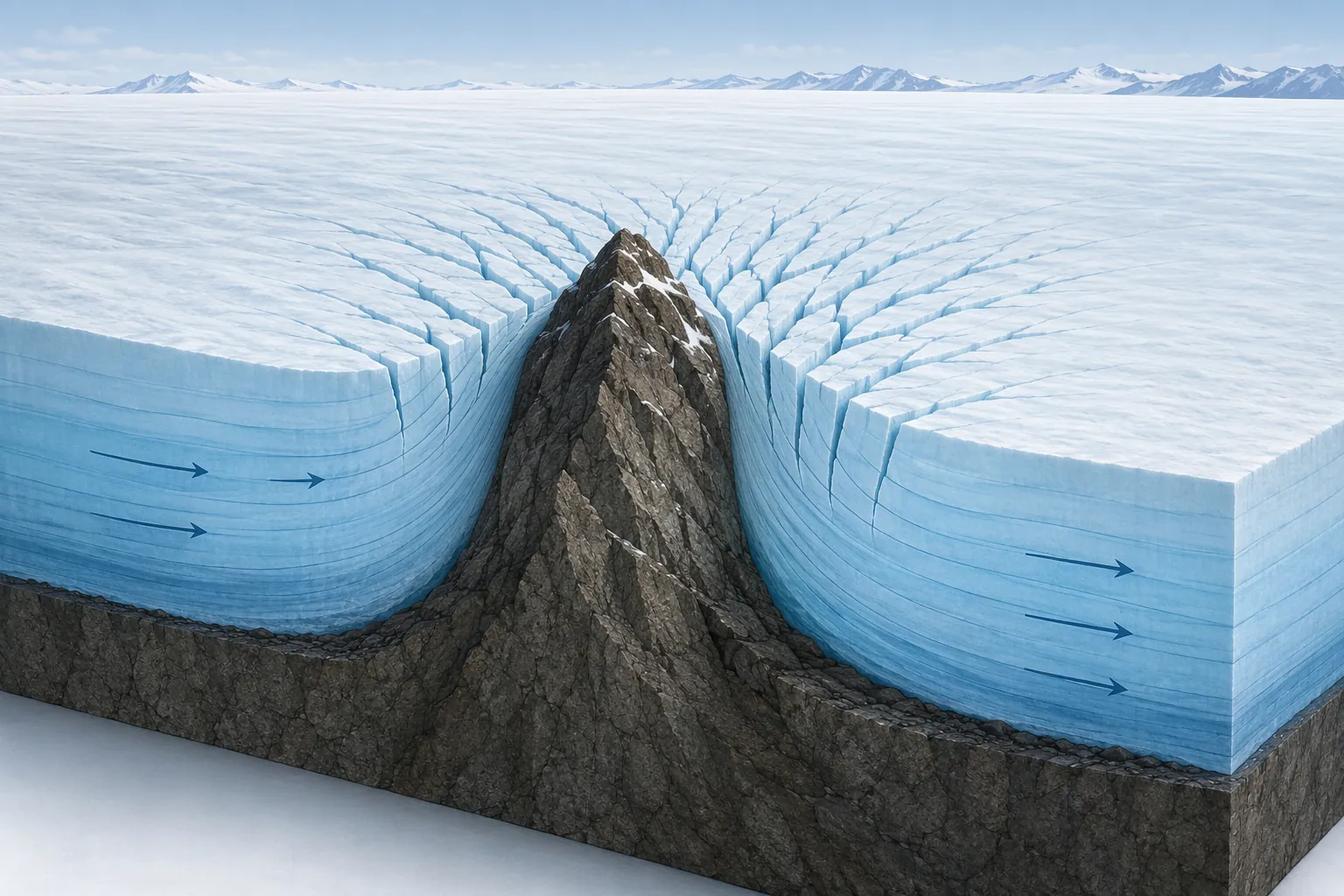
Crevasses form where glacial ice is pulled apart under stress. They can be tens of meters deep and are important clues to how ice is moving, stretching, and responding to the terrain beneath or within it.[7] In the NISAR image, the green “wings” are not decorative. They are fractured zones. The fact that the fractures radiate from the exposed peak is the physical reason the pareidolia works so well.
This is also the point where “just pareidolia” becomes a lazy answer. The hummingbird outline is supplied by the observer, but the arrangement that invites the outline is not random doodling. Rock obstructs ice. Ice flows around the obstruction. Tensile stress opens crevasses. Radar detects differences between smoother and more fractured ice. A false-color image turns those differences into a visible pattern. Then the brain, doing what brains do, reads the pattern as an animal.
A Better Way to Read the Image
For students, the image works almost like a compact science passage. It contains an observation, a method, and a mechanism. If those get blended together, the explanation becomes mushy. If they stay separate, the image becomes easier to analyze.
- Appearance: the image resembles a hummingbird because the brain recognizes a familiar animal shape.
- Instrument output: the colors come from NISAR’s radar polarimetry, not from ordinary visible-light photography.
- Physical cause: the green wing-like regions correspond to fractured ice produced as flowing ice moves around a protruding mountain peak.
- Scientific value: the fractures are evidence of glacial dynamics, even though the bird shape is not itself a scientific object.
That separation is exactly the habit tested in science-heavy reading. A student reading an MCAT CARS passage about perception, a GRE prompt about remote sensing, or an ACT science passage with false-color imagery needs to ask what kind of claim each sentence is making. Is it describing what a person sees? Is it describing what an instrument measures? Is it explaining a cause? Those are not interchangeable.
A tempting wrong answer choice might say that NISAR photographed a bird-shaped ice formation. That sounds close, but it smuggles in the wrong instrument and the wrong object. Another might say the image proves that pareidolia is caused by the same mechanism as face recognition. That overreaches, because the strongest timing evidence cited here concerns face-like patterns, not every possible animal-shaped illusion. A stronger answer would say that the image combines human pattern recognition with radar-derived evidence of crevassed ice around a nunatak.
Why This Viral Image Is a Good Exam Passage in Disguise
The NISAR hummingbird asks for the same discipline as a well-written interdisciplinary passage. Psychology explains why the outline grabs attention. Physics and engineering explain how microwave radar data become a false-color image. Earth science explains why the fracture pattern exists around a mountain peak in an ice sheet. None of those explanations cancels the others.
It is worth enjoying the hummingbird first. Wonder is not the enemy of careful reading. The mistake is stopping at wonder, or replacing it with a too-fast dismissal. The bird is imaginary; the nunatak is not. The colors are artificial; the radar returns are not. The outline is a perception; the crevasses are physical evidence. A strong science reader can hold those distinctions long enough to put them back together into one careful explanation.
References
- US-India Satellite Delivers Data, Reveals “Hummingbird” in Antarctica, NASA Jet Propulsion Laboratory, July 21, 2026.
- Pareidolia: Seeing Shapes in the Cosmos, NASA.
- Early (M170) activation of face-specific cortex by face-like objects, NeuroReport, 2009.
- What is Synthetic Aperture Radar?, NASA Earthdata.
- NISAR, NASA Science.
- Nunatak, Wikipedia.
- Crevasse, National Geographic Education.
Related exhibits & inventory
Verified outcomes
No verified outcomes on file for this exam yet
See Methodology for how outcome evidence is disclosed once logged.
Planners
No planner filed for this exam yet
A downloadable timeline template for this exam hasn't been published yet.
Tool verdicts
AI-tool cautions
No AI tools tested for this exam yet
No hands-on AI-accuracy logs have been filed for this exam.
Questions about this plan
Ask a question about a specific section, timeline, or citation in this plan — or flag something that needs correcting.
Comments
Join the discussion with an anonymous comment.