
MCAT Exam Hub
Master MCAT Biology with the New Likweli Monkey Discovery
Use the July 2026 discovery of the Likweli monkey (Colobus congoensis) to move beyond memorization and practice the analytical reasoning MCAT biology questions demand — from reading phylogenetic trees to evaluating multi-evidence studies.
- SAT
- ACT
- GRE
- MCAT
- ASVAB
- digital-sat
- adaptive-testing
- registration-fee
- content-outline
- score-target
The new Likweli monkey discovery is not useful for MCAT biology because the exam is suddenly going to ask you to identify Colobus congoensis. The AAMC does not reward memorizing a primate headline from last week. The value is different: the July 15, 2026 Likweli monkey paper looks uncannily like a strong MCAT biology passage, with genetics, anatomy, behavior, geography, and conservation all competing for your attention at once.[1]
That is exactly where many students get into trouble. They know what a phylogenetic tree is. They can define allopatric speciation. They have seen “morphology” on flashcards. Then a passage hands them several evidence types, some stronger than others, and the question asks for the best-supported inference rather than the best-known term.
The Case Has More Than One Kind of Evidence
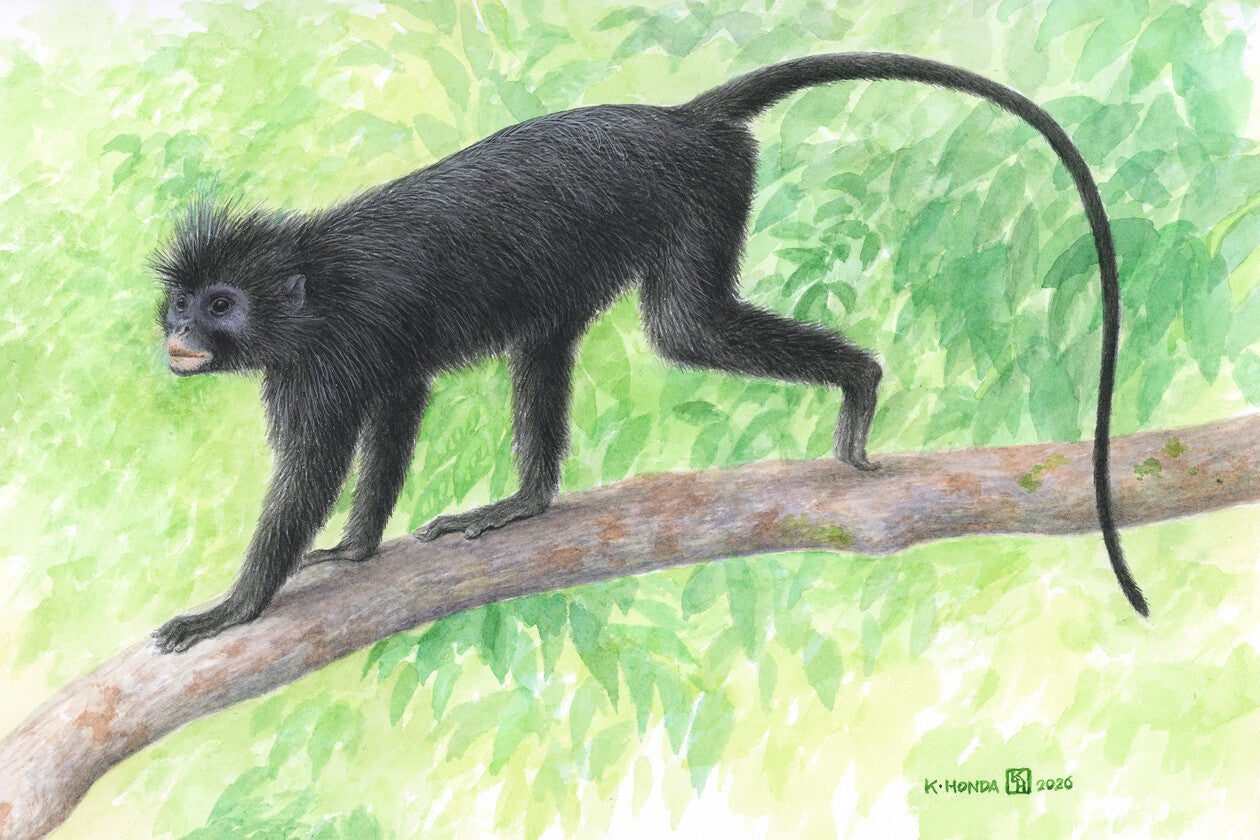
The Likweli monkey, formally described as Colobus congoensis, was reported from Lomami National Park in the Democratic Republic of Congo. Press coverage naturally leaned into the memorable parts: orange lips, a striking face, and a roar compared with a frog-like sound.[2][3] For MCAT preparation, those details are only the doorway.
The real study is built around a multi-evidence species-delimitation problem. The researchers analyzed mitochondrial DNA across a 4,090 base-pair region using 46 African colobine samples; craniodental morphometrics across 13 species and 182 museum specimens; and acoustic data from 6 roaring events.[1] They also placed the species geographically, noting the Lomami River and white-sand soil zones as possible isolating features, and estimated a restricted range of roughly 1,700 km² compared with more than 60,000 km² for some related colobus species.[1]
| Evidence line | What it measures | How an MCAT-style question might use it |
|---|---|---|
| Mitochondrial DNA | Sequence divergence and phylogenetic relationship across a 4,090 bp region | Ask which taxon is the sister species, or which evidence most strongly supports species status |
| Craniodental morphology | Skull and tooth measurements across 13 species and 182 specimens | Ask how anatomical differences may relate to diet, function, or divergence |
| Acoustics | Spectrogram differences from 6 roaring events | Ask whether behavioral evidence supports the claim, while recognizing the small sample |
| Geography | River barrier, soil zones, and distance from nearest black colobus population | Ask whether isolation is consistent with allopatric speciation |
| Conservation range | Restricted estimated range near 1,700 km² | Ask how range size affects extinction risk |
A passage with this much information is not asking you to admire the list. It is asking you to sort it.
Read the Tree Before You Reach for the Vocabulary
The strongest line of evidence in the Likweli case is the mitochondrial phylogeny. The paper estimates that C. congoensis diverged from its sister species, C. satanas, roughly 4.1–5.0 million years ago.[1] On an MCAT passage, that number is not trivia. It anchors the interpretation of the tree.
“Sister species” means the two taxa share the most recent common ancestor with each other compared with the other taxa shown. It does not mean one species evolved from the other. It does not mean the two species are identical except for a few surface traits. It does not, by itself, prove which ecological pressure caused the split. A common wrong answer would quietly treat a sister relationship as a parent-descendant relationship.
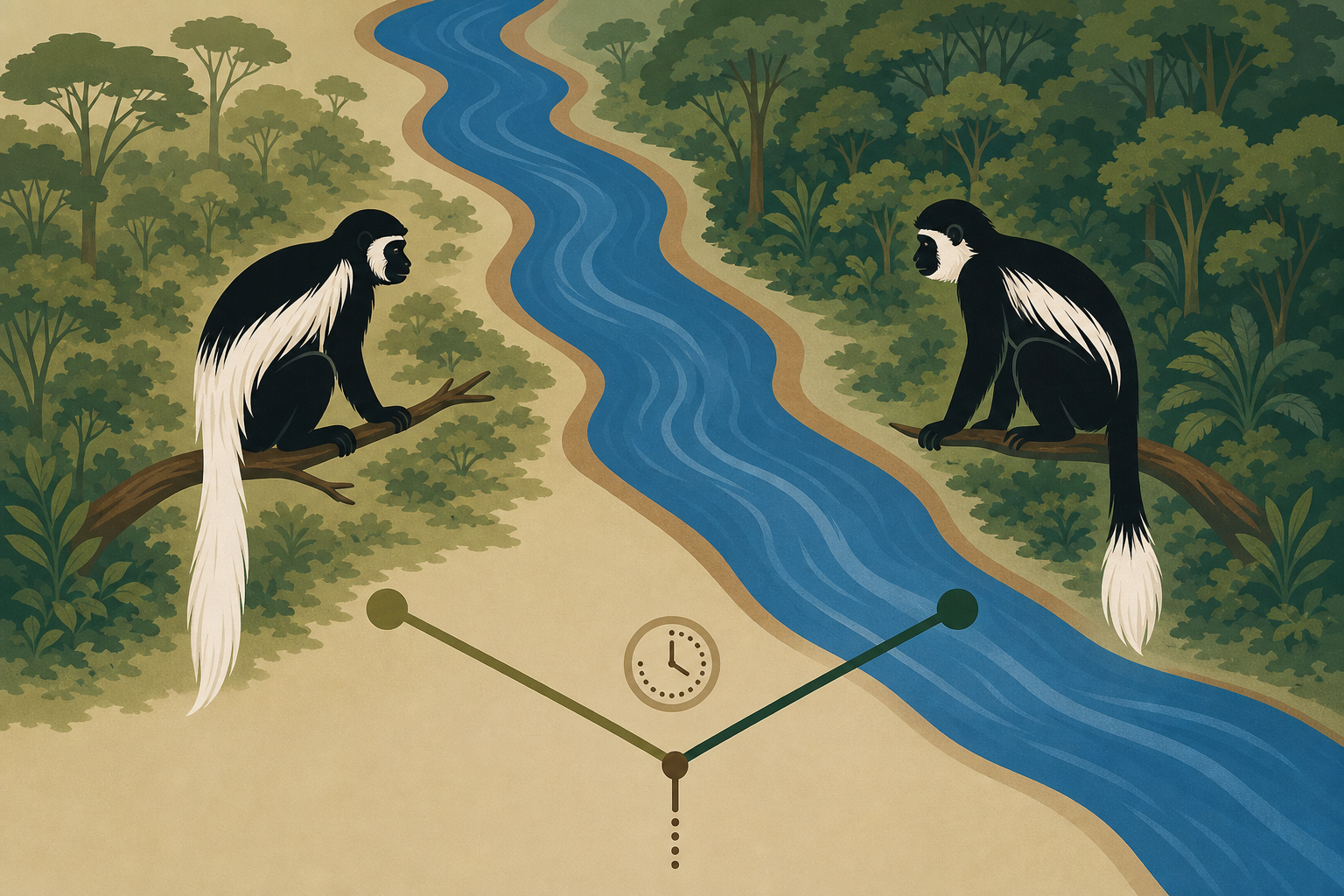
The geography makes the tree more useful. The Likweli population is separated from the nearest known C. satanas population by about 1,200 km, and the study discusses the Lomami River and white-sand soil zones as barriers or ecological separators.[1] That combination is why the case maps so cleanly onto allopatric speciation: a population becomes geographically isolated, gene flow is reduced or interrupted, and divergence accumulates over time.
The careful phrasing matters. The tree supports divergence. The geography supports a plausible isolation mechanism. Together, they are consistent with allopatric speciation. They do not let you claim that researchers experimentally demonstrated the river caused the split, because this is a historical inference, not a controlled barrier-removal experiment.
A Quick Tree-Reading Drill
If an MCAT-style question asked which statement is best supported by the Likweli phylogeny, the strongest answer would stay close to the data: C. congoensis and C. satanas are sister taxa that diverged millions of years ago. A weaker answer would say the Likweli monkey is “more evolved.” A too-bold answer would say the Lomami River has been proven to be the sole cause of speciation. A vocabulary-only answer would announce “allopatric speciation” without checking whether the passage actually includes isolation, divergence, and reduced gene flow as reasonable pieces of the story.
The Three Evidence Lines Are Not Equal
This is the part students should slow down for. The paper uses genetic, morphological, and acoustic evidence, but that does not mean each line carries the same inferential weight. MCAT passages often work the same way: several experiments appear in one setup, and the test asks which result most directly supports a claim.
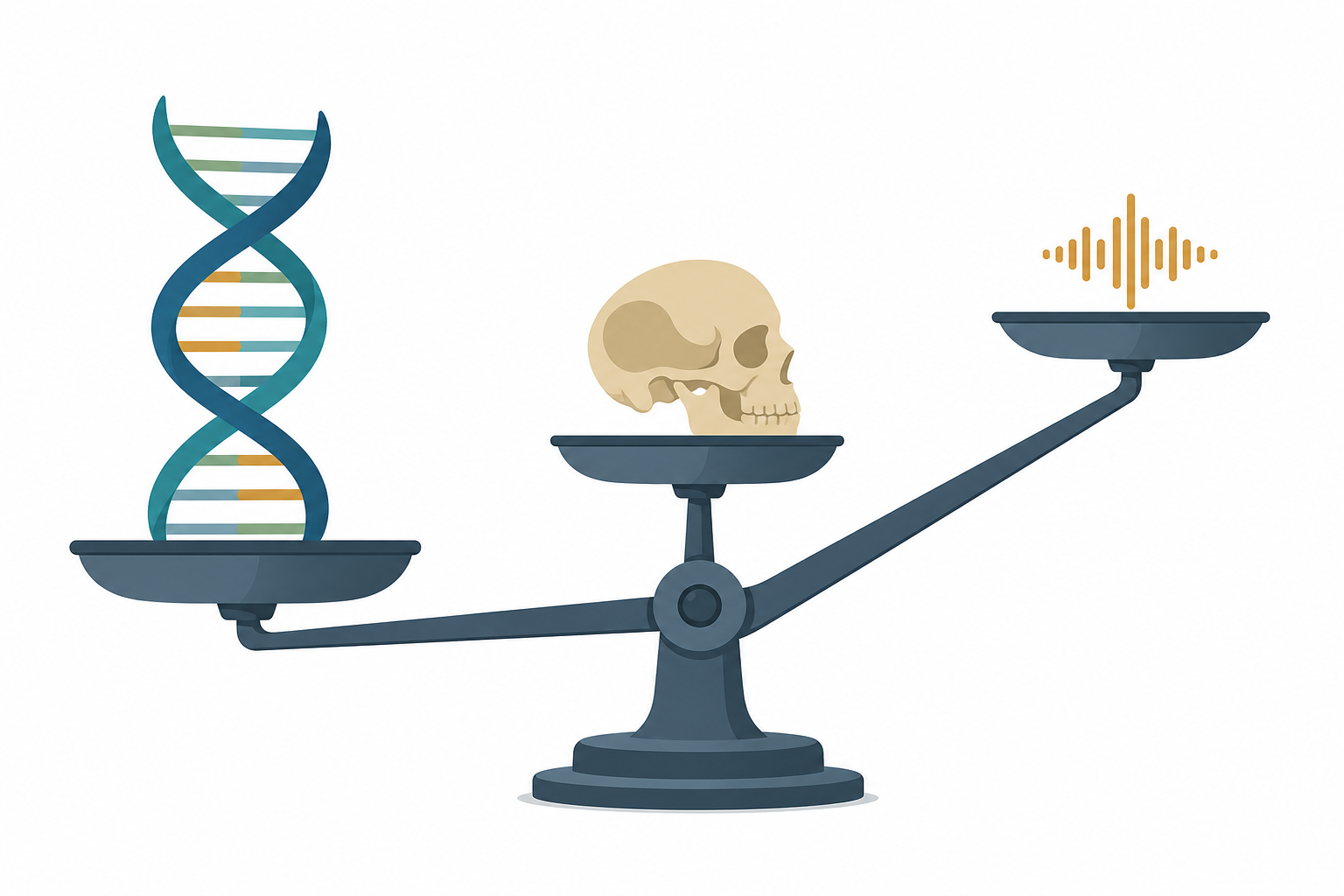
For species status, the mitochondrial DNA result is the heaviest evidence because it directly estimates evolutionary relationship and divergence using sequence data across the sampled colobines.[1] That does not make it perfect; mitochondrial DNA is one genetic marker type, not a whole-genome survey. But within the evidence stack provided, it most directly addresses ancestry and lineage separation.
The craniodental data are still important. The researchers compared skull and tooth measurements across 13 colobine species and 182 museum specimens, including traits such as molar shape and premolar size.[1] For an MCAT student, this is comparative anatomy doing real work. Teeth are not decorative traits; they can relate to feeding mechanics and dietary divergence. If a question asks which evidence suggests functional or ecological differentiation, morphology may be more relevant than the DNA tree.
The acoustic evidence is the easiest to overstate. The paper reports distinctive roaring features, but the acoustic analysis is based on 6 roaring events from one male.[1] That can provide converging behavioral evidence. It should not be treated as equally strong evidence for species delimitation compared with the genetic analysis. A good answer choice would call it supportive but limited; a bad one would make population-wide claims about Likweli communication from a tiny sample.
| If the claim is... | Most useful evidence | Reason |
|---|---|---|
| The Likweli monkey is evolutionarily distinct from its closest sampled relative | Mitochondrial DNA phylogeny | It directly addresses lineage relationship and divergence time |
| The Likweli monkey differs in anatomy that may affect feeding | Craniodental morphometrics | Tooth and skull traits can connect structure to function |
| The Likweli monkey may have a distinctive vocal behavior | Acoustic analysis | Sound data address behavior, but the sample is small |
| The divergence is consistent with allopatric speciation | Phylogeny plus geography | The tree shows divergence; the river and soil zones suggest isolation |
How This Becomes an MCAT Passage Instead of a News Item
Imagine the passage gives you a simplified tree, a table of tooth measurements, and a short note that one male produced recorded roars with a different spectrogram pattern. The question stem asks: “Which finding most strongly supports the conclusion that the Likweli monkey represents a distinct evolutionary lineage?”
The best answer would probably point to the phylogenetic placement and divergence from C. satanas. The tooth data may help distinguish the species morphologically. The roar data may add behavioral support. But if the question is about evolutionary lineage, DNA carries the cleanest match to the claim.
Now change the question: “Which result would best support the hypothesis that the species occupies a different dietary niche?” The answer changes. The genetic tree is still relevant to ancestry, but it is no longer the most direct evidence. Craniodental differences become more useful because tooth and skull traits can connect anatomy to feeding function.
That is the exam skill: do not rank evidence once and then use that ranking for every question. Rank evidence relative to the claim being tested.
What to Do When a Passage Gives You Too Much
- Identify the claim first: species status, evolutionary relationship, function, behavior, or conservation risk.
- Match each evidence line to the claim it can actually test.
- Check sample size before treating a result as broad or definitive.
- Separate correlation, consistency, and causation.
- Avoid answer choices that turn “supports” into “proves.”
The Local Knowledge Detail Is Useful, But Narrow
One detail from the fieldwork is tempting to overinterpret: only 8 of 52 surveyed villages recognized the monkey as distinct.[1] That is interesting because it shows how local ecological knowledge can help field researchers notice patterns that outsiders might miss. It also shows why recognition is uneven; not every community living near a region necessarily classifies animals the same way scientists do.
For MCAT purposes, keep the inference modest. This detail does not prove that local knowledge is always accurate, or that scientific taxonomy depends on village recognition. It supports a narrower point: field observations and local reports can help guide investigation, while species delimitation still depends on testable biological evidence.
Conservation Is the Applied Extension
The conservation angle matters, but it should not swallow the biology lesson. The study estimates the Likweli monkey’s range at roughly 1,700 km², far smaller than ranges of more than 60,000 km² reported for some congeners, and proposes Endangered status.[1] That gives an MCAT passage an easy bridge from speciation into extinction risk.
Restricted range changes the consequence of disturbance. If a species occupies a small area, habitat loss, hunting pressure, disease, or climate-related habitat shifts may affect a larger fraction of the total population than they would for a broadly distributed species. The passage does not need a detailed population model for that reasoning to work.
It does need restraint. Because the primary paper is only seven days old as of July 22, 2026, students should not pretend there is already a mature literature on Likweli behavioral ecology, population trend, or conservation intervention success.[1] The safe inference is that a restricted known range can elevate conservation concern. The unsafe inference is that the long-term population trajectory has already been established.
Use the Discovery as a Reasoning Drill
The Likweli monkey is memorable enough that the details may stick: Congo rainforest, orange lips, black-and-white colobus body, frog-like roar. But for MCAT biology, the durable lesson is how to read a mixed evidence package without flattening it.
Use the case this way: read the phylogeny for relationship, use the geography to support isolation, use morphology when the claim turns to function, treat acoustics as supportive but sample-limited, and bring in conservation only as far as the range data allow. That is much closer to how B/B and evolution questions behave than memorizing the species name.
If you want another real-world biology case that can be converted into exam reasoning practice, compare this with the Burmese python invasion and the Everglades trophic cascade. The subject changes, but the task is the same: decide which evidence best supports the claim, and stop before the data stop supporting you.
References
- Likweli: A remarkable new species of Colobus monkey from the Lomami National Park, Democratic Republic of Congo — PLOS ONE, July 15, 2026
- Scientists find new monkey species in Congo's rainforest — Reuters
- Scientists discover a 'remarkable' new monkey species with orange lips and a froglike roar — Scientific American
Related exhibits & inventory
Verified outcomes
Planners
No planner filed for this exam yet
A downloadable timeline template for this exam hasn't been published yet.
Tool verdicts
Questions about this plan
Ask a question about a specific section, timeline, or citation in this plan — or flag something that needs correcting.
Comments
Join the discussion with an anonymous comment.