
SAT Exam Hub
National Academies Climate Report Explained for Students
This article breaks down the National Academies' 2025 climate report, explaining its five key findings and why the 'beyond scientific dispute' conclusion matters for students preparing for exams with science or policy passages.
- SAT
- ACT
- GRE
- MCAT
- ASVAB
- digital-sat
- adaptive-testing
- registration-fee
- content-outline
- score-target
If you see the phrase “beyond scientific dispute” in a climate passage, slow down. That phrase is doing more work than the usual “scientists warn” language. In September 2025, the National Academies of Sciences, Engineering, and Medicine published a fast-track report reviewing whether greenhouse gas emissions harm public health and welfare in the United States. Its answer was unusually direct: the evidence that human-caused greenhouse gas emissions endanger public health and welfare is now beyond scientific dispute.[1]
To understand why that matters, start with the older document underneath the argument: the EPA’s 2009 Endangerment Finding. In plain English, that finding said carbon dioxide and other greenhouse gases threaten public health and welfare. It became the legal foundation for much of U.S. climate regulation, because once the EPA determines that a pollutant endangers health or welfare, regulation under the Clean Air Act becomes possible.[1]
The 2025 National Academies report did not invent a new climate law. It reviewed the science behind the old one after the Trump EPA moved to rescind the 2009 finding. That is why the report feels both scientific and legal at the same time. It is a science review aimed at a policy fight.
What the 2025 Report Actually Says
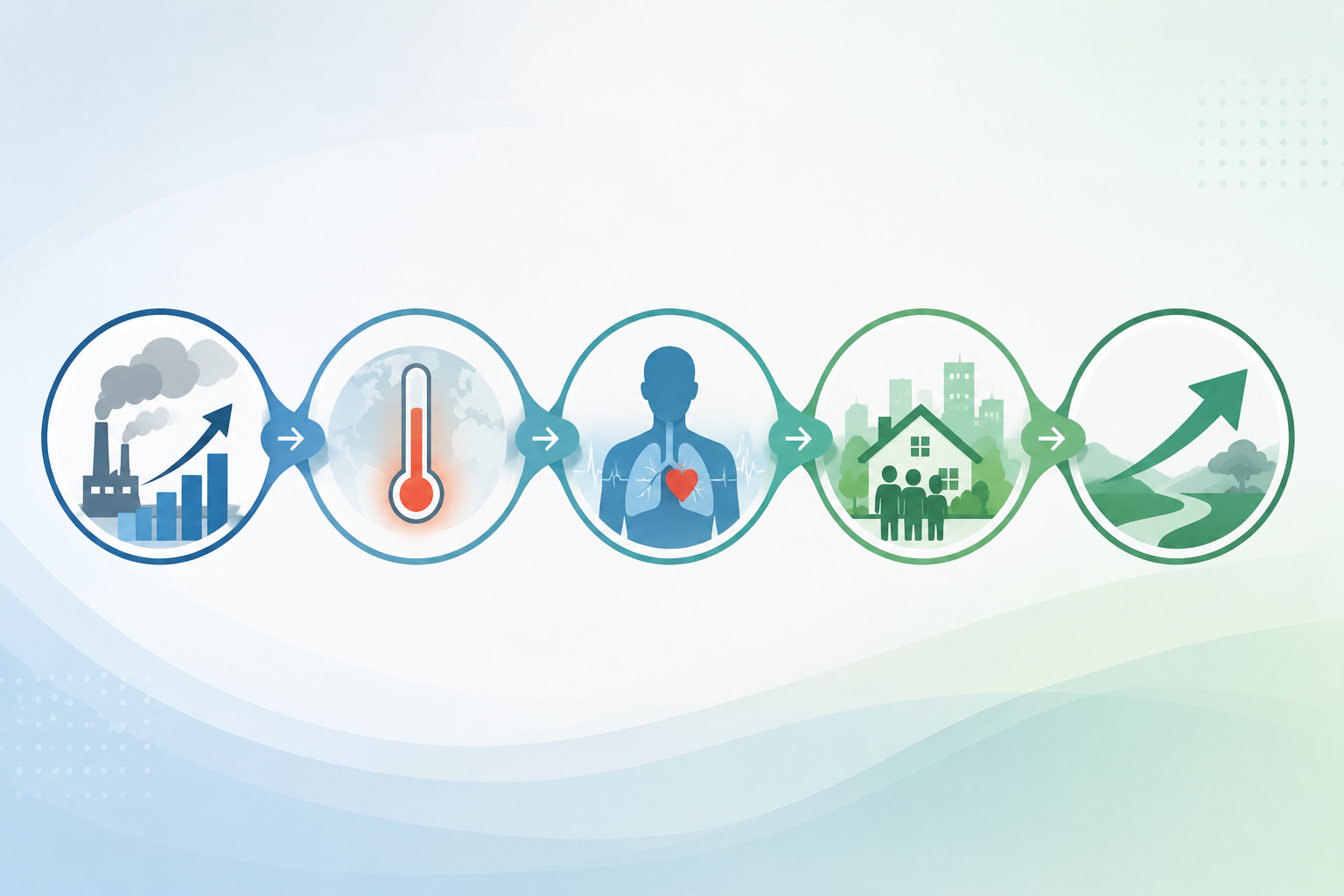
The report’s main findings can be read as five linked claims. They are not all the same kind of claim. Some describe what is happening in the atmosphere. Some describe what has already happened to people and communities. The last one explains why future emissions matter.
| Finding | Student-friendly version | Why it matters in a passage |
|---|---|---|
| Greenhouse gas emissions are still rising | The source of the problem has not disappeared. | A passage may ask whether policy reduced the underlying driver or only addressed some effects. |
| Warming is unequivocal | The report treats warming as established, not speculative. | Look for whether an author is debating existence, scale, cause, or response. |
| Health harms are documented | The report connects greenhouse gas-driven climate change to specific human health outcomes. | This is stronger than vague language about environmental concern. |
| Welfare harms are documented | The report includes damage to communities, infrastructure, ecosystems, and economic well-being. | Welfare is broader than hospital visits or disease rates. |
| Future risk grows with every added ton | More emissions increase future danger; fewer emissions limit it. | This connects evidence to regulation without proving one policy is automatically best. |
1. Greenhouse Gas Emissions Are Still Rising
The first finding is deliberately basic: greenhouse gas emissions continue to rise globally. For a student, the important point is not that every country or sector behaves identically. The point is that the report begins with the driver of the problem. If heat-trapping gases continue to accumulate, the later findings about warming, health, and welfare are not isolated observations.
In exam terms, this is the “cause” layer. A passage may give you data on emissions, temperature, health outcomes, or policy rules. Do not blend them together too quickly. Emissions are the input. Warming is the physical response. Health and welfare harms are consequences people experience.
2. Warming Is Unequivocal
The report also says warming of the climate system is unequivocal.[1] That word matters. It does not mean every local weather event has the same cause. It does not mean scientists can predict every future storm in detail. It means the broad warming trend is no longer treated as an open scientific question.
This is where many students lose the thread in climate-policy passages. A critic might dispute a regulation, a cost estimate, or an agency’s legal authority. That is not the same thing as disproving warming. A careful reader separates the scientific claim from the policy claim before judging either one.
3. Health Harms Are Now Documented in Specific Terms
The health finding is the part students should remember most clearly. The National Academies report identifies documented harms to human health, including cardiovascular and respiratory disease, mental health effects, negative pregnancy outcomes, and nutrition impacts.[1] That is much more concrete than saying climate change is “bad for people.”
Cardiovascular and respiratory harms are especially exam-friendly because they connect environmental exposure to body systems. Heat can stress the cardiovascular system. Smoke and air pollution can aggravate lungs. A passage might not use dramatic language at all; it may simply describe emergency visits, exposure pathways, or vulnerable populations. The skill is recognizing that health harm is being measured through outcomes, not slogans.
Mental health effects also matter because they prevent a too-narrow reading of “health.” Climate-related disasters, displacement, heat exposure, and uncertainty can affect psychological well-being. The report’s inclusion of mental health does not mean every emotional response to climate news is counted as a climate injury. It means the evidence base now includes mental health pathways as part of public health, not as an afterthought.[1]
Pregnancy outcomes and nutrition impacts widen the picture again. These categories are useful because they show that harm can appear through timing and dependency. A pregnant person, a developing fetus, a child, an older adult, or a person with an existing medical condition may face different risks from the same environmental stressor. For related practice with climate-health evidence, the same reading habits apply to wildfire smoke health effects research.
4. Welfare Harms Go Beyond Medical Diagnosis
The 2009 Endangerment Finding used the phrase “public health and welfare,” and the 2025 report keeps both halves in view. Health is about disease, injury, mortality, and physical or mental well-being. Welfare is broader. It includes damage to the conditions that allow communities to function: property, infrastructure, agriculture, ecosystems, water systems, labor conditions, and economic stability.[1]
That distinction is not legal trivia. Suppose a passage describes repeated flooding that damages roads, raises insurance costs, interrupts school transportation, and strains a city budget. Nobody in that example has to be diagnosed with a disease for the passage to be about welfare harm. The damage is still real, and it still falls within the kind of public welfare reasoning that climate regulation often uses.
Economic loss is where welfare language becomes easiest to see. Climate-related damage can show up as repair costs, lower productivity, disrupted supply chains, crop losses, or the cost of adapting buildings and public services. If you need more practice with that frame, compare this report’s welfare discussion with urban resilience and extreme weather economics. The same basic question appears: who pays when physical risk becomes social cost?
5. Future Risk Increases With Every Added Ton
The fifth finding connects the present to the future: every additional ton of greenhouse gas emissions adds to future risk.[1] This is not a prediction that every added ton creates an identical visible disaster. It is a cumulative-risk claim. Greenhouse gases build up, warming increases, and the probability or severity of harmful outcomes rises.
For exams, this helps with cause-and-effect questions. A passage may ask whether reducing emissions eliminates all climate risk. The better answer is usually narrower: reducing emissions limits additional risk. It does not erase all past emissions, undo all existing warming, or settle every policy tradeoff.

Why “Beyond Scientific Dispute” Is Stronger Than the 2009 Language
The 2009 Endangerment Finding was already important. It said greenhouse gases endanger public health and welfare. But the 2025 report speaks from a later evidence base. The National Academies concluded that many issues that were more uncertain or tentative in 2009 have been clarified by longer records, better observations, and more research.[1]
That is why “beyond scientific dispute” is not just a louder way to say “probably.” It signals that the report treats the central endangerment claim as settled within mainstream scientific assessment. Environmental Defense Fund highlighted the phrase because it directly counters the EPA proposal to rescind the 2009 finding.[2]
A good exam passage may test whether you can notice that difference. The report does not say all climate policies are equally effective. It does not say courts must accept one legal theory. It does not say every disputed local impact has been proven with the same level of certainty. It says the evidence that greenhouse gas emissions harm U.S. public health and welfare has become strong enough that the basic scientific endangerment claim is no longer a serious scientific contest.
How the National Academies Built the Report
The report’s process matters because students will often see competing claims presented as if they deserve equal weight merely because they exist. They do not. You judge a scientific report by asking who wrote it, what evidence they reviewed, how conflicts were handled, whether outsiders checked the work, and whether the process was transparent enough to be inspected.
The National Academies convened a committee of 15 experts. Reporting on the committee noted that it included people with varied backgrounds, including former executives from Chevron and Cummins, which matters because the committee was not simply a room of activists already famous for one policy position.[3]
The committee reviewed more than 600 peer-reviewed studies, considered more than 200 public comments, and worked on an unusually fast schedule of about six weeks.[3] The report also went through independent peer review by 15 additional experts, a detail worth noticing because peer review is part of the quality-control process, not decorative language added after the conclusion.[4]
The fast timeline is a real limitation to keep in mind. A six-week sprint is not the same as a multi-year assessment. But the narrow task also matters: the committee was not trying to write a complete climate encyclopedia. It was reviewing whether the scientific basis for the 2009 Endangerment Finding still held up in light of newer evidence.
Why the Report Became Political News
The report appeared because the policy background changed. The Trump EPA moved to rescind the 2009 Endangerment Finding, which would challenge the legal foundation for many federal climate regulations. Around the same period, the Department of Energy convened a Climate Working Group under Energy Secretary Chris Wright; reporting described the group as having five known climate-skeptic authors.[5]
That DOE effort became controversial not only because of its conclusions but because of process. A federal judge later ruled that the Climate Working Group violated transparency laws.[5] That does not automatically make every sentence in the DOE report false. It does mean students should notice the difference between a process that is openly reviewed and one criticized for lacking transparency.
The EPA proposal drew more than 105,000 public comments, and House Oversight Committee Republicans accused the National Academies of partisanship.[3][4] As of July 2026, that surrounding fight over the Endangerment Finding is still ongoing. It explains why people argued loudly about the report, but it does not replace the quieter question students should ask first: what evidence did the report review, and what conclusion did that evidence support?
This is the kind of passage that can appear in science-policy reading: ACT science interpretation, SAT reading, MCAT CARS, GRE analytical writing, or a college current-events exam. If you are building a study packet from class materials, treat this as a model for separating claim, evidence, institution, and policy consequence. That same habit is useful when you create a study guide from your syllabus or prepare for passage-heavy exams like the MCAT.
How to Read Competing Climate Claims on an Exam
Do not read this as “one official report wins, everyone else loses.” That is too crude. Scientific consensus is not made true by an acronym. It becomes more reliable when a claim survives evidence review, expert disagreement, conflict checks, public scrutiny, and independent review.
- Identify the claim: Is the passage debating emissions, warming, health harm, welfare harm, legal authority, or policy cost?
- Check the evidence base: Is the claim based on many peer-reviewed studies, a small working group, public comments, agency interpretation, or advocacy language?
- Separate adoption from effectiveness: A regulation may exist because a finding supports authority; that does not prove the regulation works perfectly.
- Separate scientific consensus from legal dispute: Courts and agencies may fight over what to do with evidence even when the core scientific claim is strong.
- Watch the verbs: “suggests,” “finds,” “documents,” “concludes,” and “is beyond scientific dispute” do not carry the same level of confidence.
The National Academies report is useful because it gives you a clean example of evidence accumulation. In 2009, the EPA made a legally important finding based on the science available then. In 2025, the National Academies reviewed a much larger body of evidence and concluded that the central health-and-welfare danger is no longer scientifically disputable in the ordinary sense.[1]
The Exam-Ready Takeaway
For students, the clean version is this: the 2009 Endangerment Finding supplied the legal foundation by saying greenhouse gases endanger public health and welfare; the 2025 National Academies report restated that conclusion more strongly after reviewing newer evidence. Its five takeaways are that emissions are still rising, warming is unequivocal, health harms are documented, welfare harms are documented, and future risk grows with every additional ton of emissions.
If a passage mentions “beyond scientific dispute,” read it as a signal of high-confidence scientific consensus, with a legal-policy fight in the background. The best answer will usually come from reading in order: first the claim, then the evidence, then the institution that reviewed it, then the policy context.
References
- National Academies Publish New Report Reviewing Evidence for Greenhouse Gas Emissions and U.S. Climate, Health, and Welfare, National Academies of Sciences, Engineering, and Medicine
- National Academies science report: Evidence that climate pollution harms human health and welfare, Environmental Defense Fund
- National Academies climate report supports greenhouse gas endangerment finding, Chemical & Engineering News, September 2025
- National Academies Report Affirms Greenhouse Gas Endangerment Finding, AIP FYI
- National Academies Will Review Endangerment Finding Science, Inside Climate News, August 7, 2025
Related exhibits & inventory
Verified outcomes
No verified outcomes on file for this exam yet
See Methodology for how outcome evidence is disclosed once logged.
Planners
No planner filed for this exam yet
A downloadable timeline template for this exam hasn't been published yet.
Tool verdicts
AI-tool cautions
No AI tools tested for this exam yet
No hands-on AI-accuracy logs have been filed for this exam.
Questions about this plan
Ask a question about a specific section, timeline, or citation in this plan — or flag something that needs correcting.
Comments
Join the discussion with an anonymous comment.