MCAT Exam Hub
How NAI Fellow 2025 Signals Translational Research at Schools
This article explains how the 2025 National Academy of Inventors Fellow list offers a patent-based proxy for translational research culture at universities, helping pre-med and grad-school applicants evaluate programs beyond traditional rankings.
- SAT
- ACT
- GRE
- MCAT
- ASVAB
- digital-sat
- adaptive-testing
- registration-fee
- content-outline
- score-target
After the MCAT or GRE, the application question gets quieter and harder. A score helps define where you can apply competitively, but it does not tell you whether a school’s research culture is mostly publication-centered, clinically translational, commercially active, or genuinely built for students who want to help move discoveries into use.
That is where the National Academy of Inventors Fellow 2025 list becomes useful—not as a new master ranking or a shortcut around fit, admissions odds, NIH funding, faculty publications, match outcomes, or placement records, but as a concrete signal of something traditional rankings often blur: whether a university has people who have repeatedly turned research into issued patents, licensed technologies, therapies, companies, or other usable inventions.
The 2025 NAI Fellows class includes 185 inductees from 127 institutions, including 169 U.S. fellows and 16 international fellows, across 40 U.S. states. Collectively, the class holds more than 5,300 U.S. patents.[1] For an applicant trying to read between the lines of program websites, those numbers matter because they point to named inventors, specific institutions, and a patent-based recognition process rather than another broad claim that a campus “values innovation.”

What NAI Fellow status measures that rankings often do not
Most applicants already know how to compare schools on familiar measures: median MCAT or GRE ranges, NIH funding, residency match lists, graduate placement, faculty publications, and institutional reputation. Those measures are still important. A strong patent culture cannot compensate for a weak fit with your target field, unrealistic admissions odds, or a program where the faculty you want to work with are not taking students.
NAI Fellow status asks a different question. Has this person produced inventions with enough patent, licensing, commercialization, public-welfare, and innovation-ecosystem impact to be recognized by a national body focused on inventorship? The nomination process requires at least one issued U.S. patent; the NAI says the median among Fellows is 21. Candidates are evaluated on career tenure, patents, licensing, commercialization, public-welfare impact, service to the NAI, and service to the innovation ecosystem, and self-nominations are not permitted.[2]
That makes the signal narrower than “excellent scientist” and more practical than “famous university.” A campus can publish heavily without making commercialization easy for trainees. Another campus may have fewer household-name departments but a stronger habit of moving inventions through disclosure, patenting, licensing, startup formation, or clinical translation. NAI Fellow concentration gives applicants one way to notice that difference before they are already enrolled.
| Traditional applicant signal | What it usually helps you judge | What NAI Fellow presence can add |
|---|---|---|
| MCAT, GRE, GPA, and admissions metrics | Whether your application is academically plausible for the program | Whether the research environment may reward invention-heavy work after you arrive |
| NIH funding and publication output | Depth of funded research activity and scholarly productivity | Whether some faculty have moved discoveries into patents, licenses, products, or public-welfare uses |
| Residency match or graduate placement | Where students go next | Whether translational mentors are part of the training ecosystem you would enter |
| Program branding around innovation | How the school wants to present itself | Whether named inventors and patent records support the claim |
Why the 2025 class is a useful applicant-level data point
The size and spread of the 2025 class make it more useful than a small honor roll. With 185 inductees across 127 institutions, the list is broad enough for applicants to find examples beyond a handful of elite coastal campuses, but still selective enough that the names are worth investigating individually.[1]
The patent count is the first clue, not the final verdict. More than 5,300 U.S. patents across the 2025 class tells you these are not merely people whose universities use innovation language in brochures.[1] Still, patents do not all mean the same thing. A patent may protect a platform technology, a drug target, a device component, a software method, or a discovery that never becomes a widely used product. For applicants, the next move is to connect the Fellow’s patents and commercialization record to the department, lab, clinical area, or graduate training pathway you would actually enter.
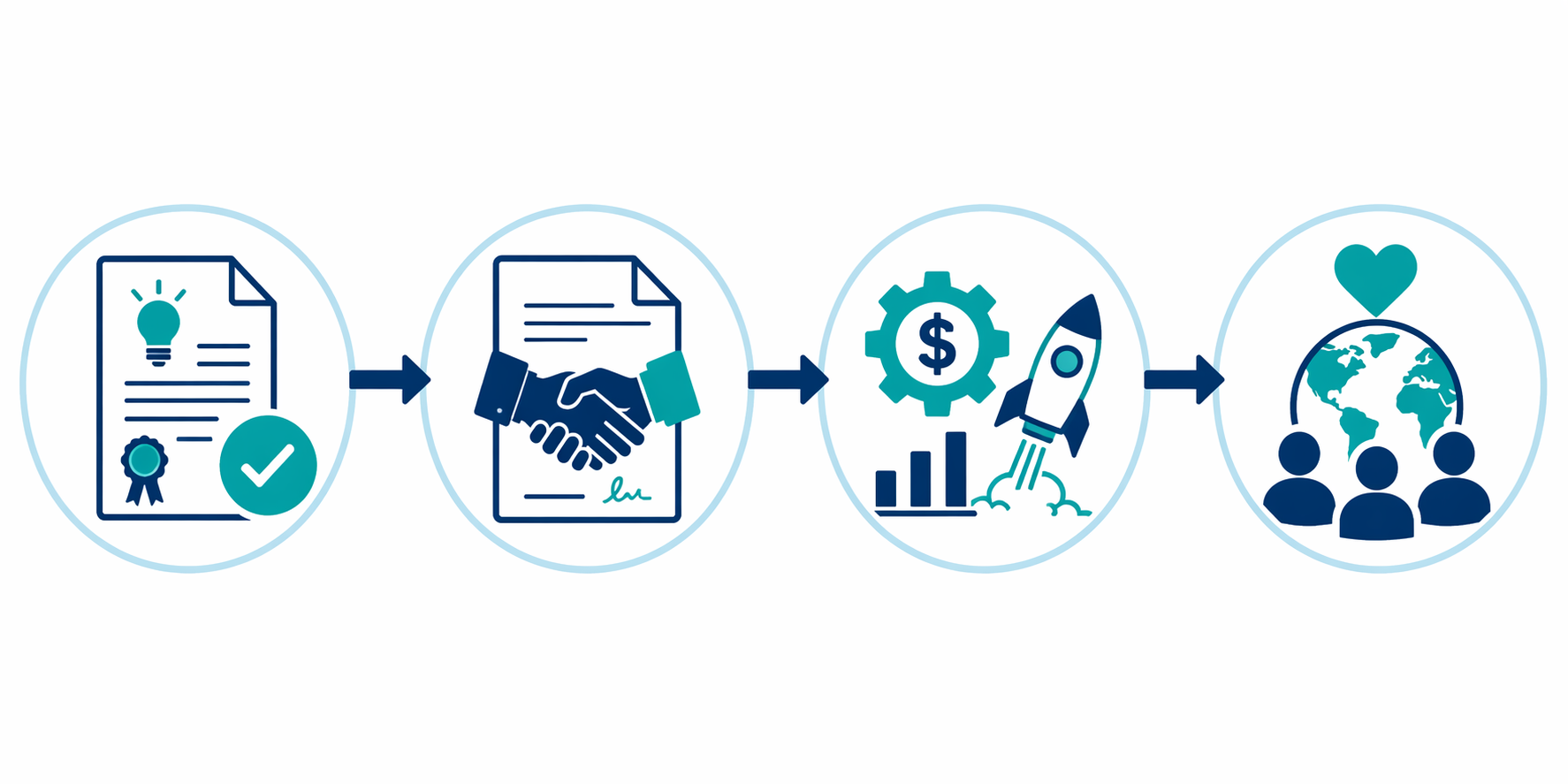
The NAI’s cumulative figures show why the organization’s Fellow program attracts attention. Across 2,253 Fellows since 2012, the NAI reports more than 86,000 U.S. patents, roughly 20,000 licensed technologies, approximately 4,000 startup companies formed, an estimated $3.8 trillion in revenue generated, and 1.4 million jobs created.[3] Those are NAI-attributed estimates, not independent proof that every Fellow’s campus will provide strong student access to commercialization. They are best read as evidence that the honor is anchored in an invention ecosystem, not as a guarantee about any one lab.
The prestige markers are real but secondary for this purpose. The NAI reports that its Fellows include 59 Nobel Laureates, 76 recipients of the National Medal of Technology and Innovation or National Medal of Science, and more than 796 members of the National Academies.[3] That establishes seriousness. But for a pre-med or graduate applicant, the more actionable question is smaller: are there people at this school whose research path shows a working route from discovery to protected invention to use?
The medical examples: when mechanisms become therapies
Two NIH inventors in the 2025 class make the translational pathway easier to see because their work sits close to material many pre-med students already study: immunity, cancer biology, signaling pathways, and therapeutic targeting.
Dr. Steven Rosenberg of the National Cancer Institute’s Surgery Branch was selected as a 2025 NAI Fellow and holds 884 U.S. patents. NIH’s technology transfer office describes him as a pioneer of CAR T-cell cancer immunotherapy.[4] For a student who has learned the basics of T cells, antigen recognition, and adaptive immunity, this is not an abstract “innovation” story. It is a reminder that some research environments train people near the boundary where cell biology, immune engineering, intellectual property, clinical trials, and patient care meet.
Dr. John O’Shea of the National Institute of Arthritis and Musculoskeletal and Skin Diseases was also selected in the 2025 class. NIH credits him with discovering JAK3, work that led to 11 approved JAK inhibitors for autoimmune diseases.[4] That example matters for applicants interested in immunology, rheumatology, dermatology, pharmacology, or molecular medicine because it shows a different translational shape: identifying a pathway, clarifying its disease relevance, and contributing to a therapeutic class.
Neither example means that every student near an NAI Fellow will get a patent, join a startup, or work on an approved therapy. Access depends on lab openings, mentor style, project timing, institutional tech-transfer support, and the student’s own preparation. But these cases show what the signal is trying to reveal: not just that a scientist is productive, but that their work has traveled through mechanisms that matter outside the journal article.
How to use the 2025 Fellow list while building a school list
For MCAT students, this belongs after the basic admissions screen. First, decide whether a school is academically realistic and mission-appropriate. If you are still shaping that part of the process, StudyMethod’s MCAT study tools comparison and evidence-focused guides to Anki for MCAT prep can help with the score side of the problem. NAI Fellow concentration becomes useful once you are choosing between programs that are already plausible.
For GRE-based graduate applicants, the same logic applies. Do not start with the award and work backward into a program you do not actually want. Start with field fit, faculty alignment, funding structure, placement outcomes, and whether the department supports the kind of training you need. Then use NAI Fellows as a second-pass filter for translational depth.
- Search the university name plus “NAI Fellow 2025” or “National Academy of Inventors Fellow.”
- Record the Fellow’s department, center, school, and research area rather than only the university name.
- Check whether the Fellow’s work overlaps with your intended field: cancer immunology, bioengineering, neuroscience, materials science, computational biology, drug discovery, devices, public health technology, or another area.
- Look for signs of student access: lab websites, recent trainees, publications with students, patent disclosures, startup activity, clinical trials, or technology-transfer news.
- Compare that evidence with the ordinary application constraints: admissions competitiveness, funding, location, curriculum, mentorship style, and outcomes.
Institutional announcements are often the easiest entry point. MIT, Purdue, Arizona State, and the University of South Florida each published announcements about their 2025 NAI Fellows, which gives applicants searchable examples of how schools identify faculty inventors publicly.[5][6][7][8] The practical value is not that every press release proves student opportunity. It is that these pages give you names to investigate, departments to map, and research themes to compare against your own goals.
A quick way to read a school’s Fellow concentration
| What you find | Reasonable interpretation | What to check next |
|---|---|---|
| Several NAI Fellows in departments related to your target field | The school may have a strong invention and translation culture in your area | Whether those faculty take students and whether trainees appear in recent publications or commercialization activity |
| NAI Fellows on campus, but in unrelated fields | The university may value invention broadly, but the signal may not apply to your training path | Your specific department’s labs, funding, placement, and mentorship record |
| One highly visible Fellow with a major invention record | A potentially valuable mentor or ecosystem clue, but not enough to define the whole program | Lab access, project fit, and whether the broader department supports translational work |
| No obvious NAI Fellows in your field | Not proof of weak research culture; the program may be stronger in publication, clinical training, policy, or basic science | NIH funding, publications, clinical infrastructure, alumni outcomes, and direct faculty fit |
The mistake is treating a patent signal like an admissions ranking
A dense cluster of NAI Fellows can be a strong clue that a university knows how to support invention. It may indicate experienced faculty, active technology-transfer pathways, industry relationships, licensing history, or a campus culture that takes applied work seriously. For students who want hands-on exposure to translational research, that is worth noticing.
But the signal can be misused. A medical school with famous inventors may still be a poor fit if its curriculum leaves little room for research, if the relevant lab is not accessible to students, or if your application is outside the school’s realistic admissions range. A graduate program may sit inside an inventive university but offer little support for the subfield you actually want. Patent culture is not the same thing as mentorship quality.
There is also a timing problem. Translation can take years, sometimes far longer than a student’s training period. A lab’s most famous patent may come from an earlier era, while the current trainee experience may be mostly basic mechanism work. That is not necessarily bad; many future therapies begin as slow basic science. It only means applicants should separate institutional mythology from the projects students are doing now.
The cleanest application rule is this: use NAI Fellow concentration as a supplemental proxy for translational research culture, especially if you want invention-heavy training. Let it sharpen your questions, not replace them. A serious school list still has to survive the ordinary tests of program fit, admissions reality, faculty publication record, match or placement outcomes, funding, and the MCAT- or GRE-driven strategy that gets you in the door.
References
- NAI Welcomes 2025 Class of Fellows, National Academy of Inventors.
- Nomination Process — NAI, National Academy of Inventors.
- About the NAI Fellows Program, National Academy of Inventors.
- Two NIH Inventors Selected as 2025 National Academy of Inventors Fellows, NIH Technology Transfer.
- MIT faculty members elected 2025 National Academy of Inventors Fellows, MIT News.
- Purdue faculty named 2025 National Academy of Inventors Fellows, Purdue Newsroom.
- ASU researchers named 2025 National Academy of Inventors Fellows, ASU News.
- USF faculty named 2025 National Academy of Inventors Fellows, USF Research & Innovation.
Related exhibits & inventory
Verified outcomes
Planners
No planner filed for this exam yet
A downloadable timeline template for this exam hasn't been published yet.
Tool verdicts
Questions about this plan
Ask a question about a specific section, timeline, or citation in this plan — or flag something that needs correcting.
Comments
Join the discussion with an anonymous comment.