
MCAT Exam Hub
The mRNA Vaccine Mechanism, Explained for MCAT Prep
An MCAT-scoped walkthrough of the mRNA vaccine mechanism, traced as one continuous pathway from cytoplasmic translation of the spike-protein mRNA through MHC class I/II presentation to T-cell and B-cell activation — so B/B prep can review the AAMC-tested biology as a chain rather than isolated facts, including why vaccine mRNA cannot alter DNA.
- gre
- mcat
- asvab
- sat
- act
- digital-adaptive
- official-material
- section-strategy
- test-date-timeline
What B/B is actually testing in this mechanism
For MCAT B/B prep, the useful version is not “a vaccine teaches the immune system.” That is too blurry for a Biological and Biochemical Foundations passage. The MCAT-relevant version is a chain: lipid nanoparticle delivery → cell uptake → endosomal escape → cytoplasmic translation of a spike-protein mRNA → antigen processing → MHC class I and class II presentation → CD8 and CD4 T-cell responses → B-cell activation → plasma cells, antibodies, and memory. The AAMC’s exam outline places molecular genetics topics such as eukaryotic mRNA processing and immune-system biology within the B/B section, which is why this mechanism is worth learning as one connected pathway instead of as separate flashcard piles [1].
If you want the parent route for this kind of passage work, keep it tied to the MCAT study hub: central dogma, translation, cell biology, antigen presentation, and adaptive immunity all show up here. The trick is not to memorize “mRNA vaccines” as a special exception. They are a clean way to test ordinary biology under a newer experimental wrapper.
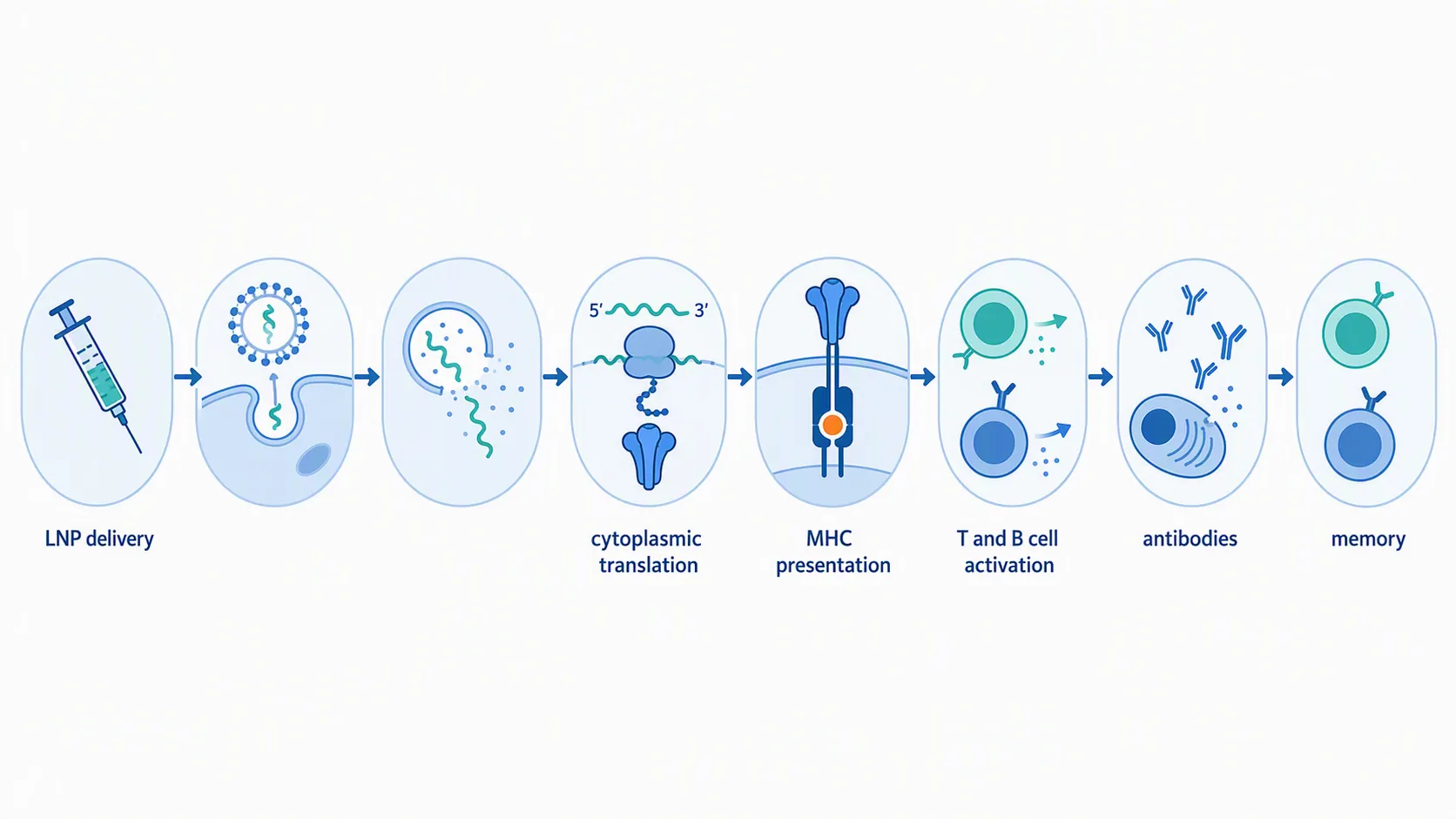
| Passage event | MCAT concept hiding inside it |
|---|---|
| Lipid nanoparticle carries mRNA into cells | Membranes, endocytosis, delivery barriers |
| mRNA reaches the cytoplasm and is translated | Central dogma, ribosomes, eukaryotic mRNA features |
| Spike protein is made inside a host cell | Endogenous antigen source |
| Fragments are displayed on MHC class I | CD8+ T-cell recognition of intracellular antigen |
| Professional APCs present antigen on MHC class II | CD4+ helper T-cell activation |
| B cells receive help and differentiate | Clonal selection, plasma cells, antibodies, memory |
One distractor should already be dead before the passage gets complicated: vaccine mRNA is translated in the cytoplasm, does not need to enter the nucleus, and cannot integrate into or alter a person’s DNA [2][3]. If an answer choice requires nuclear entry for the vaccine to work, it is fighting the mechanism.
Follow the molecule: LNP delivery to cytoplasmic translation
The vaccine does not inject spike protein as the main instruction. It delivers an mRNA molecule encoding the antigen. Because naked RNA is fragile and negatively charged, the mRNA is packaged in lipid nanoparticles. After injection, cells can take up these particles, and some delivered mRNA escapes from endosomal compartments into the cytoplasm, where ribosomes translate it into protein [4][5].
That last phrase—into the cytoplasm—is the part students should stop rushing past. Ribosomes translate mRNA in the cytoplasm or on the rough ER depending on the protein’s targeting information; translation does not require the mRNA to become DNA first. The vaccine mRNA is used as a message, not as a genome-editing reagent. MedlinePlus Genetics and NHGRI both describe the same exam-useful boundary: the mRNA works in the cytoplasm and does not enter the nucleus or change DNA [2][3].
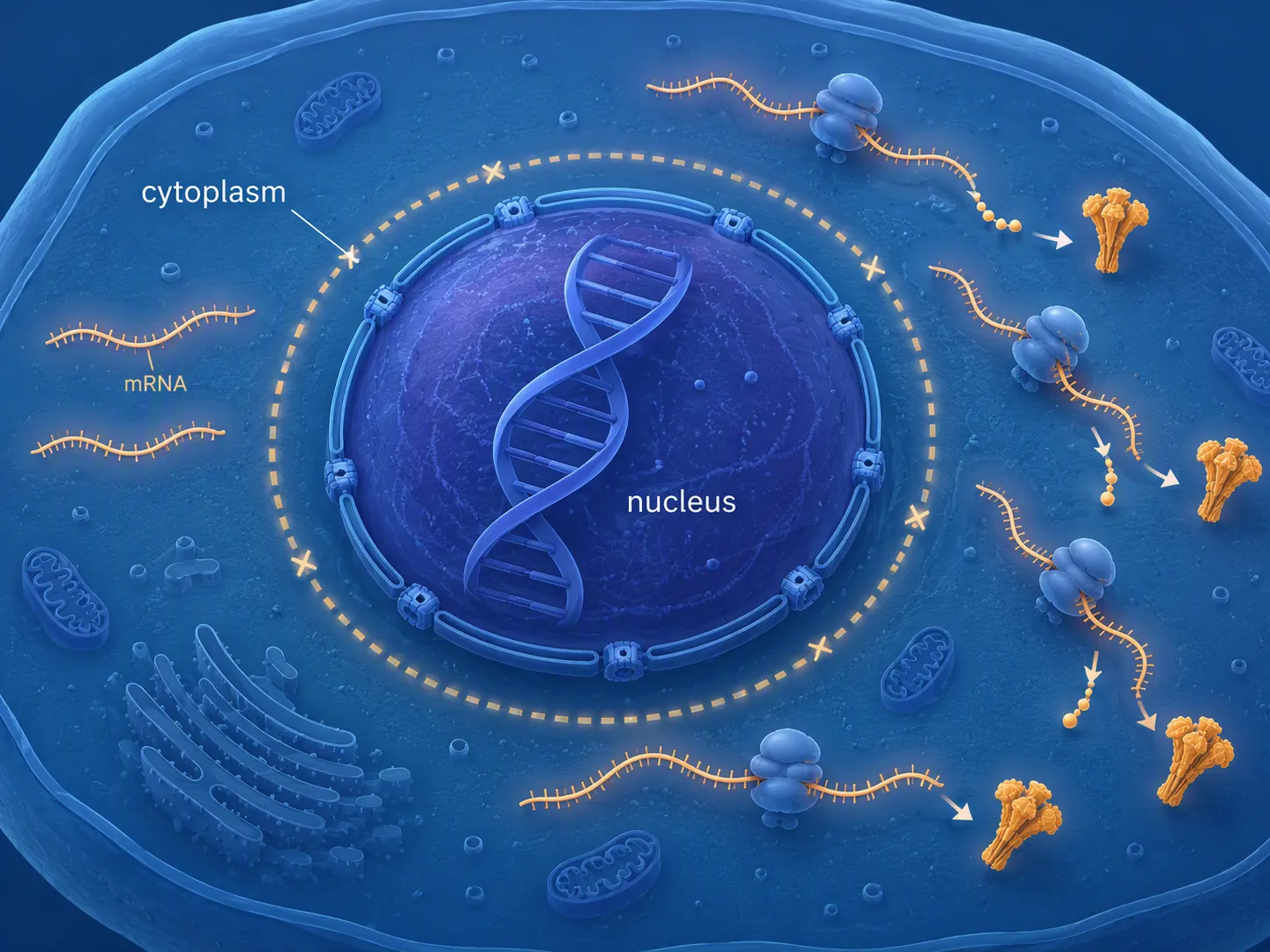
The mRNA molecule is also not just a bare coding sequence. Reviews of mRNA vaccine design describe engineered RNAs that resemble mature eukaryotic mRNA: a 5′ cap, untranslated regions, a coding sequence, and a poly(A) tail. Those features matter because the cell’s translation machinery already knows how to use mature mRNA. The cap and tail support stability and translation; UTR choices influence how long and how efficiently the message is used; codon optimization can increase protein production without changing the amino acid sequence of the antigen [4][5].
The nucleoside modification is also fair game if a passage gives it to you. Pardi and colleagues describe modified nucleosides such as N1-methylpseudouridine, or m1Ψ, as a way to reduce innate immune sensing of the RNA and improve translation; early work cited in that review reported roughly a tenfold increase in translation with pseudouridine-containing mRNA compared with unmodified mRNA [4]. Bettini and Locci discuss the same design logic in the SARS-CoV-2 mRNA vaccine setting [5]. PDB-101 gives the useful structural picture: the mRNA is packaged in lipid nanoparticles around 100 nm in diameter that include ionizable cationic lipid, cholesterol, phospholipid, and PEG-lipid components [6]. A Johns Hopkins interview with Diane Griffin frames the platform similarly: the technology supplies the genetic instructions and relies on the host cell to make the antigen [7].
Do not turn those engineering details into isolated trivia. On test day, their job is usually to explain why the message survives long enough to be translated, why ribosomes can read it, and why innate immune sensors do not immediately dominate the whole story before antigen expression occurs.
The clean handoff: cytoplasmic translation to MHC class I
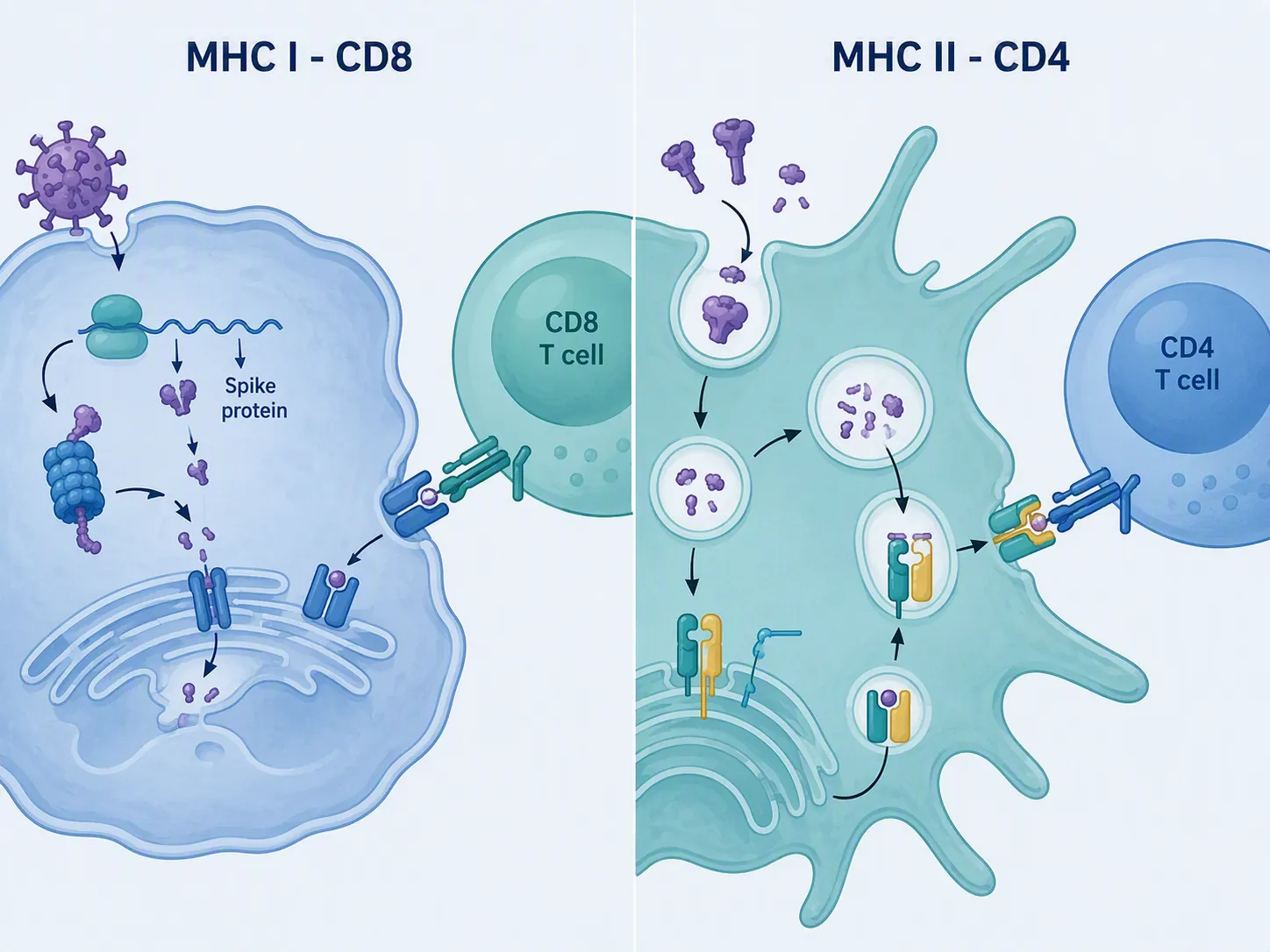
Here is the bridge that many students half-know but cannot explain under pressure: if a host cell translates the vaccine mRNA, then the spike protein is an endogenous protein from that cell’s point of view. Endogenous proteins can be degraded into peptides, and those peptides can be loaded onto MHC class I molecules for display to CD8+ T cells. The British Society for Immunology summarizes this division cleanly: MHC class I presents intracellular antigens and is expressed by all nucleated cells, while MHC class II is used by professional antigen-presenting cells to present extracellularly derived antigen to CD4+ T cells [8].
So the MCAT move is not “mRNA vaccine equals antibody vaccine.” It is: the antigen begins as an intracellular translation product, so MHC I becomes biologically plausible. A nucleated cell that makes spike protein can display spike-derived peptide on MHC I, and a CD8+ T cell with a matching T-cell receptor can recognize that peptide–MHC complex. If costimulation and activation conditions are met, CD8+ T cells can contribute cytotoxic cellular immunity.
Keep the wording disciplined. The pathway makes CD8 activation conceptually testable; it does not mean every mRNA vaccine candidate produces the same magnitude of CD8 response. Reviews of SARS-CoV-2 mRNA vaccines discuss T-cell responses, but candidate-specific data vary, so a passage may give you the response profile rather than expect you to assume it [4][5].
For a deeper version of this exact endogenous-antigen route, the MHC I antigen-presentation study note is the right adjacent review. The vaccine mechanism is one especially neat use case for the same rule: intracellular source points you toward MHC I and CD8.
Where MHC class II and CD4 help enter the same story
Now add professional antigen-presenting cells instead of replacing the MHC I story. Dendritic cells, macrophages, and B cells can handle antigen and present peptide on MHC class II to CD4+ helper T cells. MHC II is not the “opposite answer” to mRNA translation; it is the route that brings helper T-cell coordination into the adaptive response [8].
This is why a passage can start with a cytoplasmic mRNA molecule and still end up asking about CD4+ T cells. Professional APCs may express antigen after taking up vaccine material, acquire antigen from the local environment, process it, and present peptide fragments on MHC II. Once a CD4+ T cell recognizes its peptide–MHC II complex with the right costimulatory context, it can differentiate into helper subsets that support downstream immune responses [5][8].
For MCAT purposes, the key is the direction of help. CD4+ helper T cells do not become antibody factories. B cells become plasma cells. Helper T cells provide signals that let selected B-cell clones proliferate, class switch, undergo affinity maturation, and form memory. If you keep those cell roles straight, a passage that mixes MHC II, cytokines, germinal centers, and antibodies stops feeling like four separate chapters.
The B-cell response: clonal selection, plasma cells, antibodies, memory
B cells enter the mechanism through antigen recognition. A B cell with a receptor that binds the relevant antigen can internalize it, process it, and present peptide on MHC II. A previously activated helper T cell that recognizes that peptide–MHC II complex can provide the signals that push the B cell through clonal expansion and differentiation. That is the immunology sentence hiding behind a lot of easier-sounding answer choices.
Some daughter cells become plasma cells, which secrete antibodies. Some become memory B cells, which persist after the initial response and can respond more quickly if the antigen is encountered again. That is active immunity: the host’s own adaptive immune system is doing the work of generating effectors and memory. If a passage asks you to contrast that with passive immunity, or to separate humoral and cellular responses in another vaccine context, the plague vaccine immunology case study is a useful companion.
Notice how little of this depends on memorizing COVID-era headlines. The testable structure is older and broader: antigen exposure selects lymphocytes with matching receptors; activated clones expand; effector cells perform immediate functions; memory cells change the response to later exposure.
Passage strategy: translate the story before choosing the pathway
When a passage gives you an mRNA vaccine, first identify where the molecule is in the cell. If it is mRNA in the cytoplasm, think ribosome, codons, translation, protein product. If the passage asks what happens to DNA, the answer is usually that nothing needs to happen to DNA for the vaccine mRNA to function. The mRNA is not reverse-transcribed in the standard mechanism, does not need nuclear entry, and is not integrated into the host genome [2][3].
| If the passage says... | Think... | Eliminate... |
|---|---|---|
| The delivered molecule is mRNA | Cytoplasmic translation by ribosomes | Choices requiring transcription of vaccine DNA |
| The antigen is produced inside a nucleated host cell | Endogenous antigen, MHC class I, CD8+ T-cell recognition | Choices saying only extracellular antigen handling is possible |
| A dendritic cell or B cell presents antigen to a helper T cell | MHC class II, CD4+ T-cell help | Choices assigning CD4 cells the role of antibody secretion |
| Antibodies and memory are measured later | B-cell activation, plasma cells, memory B cells | Choices describing passive immunity as the main mechanism |
| An answer choice says vaccine mRNA alters host DNA | Cytoplasmic mRNA does not enter the nucleus or integrate | That answer choice |
The reusable chain is the point: engineered mRNA behaves like a translatable eukaryotic message, the host cell makes antigen, antigen presentation routes connect that protein product to T cells, and helper signaling connects the response to B-cell effector and memory outcomes. If a choice says the vaccine mRNA must enter the nucleus, integrate into DNA, or permanently alter the genome to work, it conflicts with the mechanism.
References
- What’s on the MCAT Exam?, AAMC
- What are mRNA vaccines and how do they work?, MedlinePlus Genetics
- Understanding COVID-19 mRNA Vaccines, NHGRI
- mRNA vaccines — a new era in vaccinology, Nature Reviews Drug Discovery, 2018
- SARS-CoV-2 mRNA Vaccines: Immunological Mechanism and Beyond, Vaccines, 2021
- SARS-CoV-2 mRNA Vaccine, PDB-101
- The New Technology Behind COVID-19 mRNA Vaccines and What This Means for Future Outbreaks, Johns Hopkins Bloomberg School of Public Health, 2021
- Antigen Processing and Presentation, British Society for Immunology
Related exhibits & inventory
Verified outcomes
Planners
No planner filed for this exam yet
A downloadable timeline template for this exam hasn't been published yet.
Tool verdicts
Questions about this plan
Ask a question about a specific section, timeline, or citation in this plan — or flag something that needs correcting.
Comments
Join the discussion with an anonymous comment.