
GRE Exam Hub
What a Monkey Geometry Study Means for Your Exam
The July 2026 PNAS monkey-geometry study challenges the idea that geometric reasoning is uniquely human. This briefing explains the findings and how test-takers can approach such science passages on the GRE, SAT, or ACT.
- SAT
- ACT
- GRE
- MCAT
- ASVAB
- digital-sat
- adaptive-testing
- registration-fee
- content-outline
- score-target
The July 20, 2026 PNAS monkeys geometry study findings are useful exam material for a specific reason: they do not merely say that monkeys noticed shapes. They test whether geometric reasoning depends on uniquely human symbolic systems, such as language, schooling, and culture, or whether some geometric intuition is older than those systems. For GRE, SAT, and ACT reading, that is the passage-shaped part of the study: a familiar human-uniqueness claim meets a comparative design, a statistical model, and several caveats that prevent the conclusion from becoming too large.[1]
The simple version is tempting: monkeys showed humanlike geometric intuitions. The more test-worthy version is narrower and better: in this study, much of the observed difference in geometric reasoning was explained by computational demand, especially rotation demand, rather than by a clean biological divide between humans and other primates.[1] That distinction is exactly where many timed readers lose points. They remember the animal and forget the argument.
Start With the Design, Not the Monkey Headline
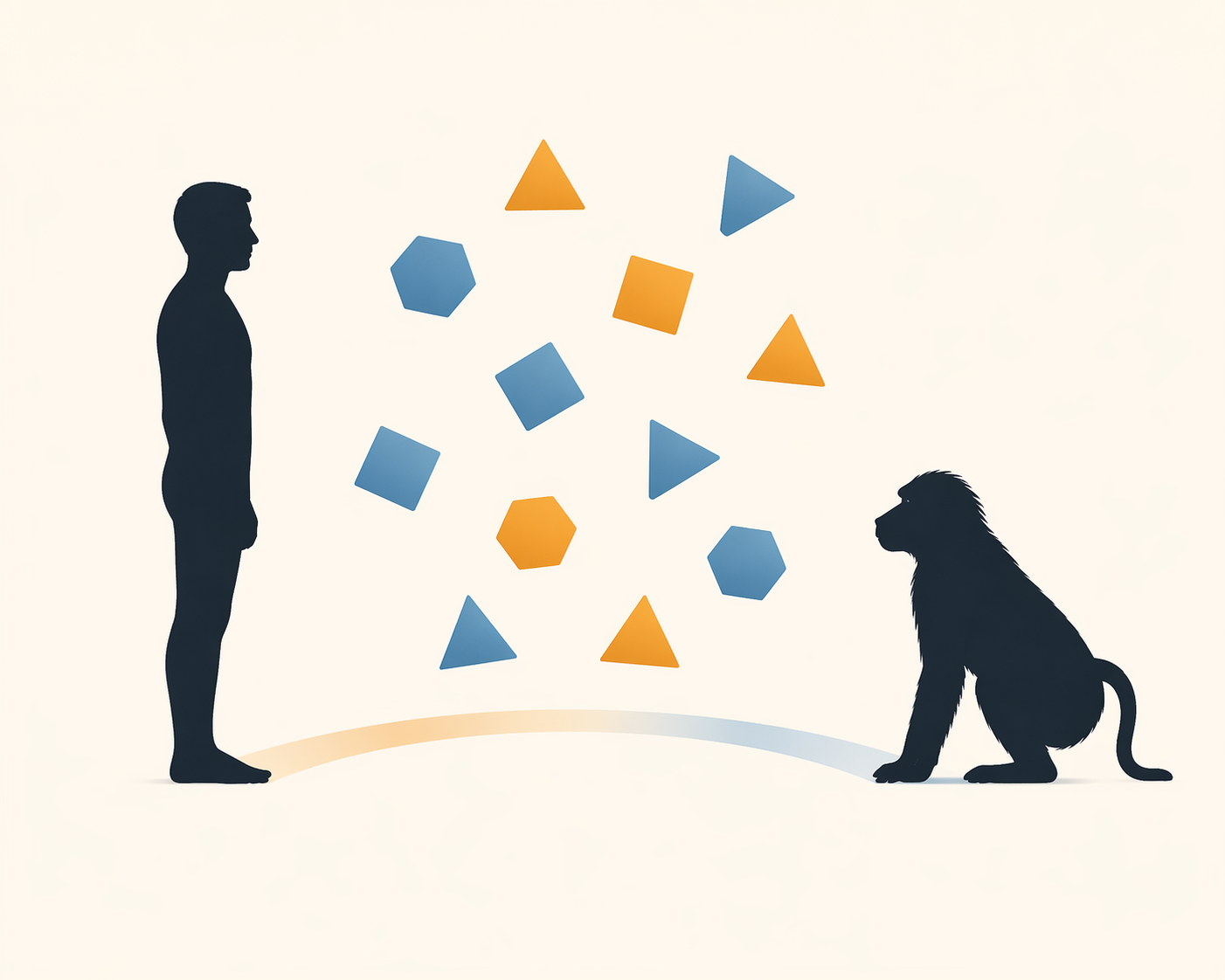
The study compared four groups: 8 nonhuman primates, made up of 4 rhesus macaques and 4 olive baboons; 58 U.S. preschoolers; 79 Tsimane' adults with a mean of 2.2 years of formal education; and 21 U.S. adults.[1] That lineup matters. A weaker study might compare laboratory-trained monkeys with college students and leave culture, schooling, and development tangled together. This design gives the passage reader more to work with: species, age, formal education, and cultural exposure are not treated as the same variable.
The comparison also keeps the study from being only a “monkeys versus humans” story. Preschoolers help separate mature schooling from early human development. Tsimane' adults help separate adult human cognition from extensive formal education. U.S. adults provide a highly schooled adult comparison group. The nonhuman primates anchor the evolutionary question. On an exam, those groups would probably appear before the most interesting numbers, because the numbers only make sense once the reader knows what alternatives the design is trying to separate.
| Group | Why It Matters for the Argument |
|---|---|
| Nonhuman primates | Tests whether geometric intuition appears outside humans |
| U.S. preschoolers | Helps distinguish early human cognition from extensive schooling |
| Tsimane' adults | Helps distinguish adult human cognition from high formal education |
| U.S. adults | Provides a formally educated adult comparison group |
That structure is the first exam lesson. When a passage gives you several participant groups, do not reduce them to “Group A did better than Group B.” Ask what each group is controlling for. Here, the four-group setup is meant to make a claim about evolved geometric intuition harder to dismiss as a side effect of language, school geometry, or a single cultural environment.
The Claim Being Challenged: Symbolic Singularity
The study is framed against the “symbolic singularity” hypothesis associated with Dehaene and colleagues. In the terms relevant here, that hypothesis treats human geometric reasoning as deeply dependent on symbolic capacities that are distinctively human, such as language, culturally transmitted symbols, and formal instruction.[1] The 2026 study challenges that position by asking whether nonhuman primates show evidence of symbolic-like geometric representations when solving shape tasks.
Notice the care in that wording. The result does not mean monkeys have human language, learned school geometry, or silently name polygons. It means the researchers found evidence that a form of geometric intuition overlaps across primate groups enough to weaken a strict human-uniqueness account. A standardized-test passage would likely ask for that level of restraint: the study challenges a strong version of symbolic singularity, but it does not erase every human difference in mathematical cognition.
The most useful phrase for a timed reader is “competing explanations.” One explanation says the important boundary is species: humans have a special symbolic system, nonhuman primates do not. The other says the important boundary is computational demand: some tasks are harder because they require more transformation, such as recognizing a shape across rotation, and performance changes with that demand. The study’s central evidence favors the second explanation over a simple species split.[1]
The Numbers That Carry the Argument
The headline finding is not just that monkeys performed a task. The load-bearing evidence comes from model weights and separation ratios. On the Intruder task, monkeys had a Bayesian symbolic-representation weight of 0.62, overlapping with preschoolers' 0.65.[1] That comparison gives the reader a concrete test of the claim: if symbolic-like geometric representation were sharply human-only, the monkey and preschooler weights should not sit so close together.
The rotation result sharpens the point. Reported accounts of the study note that monkeys' symbolic weights increased from 0.50 to 1.40 when shapes were rotated.[2] That does not mean rotation made monkeys “better at geometry” in some broad sense. It means the rotated condition changed the kind of representation needed to solve the problem. A careful reader should treat the rotation result as evidence about mechanism, not as a ranking of intelligence.

The cleanest exam-facing statistic is the within-between separation ratio. For species, the ratio was near zero, R=0.09, with a confidence interval spanning zero. For rotation demand, the ratio was much larger, R=0.88.[1] Put plainly, the study found little separation by species and much more separation by whether the task imposed rotation demand. That is the statistical center of the argument.
| Comparison | Reported Ratio | How to Read It |
|---|---|---|
| Species separation | R=0.09, confidence interval spanning zero | Weak evidence for a clean human-versus-nonhuman divide |
| Rotation-demand separation | R=0.88 | Stronger evidence that task demand explains performance differences |
On a reading exam, this is where the right answer would probably live. If a question asks which evidence most directly supports the authors' interpretation, the answer is not “monkeys were tested” or “children were included.” It is the contrast between the near-zero species separation and the much larger rotation-demand separation. The comparison, not the novelty, does the work.
How This Becomes a GRE, SAT, or ACT Passage
No exam board has announced that this particular study will appear on a GRE, SAT, or ACT. Treat exam relevance as an inference, not a fact. Still, the paper has the traits that science passages often use: a current finding, a debate about human uniqueness, cross-species evidence, statistical modeling, and limitations that complicate the conclusion. Those features make it good practice even if the exact study never appears on your test.
For GRE verbal, the likely task would be argument structure. You might need to identify the main conclusion, choose the evidence that most supports it, or recognize an answer choice that overstates the finding. If you are practicing that kind of passage mapping, the same discipline appears in our GRE science-passage guide using eagle fight injury studies. The subject changes; the job is the same. Find the tested claim, then track which evidence narrows it.
For SAT reading and ACT science, the study would more likely become a passage about interpreting comparisons. A wrong answer might say that monkeys outperformed children, that schooling has no effect on geometry, or that all mathematical reasoning is innate. Each of those answers reaches beyond the evidence. A better answer would say that the data challenge a strict human-only account of geometric intuition and point to task demands as an important explanatory factor.
- Main-claim question: The study challenges a strict symbolic-singularity account of geometric reasoning.
- Evidence question: The strongest support is the contrast between species separation and rotation-demand separation.
- Inference question: Geometric intuition may be evolutionarily conserved among primates, but the study does not prove that all geometry is innate.
- Caveat question: The nonhuman-primate sample is small, and some model explanations are difficult to separate cleanly.
This is also why the study belongs in the same practical family as other current-science briefings, such as the 2025 global climate report numbers guide. The content area is different, but the exam skill is similar: do not memorize the topic as trivia. Learn which number measures which claim.
The Caveats Are Not Decorative
The first limitation is sample size. The nonhuman-primate evidence comes from only 8 animals across 2 species.[1] That does not invalidate the study, but it does limit the size of the conclusion. A careful answer choice can say the results provide evidence for evolutionarily conserved geometric intuitions. A careless answer choice will say the study establishes how monkeys in general understand geometry.
The second limitation concerns the rotated-shape comparison. The rotated and unrotated conditions are not simply two equal-difficulty versions of the same test. Rotation changes the computational demand. That is part of the point, but it also means the result should not be read as a clean contest in which one group defeats another. If a passage asks what can be concluded from the rotation finding, the safest answer will stay close to task demand and representation.
The third limitation is model separation. The symbolic model and the rotation-invariant IT model were correlated at r=0.71, making the two explanations hard to distinguish cleanly.[1] This is exactly the sort of sentence that decides a high-level reading question. The authors can favor one interpretation while still acknowledging that related models overlap. On an exam, a wrong answer may erase that uncertainty; a right answer often preserves it.
The fourth study note is about exam use itself. This study is exam-relevant because of its structure, not because anyone can promise it will appear. That matters for how you study it. You are not trying to memorize “0.62” as a magic number. You are learning how a passage can use a number like 0.62 to support a claim about representational overlap, and how another number, R=0.88, can shift the explanation from species difference to task demand.
What Not to Overclaim
One overclaim is that monkeys broadly outperform children in geometry. The materials do not support that. The reported findings concern particular tasks, model weights, and rotated versus unrotated conditions. Another overclaim is that education does not matter. Senior author Jessica Cantlon put the educational implication more carefully: “This study suggests that children start with deep, evolutionarily ancient intuitions about shape and space. Education can build on those intuitions instead of treating geometry as something that has to be taught from scratch.”[3]
That quote is useful because it avoids a false choice. The study can support the idea that children begin with ancient spatial intuitions without implying that formal geometry instruction is unnecessary. In test terms, education is not being rejected; it is being repositioned. It builds on preexisting intuitions rather than creating every spatial concept from nothing.
A related 2025 study found that geometry learning in monkeys predicted gains in numerosity, with β=0.15 and p<0.05, suggesting a possible spatial-to-numerical transfer.[4] That finding is helpful context, but it should not replace the 2026 paper’s main argument. It supports a broader bridge between spatial and numerical cognition; it does not by itself prove the symbolic-representation claim tested in the monkey-geometry study.
The Primate Portal STEM program offers a different kind of context: elementary students code cognitive tasks for baboons, and the program has been linked to elevated math and science scores.[5] That is interesting for education, but it is not the same kind of evidence as the 2026 comparative cognition study. One is a research finding about primate geometric reasoning; the other is an educational program connected to student outcomes. A good passage reader keeps those evidence types apart.
A Practical Reading Route
If this study, or a close cousin, appears in a science passage, read it in this order. First, identify the hypothesis being challenged. Here, it is the idea that geometric reasoning depends on a uniquely human symbolic capacity. Second, locate the comparison that actually tests the hypothesis. Here, that means the four-group design and the contrast between species separation and rotation demand. Third, attach each statistic to the claim it supports. The symbolic weights speak to representational overlap; the R values speak to which boundary explains more separation.
Then slow down for the caveat sentence. In this study, the caveats are not throwaway lines: 8 nonhuman primates, condition differences involving rotation, and correlated models all limit how far the conclusion can travel.[1] For GRE, SAT, and ACT purposes, that is where many trap answers are built. They take a real finding and remove the conditions under which it was found.
For a broader prep route, use the relevant exam hub for your test, then treat studies like this as passage drills rather than fact lists. The useful question is not “Can monkeys do geometry?” It is: what hypothesis is under pressure, what comparison applies the pressure, which statistic carries the argument, and which limitation prevents overstatement?
References
- Cantlon et al. monkey-geometry study, PNAS, July 20, 2026, link
- Monkeys share human geometric thinking, StudyFinds, link
- Primate Portal geometry Jessica Cantlon, Carnegie Mellon University, 2026, link
- Geometry learning in monkeys predicted numerosity gains, PNAS, 2025, link
- Zoo, Rochester Institute of Technology, link
Related exhibits & inventory
Verified outcomes
Planners
No planner filed for this exam yet
A downloadable timeline template for this exam hasn't been published yet.
Tool verdicts
AI-tool cautions
No AI tools tested for this exam yet
No hands-on AI-accuracy logs have been filed for this exam.
Questions about this plan
Ask a question about a specific section, timeline, or citation in this plan — or flag something that needs correcting.
Comments
Join the discussion with an anonymous comment.