
SAT Exam Hub
Miami-Dade School Closures 2026: 4 Alternatives That Protect College Prep
Miami-Dade’s June 2026 school closures displaced thousands of students. This article compares four schooling paths—Miami-Dade Online Academy, FLVS Full Time, tuition-free alternative schools, and private school via voucher—to help parents choose the option that best preserves SAT/ACT prep and college readiness.
- gre
- mcat
- asvab
- sat
- act
- digital-adaptive
- official-material
- section-strategy
- test-date-timeline
On July 31, the hard part of the Miami-Dade school closures is no longer the board vote. That happened weeks ago. The harder part is the calendar sitting on a parent’s kitchen table: the 2026-27 school year is close, Florida Virtual School Full Time’s extended enrollment deadline has already passed, and a middle or high school student still needs a schedule that protects grades, credits, SAT or ACT prep, and, for some, AP or dual-enrollment plans.
Miami-Dade’s school board unanimously approved closing 9 schools on June 17, 2026, with changes taking effect for the 2026-27 school year and students moving into consolidated K-8, 6-12, and K-12 configurations.[1] That is the public system story. At home, the question is narrower: which study alternative keeps a student’s college-prep path from being rebuilt in a rush?
The pressure is not coming from one closure vote alone. Traditional public school enrollment in Miami-Dade has fallen from 327,754 students in 2006-07 to a projected 217,100 in 2026-27, a 38.3% decline over two decades, with another projected drop of about 8,000 students for 2026-27.[2] Voucher use is also projected to reach 82,500 students in Miami-Dade for 2026-27, up from 60,850 in 2024-25 and roughly 4,000 before 2019.[2] Florida’s Family Empowerment Scholarship was ranked by EdChoice as the largest school choice program in the United States, with 280,611 participants in its February 2026 rankings.[3]
Those numbers explain why families suddenly feel pushed into a crowded choice market. They do not answer the transcript question. A school can be available, nearby, tuition-free, or voucher-funded and still be a poor fit if it breaks the student’s advanced-course sequence, removes counselor support, or leaves no protected study time before SAT Saturdays.
The Decision Is Really About Academic Assets
For students in grades 6-12, especially rising ninth-, tenth-, and eleventh-graders, placement is only the first layer. The better question is which setting protects the academic assets that matter later: a clean credit record, access to AP or Honors classes, dual-enrollment eligibility, weekly test-prep time, and an adult who notices when the student is slipping.
That changes how the four main alternatives look. Miami-Dade Online Academy and FLVS pathways are the strongest on uninterrupted study time for students who can manage virtual learning. Tuition-free alternative schools and voucher-supported private schools may be safer for students who need daily in-person accountability, credit recovery, or a smaller physical setting. None of these choices should be treated as automatically college-ready just because they carry the language of flexibility or choice.
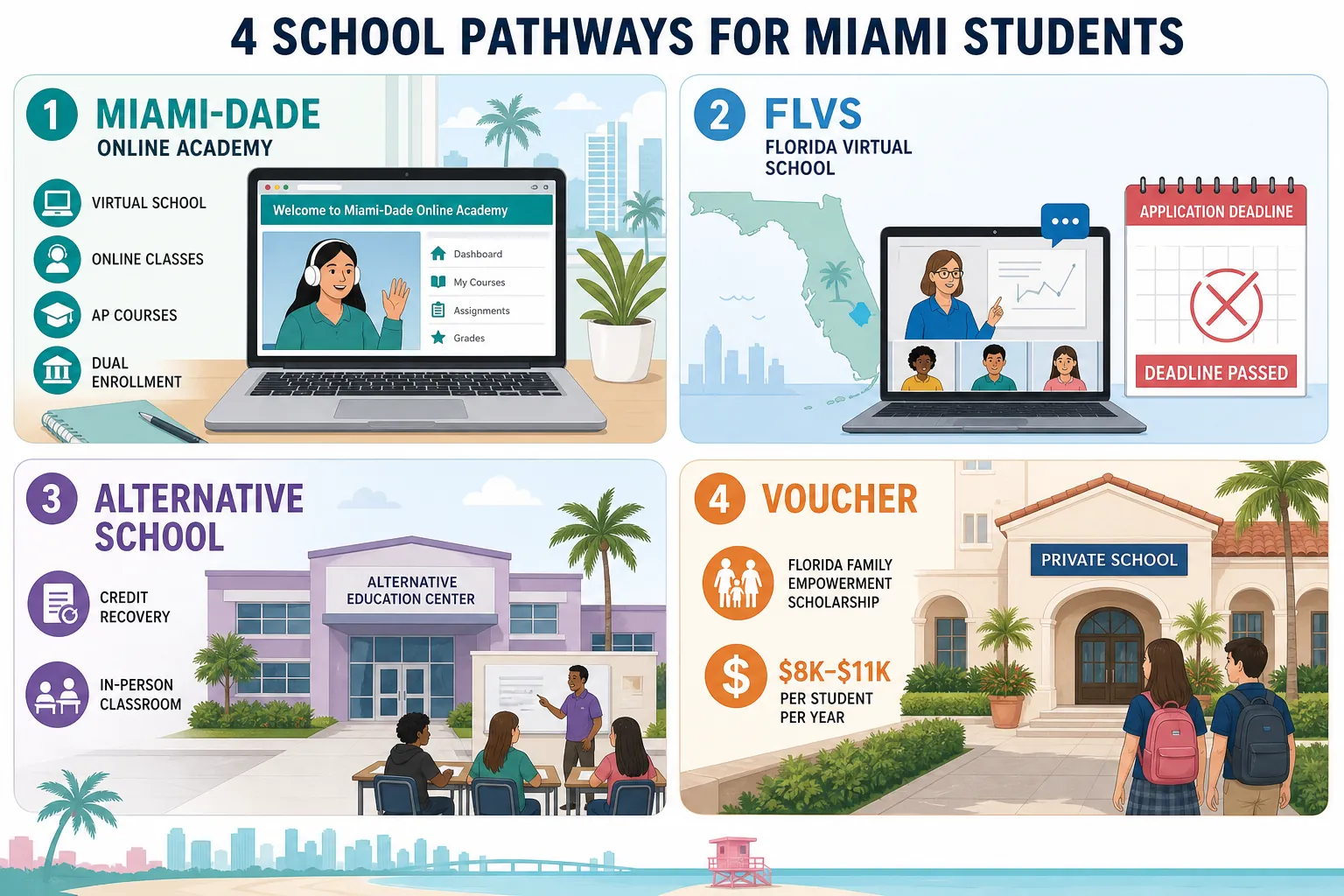
| Path | Best Fit | College-Prep Strength | Main Risk to Check Now |
|---|---|---|---|
| Miami-Dade Online Academy | Self-directed students who want a Miami-Dade public virtual option | AP/Honors access, dual enrollment through MDC, virtual schedule control | Verify exact 2026-27 course availability, counselor support, and graduation-rate claims |
| FLVS Full Time or FLVS Flex | Students who can work independently and need broad online course access | 200+ courses, including AP, AICE, CTE, and dual enrollment; FLVS Flex remains useful for individual courses | FLVS Full Time enrollment deadline was July 24, 2026, so families reading on July 31 may have missed the full-time window |
| Tuition-free alternative school | Students needing in-person structure, hybrid options, or credit recovery | Physical campuses and recovery pathways can protect graduation progress | Confirm whether AP, dual enrollment, and SAT/ACT support are actually built into the schedule |
| Private school via voucher | Families who can vet a specific campus carefully and use voucher funding to reduce cost | Potentially strong fit if the school has advanced courses, advising, and test-prep culture | Voucher access does not guarantee AP, dual enrollment, or college-counseling quality |
Miami-Dade Online Academy: The Cleanest Local Virtual Fit for Many College-Bound Students
Miami-Dade Online Academy deserves a serious look because it keeps the student inside a Miami-Dade public-school structure while moving the daily work online. The school describes itself as a tuition-free K-12 virtual magnet school with Cognia accreditation, Florida-certified teachers, AP and Honors courses, dual enrollment through Miami Dade College, and a Collegiate Academy pathway.[4]
For a college-bound student displaced by a closure, that combination matters. A virtual schedule can remove the commute reset, reduce daily transition time, and create longer blocks for reading, math practice, essay drafting, and SAT or ACT review. The MDC dual-enrollment connection is also not a small detail. If a student was counting on college-credit coursework in junior or senior year, the family should not accept a reassignment until someone can explain how that pathway continues.
The caution is supervision. A student who thrived because a teacher saw them every morning may not automatically thrive because a platform is open. Families should ask how attendance is monitored, how often teachers initiate contact, how counselor meetings are scheduled, and what happens if an AP student falls behind in September rather than in March.
Miami-Dade Online Academy’s own site reports a 100% graduation rate, but that figure should be read as school-reported and not independently verified from the materials available here.[4] It is still worth asking about, but the better parent question is more specific: among students taking AP, Honors, or dual enrollment, how many complete the course sequence they started?
FLVS: Strong Academics on Paper, but the Full-Time Deadline Has Passed
Florida Virtual School Full Time would normally sit near the top of the list for a self-managed student. FLVS says its full-time public school enrollment window for 2026-27 was extended to July 24, 2026, with classes beginning August 19.[5] As of July 31, that full-time deadline is already closed.
That timing changes the recommendation. Families should not spend the first week of August building a plan around an application window that has already shut unless FLVS itself confirms a late option. The more realistic remaining FLVS tool is FLVS Flex, which FLVS describes as available year-round for individual courses.[5] For a student reassigned to a new school but missing a needed advanced course, FLVS Flex may preserve part of the academic plan even if it does not replace the whole school day.
The academic menu is the reason parents keep looking at FLVS. FLVS reports more than 200 courses, including AP, AICE, CTE, and dual enrollment, along with a 97% high school graduation rate for 2024-25 and the claim that it was the 4th-highest performing district in Florida.[5] Those are meaningful operating facts, especially for a student whose college list will expect rigor beyond standard graduation credits.
The same warning applies here as with any virtual path: independence is not the same as invisibility. A student using FLVS Flex for AP Psychology or a math course still needs a weekly calendar, a testing plan, and a parent or counselor checking pace. Online coursework can protect SAT study time beautifully when the student is organized. It can also let a quiet problem sit untouched for weeks.
Tuition-Free Alternative Schools: Better for Structure and Credit Repair Than Maximum Test-Prep Time
Some students do not need a more flexible day. They need a building, a bell schedule, and an adult who knows whether they showed up. For those families, tuition-free alternative schools deserve a brief but serious look.
American High School Academy says it operates two physical campuses in Miami-Dade and offers in-person, hybrid, and virtual options for grades 6-12 through a Miami-Dade County Public Schools partnership, with credit recovery available.[6] That profile is not the same as a high-rigor AP magnet, and it should not be evaluated as if it were. Its strongest use case is a student whose first priority is stabilizing attendance, recovering credits, and staying on a believable graduation path.
For a sophomore short on credits, that may matter more than a perfect SAT prep schedule. For a junior already in Honors English, Algebra II, and AP coursework, the family should ask harder questions before moving: Which advanced courses are available in person? Can the student take outside online courses at the same time? Who signs off on dual enrollment? Is there a counselor tracking college applications, or only graduation requirements?
Private School via Voucher: Broadest Choice, Most Homework for Parents
Florida’s universal voucher expansion makes private school a real option for more families than it was a few years ago. Miami-Dade’s per-student voucher funding is reported at $9,629, and voucher amounts are generally described in the available materials as roughly $8,000 to $11,000 per student.[2] That can bring some private schools into reach, though it does not erase tuition gaps, fees, transportation, uniforms, or course-specific costs.
The private-school route is also the least self-executing. A voucher can help pay for a seat; it does not tell you whether the school has AP classes, dual enrollment, strong math placement, a testing calendar, or counselors who understand selective admissions. One private school may be a superb fit for a student who needs smaller classes and daily structure. Another may leave a college-bound junior with fewer advanced courses than the public option they just left.
Before accepting a voucher-funded seat, parents should ask to see the actual 2026-27 course catalog, not a general promise about college preparation. They should also ask who teaches upper-level math and science, whether AP exams are offered on campus, whether students use dual enrollment and where, how many seniors receive college-admissions advising, and how the school handles SAT or ACT test dates.
What to Verify Before You Accept Any Placement
A rushed school move can look solved in August and then create a transcript problem in January. Before committing to any of the four paths, parents should make the school answer in writing where possible.
- AP and Honors access: Which specific courses are available for the student’s grade level in 2026-27, and are there prerequisites or seat limits?
- Dual enrollment: Is there a pathway through Miami Dade College or another institution, who approves it, and what GPA or testing requirements apply?
- Credit status: Will all completed credits transfer cleanly, and what is the plan if the student is missing a required course?
- Counselor support: Who reviews the student’s graduation plan, college list, test dates, and application timeline?
- Weekly study time: Where does SAT or ACT prep fit in the actual schedule, not just in the family’s good intentions?
- Monitoring: How quickly will the school notify a parent if attendance, pacing, or grades start slipping?
The SAT and ACT Calendar Still Matters
The school decision cannot be separated from testing anymore. Summit Prep, a commercial test-prep company, reports that SAT or ACT scores are again required at Harvard, Yale, MIT, Stanford, Dartmouth, Brown, the University of Pennsylvania, Cornell, and the University of Miami for Fall 2026 applicants, and that 66% of top colleges now require scores.[7] Families should verify requirements directly with each college, but the direction is clear enough for planning: scores are not something to leave until senior fall.
The tests themselves are also changing. The SAT is now digital and adaptive, with a reported testing time of 2 hours and 14 minutes, while the ACT is shortening to 2 hours and 5 minutes with an optional Science section.[7] A student changing schools in 2026 is not just learning a new campus or online platform. They may also be preparing for a different test format than an older sibling took.
That is where virtual options can help the right student. A ninth- or tenth-grader who can work independently may use the saved commute and quieter blocks to build vocabulary, math fluency, reading stamina, and practice-test review. But for a student who avoids difficult tasks when no adult is nearby, a virtual day can turn SAT prep into the thing that always starts next Monday.
Local prep can supplement any school path. Miami Dade College’s Kendall Campus lists an SAT Test Preparation course at $255 for 30 contact hours, with sessions starting September 12 and October 17.[8] That is not a full college-readiness plan by itself, but it is the kind of fixed outside commitment that can anchor a student after a school disruption.
Which Path Protects College Prep Best?
For a self-directed, college-bound student, Miami-Dade Online Academy is often the cleanest remaining local fit because it combines a public virtual structure with AP/Honors options and a stated MDC dual-enrollment pathway. FLVS remains academically attractive, but on July 31 the full-time deadline problem is real; families should think of FLVS Flex as the more immediate tool for individual courses unless FLVS confirms another full-time opening.
For a student who needs daily in-person structure, attendance repair, or credit recovery, a tuition-free alternative school may protect graduation better than a beautifully flexible online schedule. For a family considering private school through a voucher, the school itself has to prove the fit: advanced coursework, counseling, test-prep culture, and a schedule that does not quietly lower the student’s ceiling.
The safest decision is not the one that sounds most flexible. It is the one where a parent can point to the student’s fall courses, spring testing plan, credit map, dual-enrollment or AP options, and weekly study blocks before saying yes.
References
- Miami-Dade School Board approves closing 9 schools as enrollment falls, charters move in — NBC Miami
- Miami public school enrollment to decline, voucher use rises — Miami Herald
- 2026 EdChoice Participation Rankings — EdChoice
- Miami-Dade Online Academy — mdomagnet.net
- Enrollment Now Open for Florida Virtual Full Time Public Schools Ahead of 2026–27 Academic Year — FLVS, June 1, 2026
- Tuition Free Alternative High School Miami-Dade: 7 Programs — American High School Academy
- The Ultimate Guide to the SAT, ACT, and College Admissions in 2026 — Summit Prep
- 0207 SAT Test Preparation (Kendall Campus) — MDC
Related exhibits & inventory
Verified outcomes
No verified outcomes on file for this exam yet
See Methodology for how outcome evidence is disclosed once logged.
Planners
No planner filed for this exam yet
A downloadable timeline template for this exam hasn't been published yet.
Tool verdicts
AI-tool cautions
No AI tools tested for this exam yet
No hands-on AI-accuracy logs have been filed for this exam.
Questions about this plan
Ask a question about a specific section, timeline, or citation in this plan — or flag something that needs correcting.
Comments
Join the discussion with an anonymous comment.