
MCAT Exam Hub
How to Memorize New Cholesterol Guidelines for Med School Exams
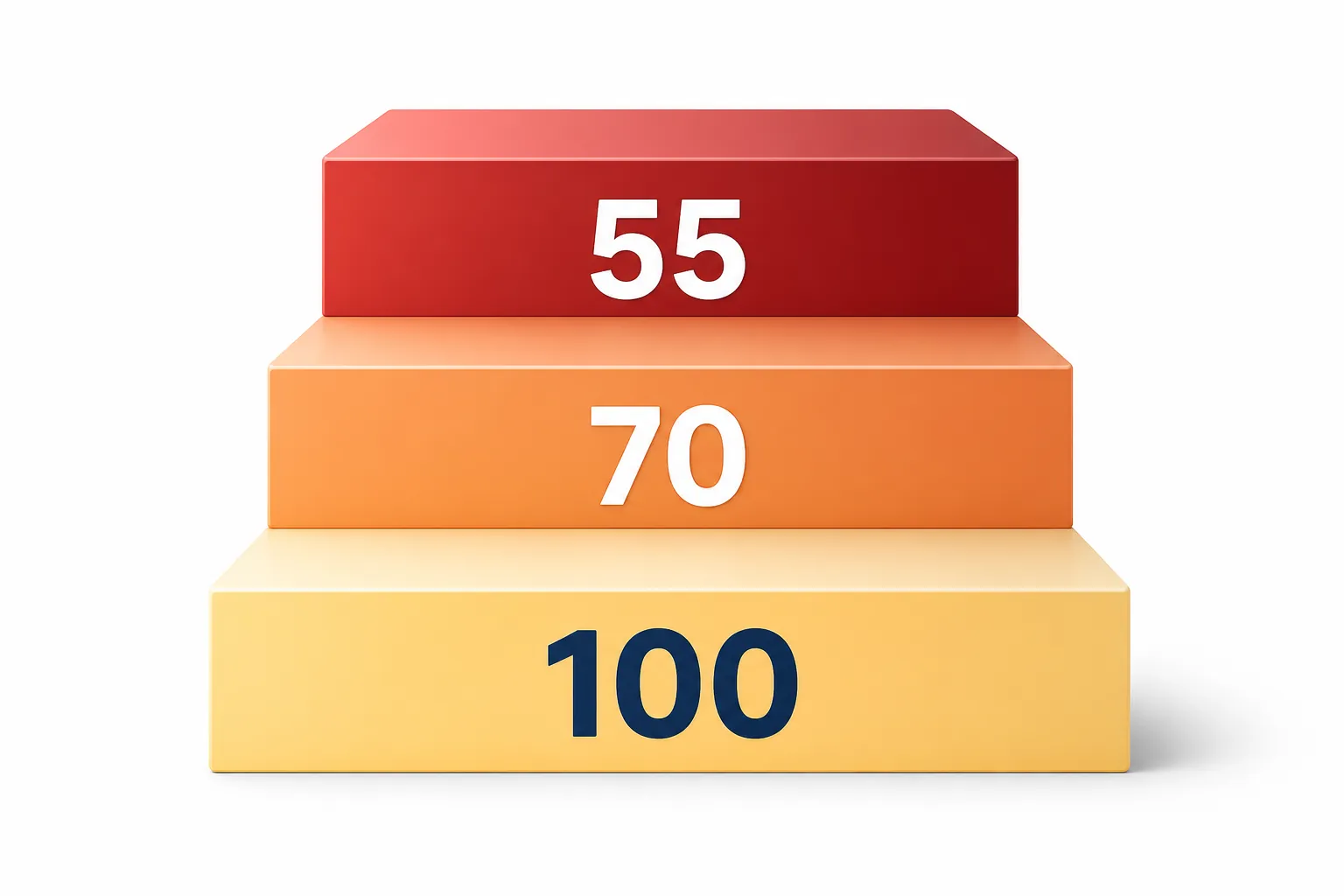
Med students can reliably recall the 2026 ACC/AHA cholesterol guideline's exact numeric thresholds — LDL targets, risk categories, Lp(a) cutoffs, statin intensities, and non-statin escalation order — by anchoring them to a simple three-number ladder (55, 70, 100 mg/dL) organized by risk tier.
- gre
- mcat
- asvab
- sat
- act
- digital-adaptive
- official-material
- section-strategy
- test-date-timeline
The cholesterol vignette usually does not punish you for forgetting what LDL does. It punishes you for hesitating between adjacent numbers. A patient has ASCVD and a treated LDL-C of 62 mg/dL. Another has diabetes plus risk factors. Another has CAC ≥1000. Another has a PREVENT-ASCVD risk of 4%. The answer choice flips because one threshold, not the general idea of prevention, is the thing being tested.
For the 2026 cholesterol guideline, the cleanest memory object is the LDL-C ladder: 55, 70, 100. The March 2026 ACC/AHA multisociety guideline uses three absolute LDL-C targets: less than 55 mg/dL, less than 70 mg/dL, and less than 100 mg/dL, organized by risk tier rather than by one universal LDL goal [1][2].
| LDL-C target | Risk tier to attach it to | Exam translation |
|---|---|---|
| <55 mg/dL | Very-high-risk ASCVD | The highest-risk secondary-prevention bucket |
| <70 mg/dL | High-risk secondary prevention, diabetes with risk factors, severe primary hyperlipidemia | The common high-risk treatment target |
| <100 mg/dL | Lower-risk primary prevention | The default lower-risk primary-prevention target |
That table is the load-bearing piece. Everything else is an attachment point. PREVENT risk categories tell you where a primary-prevention patient enters the ladder. CAC can reclassify the patient up or down. Lp(a) personalizes risk. Statin intensity tells you how hard the first medication push is. Non-statins tell you what comes next when the LDL-C is still above the target.
Start with the 55–70–100 ladder, not with every guideline detail
The top rung is 55. Put very-high-risk ASCVD there. If the vignette describes the kind of patient who has already declared themselves at the highest recurrent-event risk, do not drift toward 70 because it sounds familiar. The target is less than 55 mg/dL [1][2].
The middle rung is 70. This is where many exam questions will live: high-risk secondary prevention, diabetes with risk factors, and severe primary hyperlipidemia. If the patient is high-risk but not in the very-high-risk ASCVD bucket, less than 70 mg/dL is the number to retrieve [1][2].
The bottom rung is 100. Attach it to lower-risk primary prevention. This is not the number you want floating around unattached, because 100 also feels like a tempting “normal LDL” answer in older teaching. For exam use under the 2026 framework, less than 100 mg/dL belongs at the lower-risk primary-prevention end of the ladder [1][2].
A useful way to rehearse it is from sickest to least sick: very-high-risk ASCVD gets 55; high-risk patients get 70; lower-risk primary prevention gets 100. If you rehearse it the other way, 100–70–55, you can still memorize it, but under question pressure the vignette usually begins with risk, not with a target. Train the direction the item stem will use.
Then attach PREVENT to the primary-prevention end
PREVENT-ASCVD is the primary-prevention sorting tool in the 2026 framework. The risk categories are low risk under 3%, borderline risk 3% to less than 5%, intermediate risk 5% to less than 10%, and high risk 10% or higher [1][3].
| PREVENT-ASCVD risk | Category | Memory hook |
|---|---|---|
| <3% | Low | Below the new borderline doorway |
| 3–<5% | Borderline | The easy-to-miss new threshold |
| 5–<10% | Intermediate | Middle primary-prevention risk |
| ≥10% | High | Primary prevention behaving like high risk |
The 3% cutoff is the number most likely to betray an older deck. If a card says borderline begins at a higher value because it was built from older guideline framing, do not just suspend one card and move on. Search the whole tag. Borderline risk at 3% to less than 5% is a structural change in how primary-prevention vignettes get sorted [1][3].
PREVENT-ASCVD applies to adults ages 30–79 years without known ASCVD and with LDL-C 70–189 mg/dL [3]. That age range matters because a younger patient can now be handled through the same risk-calculation doorway rather than being treated as an awkward exception. In an exam stem, once you see primary prevention, no known ASCVD, and LDL-C in that range, calculate the risk category first; then decide whether the patient stays near the 100 rung or moves toward more intensive treatment.
This is also where the exam-transition caveat belongs. The 2026 guideline is recent. Some question banks may still label items as based on earlier ACC/AHA guidance. There is no public source in the supplied materials that tells you exactly when every USMLE-style item writer will adopt the 2026 thresholds. If a bank states its guideline basis, use that basis for that bank; if you are making your own cards for current guideline recall, build them around 55–70–100 and PREVENT 3–5–10.
Use CAC as a reclassification move, not as a separate chapter
CAC is easiest to remember if you make it move the patient on the same LDL ladder. The score does not create a fourth ladder. It tells you whether the patient can stay lower or needs to be treated like a higher-risk patient.
| CAC score | LDL-C target connection | How to read the vignette |
|---|---|---|
| 0 | <100 mg/dL, or no statin if low risk | Can support staying lower-risk |
| 1–99 | <70 mg/dL | Evidence of plaque moves the target to 70 |
| 100–999 | <70 mg/dL | Clearly treat as higher-risk primary prevention |
| ≥1000 | <55 mg/dL | Extremely high CAC maps to the very-high-risk target |
The source-backed point worth drilling is the jump at CAC 1000 or higher. CAC 1–99 and CAC 100–999 map to less than 70 mg/dL, but CAC 1000 or higher maps to less than 55 mg/dL [2].
The trap is CAC 1000. It is not just “high, therefore 70.” It jumps to the 55 rung. That is exactly the kind of number an item writer can hide in one phrase: “coronary artery calcium score of 1,120.” If you only memorized that CAC above 100 favors statins, you would miss the target.
Lp(a): memorize 125 and 250 as risk modifiers
Lp(a) adds two more numbers, but they should not compete with 55–70–100. They personalize risk before or during target selection. The 2026 guideline materials identify Lp(a) testing as Class I for all adults, with Lp(a) of at least 125 nmol/L, approximately 50 mg/dL, associated with 1.4-fold risk, and Lp(a) of at least 250 nmol/L, approximately 100 mg/dL, associated with 2-fold risk [1][4].
| Lp(a) | Approximate mg/dL equivalent | Risk signal |
|---|---|---|
| ≥125 nmol/L | ≈50 mg/dL | About 1.4× risk |
| ≥250 nmol/L | ≈100 mg/dL | About 2× risk |
For exam recall, do not turn those into LDL targets. Lp(a) is not the 125 rung of the ladder. It is a risk-enhancing measurement that can make a borderline-looking patient less reassuring. The units also matter: nmol/L and mg/dL are not interchangeable, so memorize the paired values exactly as they are commonly presented: 125 nmol/L is roughly 50 mg/dL; 250 nmol/L is roughly 100 mg/dL [1][4].
Statin intensity is a percent-reduction rule
Once the target is chosen, statin intensity tells you how much LDL-C lowering the first-line drug is expected to provide. High-intensity statin therapy lowers LDL-C by at least 50%; moderate-intensity therapy lowers LDL-C by 30% to 49%; low-intensity therapy lowers LDL-C by less than 30% [1][2].
| Statin intensity | Expected LDL-C reduction | Common exam examples |
|---|---|---|
| High | ≥50% | Atorvastatin 40–80 mg; rosuvastatin 20–40 mg |
| Moderate | 30–49% | Use when the vignette calls for less aggressive LDL lowering |
| Low | <30% | Usually not the answer when a high-risk target is being tested |
The target and the intensity answer different questions. The target asks, “Where does this patient need to land?” The intensity asks, “How hard should the first medication push be?” A very-high-risk ASCVD patient above goal usually needs high-intensity therapy unless the stem gives a reason they cannot tolerate it. A lower-risk primary-prevention patient may not need the same initial push. If the risk-tier-to-treatment mapping starts to feel dense, it is worth reviewing a dedicated statin-eligibility walkthrough rather than trying to cram every indication into the same card as the LDL ladder.
Non-statin escalation: keep the order and the outcomes distinction separate
This is the part where sloppy memorization becomes expensive. The add-on sequence is not just a list of drugs that lower LDL-C. In the 2026 materials, the practical escalation order is ezetimibe, then a PCSK9 monoclonal antibody, then bempedoic acid or inclisiran depending on the clinical situation [1][5].
| Escalation position | Drug/class | Exam-relevant distinction |
|---|---|---|
| First add-on | Ezetimibe | Usually the first non-statin to attach when LDL-C remains above target |
| Next escalation | PCSK9 monoclonal antibody | Do not confuse with inclisiran just because both affect the PCSK9 pathway |
| Later/selected use | Bempedoic acid | CLEAR Outcomes provides completed cardiovascular outcomes data in statin-intolerant patients |
| Later/selected use | Inclisiran | siRNA therapy; about 48–52% LDL-C reduction, twice-yearly dosing, outcomes trial still pending |
Bempedoic acid is the one to remember for completed outcomes data in statin-intolerant patients through CLEAR Outcomes. Inclisiran is a small interfering RNA therapy with roughly 48% to 52% LDL-C reduction and twice-yearly dosing, but its cardiovascular outcomes trial remains pending in the cited materials [5].
That distinction is more testable than the marketing language around convenience. If a question asks about an outcomes-proven option in a statin-intolerant patient, do not reflexively choose inclisiran because it sounds newer or more potent. If a question asks about twice-yearly dosing or siRNA mechanism, inclisiran becomes much more plausible. Same ladder, different clue.
Turn the guideline into cards that preserve the ladder
The fastest way to make this harder is to create fifteen isolated cards. One card for LDL 55. One card for LDL 70. One card for CAC 1000. One card for Lp(a) 125. That feels thorough, but it trains recognition without forcing you to choose among adjacent thresholds.
Build cards that ask for the movement from vignette to tier to target. The answer should require the same sequence you need on test day.
| Card front | Card back |
|---|---|
| Very-high-risk ASCVD: LDL-C target? | <55 mg/dL |
| High-risk secondary prevention, diabetes with risk factors, or severe primary hyperlipidemia: LDL-C target? | <70 mg/dL |
| Lower-risk primary prevention: LDL-C target? | <100 mg/dL |
| PREVENT-ASCVD categories? | Low <3%; borderline 3–<5%; intermediate 5–<10%; high ≥10% |
| CAC score that moves to <55 mg/dL target? | CAC ≥1000 |
| Lp(a) thresholds and risk signals? | ≥125 nmol/L ≈50 mg/dL → about 1.4× risk; ≥250 nmol/L ≈100 mg/dL → about 2× risk |
| Statin intensity cutoffs? | High ≥50%; moderate 30–49%; low <30% LDL-C reduction |
| Non-statin escalation order plus key caveat? | Ezetimibe → PCSK9 mAb → bempedoic acid/inclisiran; inclisiran outcomes pending |
Then add mixed cards. A mixed card might say: “Primary-prevention patient, no known ASCVD, LDL-C in the PREVENT range, PREVENT risk 4%: category?” The answer is borderline, because 4% sits between 3% and less than 5%. Another might say: “CAC 1,100: LDL-C target?” The answer is less than 55 mg/dL, not less than 70 mg/dL.
Those examples are hypothetical. Their job is not to mimic a real exam item; their job is to force the threshold choice. If your current Anki deck was built before the March 2026 update, search for cards containing borderline, CAC, LDL goal, Lp(a), PCSK9, inclisiran, and bempedoic acid. The dangerous cards are not always obviously wrong. They often contain a true old number in a place where the new framework now asks for a different one.
The ten-second recall workflow
The guideline’s own organizational logic is often summarized as Calculate, Personalize, Reclassify: calculate risk, personalize with risk-enhancing information, and reclassify when tools such as CAC change the treatment decision [1][3]. For exam use, that becomes a short workflow:
- Identify the risk tier first: very-high-risk ASCVD, high-risk patient, or lower-risk primary prevention.
- Choose the LDL-C target from the ladder: <55, <70, or <100 mg/dL.
- If primary prevention, sort PREVENT-ASCVD risk: <3, 3–<5, 5–<10, or ≥10%.
- Check modifiers: CAC 0, 1–99, 100–999, or ≥1000; Lp(a) ≥125 or ≥250 nmol/L.
- Select statin intensity by expected LDL-C reduction: high ≥50%, moderate 30–49%, low <30%.
- If still above target, escalate non-statins in order: ezetimibe → PCSK9 mAb → bempedoic acid or inclisiran, while keeping the outcomes-data distinction straight.
That is the memorization system. The 2026 guideline is numerically dense, but it is not fifteen unrelated facts. For a med school exam, it is one ladder — 55, 70, 100 — with PREVENT, CAC, Lp(a), statin intensity, and non-statin escalation hung in the right places.
References
- 2026 ACC/AHA/Multisociety Guideline for the Management of Blood Cholesterol: Top 10 Things to Know — American College of Cardiology, March 13, 2026.
- NLA Summary: 2026 ACC/AHA/Multisociety Guideline for the Management of Blood Cholesterol — National Lipid Association, 2026.
- 2026 ACC/AHA Cholesterol Guideline Summary — Heartcare Sydney, 2026.
- Family Heart Foundation Summary of the 2026 ACC/AHA Cholesterol Guideline — Family Heart Foundation, 2026.
- Inclisiran, Bempedoic Acid, and Nonstatin Lipid-Lowering Therapy After the 2026 Guideline — AJMC, 2026.
Related exhibits & inventory
Verified outcomes
Planners
No planner filed for this exam yet
A downloadable timeline template for this exam hasn't been published yet.
Tool verdicts
Questions about this plan
Ask a question about a specific section, timeline, or citation in this plan — or flag something that needs correcting.
Comments
Join the discussion with an anonymous comment.