
MCAT Exam Hub
Master MCAT Drug Classifications with Active Recall
Active recall is the most evidence-backed technique for memorizing MCAT drug classifications, mechanisms, and side effects. This article shows how to apply it with blank-page reconstruction, spaced-repetition flashcards, and case-based retrieval for lasting retention.
- SAT
- ACT
- GRE
- MCAT
- ASVAB
- digital-sat
- adaptive-testing
- registration-fee
- content-outline
- score-target
If you arrived here looking for FDA drug recall classifications, that is a different topic. This article is about a drug recall study method for pharmacology students: how to recall drug classes, mechanisms, adverse effects, and clinical associations for the MCAT without staring at the answer first.
For MCAT pharmacology, active recall is not a motivational study trick. Dunlosky et al. rated practice testing as one of only two “high utility” learning techniques in a review of 10 commonly used methods.[1] Rowland’s meta-analysis found a medium testing-effect advantage, with g = 0.50 for retrieval practice over restudy.[2] In medical education, test-enhanced learning has also shown better long-term retention than repeated study, including a reported 40% greater retention at 6 months in one medical-student study.[3] A 2025 review of retrieval practice across medicine, nursing, and dentistry continues to support the same basic conclusion: students remember more when they have to retrieve information, not merely re-expose themselves to it.[4]
That matters because pharmacology is where a lot of otherwise sensible pre-med students get fooled by familiarity. The highlighted beta-blocker table looks known. The suffixes look familiar. The mechanism makes sense while the page is open. Then a passage asks what happens to heart rate, bronchial tone, or renin release, and the table disappears from working memory.
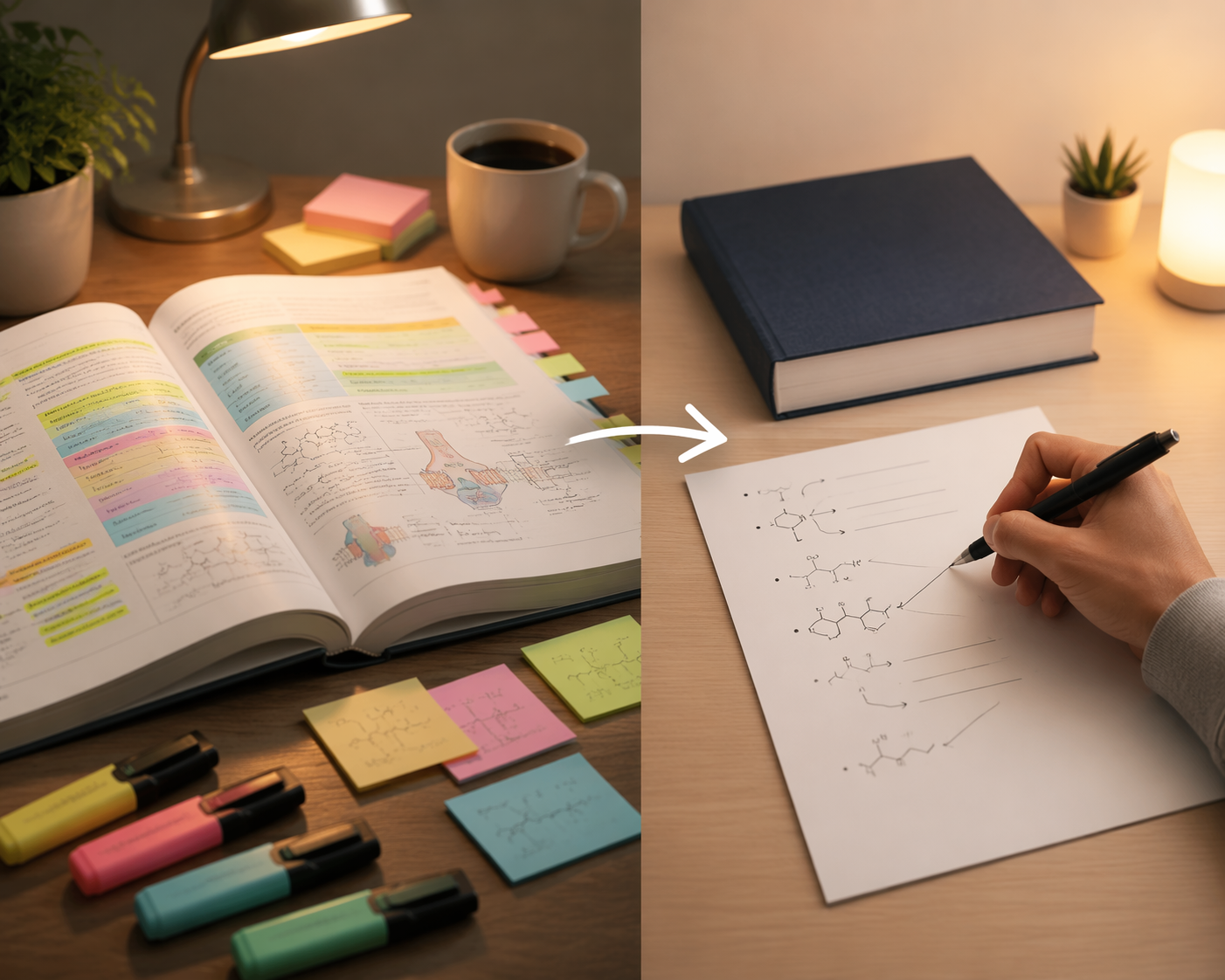
The fix is not prettier notes. It is changing the task. Instead of asking, “Do I recognize this drug?” the study session has to ask, “Can I produce the class, mechanism, effects, toxicities, and clinical hook with the source closed?”
What Counts as Real Recall in Pharmacology
Real recall means the answer has to come from you before the textbook, Anki card, or explanation gives it away. In pharmacology, that usually means generating one of four things:
- A drug class from a prototype or suffix, such as recognizing that “-olol” often points toward beta-blockers.
- A mechanism from the class, such as beta-1 receptor blockade decreasing heart rate and renin release.
- A predictable effect or toxicity from the mechanism, such as bronchoconstriction risk with nonselective beta-blockade.
- A clinical association from a passage clue, such as selecting a drug class because of a patient’s condition, contraindication, or physiologic change.
Recognition is easier. It is also weaker. Multiple choice can be useful later, especially when the MCAT asks you to reason through a passage, but recognition-based practice is a poor substitute for generation. If the answer choices are doing most of the remembering for you, you are not yet studying the part that fails on test day.
Start with Blank-Page Drug Mechanism Reconstruction
Blank-page reconstruction is the cleanest way to find out whether you know a drug class or have only been admiring it. It is uncomfortable because there is nowhere to hide. That is the point.
Pick one drug class. Close the source. On a blank page, rebuild the class from memory using the same core frame each time:
- Class name: write the drug class without looking.
- Prototype drugs or suffixes: list the examples and naming clues you expect to recognize.
- Mechanism: explain what receptor, enzyme, transporter, channel, or pathway the class affects.
- Major physiologic effects: write what increases, decreases, opens, closes, activates, or inhibits.
- Toxicities and contraindications: list the adverse effects that follow logically from the mechanism.
- Clinical hooks: add the MCAT-style clues that would make this class relevant in a passage.
For a beta-blocker page, that might mean writing “beta-blockers,” then prototypes such as propranolol or metoprolol if those are in your source, then beta receptor antagonism, then decreased heart rate and contractility, then bronchoconstriction risk for nonselective agents, then passage hooks around sympathetic tone, cardiovascular physiology, or asthma contraindication. The exact list depends on what your MCAT resource covers. The mental move is the same: rebuild the class before checking it.
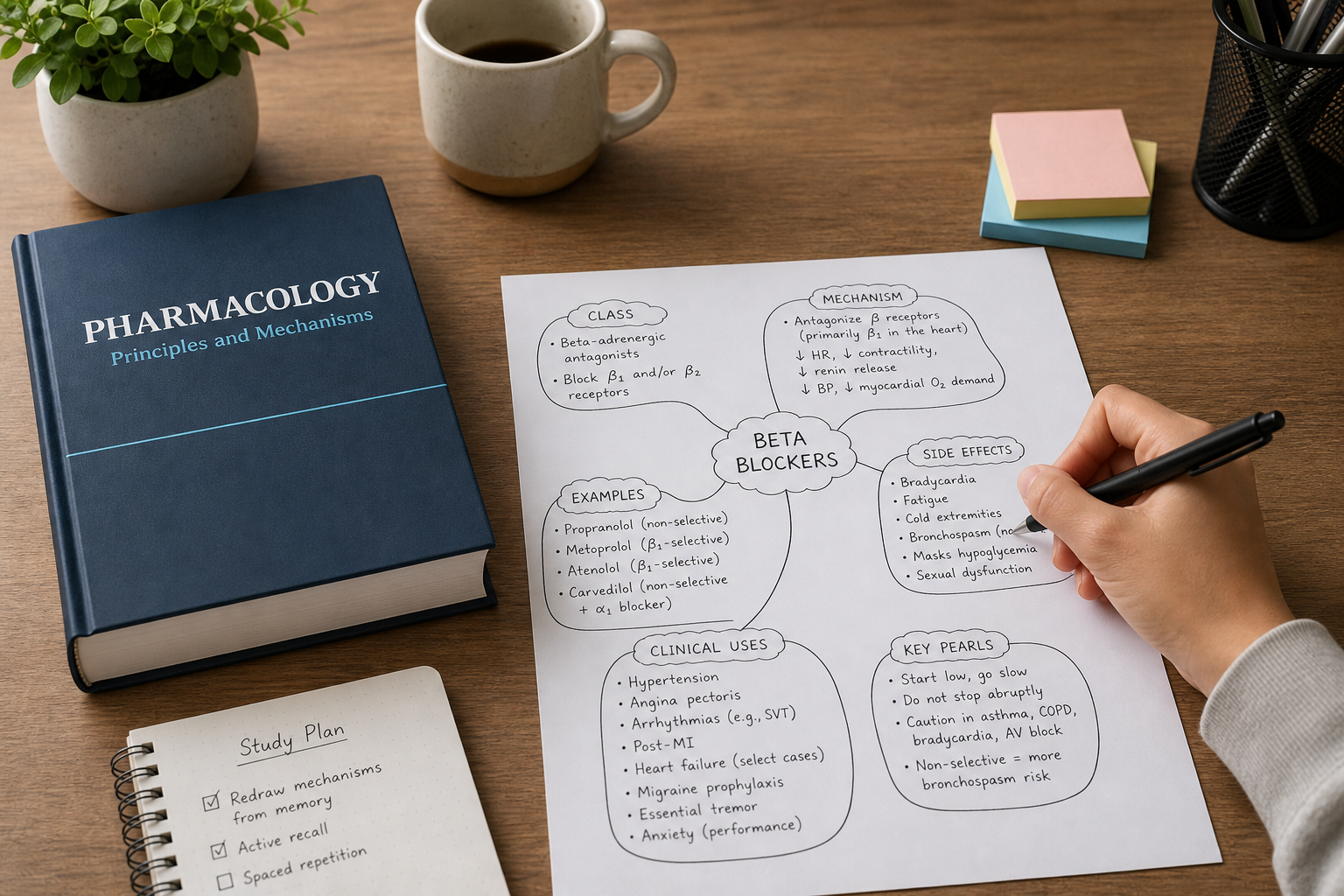
The most common mistake is checking too soon. Students write two shaky words, feel the discomfort, and reopen the table. That turns retrieval back into guided review. Give yourself a short, honest attempt first. If nothing comes after a real effort, mark the gap and then check. Retrieval can still help learning even when the first attempt fails, as long as performance is not completely off the floor and feedback follows.[4]
After checking, do not simply nod at the correct answer. Repair the page. Use a different color or a clear correction mark. Add the missing mechanism, cross out the wrong toxicity, and rewrite the causal chain in one line. The correction matters because the page should show the difference between what felt familiar and what you could actually generate.
A Simple Blank-Page Template
| Prompt | What you write from memory |
|---|---|
| Class | Drug class and naming clues |
| Examples | Prototype drugs your MCAT source expects you to know |
| Mechanism | Target and direction of action |
| Effects | Main physiologic consequences |
| Toxicities | Adverse effects and contraindication clues |
| Passage hooks | Situations where the MCAT might make the class relevant |
This does not need to be beautiful. A messy page that exposes three missing links is more valuable than a perfect copied chart. The standard is whether you can reconstruct the drug class again tomorrow with less help.
Turn the Weak Links into Spaced-Recall Flashcards
Blank-page reconstruction tells you where the holes are. Flashcards schedule those holes to come back before they rot. This is where Anki can be excellent, but only if the card forces retrieval before the answer appears.
A good pharmacology card asks for a specific generated answer. A weak card lets you recognize a term. “Beta-blockers” on the front and a huge copied explanation on the back is usually too broad. “What happens to heart rate and renin release with beta-1 blockade?” is better because it makes you produce the physiologic consequences before revealing the answer.
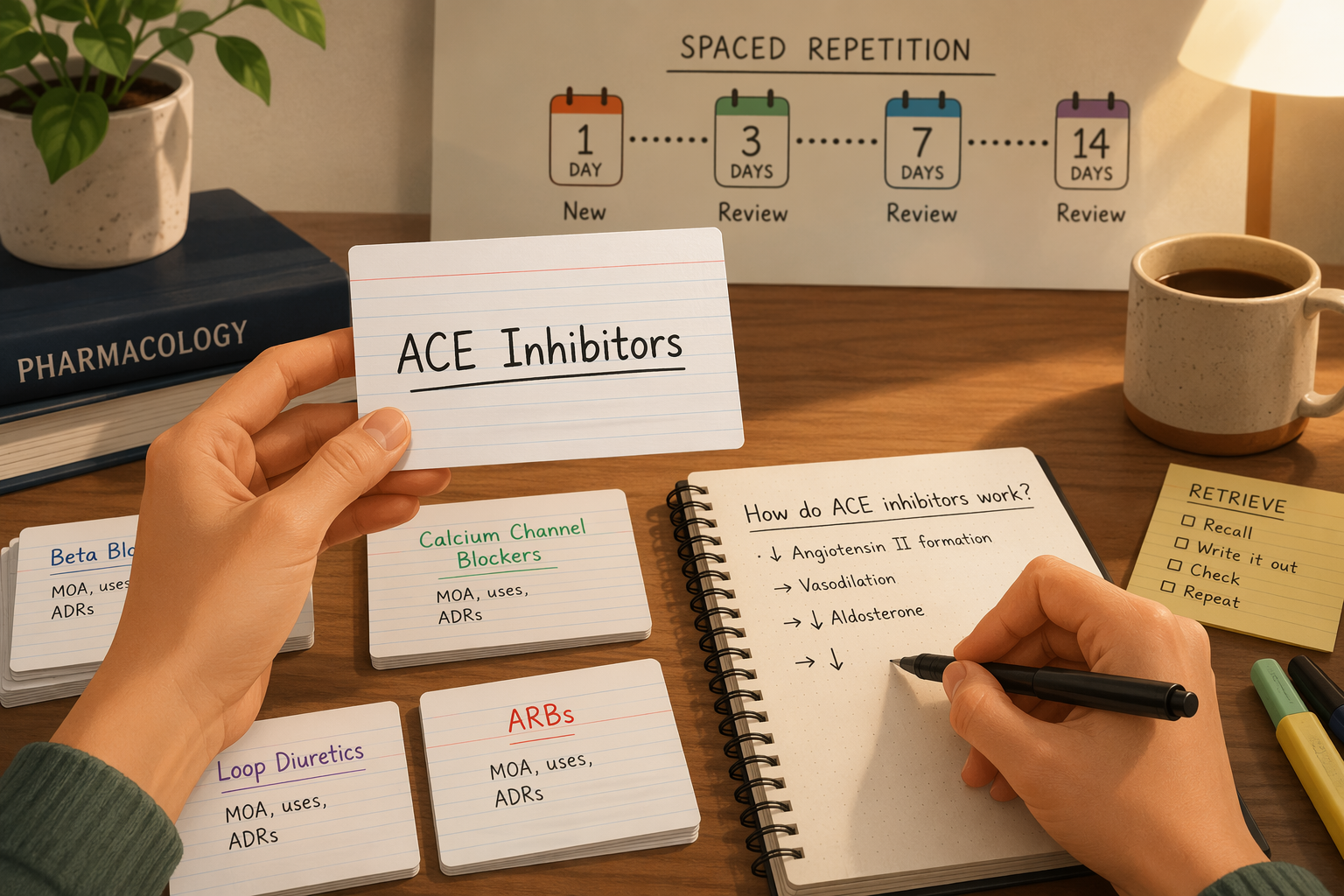
The card should also be small enough that you can grade it honestly. If the back contains six unrelated facts, you will either pass yourself for partial knowledge or fail yourself without knowing which piece broke. Split the card when the answer has more than one job.
| Weak card | Stronger recall card |
|---|---|
| Beta-blockers: mechanism, uses, side effects | What receptor effect explains decreased heart rate with beta-blockers? |
| ACE inhibitors facts | What hormone decreases downstream when ACE is inhibited? |
| Anticholinergic side effects | Name two predictable effects of blocking muscarinic signaling. |
| Opioids | Which receptor class is associated with opioid analgesic effects? |
Spaced repetition helps because the same item returns after time has passed. The retrieval attempt is the work; the schedule is the delivery system. Goldman et al. reported that flashcard tools such as Anki are positively associated with exam outcomes in health-professions education, but the 2025 review emphasizes the usage pattern that matters: multiple retrievals per item, not one-and-done exposure.[4]
That means you should resist two tempting shortcuts. First, do not reveal the answer while you are still “thinking.” Commit to an answer, even if it is rough. Second, do not keep reviewing only the comfortable cards. Pharmacology decks become decorative when students keep passing cards they already know and quietly avoid the ones that require mechanism work.
If you need the tool setup rather than the study behavior, use the site’s complete MCAT Anki guide. For this method, the rule is simpler: every important card has to make you generate the answer before you see it, and the same card has to return more than once over time.
Use Case Prompts So the Drug Facts Survive Passages
The MCAT rarely rewards isolated pharmacology trivia in the way a pure memorization quiz does. A passage gives physiology, symptoms, an experimental result, or a contraindication, and the drug fact has to attach itself to the situation. That is why case-based retrieval belongs after basic class recall, not instead of it.
A case prompt asks: which drug class fits, and why? The “why” is the part that prevents recognition from masquerading as recall.
- A patient has increased sympathetic signaling and elevated heart rate. Which drug class could reduce heart rate, and through what receptor effect?
- A drug decreases formation of angiotensin II. Which pathway is being affected, and what downstream physiologic change would you expect?
- A patient with reactive airway disease receives a nonselective beta-blocker. Which adverse effect becomes more concerning, and why?
- A passage describes receptor blockade followed by dry mouth and urinary retention. Which signaling system is likely being inhibited?
These examples are hypothetical prompts, not claims about real patients. Their job is to force a chain: clue → class → mechanism → effect. If you can only answer after seeing four answer choices, the chain is not yet stable enough.
You can write case prompts on flashcards, but they should still demand generation. Put the patient clue on the front. On the back, include the drug class and the mechanistic reason. If you miss it, do not only memorize the correct class; repair the link that failed. Maybe you knew the class but not the receptor. Maybe you knew the receptor but not the physiologic consequence. Those are different misses and they need different cards.
Draw Pathways from Memory When One Drug Class Depends on Another
Some pharmacology facts refuse to stay put because they live inside pathways. The renin-angiotensin-aldosterone system, autonomic signaling, endocrine feedback, and neurotransmitter pathways are easier to remember when you can redraw the chain.
Do this the same way as blank-page reconstruction: close the source, draw the pathway, place the drug class at the intervention point, then write what changes upstream and downstream. After checking, correct the diagram rather than recopying the whole resource. The goal is not an art project. The goal is knowing where the drug acts when a passage describes a change several steps away.
This is especially useful when side effects feel like arbitrary lists. Many adverse effects are easier to retain when they are treated as consequences. If a mechanism predicts the toxicity, memorize the mechanism first and make the side effect ride on it.
A Practical Session Structure
A pharmacology session does not need to be long to be useful, but it does need to make you retrieve. Some comparisons have found that shorter active-recall sessions can outperform much longer passive review sessions; a commonly cited contrast is 30 minutes of active recall beating 3 hours of passive review, though the exact ratio will vary with the material, the student’s starting point, and how retrieval is implemented.[4] Treat that as a warning against passive rereading, not as a promise that every 30-minute session replaces an afternoon.
For one drug class, a clean session can look like this:
| Time | Task | Standard |
|---|---|---|
| 5 minutes | Preview the source once | Notice the class, mechanism, major effects, and obvious passage hooks |
| 10 minutes | Blank-page reconstruction | Write the class structure from memory with the source closed |
| 5 minutes | Check and repair | Mark missing links and rewrite the corrected causal chain |
| 10 minutes | Build or revise flashcards | Create small cards that require generated answers |
| 5 minutes | Case prompt | Answer “which drug class and why?” without answer choices |
The preview is not the main event. It gives your brain enough material to attempt retrieval. The reconstruction and repair are where the learning gets exposed. The flashcards make the weak points return. The case prompt starts moving the drug fact toward MCAT-style use.
Where Active Recall Fits in a Full MCAT System
Active recall is excellent for durable factual memory. That includes drug classifications, mechanisms, side effects, receptor effects, and clinical associations. It does not replace passage practice, full-length exams, or the reasoning work of interpreting unfamiliar experimental setups.
The boundary is important. If you cannot remember what a class does, a passage cannot rescue you. If you can remember the class but cannot reason through the passage, flashcards alone cannot rescue you either. Use retrieval practice to make the pharmacology facts available, then use MCAT passages to practice deciding when and how those facts matter.
A reasonable workflow is to learn a drug class, reconstruct it from memory, convert the misses into spaced-repetition cards, answer a few case prompts, and then test the topic in mixed MCAT practice. For fitting Anki, UWorld, and AAMC materials into one schedule, use the broader MCAT study prep workflow. The pharmacology behavior itself stays the same: close the source, retrieve, check, correct, and repeat.
If drug classifications keep disappearing after you “review” them, assume the review was too passive before assuming your memory is broken. Make the page blank. Make the answer come from you first. Then let spaced repetition bring the same question back until the class, mechanism, toxicity, and passage clue can survive without the table open.
References
- Improving Students’ Learning With Effective Learning Techniques. Psychological Science in the Public Interest, 2013.
- The effect of testing versus restudy on retention: A meta-analytic review. Journal of Experimental Psychology, 2014.
- Test-enhanced learning in medical education. Medical Education, 2008.
- The Use of Retrieval Practice in the Health Professions: A State-of-the-Art Review. 2025.
Related exhibits & inventory
Verified outcomes
Planners
No planner filed for this exam yet
A downloadable timeline template for this exam hasn't been published yet.
Tool verdicts
Questions about this plan
Ask a question about a specific section, timeline, or citation in this plan — or flag something that needs correcting.
Comments
Join the discussion with an anonymous comment.