
MCAT Exam Hub
Master CARS by Unpacking the US-Saudi Nuclear Deal
This guide uses the July 2026 US-Saudi nuclear deal to teach MCAT test-takers how to systematically unpack dense social science passages with multiple stakeholder positions, conditional logic, and claim-counterclaim sequences. By analyzing the deal's structure, you'll learn a repeatable approach to boost your CARS score into the 127+ range.
- gre
- mcat
- asvab
- sat
- act
- digital-adaptive
- official-material
- section-strategy
- test-date-timeline
Why this story belongs in CARS practice
A dense international relations passage usually punishes the student who reads for the “topic” instead of the structure. The July 2026 US-Saudi nuclear deal is useful for MCAT CARS precisely because the topic is tempting: nuclear technology, Saudi Arabia, Israel, Trump, Congress, arms-race warnings. A 125–127 scorer can understand all of that and still miss the question if those positions collapse into one vague claim called “the passage says.”
The factual anchor is simple enough. On July 22, 2026, the United States and Saudi Arabia signed a 30-year, multi-billion-dollar 123 nuclear cooperation agreement. Then, on July 23, Trump said the deal was “subject to” Saudi Arabia joining the Abraham Accords, meaning normalization of relations with Israel became attached to the nuclear agreement in the public presentation of the deal [1][2].
That two-day sequence is the whole CARS lesson. July 22 gives you a signed agreement. July 23 adds a condition. The testable issue is not whether you personally think the condition is wise, enforceable, or likely to work. The testable issue is whether you can preserve the distinction between a signed legal framework, a presidential condition, Saudi nuclear preferences, congressional review, and expert warnings.
If you are using this US-Saudi nuclear deal and Israel recognition story as an international relations study exercise, the goal is not to memorize Middle East diplomacy for test day. The goal is to practice the kind of passage control that moves CARS from “I basically understood it” to “I know exactly whose claim this answer choice is borrowing.”
Start with the contradiction, not the controversy
A current-events reader wants to ask: Is the administration using nuclear cooperation to pressure Saudi Arabia into recognizing Israel? A CARS reader asks something smaller first: what did the passage say happened first, and what later statement complicates it?
That order matters. The July 22 announcement makes the agreement sound like an accomplished bilateral nuclear cooperation step. The July 23 “subject to” language makes the same agreement appear conditional on Saudi normalization with Israel. Those two descriptions do not have to be reconciled by the student. In fact, forcing a reconciliation is how many wrong answers become attractive.
As of July 24, 2026, the full agreement text was not publicly available in the materials summarized here. That means several important points remained unsettled: whether enrichment is actually permitted, whether the IAEA Additional Protocol is included, and what legal force Trump’s social-media condition has [3][4][5]. For CARS, that uncertainty is not a weakness in the exercise. It is the passage condition you must read under.
The passage map: who is speaking, what depends on what
A social science passage becomes manageable when every claim is assigned an owner. Do not start by asking whether the claim is “true.” Start by asking whose position it is, what kind of claim it is, and what would have to happen for it to matter.
| Stakeholder | What the claim is doing | CARS trap |
|---|---|---|
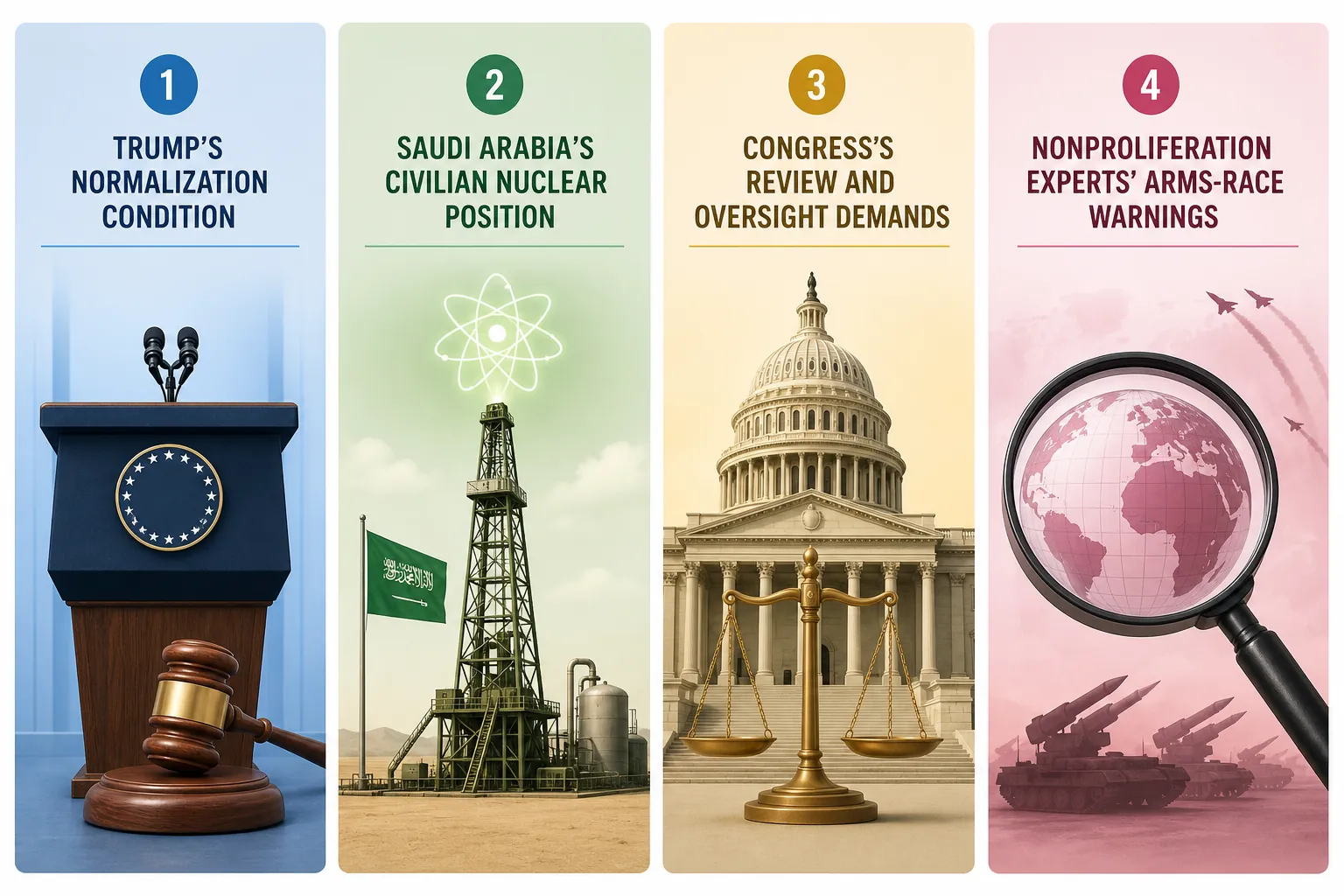
| Trump administration | Presents the nuclear cooperation agreement while adding that the deal is subject to Saudi Arabia joining the Abraham Accords and normalizing relations with Israel [1][2]. | Treating a presidential condition as automatically identical to the signed agreement’s legal text. |
| Saudi Arabia | Appears interested in civilian nuclear cooperation and, in available reporting, in a two-year feasibility study concerning indigenous enrichment [4][5]. | Converting a study of enrichment into proof that enrichment has already been authorized. |
| Congress | Has a review role for 123 agreements and congressional voices have focused on a 90-day review window and demands involving the Additional Protocol [3]. | Mistaking congressional oversight for the same thing as Trump’s Israel-normalization condition. |
| Israel | Functions mainly as the object of the normalization condition: Saudi recognition of Israel is the diplomatic prize attached to the nuclear deal in Trump’s July 23 framing [1][2]. | Assuming Israel’s interests are identical to either US executive strategy or Saudi nuclear goals. |
| Nonproliferation experts | Warn that the agreement could weaken nonproliferation norms or increase arms-race risk in the Middle East [4][5]. | Reading an expert risk warning as if it were a formal legal barrier. |
That table is not extra note-taking for its own sake. It prevents one of the most common CARS errors: laundering a claim through the wrong speaker. An answer choice may sound plausible because it uses vocabulary from the passage, but if it assigns Congress’s concern to Saudi Arabia, or turns an expert warning into Trump’s stated condition, it has already left the passage.
The verbs carry the logic
On this kind of passage, verbs matter more than nouns. “Subject to” is not the same as “encouraged by.” “Allows” is not the same as “requires.” “Demands” is not the same as “predicts.” “Warns” is not the same as “proves.”
Trump’s “subject to” formulation makes Israel normalization a condition in his public framing of the nuclear deal [1][2]. Saudi interest in a two-year enrichment feasibility study is a different kind of conditional: it concerns what Saudi Arabia may examine or preserve as an option, not necessarily what is already being built [4][5]. Congressional demands about the Additional Protocol operate through review and approval pressure, not through the same diplomatic bargain Trump announced [3]. Expert warnings about a Middle East arms race are evaluative and predictive, not procedural [4][5].
A wrong answer can exploit any one of those shifts. It might say the deal “requires Saudi enrichment,” when the available materials support only a narrower claim about an enrichment-related feasibility study. It might say Congress “conditioned the deal on Israel recognition,” when that condition belongs to Trump’s public statement. It might say experts “blocked” the agreement, when the sources support warning and criticism, not institutional veto power.
Conditional logic: do not flatten every condition into one prerequisite
Social science passages often contain several conditional statements that look similar under time pressure. The student’s job is not to treat every condition as one big “if.” The job is to ask what kind of condition it is: legal, diplomatic, technical, rhetorical, procedural, or predictive.
| Passage element | What it actually controls | What not to infer |
|---|---|---|
| “Subject to” Saudi Arabia joining the Abraham Accords | Trump’s public condition tying the nuclear deal to normalization with Israel [1][2]. | Do not assume, unless the passage says so, that the signed July 22 text itself contains the exact same enforceable clause. |
| Two-year enrichment feasibility study | A reported space for studying indigenous enrichment as part of the nuclear cooperation framework [4][5]. | Do not equate studying feasibility with beginning enrichment or receiving unrestricted enrichment rights. |
| 90-day congressional review | A separate institutional review process for nuclear cooperation agreements [3]. | Do not make Congress the author of Trump’s Abraham Accords condition. |
| Additional Protocol demands | A nonproliferation safeguard concern raised in the review and policy debate [3][4]. | Do not treat the demand as proof that the final agreement includes the protocol. |
| Saudi statements about Iran | A regional-security conditional: Saudi leaders have signaled that if Iran obtained a nuclear weapon, Saudi Arabia would follow suit [4]. | Do not turn a deterrence warning into a description of the current 123 agreement’s operative terms. |
This is where the 127+ student separates from the merely informed student. The informed student says, “There are a lot of conditions.” The stronger CARS reader says, “There are different kinds of conditions, and each one belongs to a different institutional actor.”
The July 22–July 23 sequence is a claim-counterclaim test
AAMC passages often place a claim, then a complication, then a qualification. The student who reads only for the “main idea” may remember the topic but lose the sequence. Here the sequence is unusually clean.
- July 22: the United States and Saudi Arabia sign a 30-year 123 nuclear cooperation agreement [1][2].
- The deal is reported in connection with civilian nuclear cooperation and disputed enrichment-related provisions [4][5].
- July 23: Trump states that the deal is subject to Saudi Arabia joining the Abraham Accords and normalizing relations with Israel [1][2].
- Congressional and expert concerns then complicate the deal further through review authority, Additional Protocol demands, and arms-race warnings [3][4][5].
Notice what this sequence does not permit. It does not permit you to erase July 22 because July 23 happened. It does not permit you to ignore July 23 because the agreement was already signed. It does not permit you to answer as if every critic is making the same objection. The passage’s difficulty comes from the fact that later information modifies earlier information without fully replacing it.
That is exactly the setup behind many CARS question stems: “The author would most likely agree that…,” “Which of the following most weakens…,” “The passage suggests that critics of the agreement…,” or “The author’s discussion of the July 23 statement primarily serves to….” The correct answer usually preserves the sequencing. The tempting answer usually resolves the tension too aggressively.
The UAE comparison is a contrast tool, not a side quest
The UAE comparison matters because it gives the reader a baseline. The 2009 US-UAE 123 agreement has often been described as a “gold standard” because the UAE agreed not to pursue enrichment, making it a sharper nonproliferation model than an agreement that leaves enrichment study or future enrichment questions open [3][4].
For CARS, that comparison should stay narrow. You do not need a full diplomatic history of the UAE, the Abraham Accords, or US nuclear export law. You need to know what the comparison is doing inside the argument: it makes the Saudi agreement appear more permissive or more ambiguous by placing it beside an earlier agreement with a clearer no-enrichment commitment.
A compare-contrast question might ask why the author mentions the UAE agreement. A strong answer would say something like: to establish a prior nonproliferation benchmark against which the Saudi agreement appears less restrictive. A weak answer would overreach: to prove that Saudi Arabia intends to build nuclear weapons, or to show that all Gulf nuclear agreements follow the same model.
Authorial perspective: what the sources show and what they leave out
This story also teaches a quieter CARS skill: identifying source perspective. The available materials summarized here are heavily centered on US executive action, congressional review, Israeli normalization, and nonproliferation analysis. Saudi Arabia’s official position is only partially visible through available statements and reporting. That does not mean the Saudi position is unknowable in the real world; it means a passage built from these materials gives you asymmetric access to the stakeholders.
That asymmetry should affect your answer choices. If an option claims that “Saudi officials primarily sought X,” ask whether the passage actually gave you enough Saudi-authored material to support “primarily.” If an option says “US analysts feared Y,” that may be safer if the passage directly presented expert warnings. CARS rewards the reader who notices not only what is said, but whose voice the passage allows to be fully heard.
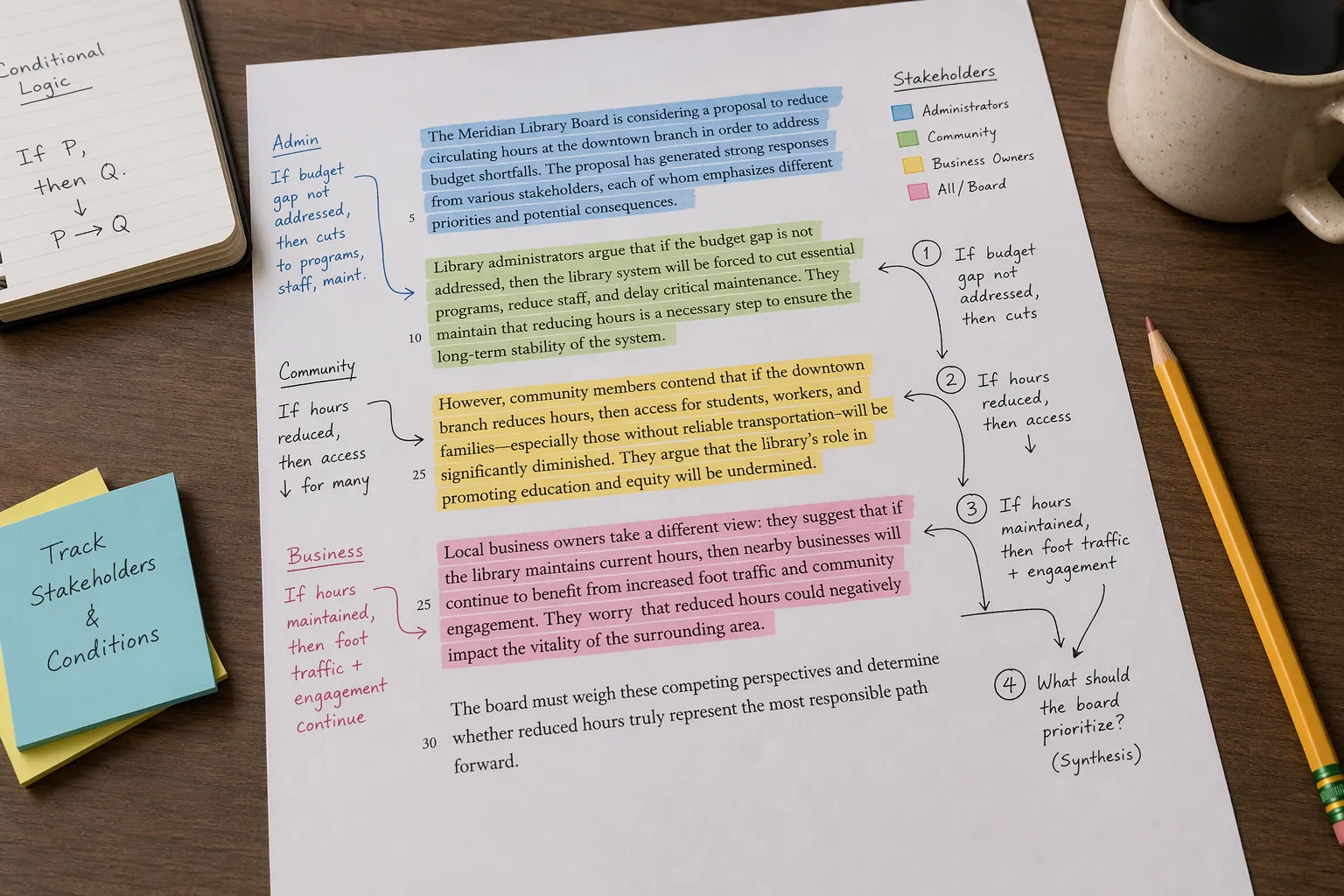
How to mark this kind of passage in real time
Do not turn this into a color-coding art project on test day. The margin system only has to preserve distinctions quickly.
- Circle condition words: “subject to,” “if,” “unless,” “provided that,” “allows,” “requires.”
- Label speakers with initials: T for Trump administration, S for Saudi Arabia, C for Congress, E for experts, I for Israel.
- Mark claim type: fact, demand, warning, comparison, qualification.
- Draw a small arrow when later information modifies earlier information.
- Put a question mark beside unresolved ambiguity instead of inventing a resolution.
For this passage, the margin might look like: “7/22 signed,” “7/23 T condition,” “S enrichment study?,” “C 90-day/AP,” “E arms race,” “UAE = contrast.” That is enough. The goal is not to reproduce the news story. The goal is to prevent the question stem from making you merge five positions into one.
This is also where your broader MCAT practice system matters. If you are building one, keep CARS passage review inside a larger plan like the MCAT Study Prep Hub, rather than treating each missed question as an isolated accident. And if you use flashcards, use them lightly for recurring cues — conditional words, author-function stems, common wrong-answer shifts — in the way described in How to Use Anki for the MCAT. No Anki deck can replace live passage dissection, but it can help you recognize the same traps faster.
The July 2026 deal is valuable for CARS because it compresses three high-yield skills into one passage pattern: stakeholder differentiation, conditional reasoning, and claim-counterclaim sequencing. A 127+ reader does not need to settle the nuclear deal. They need to keep the unresolved parts unresolved, the speakers separate, and the logic intact until the answer choices have nowhere to hide.
References
- Trump says US-Saudi nuclear deal conditional on country joining Abraham Accords, Reuters, July 23, 2026.
- Trump adds new condition to Saudi nuclear deal, says kingdom must normalize relations with Israel, PBS NewsHour.
- Congress Will Judge the Saudi Nuclear Cooperation Agreement, Just Security.
- Trump administration signs a nuclear deal with Saudi Arabia and risks a Middle East arms race, Bulletin of the Atomic Scientists, July 2026.
- Experts react: Reading between the lines of the new US-Saudi nuclear agreement, Atlantic Council.
Related exhibits & inventory
Verified outcomes
Planners
No planner filed for this exam yet
A downloadable timeline template for this exam hasn't been published yet.
Tool verdicts
Questions about this plan
Ask a question about a specific section, timeline, or citation in this plan — or flag something that needs correcting.
Comments
Join the discussion with an anonymous comment.