
GRE Exam Hub
How to Use the 2026 IP Camera Hack as GRE Issue Essay Evidence
Learn how to deploy the 2026 Iranian state-sponsored IP camera hack as specific, citable evidence in your GRE Issue essay across multiple prompt categories. This case study gives you five CVEs, a multinational scope, and a tactical context to support arguments on privacy, security, and technology regulation.
- SAT
- ACT
- GRE
- MCAT
- ASVAB
- digital-sat
- adaptive-testing
- registration-fee
- content-outline
- score-target
ETS does not reward an Issue essay for sounding broad; the highest-scoring responses need 'compelling reasons and/or examples' [1]. That is why a single verifiable cybersecurity case can do more work than a paragraph full of generic claims. The March 2026 Iranian IP camera hack is unusually useful here because it comes with named vendors, five CVEs, multinational reach, and a public write-up that can be used as evidence without pretending to prove more than it does [2].

If you are building a broader prep system, keep it beside a GRE study plan and a parallel one-case model such as StudyMethod's Burmese python case study.
Why this case fits the ETS rubric
A high-scoring Issue essay does not need a pile of facts. It needs one fact pattern that can carry a general claim without sounding invented or overused. This case does that because the core details are compact enough to memorize, specific enough to verify, and flexible enough to support several kinds of prompts without forcing the same sentence into every essay.
The fact packet to memorize
- March 2026: a reported Iranian state-sponsored campaign, not a vague 'recent cyberattack.' [2]
- Geographic reach: at least seven countries were named in the reporting — Israel, the UAE, Qatar, Bahrain, Kuwait, Lebanon, and Cyprus. [2]
- Devices involved: Hikvision and Dahua cameras. [2]
- Five exploitable CVEs: CVE-2021-36260, CVE-2021-33044, CVE-2017-7921, CVE-2023-6895, and CVE-2025-34067. [2]
- Operational context: the campaign was coordinated with missile and drone strikes, which makes it useful for prompts about the overlap between digital compromise and physical security. [2]
- Source caveat: the main write-up is on Elisity's blog, so any microsegmentation argument or the 50-70% device-agent figure should be treated as vendor-sourced, not neutral consensus. [2]
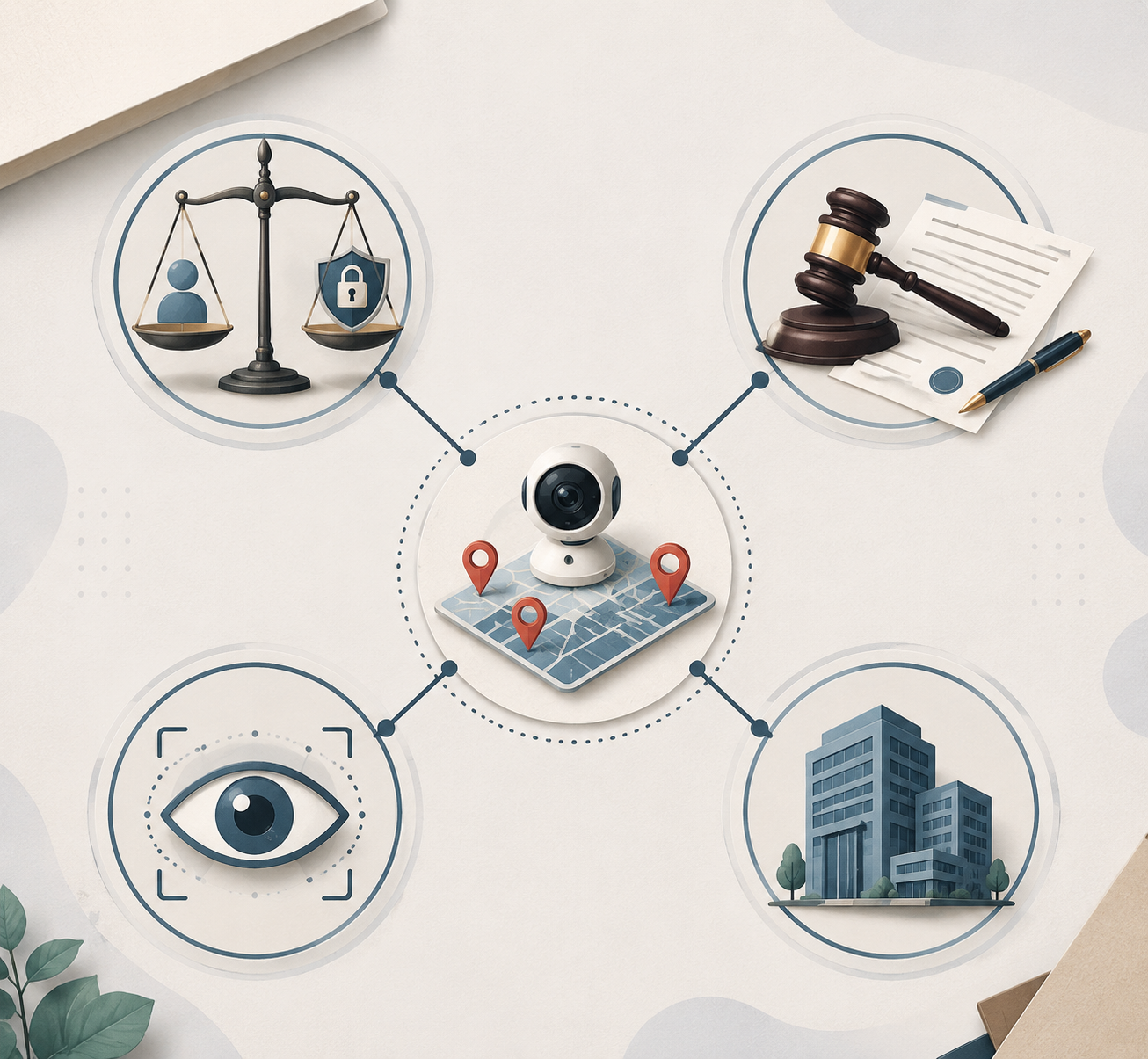
How to redeploy the same case across Issue prompts
The point is not to repeat the whole story. The point is to choose the fragment that fits the claim you are making. In one prompt, the camera becomes a privacy problem. In another, it becomes a regulation problem. In another, it becomes a question of who should bear the cost when a connected device enters a critical environment.
Privacy versus security
This is the cleanest fit. A connected camera is usually justified as protection or convenience, but the reporting here shows how the same device can be pulled into a much larger risk network [2]. That lets you make a balanced GRE move: concede that surveillance tools can improve security, then argue that the privacy cost is not abstract when the devices themselves can be exploited across borders and turned into operational assets [2].
Regulation and government surveillance
The five CVEs are most useful here. They span firmware generations from 2017 through 2025, which supports the narrower claim that this is not a one-off defect but a recurring vulnerability pattern across years of device life [2]. On a regulation prompt, that can justify an argument for baseline security requirements, patch expectations, or procurement rules. The careful version is stronger than the dramatic one: the case suggests that markets do not always self-correct fast enough, not that one specific law is automatically the answer.
The same facts also work on government-surveillance prompts. If a government expands the use of networked cameras, it also expands the attack surface that hostile actors can exploit. The fact that the campaign was tied to missile and drone strikes gives you a concrete way to show why 'more monitoring' is not a cost-free slogan. It is better to use that detail as an illustration of risk than as proof that every surveillance system will be weaponized [2].
Corporate liability
For liability prompts, focus on responsibility rather than blame theater. You do not need to say every vendor failed, and you should not claim that a single buyer caused the breach. The safer argument is that companies deploying networked cameras have a duty to patch, segment, and monitor them because weak device security can spill beyond IT into physical or strategic harm [2].
Keep the causation narrow
This is where a good example can turn brittle. The available material supports the statement that the campaign involved exploitation associated with named vulnerabilities and was coordinated with kinetic operations [2]. It does not support turning that into a sweeping claim that those five CVEs explain every consequence. In a GRE essay, the narrower version reads as evidence; the overbuilt version reads as exaggeration.
- Safer: 'The campaign reportedly used devices associated with five named CVEs.'
- Riskier: 'These five CVEs caused all of the campaign's effects.'
- Safer: 'Elisity, a vendor selling microsegmentation, reports that 50-70% of enterprise devices cannot support security agents.' [2]
- Riskier: 'Most independent experts agree agent-based security does not work.'
Why the technical background stays in the background
You do not need camera-firmware expertise to use this case well. The arXiv Tenda CP3 study shows that IP-camera vulnerability research is a real and documented technical area, and SecuriThings' overview is enough to remind you that camera vulnerabilities and best practices follow recognizable patterns [3][4]. For GRE purposes, that is a credibility check, not an invitation to write a security primer.
Used this way, the 2026 IP camera hack is worth memorizing not because it is sensational, but because it lets a GRE writer make abstract claims concrete, current, and bounded.
References
- ETS GRE Analytical Writing Analyze an Issue Task page — ETS
- IoT Device Security: Lessons from the Iranian Camera Hack — Elisity
- Finding (and exploiting) vulnerabilities on IP Cameras: the Tenda CP3 case study — arXiv
- Camera Vulnerability: Tutorial, Sample CVEs, and Best Practices — SecuriThings
- 4 Top-Scoring GRE Sample Essays, Analyzed — PrepScholar
- 328 Official GRE Essay Topics to Practice With — PrepScholar
Related exhibits & inventory
Verified outcomes
Planners
No planner filed for this exam yet
A downloadable timeline template for this exam hasn't been published yet.
Tool verdicts
AI-tool cautions
No AI tools tested for this exam yet
No hands-on AI-accuracy logs have been filed for this exam.
Questions about this plan
Ask a question about a specific section, timeline, or citation in this plan — or flag something that needs correcting.
Comments
Join the discussion with an anonymous comment.