
SAT Exam Hub
How Indoor Farming Reduces Food Contamination — and Where It Still Falls Short
Examines the peer-reviewed evidence behind claims that indoor farming prevents food contamination, drawing on systematic reviews and outbreak data to show where controlled environment agriculture succeeds at reducing risks and where it introduces new hazards that require rigorous management.
- SAT
- ACT
- GRE
- MCAT
- ASVAB
- digital-sat
- adaptive-testing
- registration-fee
- content-outline
- score-target
The careful answer to “how indoor farming prevents food contamination study” is narrower than the phrase usually promises. The best current evidence says indoor farming can reduce several familiar contamination routes, especially those tied to soil, wildlife, runoff, and outdoor pesticide exposure. It does not show that indoor farming prevents contamination in the absolute sense. The 2025 FAO global review makes the distinction bluntly useful: controlled environments can remove some hazards, but their stable temperature, humidity, water flow, and surfaces can also help pathogens persist once they get inside; the operational lesson is “keeping hazards out and containing them,” not assuming they cannot enter.[1]
That caution is not a theoretical exercise. In 2021, a Salmonella outbreak linked to a hydroponic controlled-environment agriculture operation sickened 31 people and hospitalized 4.[2] One outbreak does not prove that indoor farms are frequently contaminated. It does prove something more limited and more important for evaluating the claim: indoor production is not a biological force field.
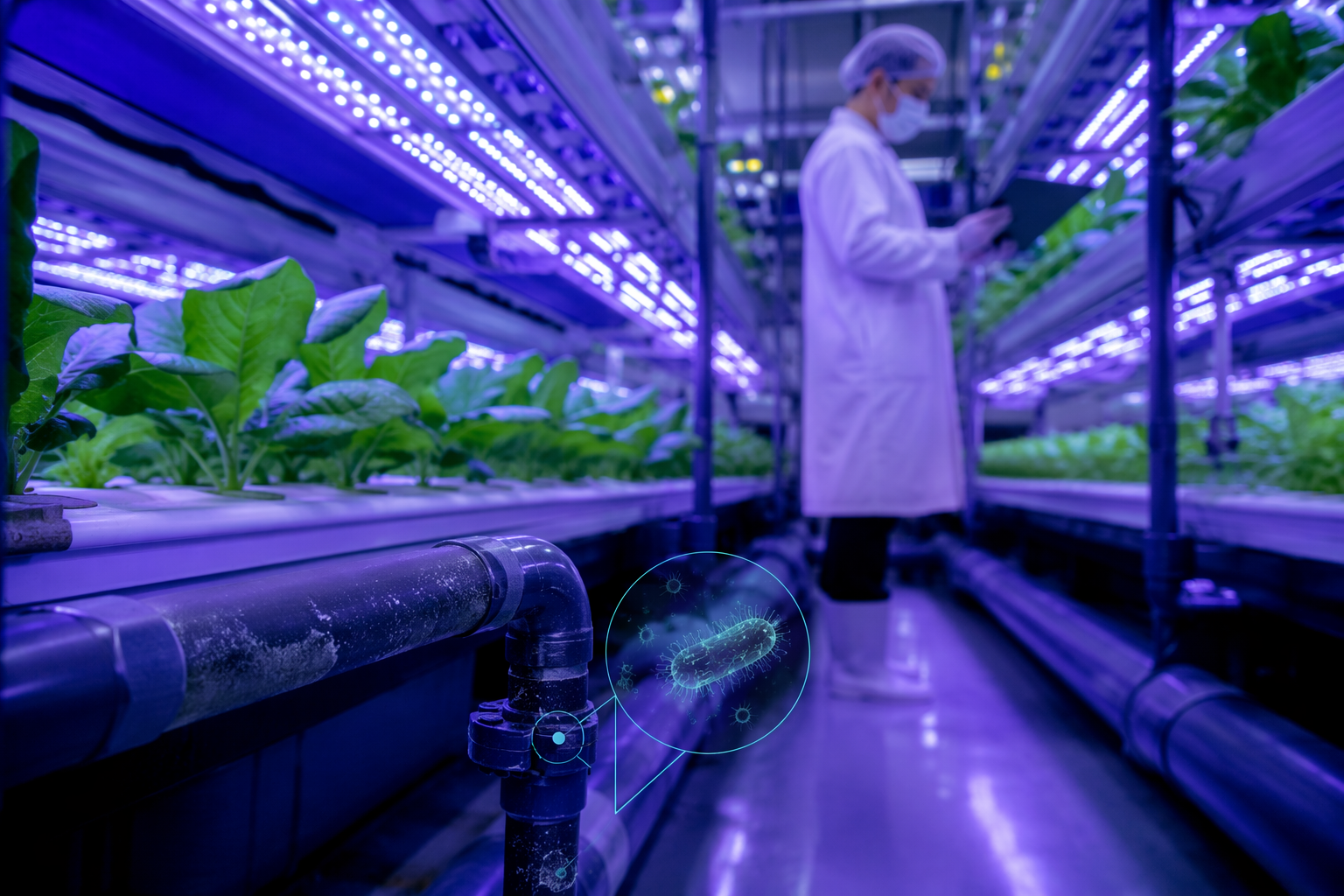
What indoor farming really reduces
The case for indoor farming starts with a legitimate baseline problem. The CDC estimates that foodborne illnesses affect 48 million people in the United States each year.[3] Leafy greens and other fresh produce are difficult because they are often eaten raw, have complex surfaces, and can be exposed to contaminated soil, irrigation water, animals, field workers, harvesting equipment, and wash systems before they reach a consumer.
Indoor farming changes several of those exposure routes. Plants can be grown without field soil. Wildlife intrusion can be physically limited. Rain splash, wind-blown dust, and runoff are no longer routine parts of production. Pesticide use can also be reduced sharply, and one 2020 review associated indoor vertical farming with complete elimination of pesticide residues in the production context it analyzed.[4] That is a meaningful food-safety and exposure argument, especially when compared with open-field systems that must manage weather, animals, and neighboring land uses.
But the word “prevents” needs discipline. Removing a pathway is not the same as eliminating a hazard. A farm can avoid soil and still receive contaminated seed. It can exclude deer and birds and still circulate contaminated water. It can use fewer pesticides and still have a sanitation failure on a surface that contacts roots, shoots, or harvest equipment. The FAO review’s value is that it does not treat controlled conditions as a synonym for safe conditions.[1]
The new weak point is persistence
The same design features that make indoor farms attractive can become liabilities after contamination occurs. Hydroponic and aquaponic systems often depend on recirculating water. Nutrients, pipes, tanks, trays, channels, pumps, and growing media create surfaces where microorganisms can attach. Stable indoor conditions reduce environmental variability, which is useful for crop production; the FAO review also warns that such stability can favor pathogen survival when hazards are introduced.[1]
This matters because many public-facing claims about indoor farming stop at the absence of soil or outdoor animals. A food-safety manager cannot stop there. The practical question is where a pathogen would go next: into a shared nutrient reservoir, onto a reusable channel, into a biofilm, across a batch, or into the next production cycle. In a tightly controlled system, the route may be cleaner and more traceable than in a field, but traceable is not the same as harmless.
That is why a broad review deserves more weight than a reassuring single-site demonstration. If a study shows a treatment reducing a pathogen under laboratory conditions, that is useful. It is not yet proof that the same treatment will eliminate the hazard across seeds, roots, water, surfaces, workers, and commercial production schedules. The evidence has to carry the size of the claim.
The systematic review is the hard stop for “solved problem” claims
The strongest method-focused check comes from Ivey et al.’s 2025 systematic review of 131 hydroponic food-safety studies. Its most important finding is not that interventions fail across the board. It is that no chemical, physical, or biological intervention fully eliminated pathogens from seeds, sprouts, or plants across the reviewed evidence.[5] That is the point at which “indoor farming prevents contamination” has to be revised to “indoor farming can reduce selected risks when hazards are controlled.”
The same review also found that only 43.4% of studies provided reproducible methodology.[5] For a student learning to evaluate scientific claims, that number should change the temperature of the room. A result that cannot be reproduced from the methods section may still be suggestive, but it is a weak foundation for broad claims about an industry. The problem is not only whether a sanitizer, biological control, or physical treatment worked in one setting. The problem is whether another researcher, regulator, or facility could repeat the method closely enough to test the claim.
| Claim type | What the evidence can support | What it cannot support |
|---|---|---|
| Indoor systems reduce outdoor exposure routes | Reduced contact with soil, wildlife, runoff, and some pesticide-residue pathways | A guarantee that pathogens cannot enter |
| Hydroponic interventions control pathogens | Some interventions can reduce contamination under tested conditions | Full pathogen elimination from seeds, sprouts, or plants across the reviewed studies |
| Controlled environments improve manageability | Hazards may be easier to monitor, contain, and trace | Automatic safety without rigorous sanitation, water management, and verification |
This is where evidence grading matters. A comprehensive review can reveal patterns and gaps that a single impressive experiment cannot. It can show whether “works” means reduction, suppression, delayed growth, partial inactivation, or elimination. It can also expose whether a study was written so another team could actually repeat it. Those distinctions are not academic fussiness; they are the difference between a safety protocol and a marketing sentence.
Water can turn one entry point into a system problem
The Purdue study on closed-loop aquaponic and hydroponic systems gives a concrete version of the same concern. Researchers demonstrated that E. coli O157:H7 could circulate through these systems.[6] The study should not be inflated into a claim that all recirculating systems are unsafe. Its narrower value is enough: if a pathogen enters shared water, the system architecture can help move it.
That makes water management central rather than peripheral. Testing incoming water is not the whole job if water is reused. A facility also has to consider reservoirs, nutrient dosing, filtration, disinfection, dead zones, root contact, worker handling, drain lines, and cleaning between cycles. The operational burden shifts from guarding a field against many messy outdoor exposures to guarding a compact system against persistence and spread.
A controlled environment can make that burden more manageable. It can also make a missed hazard more consequential because the same water, surface, or batch pathway may serve many plants. That is the tradeoff the better studies keep visible.
The BrightFarms outbreak is a reality check, not a prevalence estimate
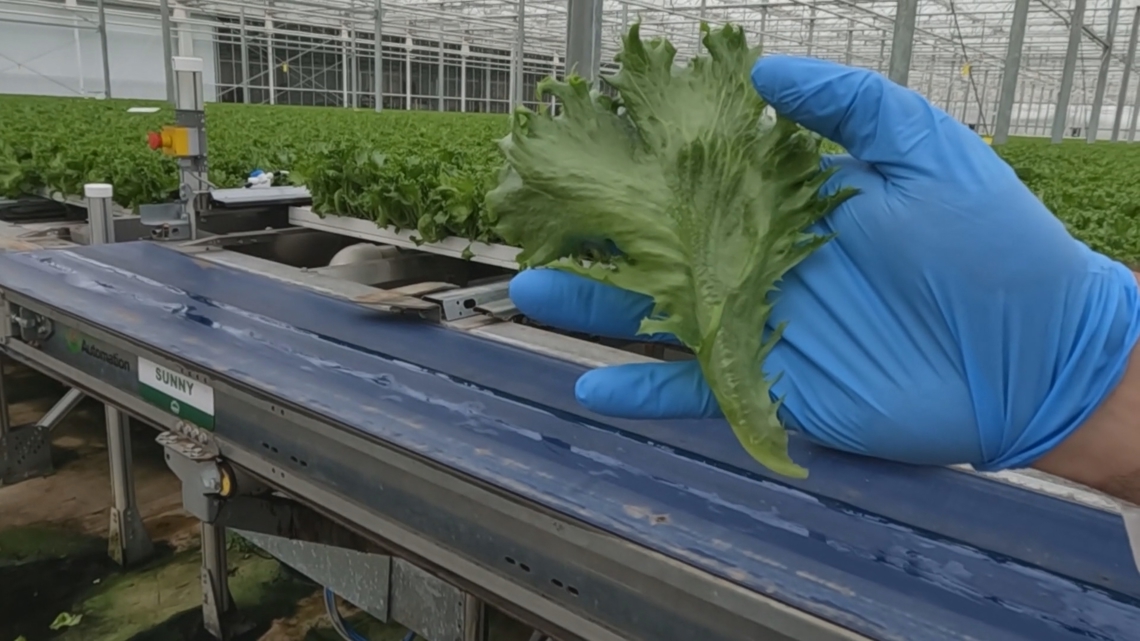
The 2021 BrightFarms outbreak keeps the discussion honest because it occurred in the kind of production setting often described as cleaner and more controlled. The investigation linked illnesses to hydroponic lettuce from a controlled-environment agriculture operation; 31 people were sickened and 4 were hospitalized.[2]
The correct inference is limited. This outbreak does not tell us how often hydroponic lettuce is contaminated compared with field-grown lettuce. It does not establish that indoor farming is more dangerous. It does, however, defeat the strongest version of the prevention claim. If contamination can occur in a commercial indoor operation and lead to documented illnesses, then “indoor” should be treated as a risk modifier, not an endpoint.
For growers and food-safety staff, that distinction changes the work. The question is not whether the facility sounds controlled. The question is whether seed sourcing, water treatment, environmental monitoring, sanitation verification, employee hygiene, corrective actions, and recall readiness are strong enough to catch the pathway that was not supposed to matter.
How to read “much less likely”
The USDA ARS statement quoted in a commercial vertical-farming blog that vertical-farming crops are “much less likely to be contaminated” is plausible as a probability claim and weak as a guarantee.[7] The source type matters here. A commercial blog quoting a federal research agency does not carry the same weight as a systematic review or outbreak investigation, and the wording itself does not say “cannot be contaminated.”
That does not make the statement useless. “Much less likely” is exactly the kind of claim indoor farming may be able to support for certain hazards, especially when the comparison is outdoor exposure to soil, wildlife, contaminated runoff, and pesticide residues. The problem begins when likelihood language is converted into certainty language. In test-prep terms, the conclusion has become broader than the premises.
What a defensible study-based answer looks like
A defensible answer to the keyword question is not a list of indoor-farming advantages. It is a claim with boundaries: indoor farming reduces contamination risk by removing or controlling several outdoor exposure routes, including soil contact, wildlife intrusion, runoff, and some pesticide-residue pathways; it may make monitoring and containment easier; it does not eliminate contamination risk because pathogens can enter through seeds, water, workers, equipment, or surfaces and may persist in recirculating systems and biofilms.
The evidence base is also uneven. The FAO review provides the broadest synthesis and the clearest conceptual warning.[1] The Ivey systematic review shows that the hydroponic intervention literature has not demonstrated full pathogen elimination from seeds, sprouts, or plants and that reproducibility reporting is weak.[5] The Purdue study supplies a mechanism check for recirculating water.[6] The BrightFarms outbreak supplies real-world proof of possibility, not a rate estimate.[2]
So the practical conclusion is rigorous protocol, not presumed safety. Indoor farms need hazard exclusion, validated water treatment, seed controls, sanitation that accounts for biofilm, environmental monitoring, documentation detailed enough to reproduce, and corrective actions that assume failures can happen. The evidence supports risk reduction. It does not support declaring the problem solved.
References
- Food safety in controlled environment agriculture — FAO, 2025.
- A multistate outbreak of Salmonella Typhimurium infections linked to hydroponic lettuce from a controlled environment agriculture operation — United States, 2021 — Journal of Food Protection, 2023.
- Burden of Foodborne Illness: Findings — CDC.
- Indoor Vertical Farming in the Urban Nexus Context: Business Growth and Resource Savings — Sustainability, 2020.
- Systematic review of food safety risks associated with hydroponic production systems — 2025.
- Survival and transfer of Escherichia coli O157:H7 in a closed-loop aquaponic and hydroponic system — Horticulturae, 2019.
- Are Vertical Farms Safe? — Grow Space.
Related exhibits & inventory
Verified outcomes
No verified outcomes on file for this exam yet
See Methodology for how outcome evidence is disclosed once logged.
Planners
No planner filed for this exam yet
A downloadable timeline template for this exam hasn't been published yet.
Tool verdicts
AI-tool cautions
No AI tools tested for this exam yet
No hands-on AI-accuracy logs have been filed for this exam.
Questions about this plan
Ask a question about a specific section, timeline, or citation in this plan — or flag something that needs correcting.
Comments
Join the discussion with an anonymous comment.