
LSAT Exam Hub
Humphrey's Executor Overruled: What Law Students Need to Know
This guide covers the full IRAC case brief for Humphrey's Executor v. United States, explains why the Supreme Court overruled it in 2026, and gives law students the current removal-power rule for their Constitutional Law exams.
- gre
- mcat
- asvab
- sat
- act
- digital-adaptive
- official-material
- section-strategy
- test-date-timeline
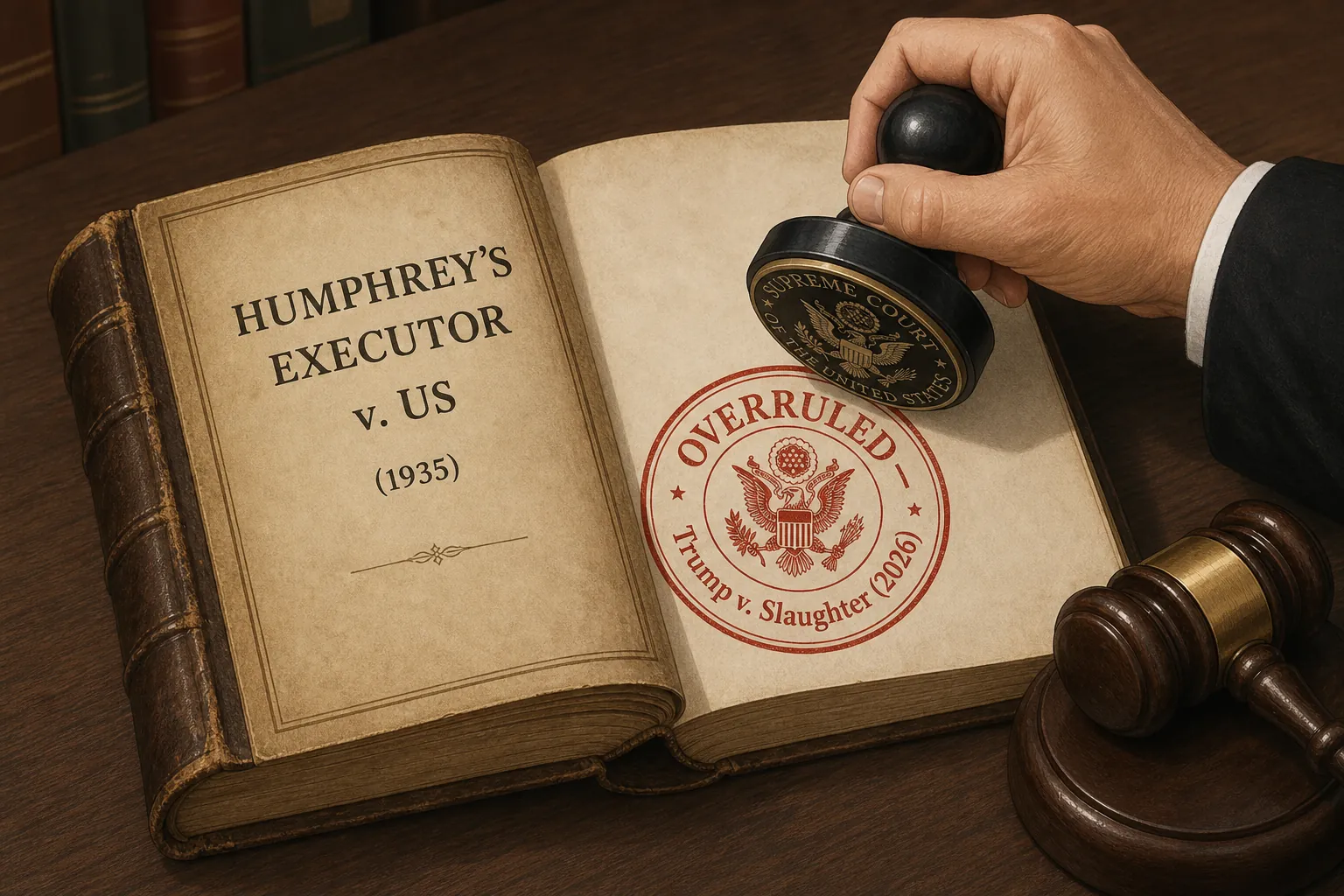
If Humphrey’s Executor is still sitting in your outline as the clean rule that Congress may protect FTC commissioners from at-will presidential removal, fix that line now. The original 1935 holding mattered for ninety-one years, but it was overruled on June 29, 2026, in Trump v. Slaughter, where the Court held 6-3 that FTC commissioners exercise substantial executive power and therefore must be removable at will by the President. The same day, Trump v. Cook preserved a narrow Federal Reserve Board carve-out by a 5-4 vote. [1]
For an exam answer in July 2026, the old sentence is not enough. The usable rule is: Humphrey’s Executor’s quasi-legislative/quasi-judicial distinction no longer shields FTC-style independent agency officers from presidential removal when they exercise substantial executive power; the Federal Reserve Board remains separately protected under Cook unless your professor tells you otherwise.
The current exam rule, before the history
| Question | Pre-2026 answer | Post-Slaughter answer |
|---|---|---|
| Can Congress protect FTC commissioners from at-will presidential removal? | Yes, under Humphrey’s Executor, because the FTC was treated as quasi-legislative and quasi-judicial rather than purely executive. | No, for FTC commissioners exercising substantial executive power. Trump v. Slaughter overruled Humphrey’s Executor on that point. [1] |
| Does Myers control every officer? | No. Humphrey’s Executor confined Myers to purely executive officers. | Myers is again central for officers exercising substantial executive power, though Slaughter uses the modern substantial-executive-power framing. |
| Is every independent agency now exactly the same? | That question did not arise under the old framework in the same way. | No. The Federal Reserve Board has a separate Cook carve-out, and the outer boundaries of substantial executive power are still undeveloped. [1] |
That table is the correction most outdated supplements will not make for you. Now the full case brief still matters, because professors can test the old case as a historical precedent, as a reasoning target, or as the rule that Slaughter rejected.
Humphrey’s Executor v. United States: IRAC case brief
Facts
William E. Humphrey was a commissioner of the Federal Trade Commission. President Franklin Roosevelt removed him in 1933 because Roosevelt wanted FTC officials who supported his policy program. Humphrey died, and his executor sued for the salary Humphrey would have received if the removal had been unlawful. The case turned on whether the removal restrictions in the Federal Trade Commission Act were constitutional. [2]
The relevant FTC Act language allowed removal for causes such as inefficiency, neglect of duty, or malfeasance in office. Roosevelt’s removal was not framed as one of those statutory causes; it was a policy-disagreement removal. That is why the case squarely presented the President’s constitutional removal power against Congress’s choice to create an independent commission. [2]
Issue
May Congress constitutionally limit the President’s power to remove a Federal Trade Commission commissioner by allowing removal only for specified causes?
Original holding
Yes. In 1935, the Supreme Court unanimously held that Congress could protect FTC commissioners from at-will presidential removal because the FTC was not treated as a purely executive body. The Court characterized the Commission’s work as quasi-legislative and quasi-judicial, and it held that Congress could insulate such officers from removal based merely on presidential policy disagreement. [2]
Original rule
Before Slaughter, Humphrey’s Executor stood for this rule: Congress may impose for-cause removal protection for members of an independent multimember commission when the officers perform quasi-legislative and quasi-judicial functions rather than purely executive functions. That was the classic law-school formulation. It is also the formulation that is now obsolete as a current answer for FTC-style agencies.
Sutherland’s reasoning
Justice Sutherland’s opinion did four important things. First, it treated Congress’s statutory design as deliberate: the FTC was meant to be nonpartisan and independent, not an arm of the President’s immediate political program. Second, it described the FTC as an expert body whose judgment Congress wanted insulated from ordinary political pressure. Third, it classified the FTC’s powers as quasi-legislative and quasi-judicial rather than purely executive. Fourth, it reasoned that separation of powers allowed Congress to protect that institutional design by limiting presidential removal. [2]
The third move did most of the work. If the FTC was not purely executive, then the case could be distinguished from Myers v. United States. If the FTC instead combined investigation, reporting, rule-like policy work, and adjudicatory functions, Congress had more room to require independence. That is the doctrinal hinge students had to learn for generations.
How Humphrey’s Executor confined Myers
Myers v. United States came first. In 1926, the Court held that the President had broad removal authority over a postmaster, which the Court treated as a purely executive officer. The Humphrey’s Executor Court did not say Myers was wrong. It narrowed Myers by saying the earlier case controlled officers performing purely executive duties, not members of a congressionally created independent commission performing quasi-legislative and quasi-judicial functions. [3]
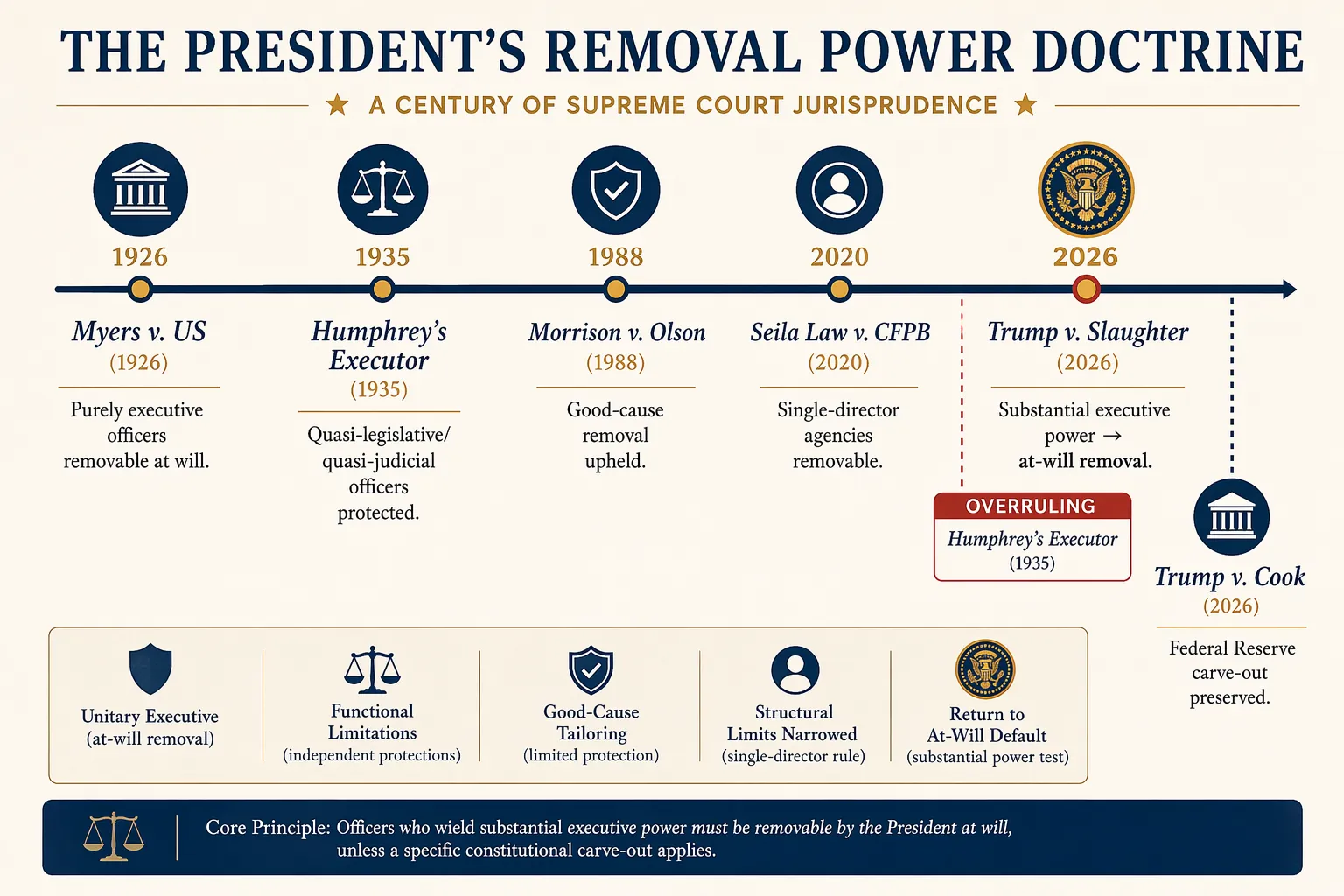
On an exam before 2026, that distinction was the safest way to organize the answer. A postmaster looked like Myers. An FTC commissioner looked like Humphrey’s Executor. Later cases could complicate the path, but the basic category line remained: purely executive officers were more vulnerable to at-will presidential removal; independent commissioners with quasi-legislative and quasi-judicial functions could receive for-cause protection.
That is also why the overruling matters so much. Slaughter did not merely adjust a footnote. It removed the category that made the traditional independent-agency answer work.
Why the 1935 rule carried so much weight
Humphrey’s Executor became the central precedent for the constitutional legitimacy of independent agencies. Its appeal was not just the outcome; it gave Congress a vocabulary for institutional design. If an agency was structured as a multimember expert commission with staggered terms, bipartisan balance, and adjudicatory or rule-like functions, the Humphrey’s Executor framework made for-cause removal protection look constitutionally ordinary.
That is why old outlines often state the case with too much confidence. They say: Congress can protect independent regulatory commissioners because they perform quasi-legislative and quasi-judicial functions. That was a fair shorthand for a long time. It is no longer the rule to apply when a modern exam asks whether the President may remove an FTC-style commissioner.
Trump v. Slaughter: what the Court removed from Humphrey’s Executor
Trump v. Slaughter overruled Humphrey’s Executor’s protection for FTC commissioners. Chief Justice Roberts wrote for a 6-3 majority that FTC commissioners exercise substantial executive power, including rulemaking, enforcement, adjudication, and civil-penalty authority. On that understanding, the President must be able to remove them at will. Roberts described Humphrey’s Executor as “a result in search of a rationale.” [1]
For exam purposes, pay attention to the mechanism, not just the headline. The Court’s objection was not that the FTC happened to be politically inconvenient to the President. The objection was that the FTC’s actual powers were executive enough to require presidential control. Rulemaking can bind regulated parties. Enforcement selects targets and brings the government’s coercive power to bear. Adjudication resolves disputes within the agency’s statutory scheme. Civil penalties add direct legal consequences. Put together, those functions made the old quasi-legislative/quasi-judicial label inadequate under Slaughter.
That last point is where many exam answers will be won or lost. Do not write only, “Humphrey’s Executor was overruled.” Write what replaced it: when an independent agency officer exercises substantial executive power, Congress generally may not prevent the President from removing that officer at will. Then apply that standard to the agency powers in the fact pattern.
Quick application note: agencies likely affected
Early post-Slaughter analysis identifies agencies such as the FTC, NLRB, SEC, FCC, EEOC, CPSC, FEC, and NRC as affected by the Court’s move toward at-will presidential removal for commissioners exercising substantial executive power. [4][5]
Use that list carefully. It is useful issue-spotting shorthand, not a substitute for analysis. If your exam gives you an agency with enforcement authority, adjudicatory machinery, rulemaking power, and penalty authority, Slaughter is doing real work. If the hypothetical gives an entity with a more limited role, say the boundary is unresolved and reason from the functions actually assigned.
Trump v. Cook and the Federal Reserve carve-out
Cook is the exception you need to attach to the new rule. In Trump v. Cook, decided the same day as Slaughter, the Court preserved Federal Reserve Board removal protections by a 5-4 vote. The Court relied on the Fed’s distinctive historical and constitutional position, including historical arguments tied to the First and Second Banks of the United States. [1]
Do not turn the Fed carve-out into a broad rescue for independent agencies. Cook protects the Federal Reserve Board on a narrow historical rationale. It does not restore Humphrey’s Executor for the FTC, and it does not give you permission to say all multimember independent agencies remain insulated from at-will removal.
How to write the removal-power IRAC after Slaughter
Start with the present rule, then show you know the old doctrine. That order prevents the classic mistake of giving a polished pre-2026 answer.
| IRAC part | What to write |
|---|---|
| Issue | Whether Congress may restrict the President’s removal of an independent agency officer who exercises substantial executive power. |
| Rule | After Trump v. Slaughter, Humphrey’s Executor no longer permits Congress to protect FTC-style commissioners from at-will removal based on the quasi-legislative/quasi-judicial distinction. Officers exercising substantial executive power are removable at will, subject to the narrow Federal Reserve carve-out preserved in Trump v. Cook. |
| Application | Identify the officer’s functions: rulemaking, enforcement, adjudication, penalty authority, investigation, supervision, or merely advisory work. The more the officer directs coercive federal power, the stronger the Slaughter argument. |
| Conclusion | If the agency resembles the FTC and exercises substantial executive power, the removal restriction is likely unconstitutional after Slaughter. If the agency is the Federal Reserve Board, discuss Cook. If the functions are materially different, flag the unresolved boundary. |
A strong exam paragraph can be compact:
“Congress once could rely on Humphrey’s Executor to protect FTC commissioners from at-will removal because the Court characterized the FTC as quasi-legislative and quasi-judicial. But Trump v. Slaughter overruled that framework for FTC-style officers exercising substantial executive power. Because this agency can issue rules, bring enforcement actions, adjudicate disputes, and seek or impose civil penalties, its commissioners likely must be removable at will by the President unless the agency falls within the narrow Federal Reserve carve-out recognized in Trump v. Cook.”
If you want more practice turning doctrine into an exam answer, use this alongside IRAC case briefing for students or a broader separation-of-powers study guide. The method matters here because the doctrine has changed faster than many outlines.
Exam watch: what is still unsettled
Slaughter is only weeks old as of July 24, 2026, so do not overstate downstream consequences. The safest statement is that Humphrey’s Executor no longer supplies the broad independent-agency removal rule for FTC-style officers exercising substantial executive power. The exact scope of “substantial executive power” still needs later cases.
Justice Gorsuch’s concurrence is worth a margin note. Early analysis describes it as urging the Court to finish the journey by returning agency powers to Congress and courts. Justice Sotomayor’s dissent warned that the decision shifted “tremendous power” to the President. [1]
That disagreement points to the next likely exam frontier: not just removal, but agency rulemaking and adjudication authority after decisions such as Loper Bright and West Virginia v. EPA. SCOTUSblog commentary before Slaughter had already identified the case as a major vehicle for unitary-executive arguments and the future of independent agencies. [6]
So the current command-center rule is this: Humphrey’s Executor originally upheld for-cause removal protection for FTC commissioners by treating the FTC as quasi-legislative and quasi-judicial and by limiting Myers to purely executive officers. Trump v. Slaughter overruled that framework for FTC-style officers exercising substantial executive power. Trump v. Cook preserves a narrow Federal Reserve Board carve-out. The boundaries of substantial executive power, the durability of the Fed exception, and future attacks on agency rulemaking or adjudication remain open.
References
- Trump v. Slaughter and Trump v. Cook coverage, Consumer Finance Monitor, June 29, 2026
- Humphrey’s Executor v. United States, 295 U.S. 602, Justia
- Myers v. United States, 272 U.S. 52, Cornell Legal Information Institute
- Trump v. Slaughter alert, Holland & Knight, July 8, 2026
- Trump v. Slaughter analysis, CDF Labor Law, July 2, 2026
- Adam White pre-decision analysis of removal-power stakes, SCOTUSblog, October 2, 2025
Related exhibits & inventory
Verified outcomes
No verified outcomes on file for this exam yet
See Methodology for how outcome evidence is disclosed once logged.
Planners
No planner filed for this exam yet
A downloadable timeline template for this exam hasn't been published yet.
Tool verdicts
AI-tool cautions
No AI tools tested for this exam yet
No hands-on AI-accuracy logs have been filed for this exam.
Questions about this plan
Ask a question about a specific section, timeline, or citation in this plan — or flag something that needs correcting.
Comments
Join the discussion with an anonymous comment.