
SAT Exam Hub
How to Appeal If Howard University Unenrolled You
Learn the step-by-step process to appeal if your college unenrolls you due to financial aid timing mismatches, using the 2026 Howard University case as a real example. This guide covers the three essential offices to contact, documentation requirements, and student-government escalation paths that have led to reinstatement.
- gre
- mcat
- asvab
- sat
- act
- digital-adaptive
- official-material
- section-strategy
- test-date-timeline
If you spent junior and senior year worrying about SAT scores, ACT dates, essays, and deposits, an unenrollment notice can feel like a trap door under the finish line. The first move is not to assume you failed to read something. The first move is to find out which deadline the school applied to your account, where that deadline was published, and which office has the power to reverse the status.
Howard University’s July 2026 case is the clearest current example. Howard said 502 first-time-in-college students received unenrollment notices tied to payment issues before the fall semester, and the university directed affected students to contact three offices: Enrollment Management, Financial Aid, and the Bursar.[1] Reporting from Kin+ identified the ugly practical mismatch: a July 10 first-year deadline appeared to operate separately from the public Bursar calendar showing an August 3 billing deadline.[2]
That distinction matters because the question is bigger than “Did I pay?” A student can pay a deposit, file the FAFSA, accept aid, check a portal, and still be caught between one office’s confirmation deadline and another office’s billing calendar. Howard’s own financial services guidance says no out-of-pocket payment is due when anticipated aid exceeds total charges, which is exactly why an account label can be misleading when aid is pending or not yet posted.[3]

Start by naming the mismatch
Before you write the appeal, make the problem specific. “I was unenrolled even though I thought my aid was handled” is true, but it is not yet useful enough. The useful version sounds more like this: “My account appears to have been evaluated under a July 10 first-year confirmation deadline, but the public billing calendar I saw listed August 3. My aid was accepted or pending, and I need a review of my enrollment status, financial aid status, and student account balance.”
For Howard students, that July 10 versus August 3 issue should be named directly if it applies to your account. For students at another college, substitute your school’s dates: orientation deadline, first-year tuition confirmation deadline, move-in clearance deadline, aid disbursement date, payment-plan deadline, or public billing due date. The important thing is to stop arguing with the portal label and start asking which rule created it.
| What to identify | Where to look | Why it matters |
|---|---|---|
| Enrollment status deadline | Admission portal, first-year checklist, enrollment emails | This may control whether your classes are dropped |
| Billing deadline | Bursar page, student account statement, payment-plan page | This may differ from the enrollment deadline |
| Aid acceptance or pending aid | Financial aid portal, award letter, loan acceptance screen | This shows whether the balance may be temporary or disputed |
| Deposit and prior payments | Receipts, bank confirmation, admission portal | This shows continued intent to enroll |
| Notice timestamp | Email header, portal message, screenshot metadata if available | This proves when you learned there was a problem |
Stabilize your record before the next phone call
Phone calls can help, especially when a deadline is moving fast. They should not be the only record. If an office later says there was no appeal, no document, or no promise, the student who has screenshots and dated emails is in a safer position than the student who remembers a reassuring call from Tuesday afternoon.
Make one folder on your computer or phone and save everything before portals change. If you only have a phone, screenshots are enough to start. Do not wait to make the perfect packet.
- Screenshot the unenrollment notice, including the date, time, student name or ID area if visible, and any stated reason.
- Screenshot the student account balance, including charges, anticipated aid, pending aid, scholarships, loans, and payment-plan information.
- Save your FAFSA submission confirmation, financial aid award page, scholarship letters, loan acceptance records, and any entrance counseling or promissory-note confirmations if relevant.
- Save your enrollment deposit receipt, housing deposit receipt, orientation registration, class schedule, and any emails showing you intended to attend.
- Start a running log with the date, time, office, person’s name if provided, phone number or email used, and what was said.
Howard-specific students should also preserve anything showing which deadline they saw. Kin+ reported the deadline confusion around July 10 and August 3 because those dates were not a small clerical detail; they went to the heart of whether students had fair notice of the rule being used against them.[2]
Use the three-office pathway Howard named
Howard’s public direction gives affected students a practical map: contact Enrollment Management for enrollment status, Financial Aid for pending aid questions, and the Bursar for balance or billing disputes.[1] Those offices do not control the same thing. That is why sending one emotional email to a general inbox is weaker than sending three targeted messages that force each office to answer its part.
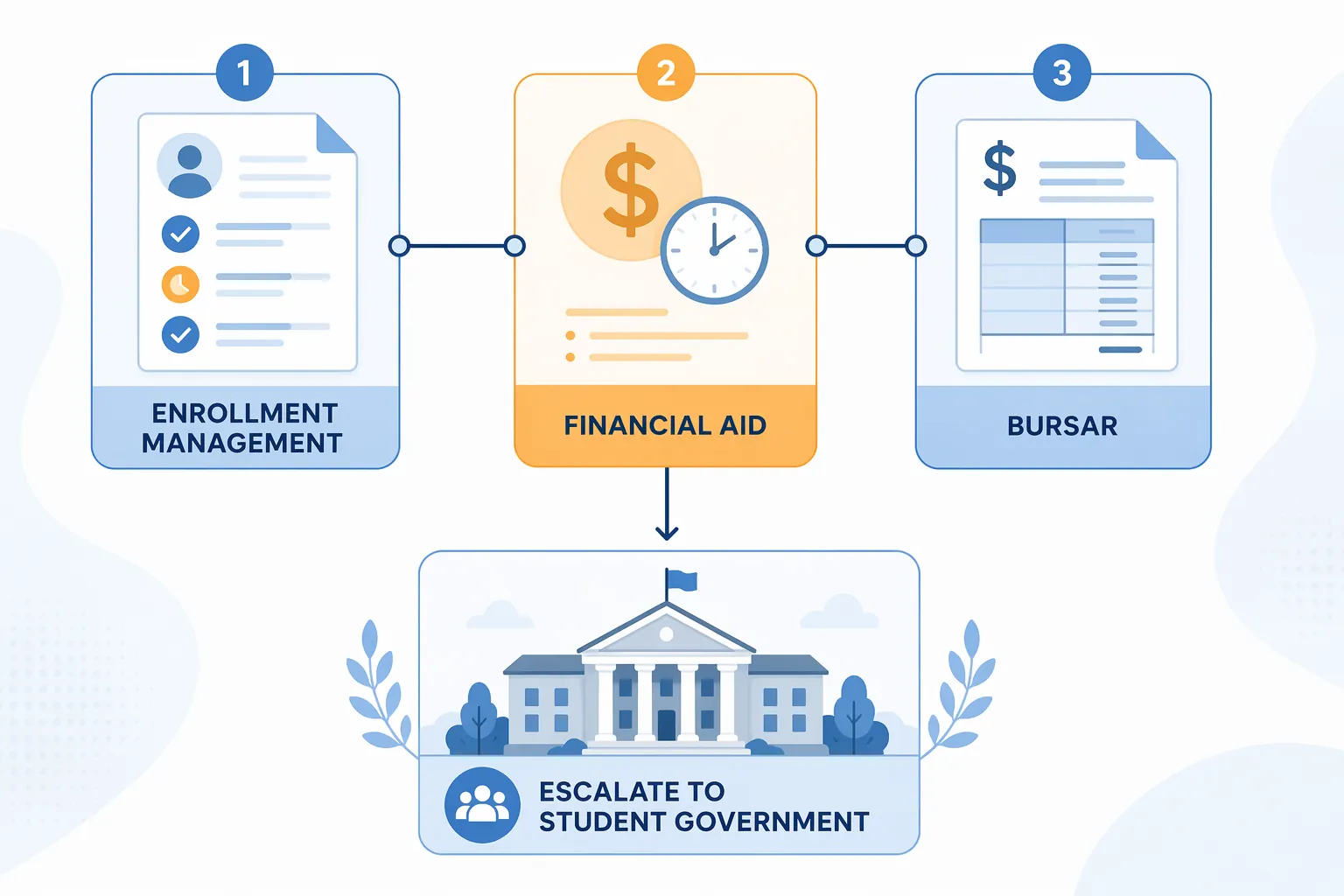
| Office | What that office can answer | What to attach |
|---|---|---|
| Enrollment Management | Whether you are currently enrolled, unenrolled, eligible for reinstatement, or missing an enrollment-confirmation requirement | Unenrollment notice, class schedule, deposit receipt, admission or enrollment checklist screenshots |
| Financial Aid | Whether aid was filed, awarded, accepted, pending, delayed, incomplete, or unable to disburse | FAFSA confirmation, award letter, accepted aid screenshots, scholarship letters, loan records |
| Bursar | Whether the balance is accurate, whether anticipated aid was counted, whether a payment deadline was applied, and whether a hold triggered unenrollment | Billing statement, account balance screenshots, payment receipts, payment-plan records, deadline screenshots |
Email 1: Enrollment Management
For Howard, the address Howard identified was [email protected].[1] Put the key facts in the subject line so the message can be triaged quickly: “Urgent reinstatement review requested — incoming freshman — unenrollment notice received July 22.”
The body should ask for a written review of your enrollment status, the deadline applied to your account, and the exact missing requirement if any. Attach the unenrollment notice, deposit receipt, admission confirmation, class schedule if you had one, and any screenshot showing the deadline you relied on.
Email 2: Financial Aid
For Howard, the address Howard identified was [email protected].[1] This email should not be a general complaint about affordability. It should ask whether your FAFSA, institutional aid, scholarships, federal loans, private loans, outside scholarships, or military benefits were received, accepted, pending, incomplete, or awaiting disbursement.
If your aid exceeded your charges, say that plainly and attach proof. Howard’s own financial services page says no out-of-pocket payment is due when anticipated aid exceeds total charges, so a student in that position should ask Financial Aid to confirm in writing whether anticipated aid should have cleared the balance or prevented the unenrollment trigger.[3]
Email 3: Bursar
For Howard, the address Howard identified was [email protected].[1] This email should ask for an itemized explanation of the balance, the payment or confirmation deadline applied, whether anticipated aid was included, and whether the account can be manually reviewed while Financial Aid verifies pending funds.
If someone told you a partial payment was required, write it carefully. Some Howard students reportedly described being asked to pay a portion of a balance by July 10, but the available materials do not confirm a universal official 50% policy. Treat that as an account-specific claim unless the university gives you written policy language.
A short appeal template you can adapt
Use your own facts, but keep the structure tight. Offices under pressure need dates, documents, and a specific request more than a long autobiography.
Subject: Urgent reinstatement review requested — incoming freshman — [Student ID]

Hello,

I am an incoming first-year student requesting immediate review of my unenrollment notice and account status.

Student name: [Full name]
Student ID: [ID]
Program/term: [Fall 2026, program if known]
Notice received: [Date and time]

I believed my enrollment and financial arrangements were complete because [briefly state: FAFSA submitted, aid accepted, deposit paid, scholarship pending, payment plan set up, etc.]. My records show [briefly describe aid/payment status].

Please confirm in writing:
1. Which deadline was applied to my account;
2. Where that deadline was published or sent to me;
3. Which requirement is still considered incomplete;
4. Whether my enrollment/classes can be restored while my aid and balance are reviewed;
5. Whether any additional document or payment is required today.

Attached are my relevant records: [list attachments].

Because this affects my ability to attend classes and keep my schedule, I am requesting expedited review and a written response.

Thank you,
[Name]
[Phone]
[Email]
Send separate versions to each office, changing the questions to fit that office’s job. Copy yourself. If you have a parent, counselor, mentor, or advocate helping, copy them only if you are comfortable and if your school’s privacy rules allow the office to discuss details with them.
Proof that action can matter, without pretending everyone is already safe
WJLA/7News reported that Isabella Williams, one of the affected Howard freshmen, had her classes restored after directly contacting the university.[4] That matters because it shows the status was not necessarily permanent for every student who received a notice. It does not prove how many students have been restored, how quickly all cases will be reviewed, or whether every account has the same facts.
Escalate through student government when responses stall
Student government is not just a symbolic channel when many students are caught in the same administrative bottleneck. In the Howard case, the Howard University Student Association created a reconsideration intake form and urged affected students to copy [email protected] while it pushed the administration for a clearer process, according to Kin+ and Fox5 DC reporting.[2][5]
Use that kind of escalation when you have already contacted the offices or when the timeline is too tight to wait quietly. The goal is not to make the email louder. The goal is to make the unresolved case visible to people who can aggregate patterns: multiple students seeing the wrong deadline, scholarship funds scheduled after the cutoff, deposits accepted before unenrollment, or portal balances that do not reflect accepted aid.
- At Howard, check HUSA’s current instructions before submitting anything, because the intake process may change.
- At another college, look for student government, a student ombuds office, dean of students, first-year experience office, or emergency financial aid office.
- Forward the original email chain instead of starting from scratch, so the escalation record shows when you first asked for help.
- Keep your attachments organized and labeled, because advocates cannot move quickly if they have to reconstruct your timeline from scattered screenshots.
Keep checking for reinstatement, classes, housing, and aid
Reinstatement is not one switch. A student may need enrollment status restored, classes re-added, housing preserved, aid repackaged, a hold removed, or a balance corrected. After any office says your case is fixed, check the portal yourself and screenshot the corrected page.
- Check whether your student status says enrolled, active, registered, or another official term your school uses.
- Check whether your class schedule is still intact or whether you need an adviser or registrar to restore dropped courses.
- Check housing, meal plan, orientation, and move-in status if those depend on enrollment clearance.
- Check whether aid appears as pending, anticipated, disbursed, or missing.
- Reply to the same email thread with a short confirmation request if any piece is still wrong.
If a school tells you the status is restored by phone, send a same-day email: “Thank you for speaking with me today. I understand that my enrollment will be restored and my classes reviewed for reinstatement. Please confirm if I misunderstood anything.” That message is not rude. It is how you keep the fix from disappearing into a call log you cannot see.
Why this hits first-generation and low-income students harder
A deadline mismatch is not equally easy for every family to absorb. Some students can put thousands of dollars on a card while offices sort out aid. Others cannot float a balance that the school may later decide was covered. NBC Washington reported that Howard required an $800 nonrefundable enrollment deposit from incoming students, and students interviewed after the July 2026 notices described the stress of losing a seat shortly before the semester.[6]
Fox5 DC reported student concerns about account screenshots and scholarship timing, including an August 1 scholarship disbursement date that collided with the earlier deadline students said was used in their cases.[5] That is the kind of timing problem that makes a student look unpaid on one date even when the funding path exists on another.
StudyMethod usually meets students earlier in the process, when they are using an SAT prep guide or comparing access barriers in test prep. But the same access problem follows students after admission: the student who earned the score still has to survive portals, aid calendars, billing holds, and offices that may not be using the same timeline. That is also why broader changes to support systems, including the kinds of issues discussed in How DEI Funding Cuts Are Changing Test Prep Access, matter beyond test day.
System problems still require a dated appeal record
Howard’s 2026 unenrollment notices did not appear out of nowhere. NBC News reported in 2025 that Howard students had already complained about unexpected tuition bills, and the July 2026 case raised new concerns about how billing, aid, and enrollment systems communicate with students.[7] That context matters, but it does not help an incoming freshman who needs a schedule restored before move-in unless it turns into a dated appeal record.
So keep the argument practical. If the university had multiple deadlines, ask which one controlled your account. If aid was pending, ask Financial Aid to verify it in writing. If the balance was wrong, ask the Bursar for an itemized review. If your status changed, ask Enrollment Management what condition must be satisfied for reinstatement. If nobody answers, escalate with the whole chain attached.
As of July 25, 2026, the safest Howard appeal path
As of July 25, 2026, Howard had not published one single unified appeal form in the available public materials reviewed for this guide. The best available path is the written three-office route Howard named, supported by documentation and escalated through HUSA when responses stall.[1][2]
- Email Enrollment Management at [email protected] for enrollment status and reinstatement review.
- Email Financial Aid at [email protected] for FAFSA, award, scholarship, loan, and pending-aid review.
- Email the Bursar at [email protected] for balance, billing-deadline, anticipated-aid, and payment-dispute review.
- Attach screenshots and receipts rather than describing documents you can prove.
- Use HUSA’s current reconsideration instructions or your campus’s equivalent escalation channel if replies stall.
- Check the portal after any promised fix and ask for written confirmation that enrollment, classes, housing, and aid are restored.
Howard-specific instructions may change quickly. The portable lesson does not: when aid timing and billing deadlines collide, your strongest defense is a fast, documented, multi-office appeal that forces the school to review the actual account instead of treating the portal label as the whole truth.
References
- Howard University unenrolls 502 students because of payment issues — AP News
- BREAKING: Howard CONFIRMS 502 Incoming Students Received Enrollment Notices — Kin+
- Howard Financial Services — Parents and Families page — Howard Financial Services
- Hundreds of Howard University freshman unenrolled weeks before Fall semester — WJLA/7News
- Howard University freshmen say they were mistakenly unenrolled over unpaid bills — Fox5 DC
- Howard University students unenrolled before fall semester — NBC Washington
- Howard University faces student complaints about unexpected tuition bills — NBC News, 2025
Related exhibits & inventory
Verified outcomes
No verified outcomes on file for this exam yet
See Methodology for how outcome evidence is disclosed once logged.
Planners
No planner filed for this exam yet
A downloadable timeline template for this exam hasn't been published yet.
Tool verdicts
AI-tool cautions
No AI tools tested for this exam yet
No hands-on AI-accuracy logs have been filed for this exam.
Questions about this plan
Ask a question about a specific section, timeline, or citation in this plan — or flag something that needs correcting.
Comments
Join the discussion with an anonymous comment.