
SAT Exam Hub
What a New Study Reveals About Homelessness Legal Policies
Analyzing a nationwide quasi-experimental study, this article examines whether anti-homelessness criminalization laws reduce homelessness at the community level — and finds no evidence they do.
- SAT
- ACT
- GRE
- MCAT
- ASVAB
- digital-sat
- adaptive-testing
- registration-fee
- content-outline
- score-target
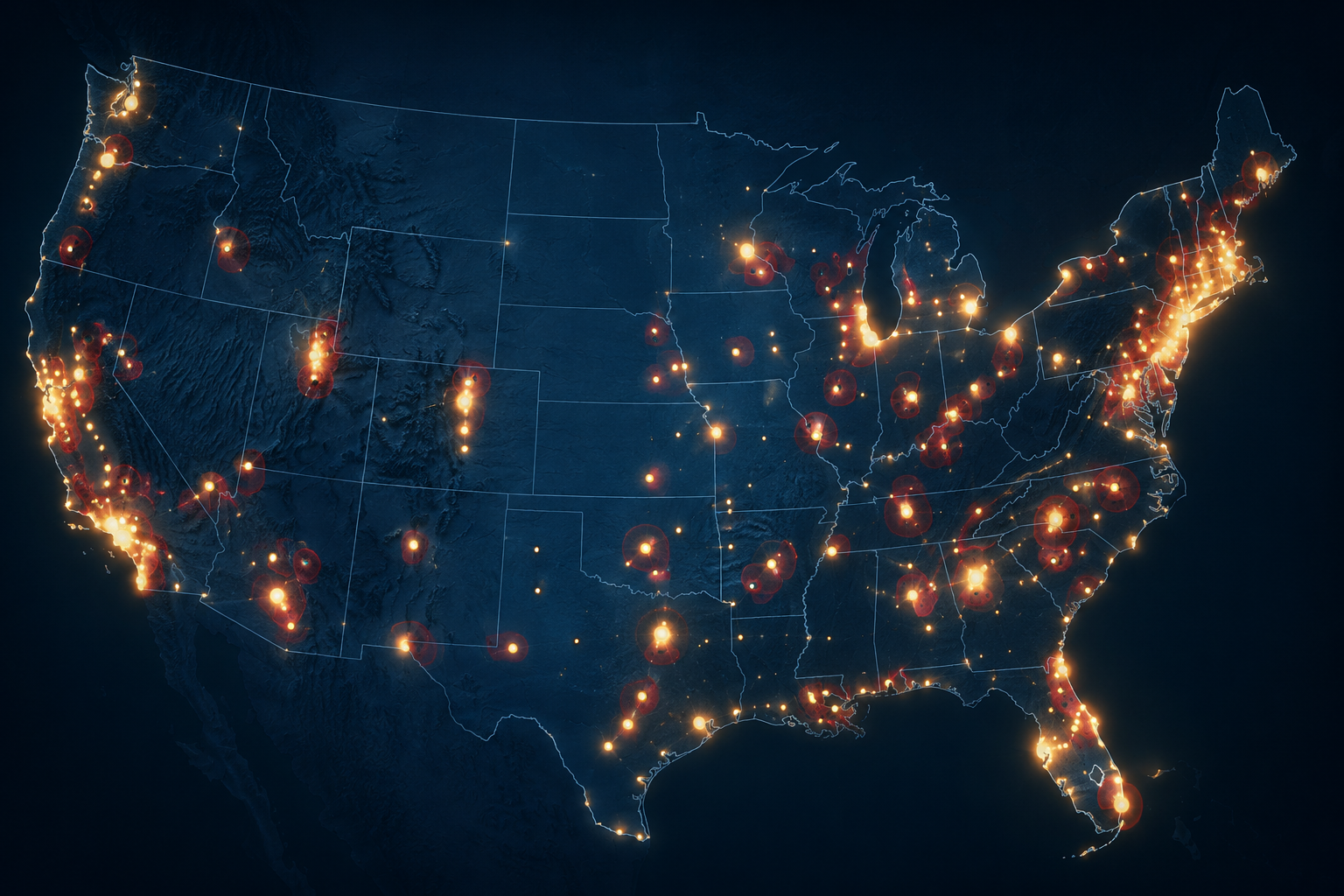
The cleanest answer from the current homelessness legal policy literature is also the least convenient one for officials who sell punishment as deterrence: the first nationwide quasi-experimental test finds no evidence that anti-homelessness criminalization reduces homelessness at the community level. Lebovits and Sullivan studied ordinances in the 100 largest U.S. cities from 2000 to 2021 and do not find a statistically significant decline in homelessness after cities adopt laws such as camping bans, panhandling restrictions, or sit-lie ordinances.[1]
That matters because the policy claim being tested is causal. The usual argument is not merely that public camping, panhandling, or sleeping outside should be illegal. It is that making these acts punishable will change behavior: people will enter shelter, accept services, move elsewhere, or otherwise disappear from public homelessness counts. A study that cannot separate that claim from local politics, housing markets, shelter availability, weather, policing habits, and broader economic change is not much help. This one tries to do that separation directly.
What the study actually tests
Lebovits and Sullivan use a difference-in-differences design, a common quasi-experimental method for policy questions where randomized trials are not available. In plain terms, the design compares changes in homelessness in cities that adopted criminalization ordinances with changes in otherwise comparable cities that did not adopt them at the same time. The point is not to ask whether cities with bans have more or less homelessness in a simple snapshot. It is to ask whether homelessness changes differently after a city enacts a ban than it would have been expected to change without that ordinance.[1]
That distinction is where a lot of casual policy debate falls apart. A city may pass a camping ban because visible homelessness is already rising. Another city may avoid one because it has more shelter capacity, stronger tenant protections, different police priorities, or less pressure from business districts. If a reader only compares those cities after the fact, the ordinance can look powerful or harmless for reasons that have little to do with the law itself. The value of the Lebovits and Sullivan design is that it treats timing as central: what changes after adoption, relative to cities not experiencing the same legal change?
The study covers ordinances enacted between 2000 and 2021 across the 100 largest U.S. cities, which gives it a much wider scope than a single-city case study or a short news-cycle comparison. It examines whether criminalization affects local homelessness counts and whether it pushes homelessness into neighboring jurisdictions. The second question is important because deterrence can be disguised as displacement. If a city’s count falls only because people are forced across a boundary, the policy has not reduced homelessness; it has exported visibility.
The result is a null finding, not a hidden success
The headline result is not that criminalization produces a large measurable harm in the homelessness count. It is narrower and, for the deterrence argument, more damaging: the study finds no statistically significant reduction in homelessness. The point estimate for unsheltered homelessness is a 2.2% increase, but that estimate is not statistically significant. In other words, the study does not support the claim that these ordinances reduce unsheltered homelessness, and it also does not justify treating the estimated increase as a precise proven effect.[1]
That is the correct reading of a null result. It is not a license to say the laws always increase homelessness. It is also not a license to say the laws might work because the study did not prove every possible version of failure. The causal claim on offer from criminalization supporters is that punishment reduces homelessness at the community level. The best nationwide quasi-experimental evidence currently available does not find that effect.[1]
The displacement finding further weakens a common fallback defense. If a city adopts a punitive ordinance and then simply pushes people into nearby jurisdictions, local officials might claim success while the regional problem remains unchanged. Lebovits and Sullivan report no evidence of displacement to neighboring jurisdictions. That does not mean no individual ever leaves after enforcement. It means the study does not find a community-level displacement pattern large enough to support the idea that these ordinances move homelessness out of the adopting city in a detectable way.[1]
| Question | What the study supports |
|---|---|
| Do criminalization ordinances reduce homelessness at the community level? | No statistically significant reduction is found. |
| What happens to the unsheltered homelessness estimate? | The point estimate is a 2.2% increase, but it is not statistically significant. |
| Do the laws appear to push homelessness into neighboring jurisdictions? | The study finds no evidence of displacement to neighboring jurisdictions. |
| What period can this causal claim cover? | The study examines ordinances enacted from 2000 to 2021 in the 100 largest U.S. cities. |
For students or analysts reading this as a social-science passage, the useful move is to keep the inference in its lane. The study tests whether adoption of criminalization ordinances changes homelessness outcomes at the community level. It does not measure every possible individual consequence of every police encounter. It does not settle every moral or constitutional argument about public space. It does something more specific: it tests the deterrence premise behind a major category of homelessness legal policies and finds no supporting effect.
Why the laws keep spreading anyway
The evidence has not stopped the politics. After the Supreme Court’s June 2024 Grants Pass decision, advocacy tracking by the ACLU reported more than 350 cities and more than 260 laws in the first year after the decision. That figure shows momentum, not effectiveness. It tells us that cities are adopting punitive rules at scale; it does not show that those rules reduce homelessness.[2]
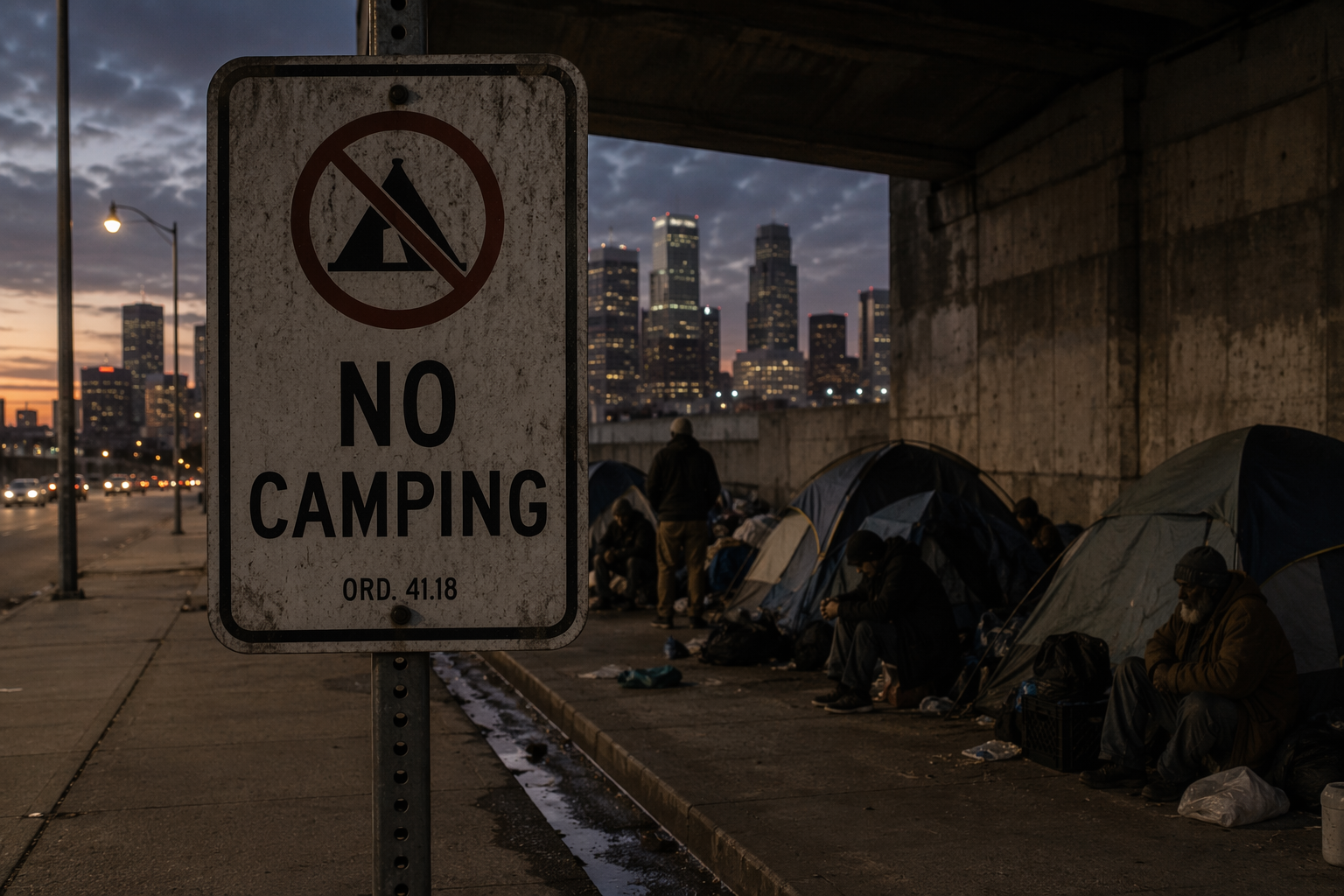
The spread is easier to understand when homelessness policy is treated as a governing problem rather than a pure evidence problem. Shelterforce’s coverage of the study notes survey findings in which 78% of mayors say police influence homelessness policy and 81% feel they lack control over the issue.[3] Those numbers describe a political environment where enforcement can become the tool that is most available, most visible, and most easily defended, even when the causal evidence for reducing homelessness is weak.
That does not require assuming every local official is acting in bad faith. A mayor facing encampment complaints may have limited shelter capacity, slow housing pipelines, court constraints, angry constituents, and a police department already pulled into homelessness response. Under those conditions, an ordinance can function as a display of control. It gives government something to announce, something to enforce, and something to point to when residents demand action. The problem is that visible action and effective action are not the same measurement.
This is where “common sense” often does too much work. It may sound intuitive that if sleeping outside becomes risky enough, fewer people will sleep outside. But deterrence depends on available alternatives. If shelter is full, inaccessible, unsafe for a particular person, incompatible with work schedules, restrictive for couples or pets, or disconnected from treatment needs, punishment does not create housing. It creates pressure on people who may have nowhere lawful and stable to go.
The harm evidence answers a different question
Evidence about the harms of enforcement should not be used as a substitute for causal evidence about community-level homelessness counts. The two questions are different. A sweep can be destructive even if it does not change the number of people counted as homeless. A policy can fail to reduce homelessness even if some individual enforcement encounters are brief. Keeping those questions separate is part of reading the evidence honestly.
Still, the harm evidence matters because it shows what the policy does while failing to produce the promised aggregate result. The National Alliance to End Homelessness describes punitive policies and encampment sweeps as causing concrete losses, including medication, identification documents, and other belongings, while also connecting enforcement with trauma and PTSD concerns.[4] Those are not atmospheric details. Medication is a treatment plan. An ID is access to benefits, employment paperwork, housing applications, and medical systems. Destroying or losing those items can lengthen the route out of homelessness.
This is the policy consequence that often disappears behind tidy words like “abatement” or “cleanup.” A person may spend the next day replacing documents instead of attending an appointment. A caseworker may have to restart a housing application because paperwork is gone. A clinician may lose continuity with a patient whose belongings and location were disrupted. None of that proves, by itself, that a citywide homelessness count will rise after an ordinance. It does show that the enforcement mechanism is not costless.
How to read the causal claim without overstating it
A careful reading of this evidence produces a firmer conclusion than a louder one. The Lebovits and Sullivan study supports a causal claim about the period and cities it examines: from 2000 to 2021, across the 100 largest U.S. cities, criminalization ordinances do not show a statistically significant reduction in homelessness, and the study finds no evidence of displacement to neighboring jurisdictions.[1]
The post-Grants Pass period is different. The 2024–2026 crackdown is being tracked through advocacy and news sources, not through the same nationwide difference-in-differences design. The ACLU’s tracking can show a wave of new laws after Grants Pass.[2] It cannot, on its own, estimate the causal effect of those new laws on homelessness counts with the same force as the Lebovits and Sullivan study. Treating those two kinds of evidence as interchangeable would make the conclusion look stronger while actually making it less trustworthy.
The same caution applies to model-bill influence and advocacy tracking around state and local legislation. Those sources can identify patterns, proposals, and political campaigns. They may also frame the stakes in explicitly oppositional terms. That does not make them useless. It means they should be used for what they can document: policy movement, legal language, and organizing context, not independent causal estimates of effectiveness.
For a related evidence-first policy reading, see What the Evidence Says About Aging Homeless Prevention Funding. The useful habit is the same: separate what a policy is intended to do from what the available evidence can actually show.
The deterrence theory is the weak link
The central failure is not that criminalization laws are controversial. Many policies are controversial and still effective. The failure is that the deterrence logic has now been tested at national scale with a quasi-experimental design, and the expected reduction does not appear. If punishment were reliably pushing people into shelter, housing, or stable alternatives, the community-level data should show a decline after adoption. Lebovits and Sullivan do not find one.[1]
That leaves a blunt policy picture. Anti-homelessness ordinances remain politically durable because they offer visible action under pressure. They satisfy demands to “do something” when homelessness is public, concentrated, and difficult for local governments to solve quickly. But the best nationwide causal evidence available for 2000–2021 contradicts the claim that these laws reduce homelessness at the community level. The newer post-2024 wave may be large, but its effectiveness has not been established by the same kind of study.
That boundary is not a hedge. It is the reason the conclusion is worth taking seriously. The causal evidence says criminalization did not reduce homelessness in the period tested. The descriptive evidence says cities have continued to expand these laws after Grants Pass. The harm evidence shows that enforcement can damage the practical tools people need to stabilize their lives. Put together, the record does not support treating punishment as an empirically effective homelessness policy.
References
- Do Criminalization Policies Impact Local Homelessness? — Lebovits & Sullivan, Policy Studies Journal, 2026.
- Two Years Since Grants Pass: Tracking the Criminalization of Homelessness — ACLU.
- Criminalizing Homelessness Doesn't Work, Study Finds — Shelterforce.
- Punitive Policies Will Never Solve Homelessness: The Evidence is Clear — National Alliance to End Homelessness.
Related exhibits & inventory
Verified outcomes
No verified outcomes on file for this exam yet
See Methodology for how outcome evidence is disclosed once logged.
Planners
No planner filed for this exam yet
A downloadable timeline template for this exam hasn't been published yet.
Tool verdicts
AI-tool cautions
No AI tools tested for this exam yet
No hands-on AI-accuracy logs have been filed for this exam.
Questions about this plan
Ask a question about a specific section, timeline, or citation in this plan — or flag something that needs correcting.
Comments
Join the discussion with an anonymous comment.