
GRE Exam Hub
GRE Reading Comprehension: Defamation Law Case Study
Using defamation case studies like New York Times v. Sullivan, this walkthrough shows GRE test-takers how to extract argument structure, track rule application, and distinguish holding from dicta in law-themed Reading Comprehension passages — no legal background required.
- SAT
- ACT
- GRE
- MCAT
- ASVAB
- digital-sat
- adaptive-testing
- registration-fee
- content-outline
- score-target
A defamation law case study can look, at first glance, like the GRE has smuggled a law-school exam into Reading Comprehension. The passage names a famous case, mentions public officials, introduces “actual malice,” and suddenly a perfectly capable reader feels late to a class they never enrolled in.
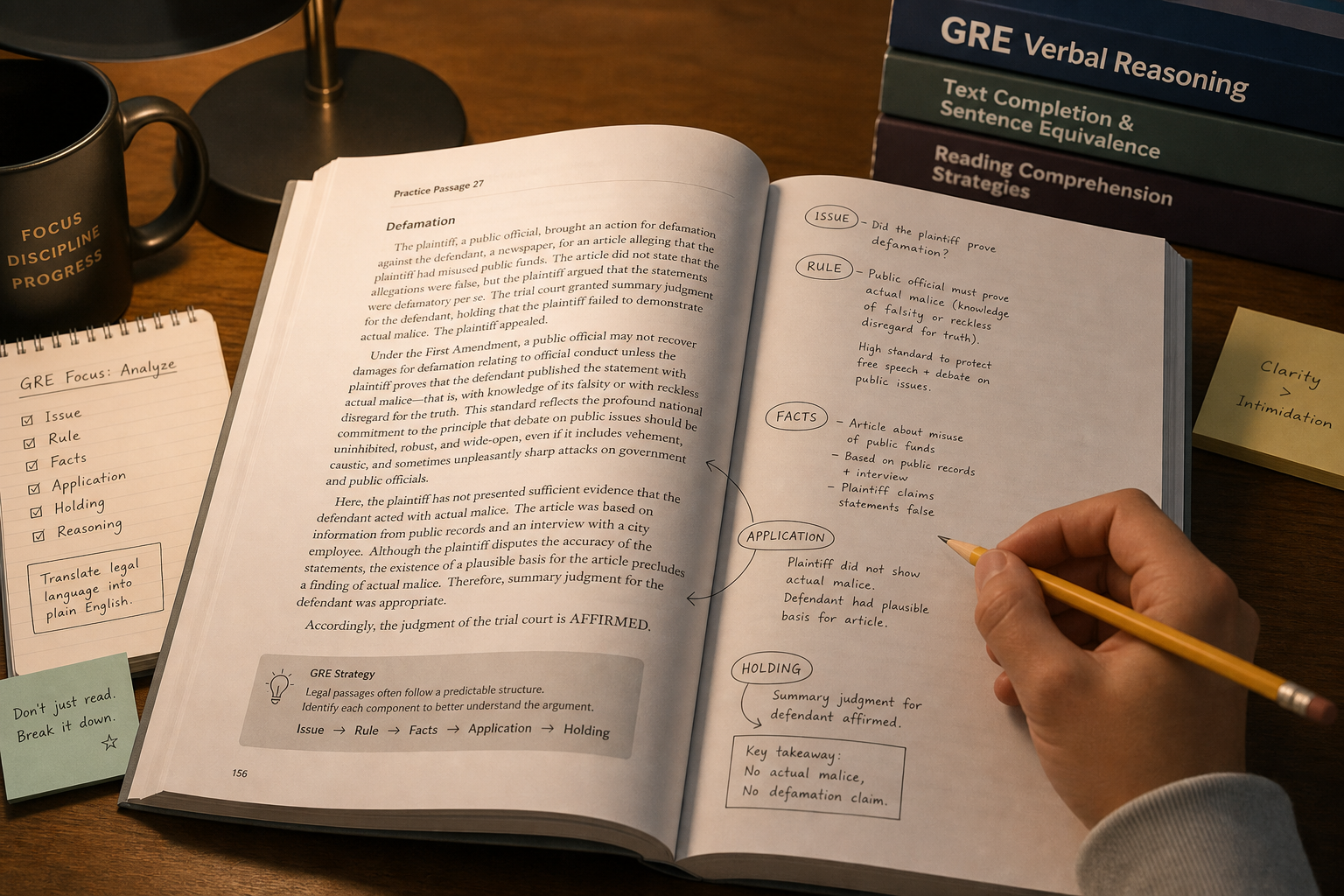
That feeling is understandable. It is also unnecessary. For GRE purposes, you do not need to become a defamation expert. You need to notice what the passage is doing with a rule: where it states the rule, which facts matter under that rule, how the court applies the rule, and where the court says something broader than it strictly has to decide.
Two scope notes matter before we start. First, this article is about U.S. defamation law, not the law of defamation in the United Kingdom or elsewhere. Second, ETS does not publish an official percentage of GRE Reading Comprehension passages that are law-themed. Law passages are familiar to many tutors and test-takers, but any precise frequency claim would be fake confidence.
The Small Rule Kit You Need Before Reading
A GRE passage about defamation will usually give you the rules it needs. Still, a few terms are worth having ready, because they keep the legal language from feeling like a locked door.
In the basic U.S. framework, defamation generally involves a false statement about another person, publication or communication of that statement to someone else, fault by the speaker, and harm or damages to the person’s reputation.[1] LawTeacher’s student-facing treatment uses the same core distinction between defamatory statements and the separate labels of libel and slander, with libel usually referring to written or otherwise fixed statements and slander to spoken statements.[2]
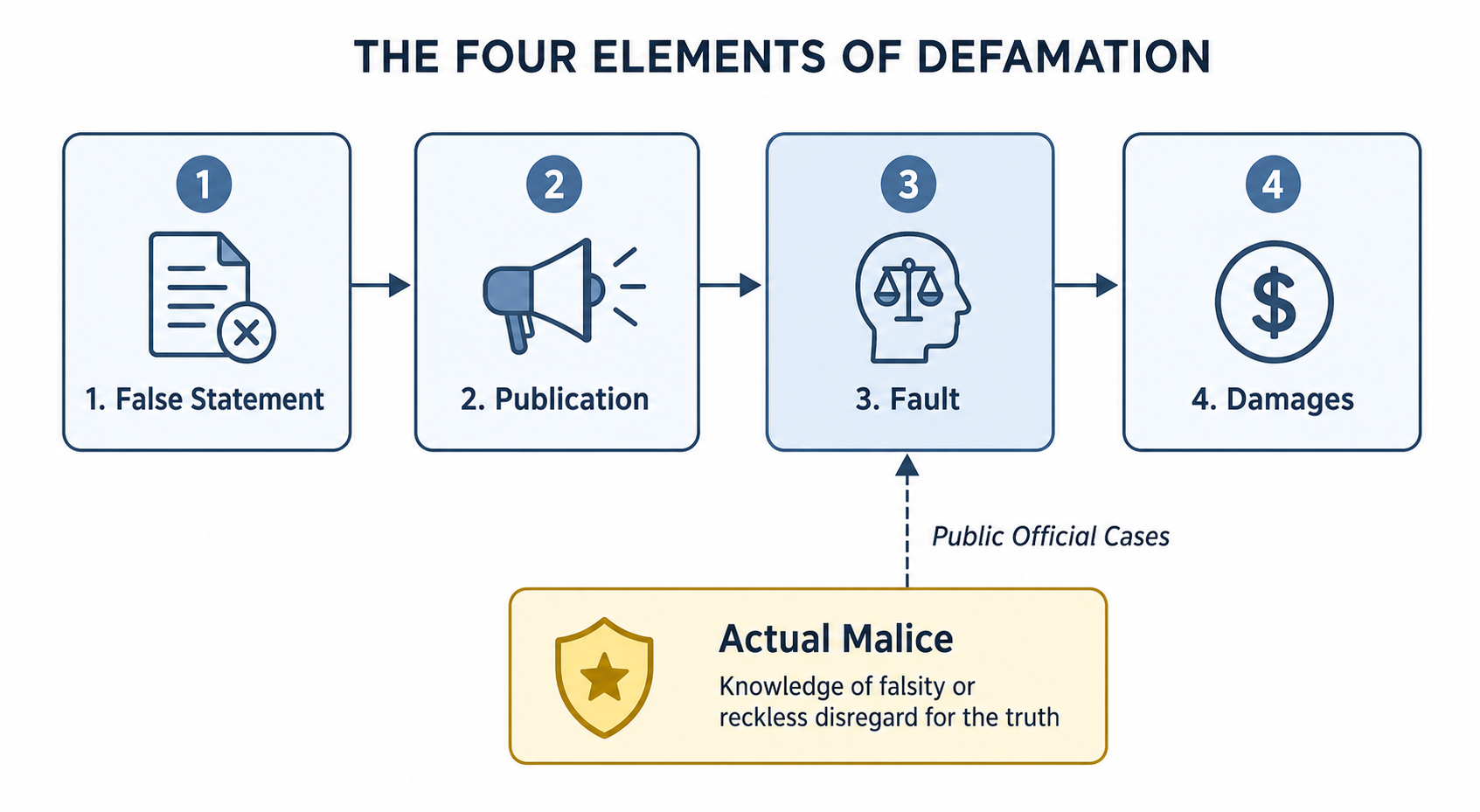
For GRE Reading Comprehension, the important word in that list is often “fault.” Fault is where the law starts to sort different speakers, plaintiffs, and contexts. A private person suing over an ordinary defamatory statement is not in the same posture as a public official suing a newspaper over criticism of official conduct. That difference is exactly why New York Times Co. v. Sullivan is such a useful reading passage.
| Term | GRE reading use |
|---|---|
| False statement | Ask whether the passage treats the challenged statement as factually assertive, not merely harsh or insulting. |
| Publication | Look for who communicated the statement and who received it. |
| Fault | Watch for the standard the plaintiff must prove, especially negligence or actual malice. |
| Damages | Notice whether the passage requires reputational harm or treats harm as presumed in a specific context. |
| Actual malice | Do not read it as ordinary spite. In Sullivan, it means knowledge of falsity or reckless disregard for whether the statement was false. |
Sullivan as a GRE Passage, Not a Case Brief
The facts of New York Times Co. v. Sullivan are compact enough for a GRE-style passage. In 1960, the New York Times published a full-page advertisement titled “Heed Their Rising Voices,” which criticized officials in Montgomery, Alabama, over their treatment of civil-rights protesters. L. B. Sullivan, a Montgomery city commissioner, sued for libel even though the advertisement did not name him. An Alabama jury awarded him $500,000, and the case reached the Supreme Court.[3]
A law student might brief the procedural history, parties, issue, rule, and disposition. A GRE reader has a narrower job. The first task is to find the pressure point: the old libel rule gave too much room for public officials to punish criticism of official conduct. The Court’s move was to add a constitutional constraint.
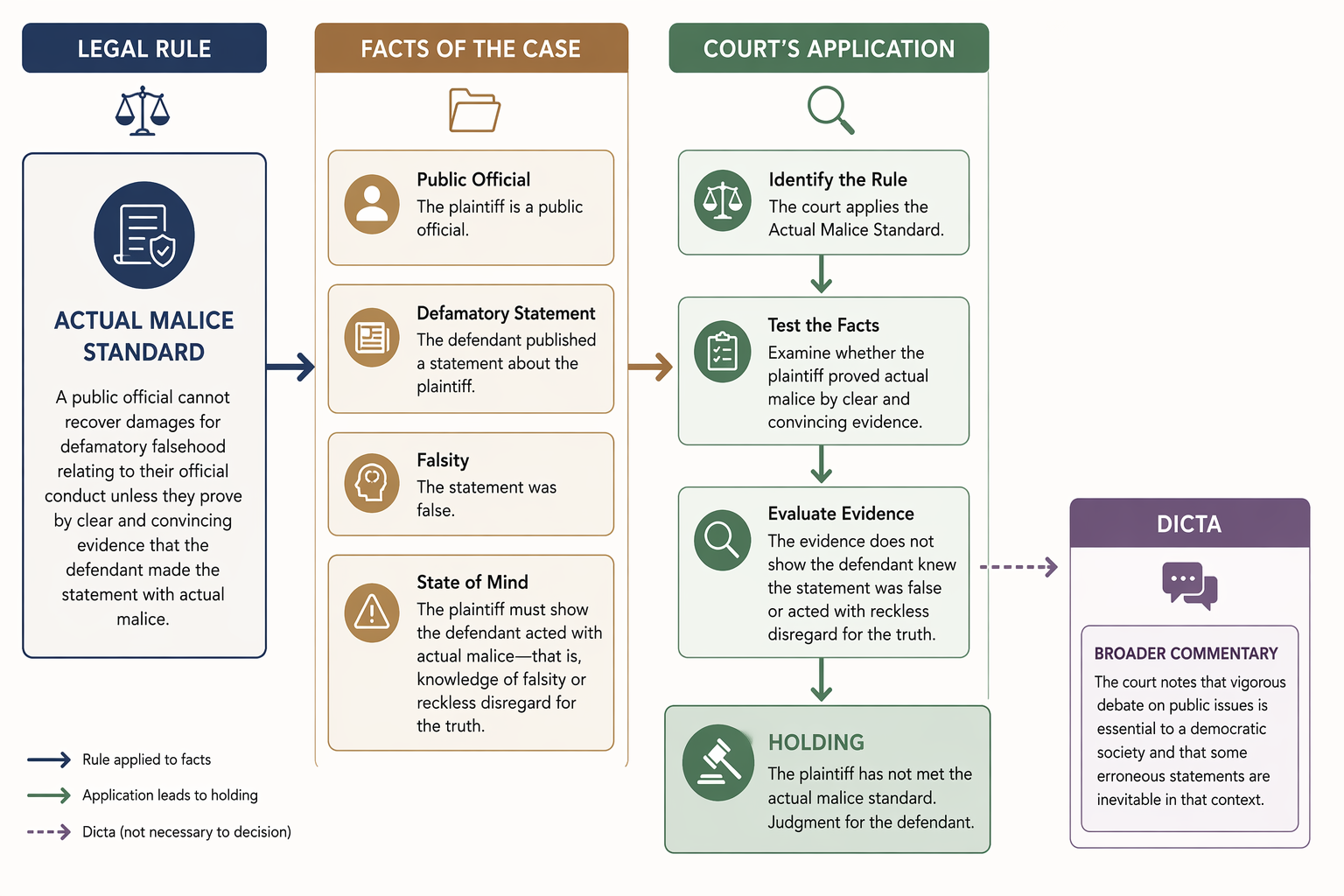
Here is the rule you would want to underline if it appeared in a passage: a public official cannot recover damages for a defamatory falsehood relating to official conduct unless the official proves the statement was made with “actual malice,” meaning knowledge that it was false or reckless disregard of whether it was false.[3]
Pause over that phrase. In ordinary speech, “malice” sounds like hatred. On the GRE, ordinary connotation can be a trap. In this legal setting, actual malice is not mainly about whether the newspaper disliked Sullivan. It is about the speaker’s relationship to truth: Did the speaker know the statement was false, or act with reckless disregard about falsity?
Mark the Rule Before You Chase the Facts
In a dense legal passage, facts arrive in clusters. Some are colorful; some are legally decisive. The rule tells you which ones deserve attention.
In Sullivan, several facts might tempt a reader: the advertisement was about civil-rights protests, the plaintiff was a city commissioner, the advertisement contained inaccuracies, and the state jury awarded substantial damages. The actual-malice rule sorts those facts. The relevant question becomes not merely “Were there errors?” but “Do those errors show knowledge of falsity or reckless disregard for truth?”
That is the moment many GRE questions live in. A passage may spend several sentences on factual detail, then ask which fact most directly supports the author’s conclusion. The answer is rarely the most dramatic fact. It is the fact that activates the rule.
Track the Court’s Application
Once the rule is visible, the next question is application. The Supreme Court did not say, in effect, “This advertisement had some mistakes, so Sullivan wins.” It moved the other way: even false statements about public officials may be protected unless the plaintiff satisfies the demanding actual-malice standard. Oyez summarizes the holding as requiring public officials who sue for libel to prove that the statement was made with knowledge of falsity or reckless disregard for the truth.[3]
That structure matters more than the case name. If an RC passage gives you a court opinion, you can often annotate the middle like this:
- Old rule or problem: state libel law allowed a public official to recover for criticism of official conduct without the constitutional safeguard the Court thought necessary.
- New rule: the public official must prove actual malice.
- Key factual application: inaccuracies alone do not establish actual malice.
- Result: Sullivan could not recover under the constitutional standard.
Notice how little doctrine you had to memorize. The passage supplies the conflict; the reader’s job is to keep the conflict organized.
Separate Holding from Broader Language
Legal passages often include soaring language. Sullivan is famous partly because of its First Amendment language about debate on public issues. Freedom Forum describes it as one of the most important defamation cases and emphasizes its protection for criticism of public officials.[4] That context helps, but GRE questions may punish a reader who treats every broad sentence as the exact rule of the case.
The holding is narrower than “newspapers can say anything about officials.” The holding concerns when a public official may recover damages for a defamatory falsehood about official conduct. The broader commentary about uninhibited public debate explains the Court’s reason for adopting the rule, but it is not a free-floating permission slip for all false statements in all contexts.
That distinction is a gift on GRE inference questions. If an answer choice says the Court believed all false political statements deserve absolute protection, it is too broad. If an answer choice says the Court made recovery harder for public officials by requiring proof of knowledge of falsity or reckless disregard, it is much closer to the passage’s center.
How This Becomes GRE Reading Work
GRE Reading Comprehension questions tend to ask about main point, inference, function, author attitude, and the role of specific details. Menlo Coaching’s sample GRE RC materials illustrate the familiar pattern: a passage is followed by questions that require close attention to what is stated, implied, or structurally important, rather than outside knowledge.[5]
A law-themed passage is not an exception to that pattern. It simply hides ordinary reading tasks under legal nouns.
| If the GRE asks... | In a defamation passage, look for... |
|---|---|
| Main point | The rule change or legal conclusion the passage is built around. |
| Function of a sentence | Whether the sentence states the rule, gives facts, applies the rule, states an exception, or adds policy reasoning. |
| Inference | What must follow from the rule as applied, without adding doctrine from outside the passage. |
| Author attitude | Whether the passage treats the court’s rule as protective, restrictive, controversial, clarifying, or limited. |
| Detail question | The specific fact that matters under the legal standard, not merely the most memorable detail. |
Suppose a GRE-style question asks why the passage mentions the advertisement’s factual errors. The answer is not “to prove the newspaper committed defamation” if the passage is following Sullivan. The errors matter because they create the problem the Court must analyze: whether falsity, by itself, is enough for a public official to recover. Under the new standard, it is not.
Suppose another question asks what can be inferred about a public official who proves only that a statement was false. The careful answer is that falsity alone would not satisfy the Sullivan standard. The tempting but wrong answer would add something absolute, such as “the official can never recover.” The passage’s rule leaves room for recovery when actual malice is proved.
This is why legal prose can be fairer than it first appears. The vocabulary is stiff, but the reasoning is usually explicit. Courts have to show their work, and that makes the passage easier to map.
A Short Transfer Example: Hustler and the Opinion Problem
After Sullivan, a shorter contrast helps. In Hustler Magazine v. Falwell, the Supreme Court considered a parody advertisement involving the public figure Jerry Falwell. The Court held that public figures and public officials cannot recover for intentional infliction of emotional distress based on such speech without showing a false statement of fact made with actual malice.[4]
For GRE purposes, the useful contrast is not the scandalous content of the parody. It is the distinction between a factual assertion and protected expression. A statement that readers would reasonably understand as asserting a fact can be treated differently from a parody, opinion, or rhetorical exaggeration. The RC task is to ask what kind of statement the passage says is legally actionable.
A function question might ask why the author introduces Hustler after Sullivan. A good answer would say that the second case extends the discussion from public-official libel to another boundary: when offensive expression does or does not count as the sort of factual claim that can support liability. A weaker answer would say that Hustler simply repeats Sullivan. It does not. It uses related First Amendment logic in a different posture.
That is a common GRE move. A second example may not be there to decorate the passage. It may narrow, qualify, contrast with, or transfer the first rule.
What Not to Do with Famous Defamation Cases
It is easy to turn defamation into a tour of famous media fights. That is usually bad GRE preparation. A passage may mention a famous case because the case supplies a clean rule. It is rarely asking you to remember the cultural drama around the lawsuit.
Modern examples can be useful only if they stay in their lane. Freedom Forum notes that Fox News agreed in 2023 to pay Dominion Voting Systems $787 million to settle a defamation lawsuit.[4] That number is memorable, but it does not teach the main GRE skill unless a passage uses the case to discuss evidence, fault, settlement posture, or the difference between allegation and adjudicated holding.
Smartmatic’s claims against Fox have also appeared in public discussion, but any article or practice passage mentioning that litigation needs a freshness check because the status could change. GRE readers should be especially cautious with current-litigation passages: a complaint, a settlement, a trial verdict, and a Supreme Court holding are not the same kind of legal event.
The Five Moves to Use on Any Law-Themed GRE Passage
When a legal passage starts to sound forbidding, stop trying to understand every doctrine-level implication. Read it as a rule-application argument.
- Name the legal problem. Ask what dispute the court, scholar, or passage author is trying to resolve.
- Box the rule. Look for words such as “requires,” “unless,” “only if,” “standard,” “exception,” and “burden.”
- Sort the facts by relevance. Keep the facts that matter under the rule; demote the facts that merely set the scene.
- Track the application. Notice whether the rule helps the plaintiff, the defendant, the government, the speaker, or the challenger.
- Limit the conclusion. Separate the holding from broad policy language, examples, and commentary.
If you want a deeper routine for judicial-opinion passages, the same habit pairs well with this appeals-court ruling method. For broader test-prep context, keep this skill inside your overall GRE exam preparation, not in a separate imaginary law-school folder.
The goal is not to walk away reciting defamation doctrine. The goal is to stop freezing when a passage sounds legal. Find the rule. Follow the facts into the rule. Watch the application. Keep the holding narrower than the rhetoric. Then answer the question the GRE actually asked.
References
- Defamation — Wex, Cornell LII
- Defamation, Libel, Slander — LawTeacher.net, April 2026
- New York Times Co. v. Sullivan — Oyez
- 8 Famous Defamation Cases You Should Know — Freedom Forum, August 2025
- Sample GRE RC Questions — Menlo Coaching
Related exhibits & inventory
Verified outcomes
Planners
No planner filed for this exam yet
A downloadable timeline template for this exam hasn't been published yet.
Tool verdicts
AI-tool cautions
No AI tools tested for this exam yet
No hands-on AI-accuracy logs have been filed for this exam.
Questions about this plan
Ask a question about a specific section, timeline, or citation in this plan — or flag something that needs correcting.
Comments
Join the discussion with an anonymous comment.