
SAT Exam Hub
Eton vs US Prep Schools: Which Experience Fits Your Son Better?
Compare the day-to-day student experience at Eton College against top US boarding schools like Phillips Exeter and Andover, focusing on academics, boarding life, test prep, and university placement outcomes for families targeting US college admissions.
- SAT
- ACT
- GRE
- MCAT
- ASVAB
- digital-sat
- adaptive-testing
- registration-fee
- content-outline
- score-target
The Eton vs. Exeter or Andover decision is usually framed too late, after the family has already been impressed by names. The better starting point is simpler: what does your son have to do on a Tuesday night at 16, who notices if he stops doing it well, and how cleanly does that school week connect to a US college application?
Eton is not a stronger or weaker version of an elite US prep school. It is a different operating system. For a boy who is academically directional, comfortable with independence, and likely to enjoy defending serious work with adults, that system can be unusually powerful. For a boy who still needs range, social scaffolding, or a more recognizably American path to college, Exeter or Andover may be the safer fit.
| Question | Eton College | Top US prep schools such as Exeter or Andover |
|---|---|---|
| Academic structure | A-Level specialization from 16, usually 3-4 subjects studied in depth; tutorials and weekly essay work are central. | Broader curriculum through age 18; Exeter is especially associated with Harkness-style round-table discussion. |
| Boarding model | Private room from age 13, 25 houses of about 50 boys, spread through the village of Eton rather than enclosed behind one campus wall. | More contained campus and dormitory clusters; younger students commonly share rooms. |
| SAT/ACT preparation | Private SAT test center, formal SAT/ACT prep classes billed through school, and US admissions staff embedded in the school. | US testing and college prep are more native to the environment, though specific services vary by school. |
| US university counseling | US Universities Adviser, Master-in-Charge of US applications, and an Annenberg Fellow support applicants; 27 boys received early US offers in 2026. | The entire counseling culture is built around US applications, but public placement data are not always directly comparable school to school. |
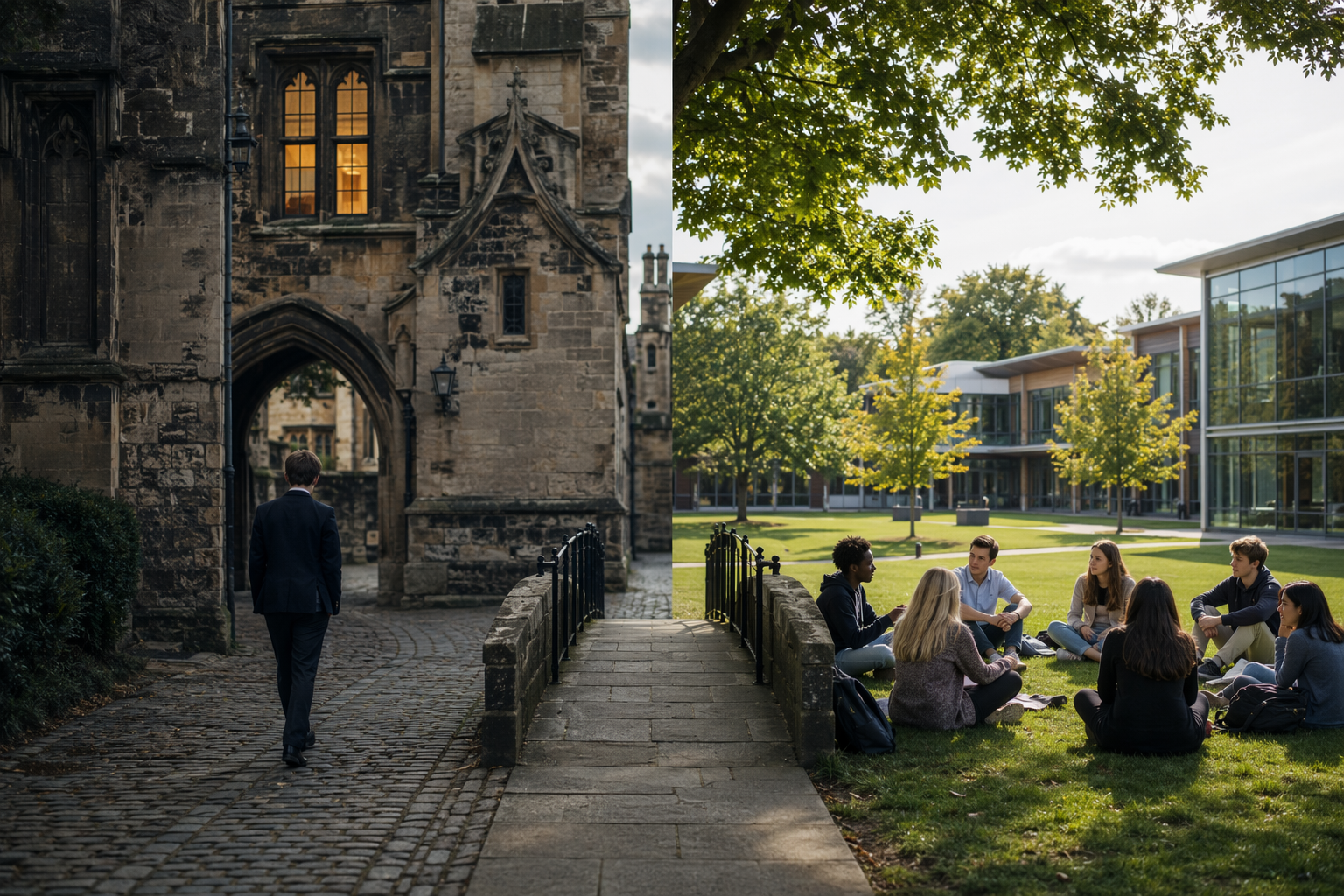
The academic trade-off starts at 16
The most important academic difference is not accent, architecture, or whether boys wear tails on formal occasions. It is the moment when the curriculum narrows.
At Eton, boys move toward A-Level specialization. By 16, they choose a small set of subjects, typically 3-4, and study them in depth. The school’s academic model includes a 7:1 student-to-teacher ratio and a tutorial system in which boys write weekly essays and defend their thinking one-on-one or in small academic settings.[1]
That can be a gift for the right student. A boy who already knows he wants physics, classics, economics, mathematics, history, or literature may find that Eton gives him permission to become serious earlier. He is not just sampling a subject; he is expected to argue inside it. The weekly essay is not decoration. It trains a student to organize evidence, take a position, and survive an adult’s follow-up questions.
For US college admissions, that depth can translate well when the academic story is coherent. A student applying as a future physicist with advanced math and physics work, or as a classics applicant with sustained language and textual analysis, may look intellectually sharper than a student with a scattered course list. But this is not the same as saying A-Levels are automatically better for US admissions. They create a pointed profile; they do not create breadth by themselves.

This is where Exeter and Andover remain compelling for many families. Exeter’s Harkness method places students around a table, using discussion as the engine of learning, while US prep schools generally keep students in a broader curriculum through the end of high school.[1] A student can continue advanced math, lab science, literature, history, language, arts, and electives without making the same formal narrowing decision at 16.
That breadth matters for a boy who is still becoming. It also matters for families imagining something like a pre-med path in the US. American colleges do not require a high school student to declare pre-med, but they do read patterns: science preparation, math continuation, writing ability, and evidence that the student can handle a range of work. A-Level depth can support that story if chosen carefully. It can complicate it if the student narrows before he understands what US colleges will later expect him to show.
Eton asks for independence earlier
Boarding life is another place where the two systems feel different before they look different on a website. At Eton, every boy has his own private room from day one, beginning at age 13. The school is organized into 25 houses of about 50 boys, each with its own identity, and the campus is woven through the village of Eton rather than sealed inside a single perimeter wall.[2][3][4]
Private rooms sound like luxury, and sometimes they are. They also change the supervision problem. A 13- or 14-year-old can close a door. He can work beautifully, read late, practice an instrument, or decompress after a long day. He can also disappear socially or drift academically in ways that require adults and older boys in the house to be alert. The question for a family is not whether a private room is impressive. It is whether their son uses solitude well.
US boarding schools tend to feel more contained. Dormitory clusters, shared rooms for younger students, and a campus rhythm built around common spaces give adults and peers more casual contact points. That does not automatically make the care better. It does make the environment more familiar to families who picture American boarding school as a residential community where social life, advisory systems, athletics, and college counseling sit inside one campus ecosystem.
A mature boy may love Eton’s geography. He moves between house, classroom, chapel, river, theater, society meetings, and town with a level of autonomy that feels closer to university than to a US high school dorm. A boy who needs more visible structure may experience the same freedom as looseness.
The US admissions machinery is unusually concrete
For families targeting US colleges, Eton’s most practical advantage is not that some boys go to famous universities. It is that the school has built identifiable systems around the process.
Eton reports that 27 boys received early offers from US universities in 2026, including Harvard, Yale, the University of Pennsylvania, Dartmouth, and the University of Chicago.[5] Forbes reported in October 2025 that more than 15% of Eton leavers now apply to US universities, a meaningful shift from the older assumption that Eton primarily points boys toward Oxford, Cambridge, and UK routes.[1]
The more interesting detail is how the school supports those applicants. Eton has private SAT test center status, so boys can sit the SAT on site rather than traveling to a remote test center. It offers formal SAT/ACT preparation classes that can be charged to the school bill. It also names a US Universities Adviser, a Master-in-Charge of US applications, and an Annenberg Fellow, described as a recent graduate from a top US university who lives in the school community and works with boys considering American universities.[1][5]
That infrastructure matters because the US application is not just a transcript exercise. A boy has to manage SAT or ACT timing, teacher recommendations, activity presentation, essays, application platforms, financial documentation where relevant, and sometimes athletic or arts recruitment timelines. A strong UK school without US-specific systems can still educate a student superbly while leaving the family to improvise the American admissions process on weekends and holidays.
Eton’s arrangement reduces some of that friction. On-site testing removes a logistical failure point. Formal test-prep classes keep SAT and ACT preparation from becoming a separate shadow school. The Annenberg Fellow can make US campus vocabulary and application expectations less abstract. Dedicated advising roles mean the family is not relying on a general university counselor who spends most of the year thinking about UCAS.
Still, the early-offer number should not be read as a shortcut ranking. Twenty-seven early offers in 2026 is a useful signal that the pipeline exists and is functioning.[5] It does not tell a family the admit rate, the full applicant pool, how many students applied to each institution, how many were recruited athletes or development cases, or how outcomes compare directly with Exeter or Andover in a standardized way.
US prep schools have a different advantage: the American college process is not an imported pathway. It is the native language of the institution. Course planning, counselor letters, school profiles, activity lists, recommendations, testing calendars, and parent expectations all operate inside a US admissions culture. Exeter and Andover do not need to translate what an American college is; they live inside that system.
The comparison is therefore not “Eton has US counseling and US schools do not.” It is more precise: Eton has unusually developed US admissions infrastructure for a British boarding school, while Exeter and Andover place the student in an environment where US college admissions shapes the whole high school calendar more naturally.
SAT and ACT planning looks different under A-Levels
The SAT/ACT question is where families often discover the hidden cost of curricular structure. A-Level specialization can produce exceptional depth, but the SAT and ACT still reward broad school-based fluency: algebra, data analysis, grammar, reading across genres, science reasoning for the ACT, and fast test execution. A boy who has narrowed his school subjects may need to maintain test breadth deliberately.
At a US prep school, standardized testing is usually synchronized with the academic and counseling rhythm. Students hear about PSAT, SAT, ACT, AP choices where applicable, college lists, and application timing from peers as well as adults. The family may still hire outside test prep, but the tests are socially and institutionally familiar.
At Eton, the existence of an on-site SAT center and formal SAT/ACT prep classes is therefore more than a convenience.[1][5] It is a bridge between two systems. Without that bridge, a student could be writing sophisticated A-Level essays while underpreparing for a test that asks for speed, breadth, and American-style question handling. With it, the family can plan the testing arc without treating US admissions as an extracurricular emergency.
Extracurricular strength still has to be translated
Eton is not narrow outside the classroom. It offers more than 80 societies, 1,316 individual music lessons per week, the Combined Cadet Force, rowing at Dorney Lake, and the Farrer Theatre program.[6] The scale is real, and for a boy with appetite it can be extraordinary.
But US holistic admissions do not reward activity volume by itself. They reward intelligible commitment, contribution, leadership, craft, and sometimes public evidence of excellence. A boy who joins six societies and rows casually may have less useful admissions material than a boy who pursues one scholarly society, writes seriously, mentors younger students, and competes or performs at a high level.
This is not an Eton problem. It is a translation problem. British schools often carry traditions, roles, competitions, and house responsibilities that do not map neatly onto a US activity list. The student has to learn how to explain what he did, why it mattered, who benefited, and what changed because he was there.
Cost comparisons need the full bill, not the headline fee
Eton’s annual fees have been reported at £63,300, roughly $80,000, while top US boarding schools are commonly discussed in the $60,000-$70,000 tuition range.[1][7] That headline comparison is only a starting point.
For an international family, Eton can also involve transatlantic travel, guardian arrangements, visas where applicable, holiday logistics, and extras that do not sit neatly inside a tuition figure. Forbes and Town & Country place the fuller annual cost for international families in a range that can reach about $95,000-$108,000, making Eton comparable to or somewhat above the cost of top US prep schools once the whole year is counted.[1][7]
The financial question is not just affordability. It is whether the family is buying the right kind of support. If the family’s plan is US college admission, then test access, advising, application translation, and travel timing are part of the value calculation, not side notes.
Modernization and student mix should be part of the fit question
Eton has made efforts around scholarship provision and access, including bursary-related initiatives, and outside coverage has noted how elite British boarding schools are trying to remain competitive in a changing global admissions market.[1] Families should ask direct questions about socioeconomic mix, international representation, pastoral support, and how boys from different backgrounds experience the house system.
US prep schools such as Exeter and Andover also carry privilege, but their admissions language and student-life culture are usually more explicitly shaped by American diversity, equity, and access frameworks. That difference will matter more to some boys than others. It should be evaluated through current student conversations and school-specific data rather than assumptions about either country.
Which boy is more likely to thrive where?
Eton is the stronger fit for a boy who is ready to specialize early, likes adult intellectual attention, and can use independence without becoming invisible. He does not need every hour socially arranged. He can live in a private room, manage a village-like boarding environment, and convert serious academic or extracurricular work into a coherent US application with help from the school’s US-facing infrastructure.
Exeter or Andover is likely the stronger fit for a boy who needs breadth through 18, learns best in peer discussion, wants a more contained residential campus, or would benefit from a college counseling culture where US admissions is the default rather than a specialized pathway. This is especially worth considering for students whose interests are still changing, or for families who want the high school transcript to look immediately legible to American colleges without much translation.
The wrong question is which name is stronger. The useful question is which school week will make your son more serious, more supported, and more readable to the colleges he may eventually pursue.
References
- Why Elite British Boarding Schools Are Transforming To Stay Competitive In The Ivy League and U.S. College Admissions Race — Forbes, October 2025.
- Eton vs Harrow 2026: an honest head-to-head from UK boarding advisors — BestPeopleDo.
- Eton College Review — The Good Schools Guide.
- Eton College Review — WhichSchoolAdvisor.
- After Eton — Eton College official site.
- Eton College: life beyond the classroom — Independent School Parent.
- Why More American Students Are Attending British Boarding Schools — Town & Country, 2026.
Related exhibits & inventory
Verified outcomes
No verified outcomes on file for this exam yet
See Methodology for how outcome evidence is disclosed once logged.
Planners
No planner filed for this exam yet
A downloadable timeline template for this exam hasn't been published yet.
Tool verdicts
AI-tool cautions
No AI tools tested for this exam yet
No hands-on AI-accuracy logs have been filed for this exam.
Questions about this plan
Ask a question about a specific section, timeline, or citation in this plan — or flag something that needs correcting.
Comments
Join the discussion with an anonymous comment.