
MCAT Exam Hub
Two Mnemonics for Recalling Early Dementia Signs on Exams
This guide helps medical students reliably recall early dementia signs — from classic cortical symptoms to prodromal changes — using the 5 A's and MEMORIES mnemonics layered with the Alzheimer's Association's 10 Warning Signs, providing a comprehensive approach for board exam preparation.
- SAT
- ACT
- GRE
- MCAT
- ASVAB
- digital-sat
- adaptive-testing
- registration-fee
- content-outline
- score-target
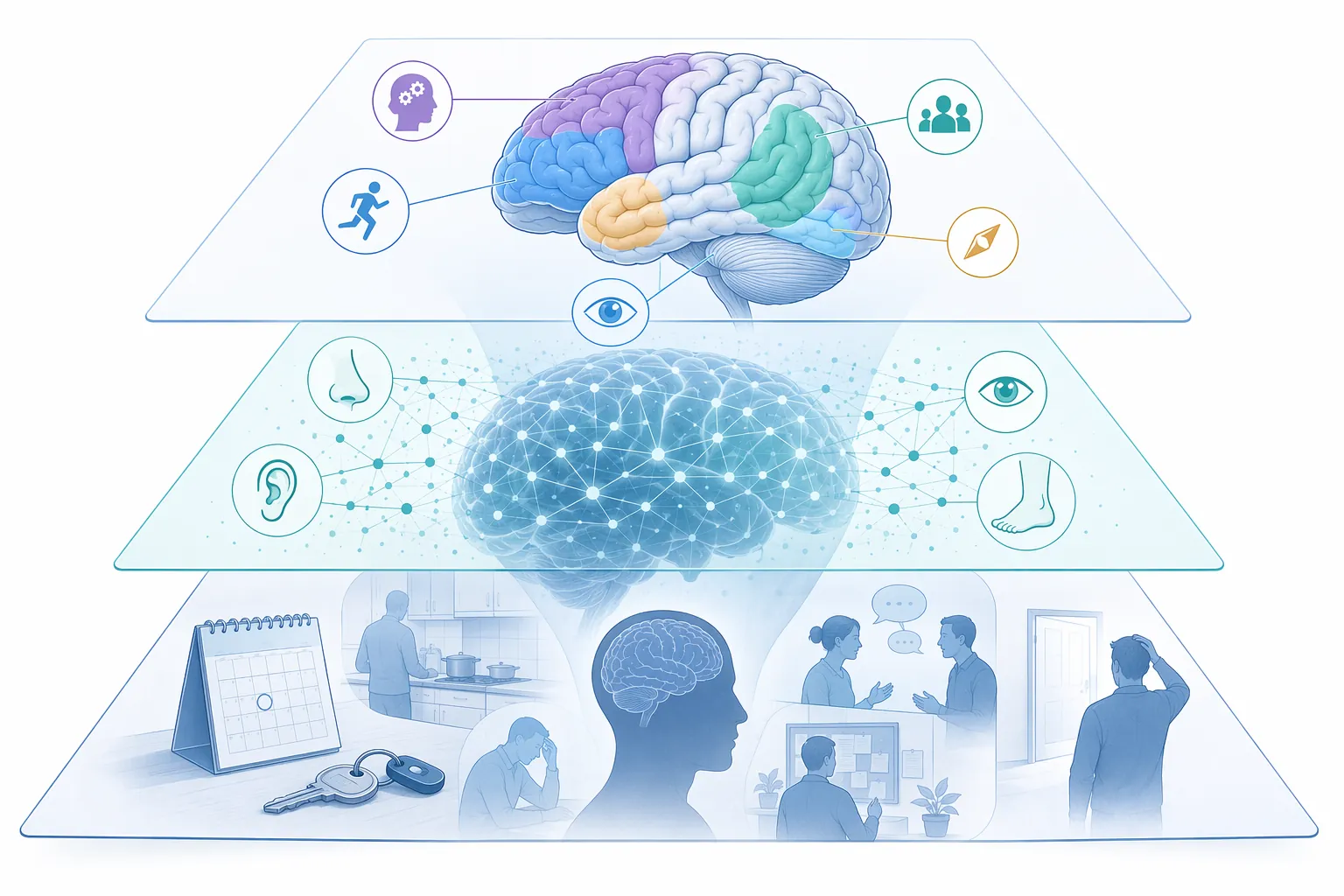
For medical students studying early dementia signs, one mnemonic is not enough. The 5 A’s are the board-core pattern: amnesia, aphasia, apraxia, agnosia, and anomia. The Alzheimer’s Association’s 10 Warning Signs translate that pattern into everyday-function language. MEMORIES is the enrichment layer for prodromal sensory, motor, metabolic, autonomic, taste, hearing, and bowel changes that may show up in advanced stems, but should not outrank cortical deficits on a timed USMLE or shelf question.
The sequence is simple: first ask whether the vignette has a cortical sign; then ask whether independence in daily life is still preserved; then, if the stem hints at years-before-cognition changes, use MEMORIES as a broader scan rather than as the main diagnostic anchor.
Start With the 5 A’s, Because Exams Usually Do
The 5 A’s mnemonic is the most load-bearing dementia mnemonic for medical exams because it names the cortical problems that make early Alzheimer’s disease look different from vague forgetfulness: amnesia, aphasia, apraxia, agnosia, and anomia.[1]
| 5 A | What it means | How it looks in a vignette | Common trap |
|---|---|---|---|
| Amnesia | Memory impairment, especially new learning | Repeats questions, forgets recent conversations, misses appointments despite reminders | Normal aging is slower recall; amnesia is a pattern that disrupts reliability |
| Aphasia | Language impairment | Trouble following conversation, naming objects, or producing fluent meaningful speech | Do not reduce aphasia to just slurred speech; dysarthria is a motor speech problem |
| Apraxia | Impaired learned motor task despite intact strength and comprehension | Cannot use a toothbrush, dress properly, or copy a familiar multistep action | Weakness, sensory loss, or poor effort does not equal apraxia |
| Agnosia | Failure to recognize despite intact primary sensation | Sees a key but cannot identify what it is; hears a familiar sound but cannot place it | This is recognition, not naming alone |
| Anomia | Word-finding or naming difficulty | Uses circumlocution such as “the thing you write with” for pen | Anomia overlaps with aphasia, but it specifically points to naming |
Amnesia is usually the easiest A to spot and the easiest one to overcall. A patient who occasionally forgets where the keys are but retraces steps and manages bills is not the same as a patient who repeatedly forgets recent conversations and cannot compensate. On exams, memory becomes more concerning when it affects consistency, safety, medication use, finances, or appointments.
Aphasia and anomia deserve to be separated in your head even though they travel together clinically. Aphasia is the broader language deficit: comprehension, fluency, repetition, naming, or meaningful output may be affected. Anomia is the naming piece. If the stem says the patient “knows what he wants to say but cannot find the word,” that is anomia. If conversation itself is impaired, widen the label to aphasia.
Agnosia is not “forgot the name.” It is failure to recognize. The patient can see the object, hear the sound, or feel the item, but the brain does not correctly identify it. That distinction matters because anomia can sound similar in a rushed stem: the patient may recognize a pen perfectly but cannot retrieve the word “pen.”
Apraxia is also easy to blur. The issue is not paralysis. It is not cerebellar ataxia. It is not refusing to cooperate. It is a breakdown in performing a learned purposeful action despite enough strength, sensation, and understanding to attempt it. A board vignette may show this as trouble dressing, using utensils, brushing teeth, or copying a familiar gesture.
The MCI-Versus-Dementia Hinge Is Functional Independence
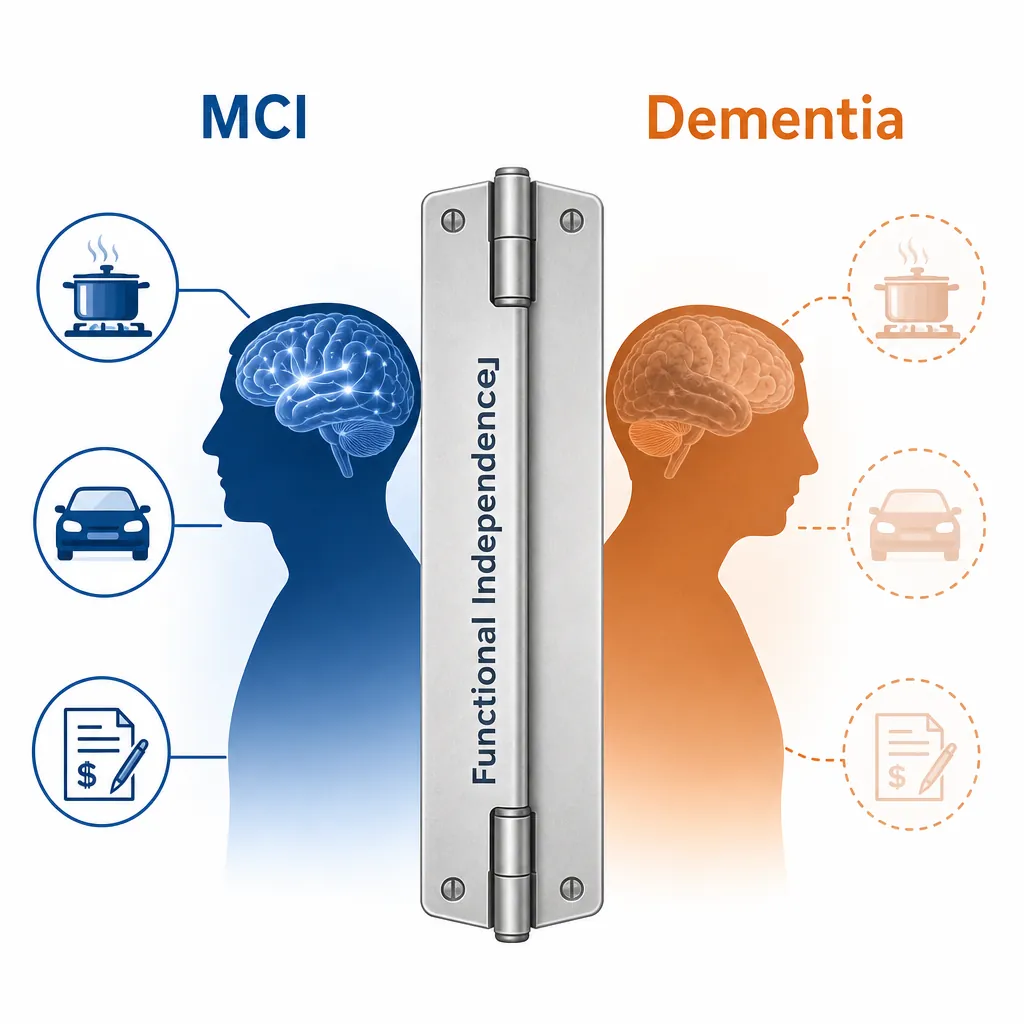
The most testable discriminator is not whether the patient has any cognitive complaint. It is whether the patient remains functionally independent. Mild cognitive impairment can include objective cognitive decline, but daily function is essentially preserved. Dementia requires cognitive decline severe enough to interfere with independence.
That is why a stem about a retired teacher who needs more notes but still cooks, drives familiar routes, manages medications, and pays bills should not be reflexively labeled dementia. A stem about a patient who forgets the stove, mishandles finances, gets lost on familiar routes, or needs another person to take over medications has crossed into a different testing lane.
This hinge also prevents the classic overcall: treating every older adult’s memory complaint as early Alzheimer’s disease. Depression, delirium, medication effects, sleep disruption, sensory impairment, and normal aging can all sit in the answer choices. The 5 A’s help identify the cortical syndrome; functional independence tells you whether the syndrome has become dementia.
Use the 10 Warning Signs as Everyday Clinical Translation
The Alzheimer’s Association’s 10 Warning Signs are patient-facing, but they are useful for exams because they describe how cognitive deficits show up outside a neuro exam room: memory loss disrupting daily life, planning problems, difficulty completing familiar tasks, confusion with time or place, visual trouble, word-finding problems, misplacing items, poor judgment, social withdrawal, and mood changes.[2]
| Warning-sign language | Exam translation |
|---|---|
| Memory loss disrupting daily life | Amnesia plus functional consequence |
| Challenges in planning or solving problems | Executive dysfunction; check whether finances, medications, or schedules are affected |
| Difficulty completing familiar tasks | Could reflect apraxia, executive dysfunction, or both |
| Confusion with time or place | Orientation and navigation problem; distinguish from acute delirium |
| Trouble understanding visual images and spatial relationships | Visuospatial dysfunction; not just poor visual acuity |
| New problems with words in speaking or writing | Aphasia or anomia |
| Misplacing things and losing ability to retrace steps | Memory plus impaired recovery strategy |
| Decreased or poor judgment | Executive dysfunction with safety or financial consequences |
| Withdrawal from work or social activities | Can occur in dementia, but also screen mentally for depression |
| Changes in mood and personality | Clinically relevant but nonspecific |
This list is not a replacement for the 5 A’s. It is a translation layer. “Difficulty completing familiar tasks” may be the real-world version of apraxia. “Problems with words” may be anomia or aphasia. “Visual trouble” may point toward visuospatial impairment rather than an eye-chart problem. “Poor judgment” moves you toward executive dysfunction and functional risk.
For Step-style questions, the 10 Warning Signs are especially helpful when the answer choices use plain language instead of neuropsychological terms. A spouse may not report “apraxia.” The spouse reports that the patient can no longer prepare a familiar meal or use household tools correctly. The exam expects you to convert the story into the cortical or functional domain.
MEMORIES Is Useful, but It Belongs in the Enrichment Layer
MEMORIES organizes eight possible prodromal domains: Metabolism change, Eye or visual impairments, March or gait disturbances, Olfactory dysfunction, Rhythm changes involving heart rate variability or blood pressure variability, Insensitivity of tongue or taste change, Ears or hearing loss, and Stool or constipation. The framework comes from a systematic review of pre-dementia signs that may appear years before cognitive symptoms, but the authors caution that these signs require further clinical validation and are not exclusive to Alzheimer’s disease.[3]

That caveat changes how to study it. MEMORIES is worth knowing for pattern recognition, advanced stems, and research-flavored questions. It is not the first move when a board stem gives you word-finding difficulty, impaired tool use, or loss of independence. Those are still 5 A’s plus function.
| MEMORIES letter | Domain | How to treat it on exams |
|---|---|---|
| M | Metabolism change | Think weight loss or metabolic shift as a possible long prodrome, not a standalone diagnosis |
| E | Eye/visual impairments | Connect to visual or visuospatial clues only after ruling out primary eye disease when relevant |
| M | March/gait disturbances | Gait decline becomes more concerning when paired with cognitive or memory decline |
| O | Olfactory dysfunction | Recognize smell loss as a possible early signal, but keep Parkinson disease and other causes in mind |
| R | Rhythm changes | Autonomic or variability findings are enrichment-level, not routine board-core Alzheimer’s clues |
| I | Insensitivity of tongue | Taste change is a possible prodromal domain, but nonspecific |
| E | Ears/hearing loss | Hearing impairment is associated with later Alzheimer’s risk, but association is not the same as diagnosis |
| S | Stool/constipation | Constipation belongs to the broader prodromal scan, not to the classic Alzheimer’s stem |
The strongest way to keep MEMORIES from becoming a junk drawer is to attach each domain to its evidence strength and its test role. Olfactory dysfunction, for example, has been reported about 5 years before mild cognitive impairment diagnosis and about 3 years before dementia diagnosis in one study.[4] That is interesting and potentially stem-worthy. It still does not beat aphasia, apraxia, agnosia, anomia, amnesia, or functional decline when those are present.
Metabolism change has similar board-adjacent value. In an analysis using 16 years of Health and Retirement Study data, weight loss began at least 10 years before dementia diagnosis and accelerated 2–4 years before onset, with greater decline reported in women and participants with baseline obesity.[5] That supports weight loss as a possible long-prodrome clue, not as a dementia-defining sign.
Hearing loss is another association to respect without overusing. One review reported that hearing loss increased Alzheimer’s disease risk by 1.5 times over 5 years and that people with hearing impairment were 3 times more likely to develop Alzheimer’s disease.[6] A vignette that gives hearing loss alone is not handing you Alzheimer’s. A vignette that combines hearing loss with progressive memory and daily-function decline is asking for better integration.
Gait gets more serious when it travels with memory decline. In a cohort study, gait decline of at least 0.05 m/s per year combined with memory decline was associated with a 5.2- to 11.7-fold increased risk of Alzheimer’s disease.[7] The combination matters. A gait problem by itself opens a broad differential; gait plus memory decline pushes the stem toward neurodegenerative risk.
A Fast Sorting System for Vignettes
When the clock is running, sort the stem before memorizing more facts. The order below keeps the board-core material in front and prevents prodromal clues from overpowering the diagnosis.
- Check for delirium first if the onset is acute, fluctuating, or tied to infection, intoxication, withdrawal, hospitalization, or medication change.
- Check for depression if the stem emphasizes low mood, sleep or appetite change, guilt, psychomotor change, or prominent “I don’t know” responses.
- Look for the 5 A’s if the decline is progressive: amnesia, aphasia, apraxia, agnosia, or anomia.
- Ask whether instrumental daily activities are still independent: medications, finances, cooking, driving, shopping, and appointments.
- Use the 10 Warning Signs to translate family-reported behavior into cognitive and functional domains.
- Use MEMORIES only after that, especially when the stem hints at smell, weight, gait, hearing, vision, autonomic rhythm, taste, or constipation changes years before obvious cognitive decline.
MCI sits in the middle of this sorting system. It is not “nothing,” and it is not automatically dementia. Each year, 10–15% of people with mild cognitive impairment progress to clinical dementia, so the diagnosis matters, but the exam hinge remains preserved functional independence.[8]
How the Three Systems Layer Together
A clean dementia recall map has three layers, not three competing lists.
| Layer | Best use | Exam priority |
|---|---|---|
| 5 A’s | Classic cortical deficits: memory, language, praxis, recognition, naming | Highest |
| 10 Warning Signs | Everyday behavior and functional framing | Moderate to high |
| MEMORIES | Prodromal sensory, motor, metabolic, autonomic, taste, hearing, and bowel clues | Enrichment |
In a classic stem, the 5 A’s do most of the work. A patient repeats questions, struggles to name objects, gets lost in familiar places, and can no longer manage bills. That is not a subtle prodrome question. The important moves are to identify memory and language dysfunction, recognize functional decline, and choose dementia over MCI.
In a family-medicine or psychiatry-style stem, the 10 Warning Signs may be the language you actually get. The spouse says the patient stopped hosting weekly dinners because recipes no longer make sense, has trouble following a familiar route, and becomes irritable when corrected. Convert that into familiar-task impairment, visuospatial or orientation difficulty, mood/personality change, and functional consequence.
In an advanced or research-flavored stem, MEMORIES helps you avoid missing the pre-cognitive setup. A question may mention progressive smell loss, weight change, hearing impairment, gait slowing, or constipation before asking which domain has been associated with later cognitive decline. That is where MEMORIES earns its space. It should not make you diagnose Alzheimer’s disease from smell loss alone.
Keep the Differentials Close
Normal aging usually preserves independence and does not produce prominent cortical signs. The patient may need more time to remember a name but eventually retrieves it, uses compensatory strategies, and continues daily activities.
Delirium is acute, fluctuating, and attention-heavy. Dementia is usually chronic and progressive. If the stem gives fever, urinary symptoms, new anticholinergic medication, alcohol withdrawal, postoperative status, or waxing-and-waning consciousness, do not let the word “confused” drag you straight to Alzheimer’s.
Depression can imitate cognitive decline, especially in older adults. If low mood, anhedonia, sleep change, appetite change, guilt, and psychomotor slowing dominate the vignette, the memory complaint may be part of a mood disorder rather than a primary neurodegenerative syndrome.
Other neurodegenerative processes can also compete. Early visual hallucinations and parkinsonism push away from straightforward Alzheimer’s disease. Prominent early personality disinhibition or language-predominant decline may suggest frontotemporal patterns. MEMORIES itself is not Alzheimer’s-specific, and the review describing it notes overlap with conditions such as Parkinson’s disease.[3]
The Recall Sequence to Use on Test Day
When a vignette mentions memory plus language, praxis, naming, recognition, or visuospatial trouble, reach for the 5 A’s first. When it describes daily-life changes — missed bills, unsafe cooking, getting lost, poor judgment, withdrawal, mood change, or trouble with familiar tasks — map the story to the Alzheimer’s Association’s warning-sign language. When it hints at years-before-cognition smell, weight, hearing, gait, visual, rhythm, taste, or bowel changes, recognize MEMORIES, but keep the validation caveat in view.
The combined system works because it ranks the material instead of flattening it. The 5 A’s carry the classic exam syndrome. The 10 Warning Signs translate that syndrome into real-world behavior. MEMORIES widens pattern recognition for prodromal clues. Functional independence stays in the center, because that is the hinge that separates MCI from dementia when the answer choices are trying to make everything feel almost true.
References
- Alzheimer Disease Signs/Symptoms — 5 A's Mnemonic, Picmonic.
- 10 Early Signs and Symptoms of Alzheimer's and Dementia, Alzheimer's Association.
- MEMORIES: A mnemonic for pre-dementia signs of Alzheimer's disease, Chronic Diseases and Translational Medicine, 2024.
- Olfactory dysfunction predicts subsequent dementia in older US adults, EBioMedicine, 2023.
- Body Weight Trajectories Before and After Dementia Diagnosis, Journal of Aging and Health, 2024.
- Hearing loss and dementia: A meta-analysis of prospective cohort studies, Maturitas, 2018.
- Association of Dual Decline in Memory and Gait Speed With Risk for Dementia Among Adults Older Than 60 Years, JAMA Network Open, 2020.
- Mild cognitive impairment, Geeky Medics.
Related exhibits & inventory
Verified outcomes
Planners
No planner filed for this exam yet
A downloadable timeline template for this exam hasn't been published yet.
Tool verdicts
Questions about this plan
Ask a question about a specific section, timeline, or citation in this plan — or flag something that needs correcting.
Comments
Join the discussion with an anonymous comment.