
SAT Exam Hub
Does Daylight Saving Time Actually Hurt Your Test Scores?
The spring transition to daylight saving time can cause measurable drops in standardized test scores — up to 16 points on the SAT — primarily through cumulative sleep loss and impaired cognitive function. This article examines the evidence, the caveats, and practical strategies to protect your exam performance.
- SAT
- ACT
- GRE
- MCAT
- ASVAB
- digital-sat
- adaptive-testing
- registration-fee
- content-outline
- score-target
The short answer
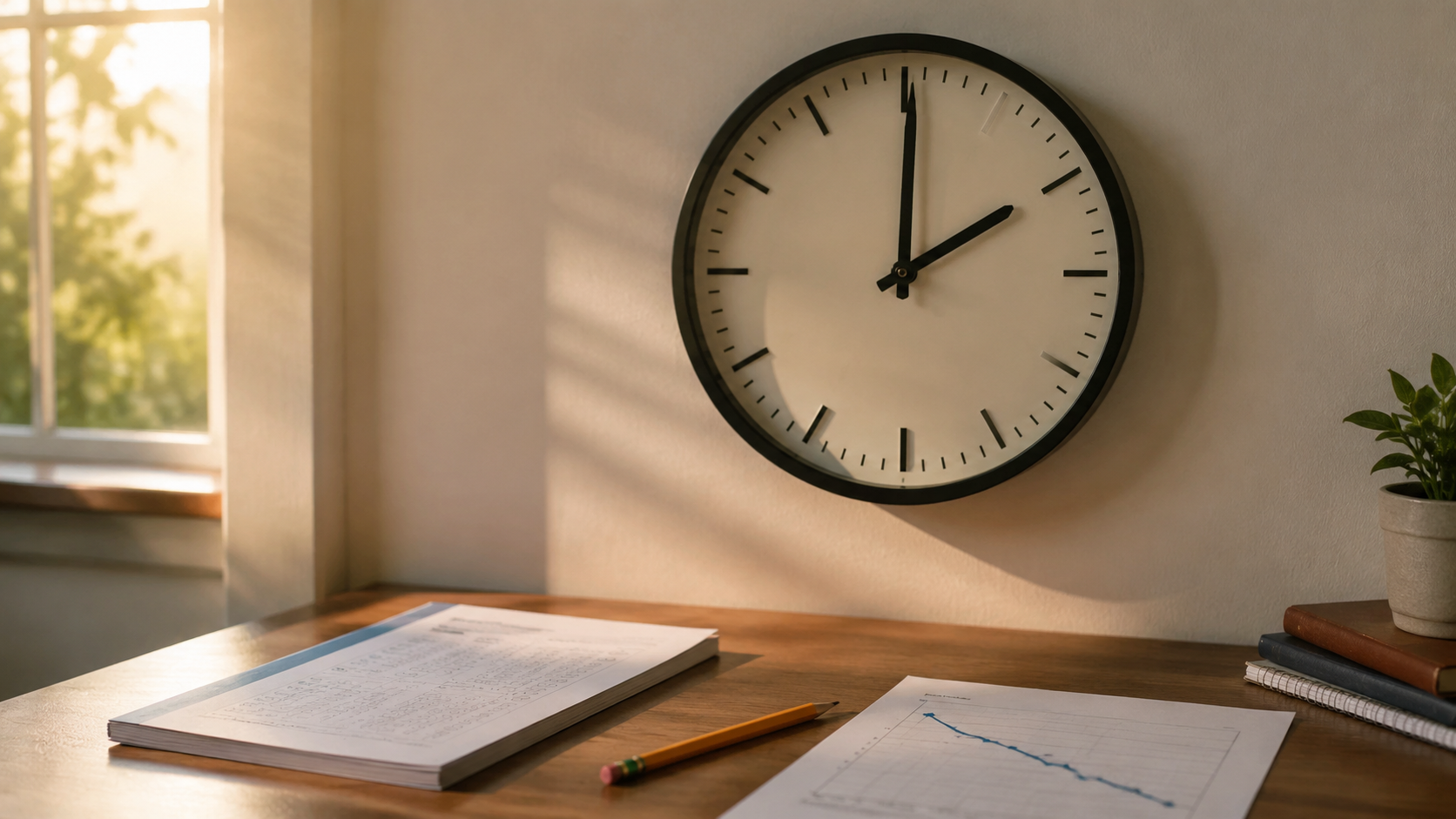
Yes - the spring daylight saving time shift can hurt test performance enough to matter, especially when a score target is tight. The most useful starting point is the Indiana SAT evidence: students in DST-observing counties scored 16 points lower on average than students in counties that stayed on standard time, and the gap was much larger for students at the bottom of the income distribution, at 49 points lower versus 8 points lower for the highest-income group.[1]
What the SAT data can and cannot prove
That Indiana result is a real-world comparison, not a randomized trial. It points to a meaningful association, but it does not prove that the clock change alone caused every lost point. It is also specific to Indiana counties and the SAT, so it should not be stretched carelessly to every state, every exam, or every test date.
Even with that caution, the size of the gap is hard to brush off for a student who is trying to protect a scholarship cutoff or a narrow admissions target. If you are building an SAT plan around a score margin, the right reaction is not panic; it is to treat the spring transition as a scheduling variable, not a calendar footnote.
Why the one-hour shift reaches learning
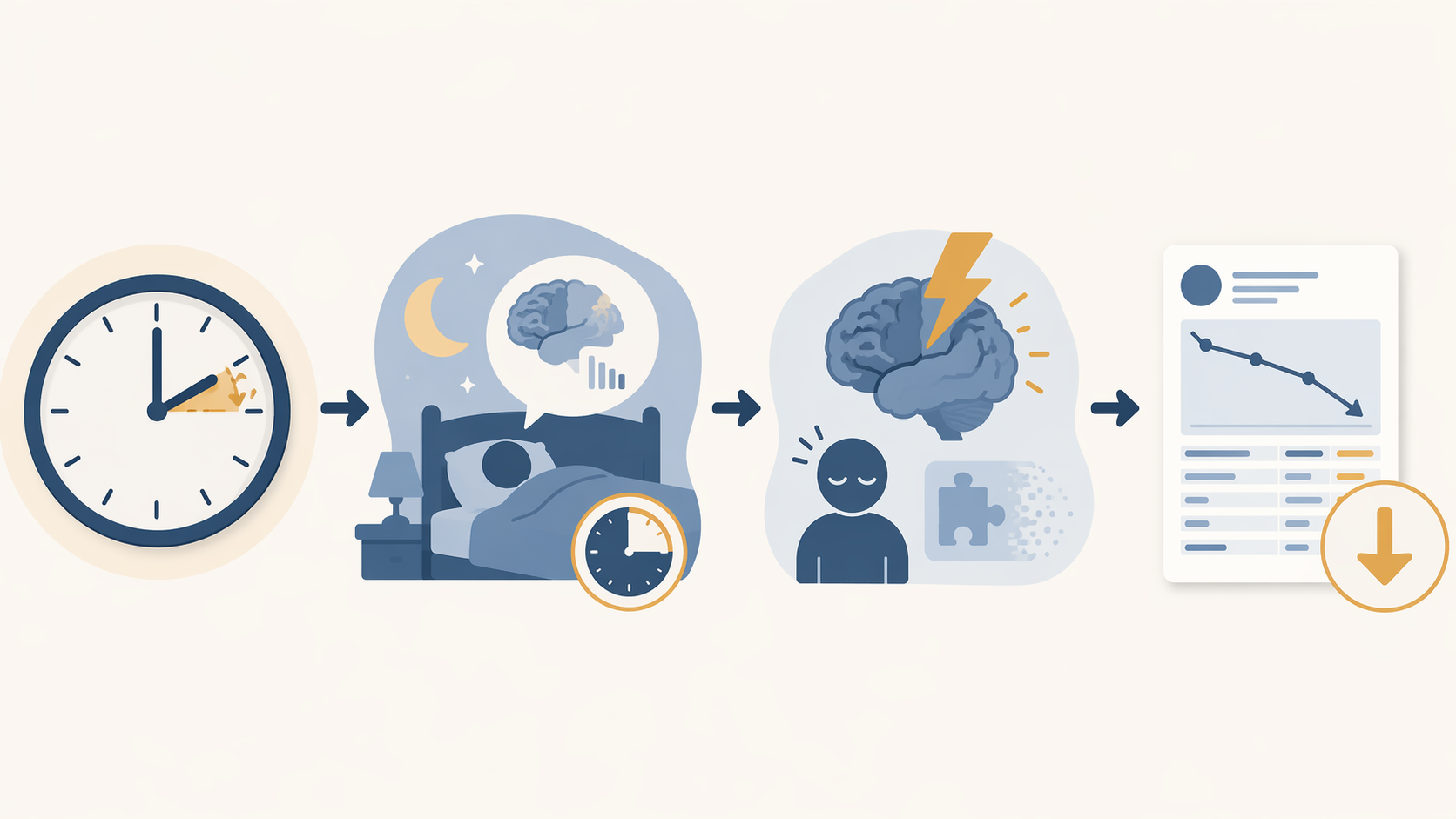
The sleep mechanism is what makes the score story plausible. In an objective actigraphy study of high school students, the week after spring DST cut sleep by 32 minutes a night on average, or 2 hours 42 minutes over the school week; total sleep fell to 7 hours 19 minutes, well below the 9-plus hours recommended for adolescents.[2]
That is not just a quieter morning. Less sleep means longer reaction times and more attention lapses on psychomotor vigilance testing, which matters on a timed exam because pacing slips first and confidence follows. Sleep loss also makes study time less efficient, because the material you review late at night is less likely to consolidate cleanly into long-term memory.
The same logic shows up in school-start-time research: a one-hour delay in school start time relative to sunrise has been associated with an 8% of a standard deviation increase in adolescent math scores.[3] Most students adjust to the spring shift within about a week, though some never fully acclimate, so the problem is usually temporary but not imaginary.[5]
Where the evidence is narrower
The literature is not perfectly one-sided. A later 2017 Economics of Education Review study found the effect to be very small and not statistically significant, which is a good reminder not to overclaim from one dataset. A separate SSRN working paper reports a 2.5 percentage-point drop in graduation test passage rates on the day after the clock change, but that result is still preprint-level evidence rather than peer review.[4]
There is also a policy backdrop in 2026, but it belongs in context, not at the center of a student planning decision. Major sleep and medical organizations continue to favor permanent standard time.[6]
What to do if your test lands near the spring shift
- Move bedtime and wake time earlier by 15 to 20 minutes for 3 to 5 days before the transition, and write it into your planner instead of trusting memory. If you need a place to put that change, start with the paper planner guide.
- Treat the week after the clock change as a maintenance block, not your hardest full-length testing window.
- If a practice score lands low right after DST, compare it with your usual range before you rewrite your target. A tired Saturday morning can tell you something useful, but it is not always the same thing as a real score drop.
- For SAT planning, use the SAT Exam Prep Guide and the score-gap method to decide whether a post-DST practice test belongs in your target estimate.
References
- The Effect of Daylight Saving Time on SAT Scores. Journal of Neuroscience, Psychology, and Economics. 2011.
- Study Shows That Teens Lose Sleep After Change to Daylight Saving Time. American Academy of Sleep Medicine. 2015.
- Rise and Shine: How School Start Times Affect Academic Performance. Education Next.
- Daylight Saving Time and Graduation Test Passage Rates. SSRN working paper.
- Daylight Saving Time. Sleep Foundation.
- Daylight Saving Time. Sleep Education.
Related exhibits & inventory
Verified outcomes
No verified outcomes on file for this exam yet
See Methodology for how outcome evidence is disclosed once logged.
Planners
No planner filed for this exam yet
A downloadable timeline template for this exam hasn't been published yet.
Tool verdicts
AI-tool cautions
No AI tools tested for this exam yet
No hands-on AI-accuracy logs have been filed for this exam.
Questions about this plan
Ask a question about a specific section, timeline, or citation in this plan — or flag something that needs correcting.
Comments
Join the discussion with an anonymous comment.