
SAT, ACT Exam Hub
Boost SAT/ACT Vocabulary with Connections Sports Edition Trivia
Learn how the NYT Connections Sports Edition puzzle builds SAT/ACT vocabulary and critical thinking skills through categorization and elimination reasoning, with a 10-minute daily routine and tools to create custom puzzles from exam word lists.
- gre
- mcat
- asvab
- sat
- act
- digital-adaptive
- official-material
- section-strategy
- test-date-timeline
A student who will not open a vocabulary deck may still spend ten minutes arguing that four sports terms belong together and a fifth one is a trap. That is the useful opening for Connections Sports Edition trivia learning for students: not pretending a game is a full SAT or ACT plan, but using the game to get a reluctant student practicing category logic, word relationships, and elimination before the real work starts.
The boundary matters. NYT Connections Sports Edition can be a strong warm-up when the solve is debriefed and paired with custom exam-vocabulary puzzles. It does not replace reading passages, grammar review, math practice, official practice tests, or a serious SAT prep plan or ACT study schedule. The puzzle earns its place only if the student can name the skill being practiced.
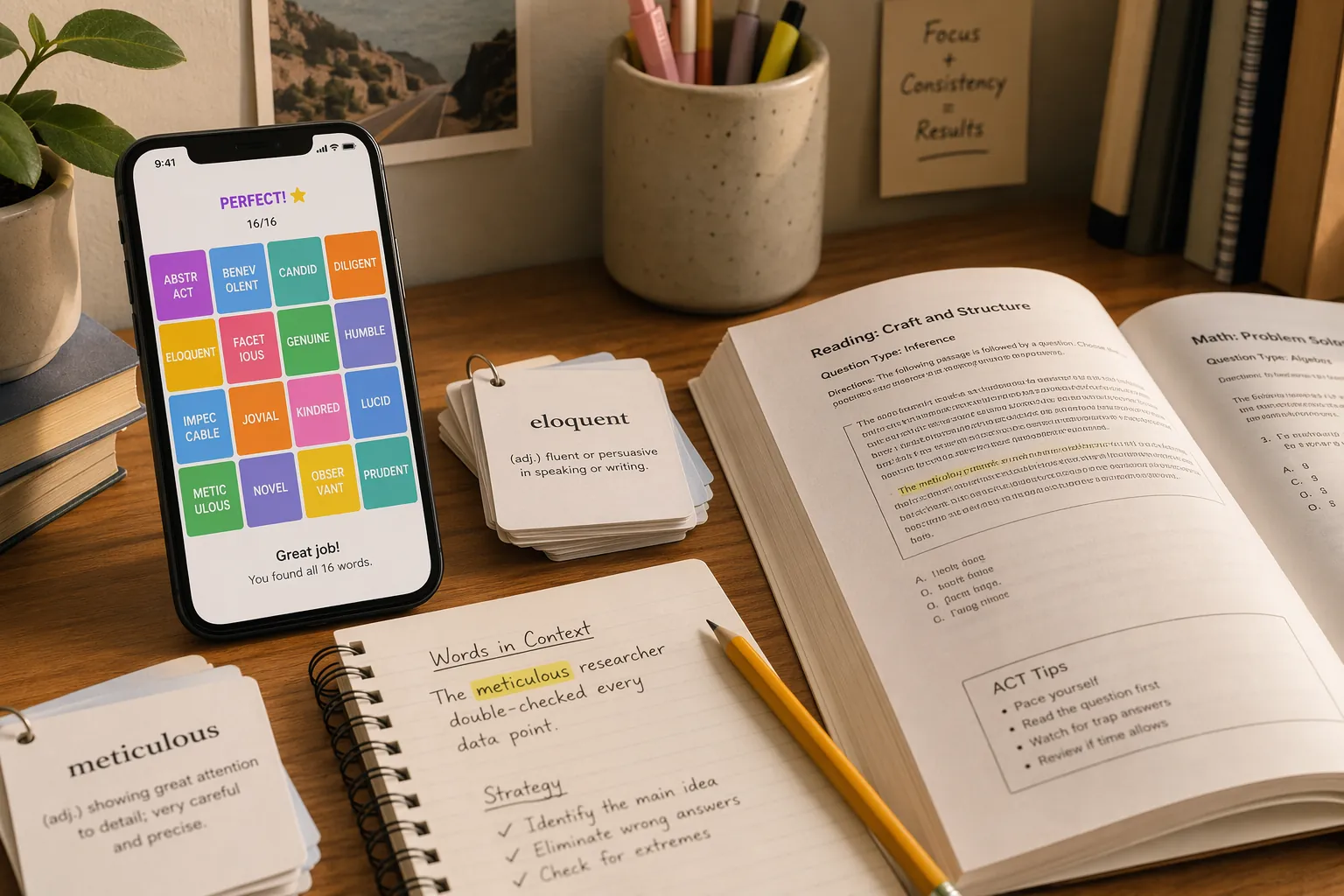
The game context, kept in its proper size
Connections Sports Edition is the sports version of the NYT/The Athletic Connections format. It was created by The Athletic’s Mark Cooper, launched out of beta on Super Bowl Sunday in February 2025, and uses the familiar structure: 16 words, four hidden categories, and color-coded difficulty from easier yellow groups to harder purple-style logic [1].
That is enough origin story. For test prep, the important question is what happens between seeing the grid and committing to a group. A student has to notice meaning, test a category, reject a tempting but incomplete pattern, and keep working when the obvious answer is gone. Those are not the whole SAT or ACT, but they are real academic moves.
Use the official puzzle at The Athletic/NYT as the daily warm-up. Unaffiliated sports-Connections clones may offer unlimited play, but they are not the NYT/The Athletic Sports Edition and they do not carry the same editorial consistency or quality control. If the student first needs puzzle-solving help, start with step-by-step solving tips for Connections Sports Edition before treating it as a study routine.
How puzzle #628 shows the SAT/ACT overlap
The most useful way to see the overlap is to watch a real solve, not to praise “critical thinking” in the abstract. NYT Connections Sports Edition puzzle #628, published June 13, 2026, was listed at 3 out of 5 difficulty, which makes it a good teaching example: not brutal, not automatic, and varied enough to force revision [2].
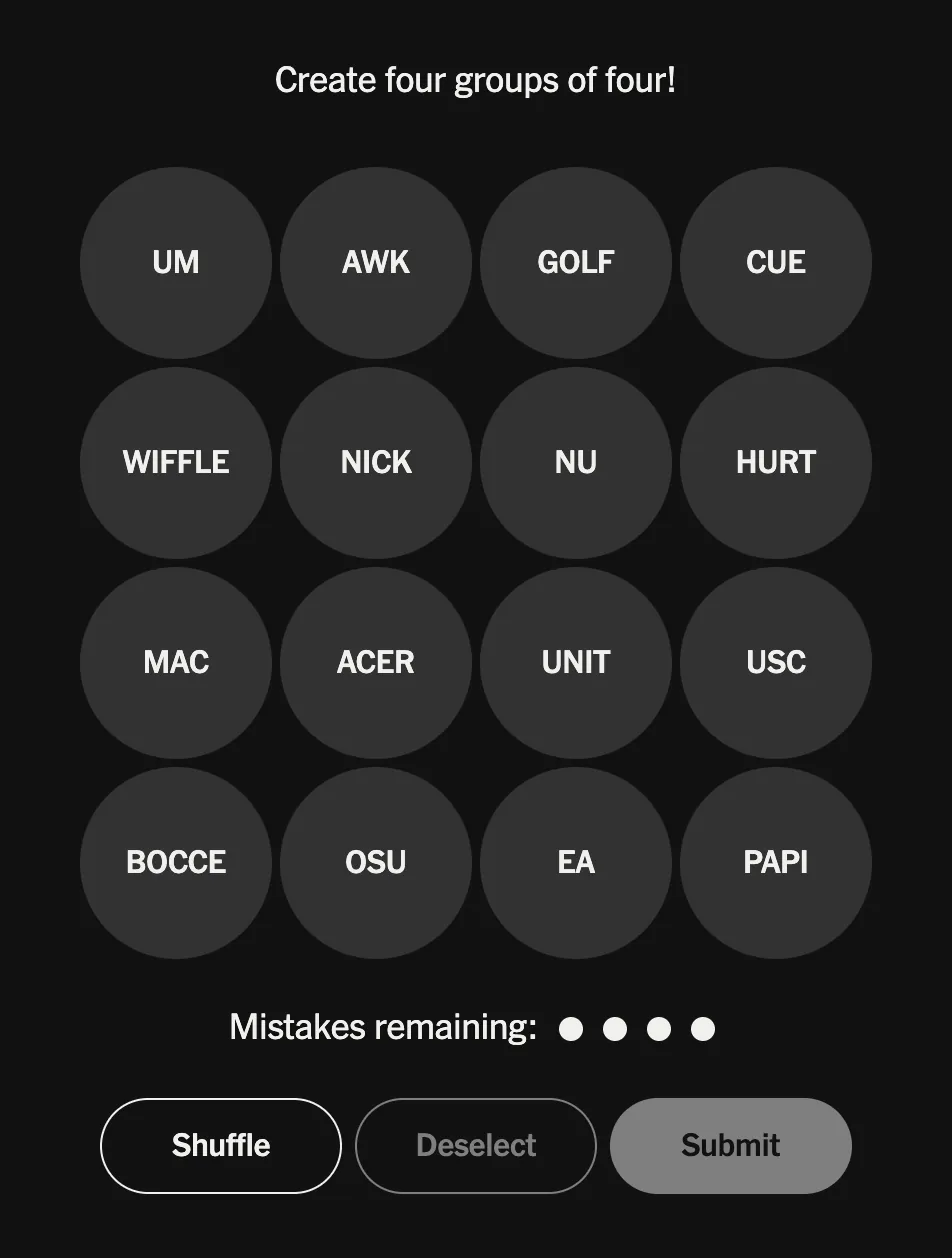
With #628 open, the student’s first job is not to prove sports knowledge. It is to find the safest relationship in the grid. In most Connections solves, that means looking for four terms that share the same kind of link: a role, a team-related label, a piece of equipment, a phrase pattern, a location type, or another category that can be named cleanly. The SAT and ACT version of that skill is vocabulary-in-context: a word is not understood in isolation, but by the role it plays among nearby words.
The useful tutor move here is to slow the student down before submission. Ask: “What is the category sentence?” Not “these all feel sporty,” but “these four are all ___.” If the student cannot finish that sentence, the group is still a guess. On reading and writing questions, the same discipline prevents students from choosing an answer because it sounds academically plausible rather than because it fits the sentence.
| Solving move in #628 | What the student practices | SAT/ACT connection |
|---|---|---|
| Spot the most obvious four-word group first | Contextual grouping | Choosing a word or phrase because it fits the surrounding meaning, not because it is familiar |
| Test a tempting sports category before locking it in | Distractor resistance | Avoiding answers that are related to the topic but do not answer the exact question |
| Use the remaining words to revise the first assumption | Logical elimination | Crossing out choices because they create contradictions or leave no workable answer |
| Handle the harder blue/purple-style logic after the easy groups are gone | Difficulty management | Staying accurate when later questions require less obvious patterns |
The second move in #628 is where the study value usually appears. A sports grid naturally contains words that can belong to more than one mental bucket. A term might look like it belongs with a league, a team, a nickname, a statistic, or a phrase. That overlap is not a flaw; it is the point. Standardized-test distractors work the same way. They borrow one feature from the correct answer, then fail on the condition the question actually asks.
When a student proposes a category too early, do not simply say whether it is right. Ask which word is doing the most misleading work. In a puzzle, that word may be the one that seems to confirm the category while quietly belonging somewhere else. In an SAT Reading and Writing question, the misleading word may be the answer choice that repeats language from the passage but changes the logic. In an ACT English question, it may be the option that sounds smoother but breaks the sentence’s actual relationship.
The third move is elimination. After one correct group is removed, the remaining grid changes. A category that looked possible with 16 words may become impossible with 12. That is the moment students need in test prep: not clinging to the first idea because it felt strong, but letting the remaining evidence force a cleaner answer.
The last move in a 3/5 puzzle like #628 is often emotional as much as intellectual. Once the obvious group is gone, the student may face categories that depend on wordplay, indirect associations, or a sports reference that is not equally familiar to every player. That is where the tutor should name difficulty management. On the SAT and ACT, students also meet questions that are not solved by the first visible clue. The skill is to keep sorting evidence without turning one hard item into a five-minute spiral.
What the evidence supports, and what it does not
This is the point where it is tempting to say the game “boosts the brain.” That claim is too large. Northeastern University reporting on comments from Susanne Jaeggi and Art Kramer describes word games such as Wordle and Connections as tasks that can prompt people to think in new ways, but “they’re not necessarily improving people’s brain health” [3].
The same Northeastern piece notes that word games can teach the brain to resist distractions and engage executive function, while also warning that improvement in the game does not prove broad cognitive transfer [3]. That distinction is exactly the one families need. A student may get better at the type of categorizing and distractor-checking Connections demands. That is not the same as evidence that Connections Sports Edition raises SAT or ACT scores.
There is also a narrower evidence issue: the Northeastern discussion concerns Wordle and general Connections, not a controlled study of Connections Sports Edition. No source in the available research directly tests whether playing the Sports Edition improves standardized-test outcomes. The honest claim is skill overlap, not guaranteed score gain.
That narrower claim is still useful. Many students do not lose points because they have never heard of an obscure word list. They lose points because they rush past context, accept the first related answer, or fail to revise when evidence changes. A ten-minute puzzle routine can rehearse those habits in a lower-pressure setting before the student opens a passage set.
The 10-minute daily routine
For a student who already likes sports trivia, the official daily puzzle can sit at the very beginning of a study session. It should be short enough that it does not steal the session and structured enough that it is not just procrastination with a cleaner name.
| Time | Action | Tutor or student question |
|---|---|---|
| 6–8 minutes | Play the official Connections Sports Edition puzzle | Name the category before submitting, not after |
| 1 minute | Debrief the best and worst guess | Which word misled you, and why? |
| 1 minute | Connect the solve to exam behavior | What would the SAT or ACT version of that trap look like? |
The debrief is the part that makes it study. Without it, the student may only be practicing speed and sports recall. With it, the student has to explain reasoning, and explanation is where vocabulary work starts to become visible.
The one-minute debrief
- Which category did you assume too early?
- Which word looked like it belonged in one group but actually forced a different relationship?
- Did you use definition, context, phrase pattern, or outside sports knowledge?
- Which guess would have been a classic SAT or ACT distractor?
- At what point did the difficulty change from recognition to reasoning?
A parent does not need to be a sports expert to run this. The student can explain the sports content. The adult’s job is to press for the logic: “What made those four belong together?” and “What evidence made you drop the first idea?” If the student cannot answer, the solve may have been lucky, and lucky does not transfer well.
Students who prefer the non-sports version can use the same reasoning structure in NYT Connections SAT vocabulary practice. The Sports Edition is a motivational scaffold for some students, not a universal advantage. If a student does not care about sports, forcing the sports version defeats the purpose.
Turn the sports hook into exam vocabulary once a week
The official Sports Edition puzzle is the engagement hook. The custom puzzle is the targeted review. They should not be confused. A daily Sports Edition grid may train category logic and keep a student willing to begin; a custom grid lets the tutor decide which words, roots, or academic terms the student actually needs.
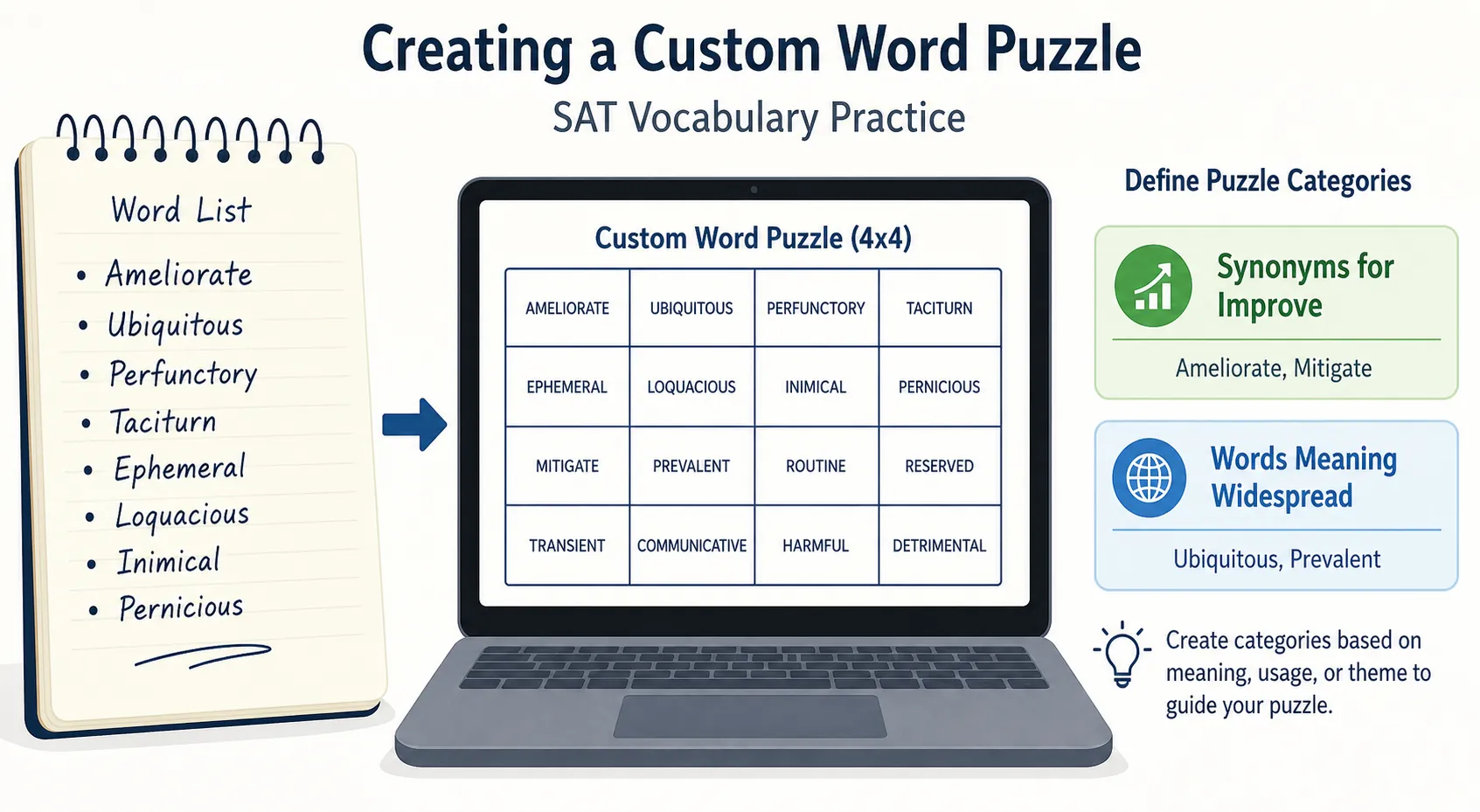
Once a week, build a 16-word custom puzzle from current SAT or ACT material. Free third-party tools such as Connections+ and Swellgarfo can create shareable custom grids; Connections+ also includes archive and community-sharing features, while Swellgarfo is useful for quick simple links [4][5]. Custom Connections by Claire Wang is another commonly used third-party option when available. These tools are practical aids, not permanent infrastructure, so save your word lists outside the tool.
The best custom puzzles use categories that force meaning decisions. Do not make four random “hard words” and call that vocabulary. The category itself should teach the student something.
| Custom category type | Example of what to include | Why it helps |
|---|---|---|
| Tier 2 academic words | Words that appear across history, science, and literature passages | Builds flexible meaning, not subject-specific memorization |
| Near-synonyms | Words with similar meanings but different tone or strength | Prepares students for answer choices that are almost right |
| SAT roots and word families | Words sharing a root, prefix, or suffix | Helps students infer unfamiliar words without memorizing every form |
| ACT science terms | Terms used in charts, experiments, and conflicting-viewpoints passages | Connects vocabulary to the way ACT questions present evidence |
| Function words and transition logic | Words that signal contrast, cause, concession, or sequence | Supports grammar and rhetoric questions, not just vocabulary questions |
A weekly custom puzzle can be built in a few minutes if the word list is already prepared. Pick four categories, choose four words per category, then add one or two tempting overlaps on purpose. The overlap is not a trick for its own sake. It is how students learn to ask, “What is the exact relationship?” instead of “Which words look related?”
A simple weekly workflow
- Pull 16 words from the student’s current SAT or ACT work, not from a generic impressive-sounding list.
- Sort them into four categories that share the same dimension: meaning, root, rhetorical function, science context, or usage.
- Add at least one plausible distractor, such as a word that shares a topic but not the category rule.
- Have the student solve aloud and name each category before submitting.
- After solving, choose three words for sentence-level practice in actual SAT or ACT style.
The last step is important. A custom Connections-style puzzle can help a student group and distinguish words, but standardized tests ask students to read sentences, passages, punctuation, transitions, charts, and arguments. After the puzzle, the words have to return to sentences.
For students comparing puzzle formats, the broader discussion of whether daily NYT Connections can count as vocabulary study is a useful companion. Students who like word-search patterns more than category logic may also want to compare NYT Strands for SAT and GRE vocabulary. The format matters less than whether the student can explain the thinking it trains.
What this routine should and should not replace
Use Connections Sports Edition to replace the dead first ten minutes of a study session: the phone-checking, the resistance, the half-hearted flashcard shuffle. Do not use it to replace the work that actually determines test readiness.
- It can replace a low-energy warm-up.
- It can support vocabulary-in-context practice.
- It can give tutors a quick window into how a student handles distractors.
- It should not replace official SAT or ACT practice questions.
- It should not replace passage reading, grammar rules, math content, or timed section work.
- It should not be sold to students as a score-improvement shortcut.
If a student is studying for the SAT in 2026, the puzzle routine belongs beside a diagnostic-driven plan such as the Score-Gap Method, not in place of one. For ACT students, the same principle applies: use the puzzle to practice reasoning habits, then move into ACT English, Reading, Math, and Science work with actual exam-style questions.
The bounded recommendation is simple: if a student already likes sports trivia, use the official daily Connections Sports Edition puzzle for engagement, debrief it for reasoning, create weekly custom puzzles from exam vocabulary, and keep the main SAT or ACT plan anchored in official practice, content review, and full section work.
References
- Connections: Sports Edition — The Athletic
- Connections: Sports Edition Hints and Answers for June 13, 2026 — The Athletic — June 13, 2026
- Do Wordle, Connections and other brain games really boost brain health? — Northeastern Global News — April 30, 2024
- Connections+ — Connections+
- Connections — Swellgarfo
Related exhibits & inventory
Verified outcomes
No verified outcomes on file for this exam yet
See Methodology for how outcome evidence is disclosed once logged.
Planners
No planner filed for this exam yet
A downloadable timeline template for this exam hasn't been published yet.
Tool verdicts
AI-tool cautions
No AI tools tested for this exam yet
No hands-on AI-accuracy logs have been filed for this exam.
Questions about this plan
Ask a question about a specific section, timeline, or citation in this plan — or flag something that needs correcting.
Comments
Join the discussion with an anonymous comment.