
MCAT Exam Hub
Does Chlorine Kill All Germs? A Science Experiment
This article presents a reproducible agar-plate serial-dilution experiment that tests whether chlorine really kills all germs. You'll learn the evidence-based conclusion: chlorine kills most bacteria at adequate concentration and contact time, but fails against specific pathogens like Cryptosporidium and C. diff spores.
- SAT
- ACT
- GRE
- MCAT
- ASVAB
- digital-sat
- adaptive-testing
- registration-fee
- content-outline
- score-target
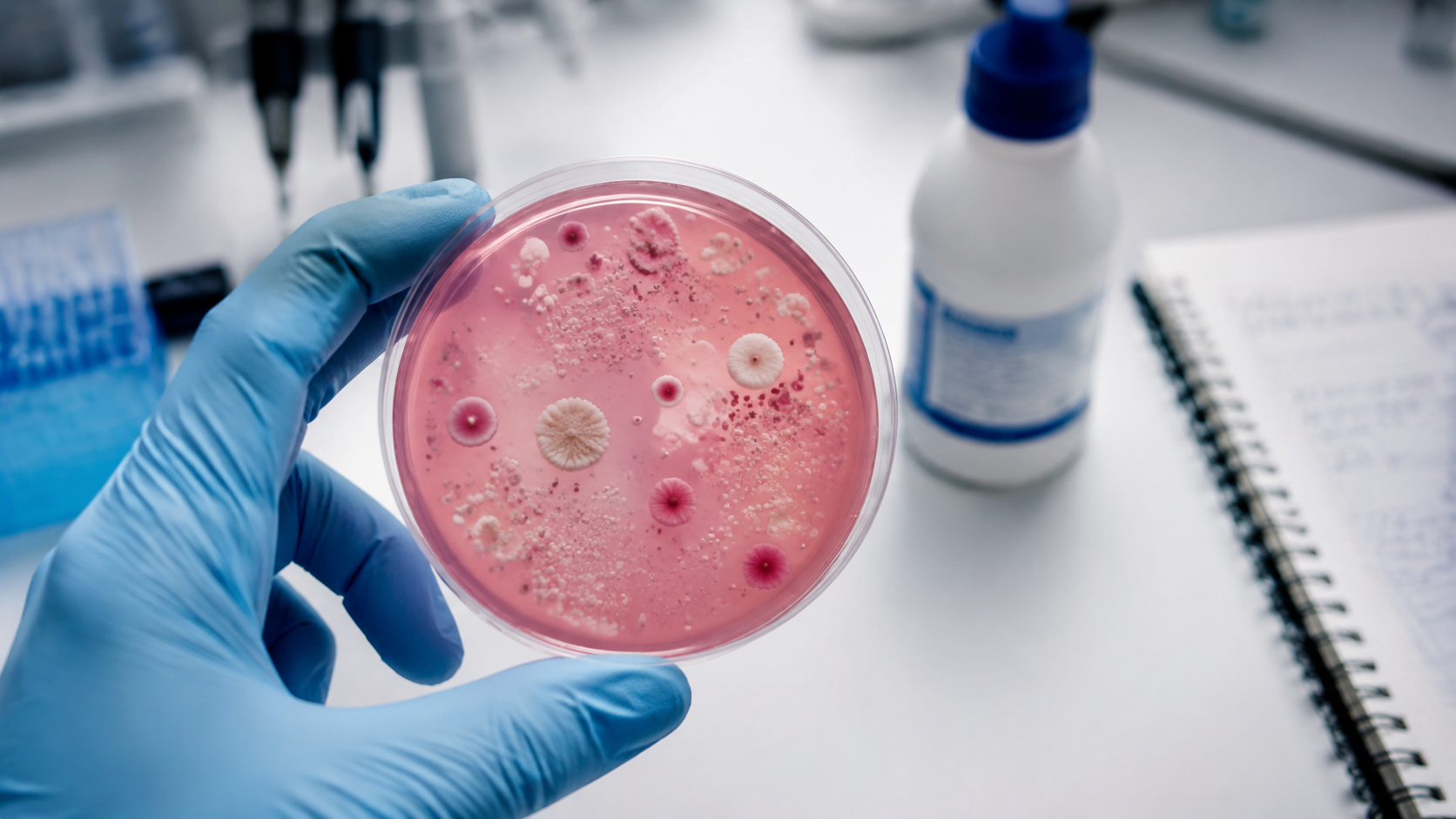
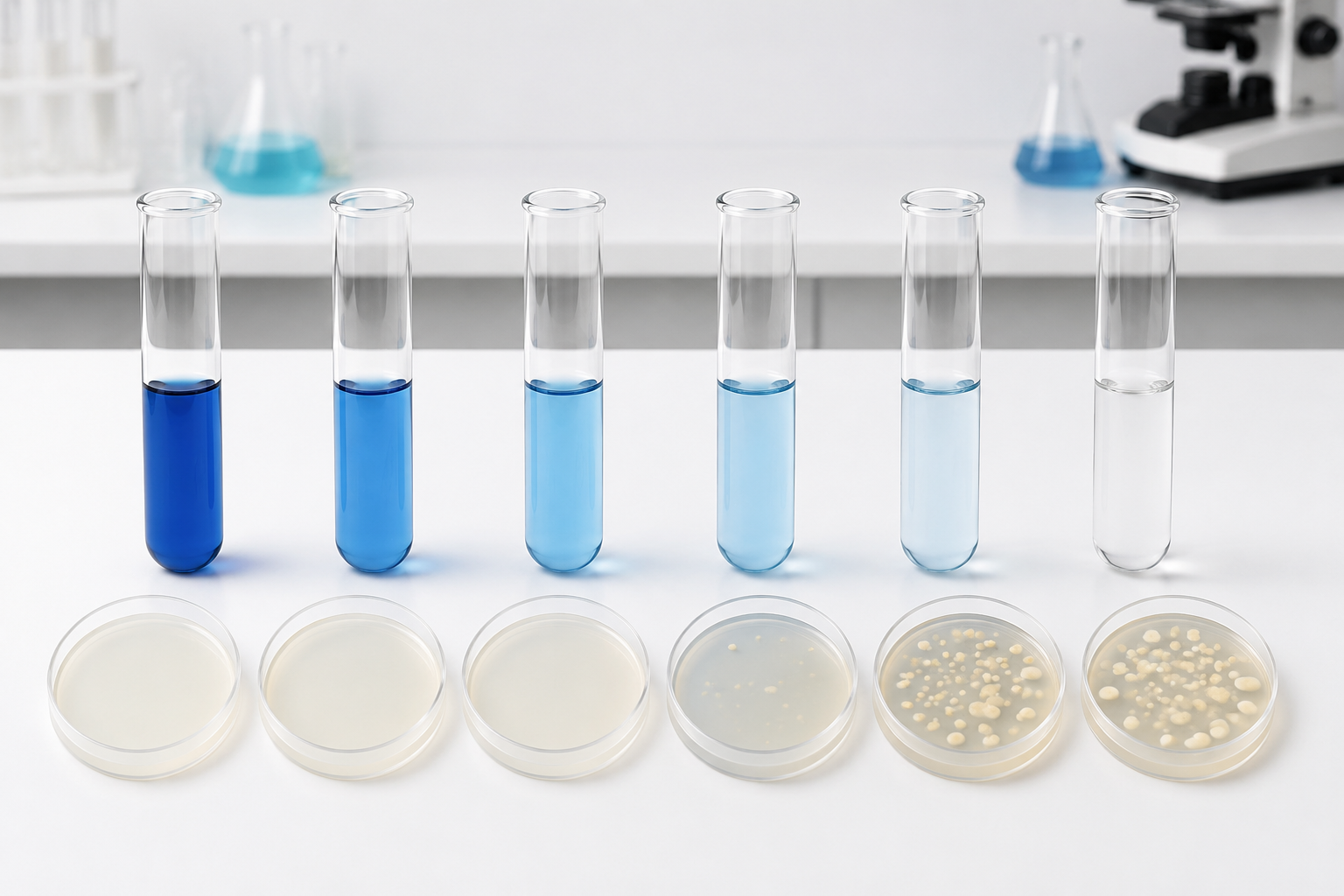
If you want to test whether chlorine really kills germs, start with a plate, not a label. A reproducible classroom version uses serial dilutions of household bleach against E. coli K-12: make bleach dilutions from 10% down to 0.0001%, inoculate nutrient agar, incubate for 24 hours at 37 C, and compare the colony counts across the series. In the Education.com protocol, no colonies appear at 1% bleach and above, while colonies return at 0.1% and below [1].
Run the Test the Right Way
The point of the setup is not drama; it is control. The question only means something if the dilution is explicit, the organism is identified, the contact time is fixed, and the comparison plate gives you a baseline for growth without bleach [1].
| Step | What you do | Why it matters |
|---|---|---|
| Make serial dilutions of bleach | Prepare a dilution series from 10% to 0.0001% | Lets you see a threshold instead of guessing |
| Use a safe lab strain | Inoculate E. coli K-12 | Keeps the demonstration reproducible and nonpathogenic |
| Plate and incubate | Spread the sample on nutrient agar and incubate 24 hours at 37 C | Turns germ-killing into a countable outcome |
| Compare with a control | Keep a water-only plate alongside the bleach plates | Shows whether growth changed because of bleach, not handling |
The concentration gap is the part people like to skip. In this classroom setup, 1% bleach works out to about 10,000 ppm available chlorine [1], while pool chlorine is usually discussed at about 1 to 3 ppm free chlorine [2]. That is not a small difference. It is the difference between a strong disinfectant solution and a lightly chlorinated pool.
The chemistry is simple enough to keep in view. In water, chlorine forms hypochlorous acid, and HOCl can cross cell walls, oxidize thiol groups and iron-sulfur clusters, and disable the enzymes a bacterium needs to keep metabolism running [4]. That explains why the plate goes quiet at strong bleach concentrations without pretending every germ is equally easy to kill.
Time Is Part of the Dose
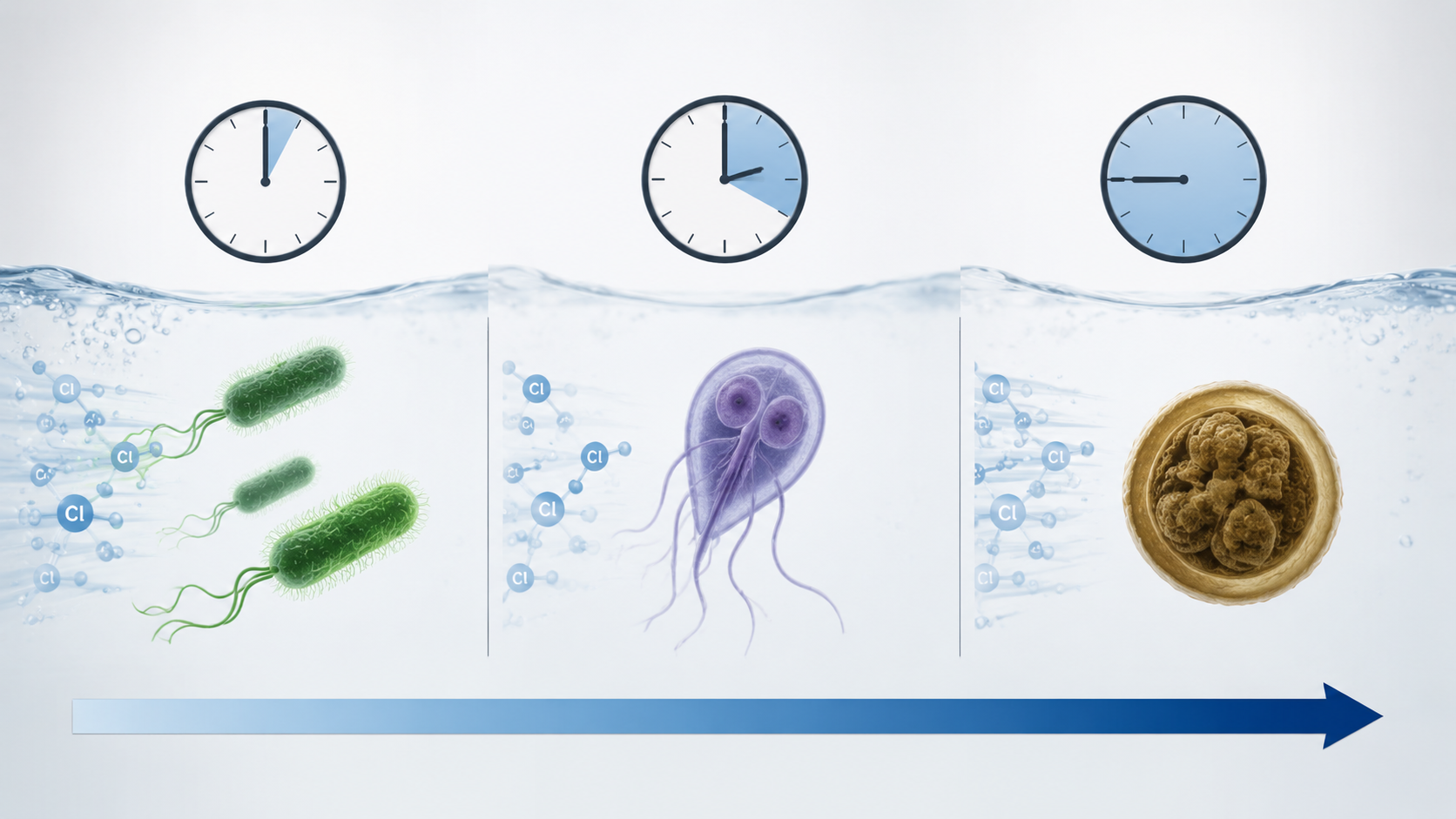
CDC pool guidance makes the same point in slower motion: chlorine works as a function of concentration and contact time, not just presence or smell [2]. At 1 ppm free chlorine, the CDC timetable lists E. coli as less than 1 minute, Hepatitis A at about 16 minutes, Giardia at about 45 minutes, and Cryptosporidium at about 10.6 days under the stated conditions of 1 ppm free chlorine, pH 7.5, and 77 F [2].
| Organism | Time at 1 ppm free chlorine |
|---|---|
| E. coli | Less than 1 minute |
| Hepatitis A | About 16 minutes |
| Giardia | About 45 minutes |
| Cryptosporidium | About 10.6 days |
That is also why the strong chlorine smell in a pool is not proof of stronger disinfection. Chloramines form when chlorine reacts with ammonia from urine or sweat, which means some of the free chlorine has already been used up instead of sitting around to disinfect [6]. Smell tells you something happened; it does not tell you that the water is safer.
Where the Universal Claim Breaks
Real-world pools still produce outbreaks. CDC surveillance reported 208 pool-associated outbreaks from 2015 to 2019, with 3,646 illnesses, 98 hospitalizations, and 1 death [3]. That does not mean chlorine is useless. It means a treated pool is not a sterile system, and pathogen load, contact time, splash transmission, filtration, and contamination events all matter.
There is one more caution worth keeping in the frame. Zhang et al. reported that sub-lethal chlorine exposure increased horizontal transfer of antibiotic resistance genes by up to 10-fold in Acinetobacter baylyi ADP1, apparently through oxidative stress and increased cell membrane permeability [5]. That finding is organism-specific, so it should not be stretched into a universal rule, but it is a good warning against treating low-level chlorine exposure as automatically harmless.
So the defensible conclusion is narrower than the slogan. Chlorine kills many germs when the concentration and contact time are adequate, and the bleach plate makes that easy to see [1][2]. But "kills all germs" fails as a universal claim because some pathogens need far longer exposure, some spores are tougher than the slogan allows, and real pools still generate outbreaks under ordinary use [2][3][5].
References
- Bacteria Science Fair Project: How Does Bleach Kill Bacteria? — Education.com
- Home Pool and Hot Tub Water Treatment and Testing — CDC
- Outbreaks Associated with Treated Recreational Water — United States, 2015-2019 — CDC
- Chlorine — Chemical Safety Facts
- Sublethal chlorine exposure promotes horizontal gene transfer of antibiotic resistance genes by increasing cell membrane permeability — ISME Journal, 2021
- Why a strong chlorine smell in pools usually means chloramines — Halogen Supply
Related exhibits & inventory
Verified outcomes
Planners
No planner filed for this exam yet
A downloadable timeline template for this exam hasn't been published yet.
Tool verdicts
Questions about this plan
Ask a question about a specific section, timeline, or citation in this plan — or flag something that needs correcting.
Comments
Join the discussion with an anonymous comment.