CA DMV WRITTEN TEST Exam Hub
Why Half of CA DMV Written Test Takers Fail and How to Pass It
Half of California DMV written test takers fail, but most miss the same topics and use passive study methods. This article explains why the failure rate is so high and provides an actionable study protocol—handbook-first active recall on the most-missed clusters—to help you pass on the first attempt.
- SAT
- ACT
- GRE
- MCAT
- ASVAB
- digital-sat
- adaptive-testing
- registration-fee
- content-outline
- score-target
Last reviewed: July 23, 2026. California DMV rules, fees, and online test options can change, so use the DMV site as the final authority before you apply or retest.
When people hear that about half of California DMV written test takers fail, the useful question is not whether the test is “tricky.” It is: what are they missing? The best public number available is from Sacramento Bee reporting in July 2022, which cited a DMV spokesperson saying California’s written knowledge test had averaged a 51.5% fail rate over two decades. The same reporting said the fail rate rose to 56.9% in the year after the pandemic, a 17% increase from 2020.[1]
That number is old enough to deserve a caution label, not a shrug. The DMV does not publish a live public dashboard of written-test pass rates. But the pattern matches what shows up in retake classes: people do not usually fail because they cannot understand the handbook. They fail because they skim it, jump into practice tests too early, and remember the wording of app questions instead of the rule.
The uncomfortable part is not only new drivers. Sacramento Bee also cited a 2007 DMV evaluation report saying 39.5% of new applicants failed on their first attempt, while 58% of renewal applicants failed on their first attempt.[1] A renewal applicant may drive every day and still freeze on hill parking, curb colors, or a school-zone default because daily habit does not rehearse every handbook rule.
What The Test Requires Before You Start Studying
For a California Class C knowledge test, the first number to know is the correct-answer count. Under-18 applicants answer 46 questions and need 38 correct. Applicants 18 or older answer 36 questions and need 30 correct.[2] You may see different passing percentages described elsewhere because test forms and DMV wording vary; the safer study target is the count you must clear.
The attempt limit matters because it changes the cost of casual preparation. California allows three attempts within 12 months of the application, with a seven-day wait between retakes. After three failures, or after the application expires, the applicant must start over and pay again.[2] Fee amounts should be checked against the current DMV fee schedule before you go, because published amounts across secondary sources do not always match.
Those rules make “I’ll just try it and see” a poor plan. A failed attempt costs more than the test window. It means another appointment or wait, another week, and for nervous test takers, another round of knowing the computer has already beaten them once.
The Missed Topics Are Not Random
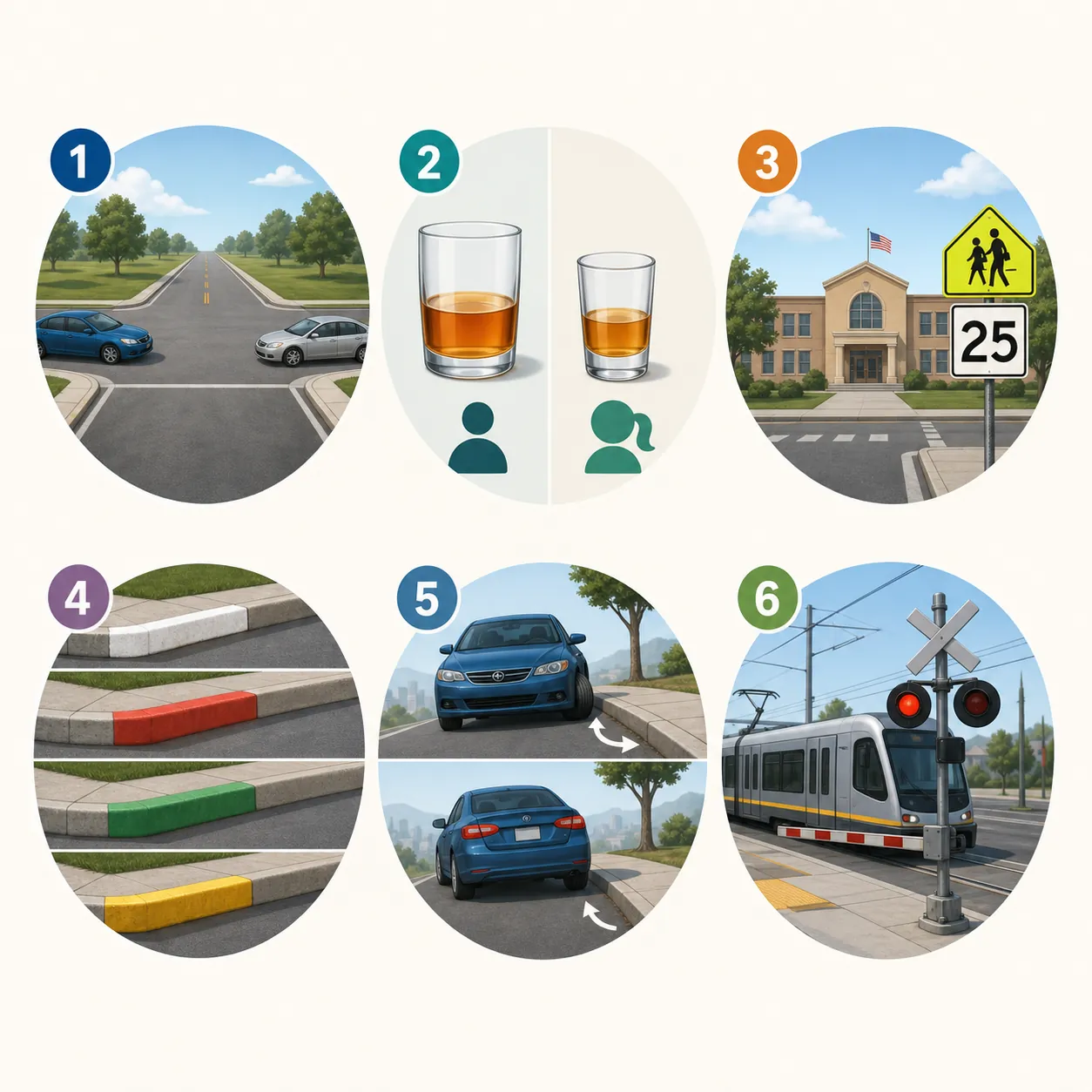
The most useful California DMV written test study tips begin with topic selection. Sacramento Bee reporting, San Diego Magazine, and DriversEd.com all point toward the same clusters: uncontrolled-intersection right-of-way, blood alcohol concentration tiers, school-zone speed defaults, painted curbs, hill-parking wheel direction, and light-rail crossings.[1][3][4] That does not mean these are the only topics on the test. It means they deserve more than one quick read.
Uncontrolled Intersections
Right-of-way questions become harder when there is no signal, no stop sign, and no officer directing traffic. Students often study the obvious scenes first: red light, stop sign, pedestrian in crosswalk. Then the test asks about two vehicles arriving at an uncontrolled intersection, and the rule has to be recalled without the comfort of a sign. Do not study this as a picture you recognize. Study it as a sentence you can explain: who yields, who proceeds, and why.
BAC Tiers
Alcohol-limit questions catch younger applicants because adults repeat 0.08% so often that it becomes the only number in the room. For drivers under 21, California’s zero-tolerance threshold is different: 0.01%.[3][4] The mistake is not forgetting that alcohol is restricted. The mistake is using the adult number for the wrong driver category.
School Zones
School-zone questions are easy to under-study because the rule feels familiar. The default number that appears in missed-question lists is 25 mph when children are present.[3][4] The word “present” matters. A test taker who only remembers “slow down near schools” still has not learned the testable rule.
Painted Curbs
Painted curbs are one of the fastest ways to expose passive studying. Red usually sticks. White, green, and yellow blur together. San Diego Magazine calls curb-color meanings the most-missed single topic in its permit-practice-test breakdown.[3] This is a small chapter item, but it behaves like a vocabulary set: each color needs its own prompt, not one vague memory of “parking rules.”
Hill Parking
Hill parking frustrates experienced drivers because it is physical. People remember doing it, but not the verbal rule. The test can ask where to turn the wheels when parking uphill, downhill, with a curb, or without a curb.[3][4] If you cannot close the handbook and say the wheel direction for each condition, you are guessing from an image in your head.
Light-Rail Crossings
Light-rail questions show up in missed-question discussions because many drivers do not encounter them often enough to build a habit.[1][3][4] Treat them as handbook rules, not as common sense. A person who rarely drives near tracks may still be tested on them.
A Handbook-First Study Protocol
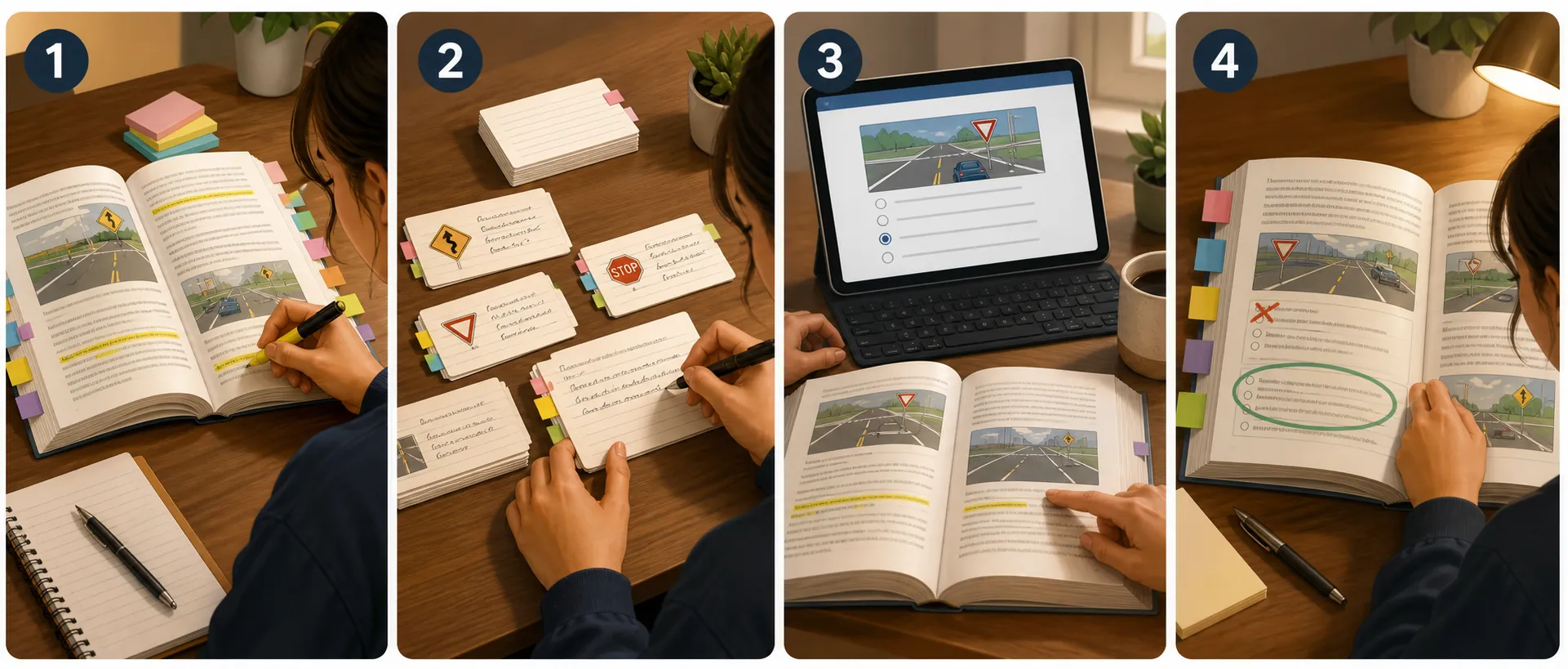
Practice tests are useful after you know the rule. Before that, they can train recognition without memory. A student can swipe through fifty questions and feel busy while never learning where the answer lives in the official handbook.
| Study move | What to do | What it prevents |
|---|---|---|
| Mark the handbook first | Read the official DMV handbook sections covering the high-yield clusters and flag the exact rule pages. | Depending on third-party wording instead of current DMV language. |
| Turn rules into recall prompts | Make short questions that require you to produce the rule from memory. | Mistaking recognition for knowledge. |
| Use targeted practice | Take practice questions by topic after the rule is known. | Letting random quizzes hide weak areas. |
| Review wrong answers in the handbook | For every miss, return to the official rule and rewrite the prompt. | Memorizing one practice-test sentence instead of the underlying rule. |
| Simulate the final test | Only after topic work, take mixed practice sets without notes. | Finding out too late that you only knew the answer with cues. |
Step 1: Flag The Rules Before You Quiz
Start with the official California DMV handbook, not a screenshot folder. Put tabs or notes on the pages for right-of-way, alcohol rules, school zones, curb colors, hill parking, and light rail. The goal is not to decorate the book. The goal is to make every practice-test miss traceable to an official rule.
On the first pass, write down only rules you could imagine confusing under pressure. For example, “red curb means no stopping” may already be solid. “White versus green versus yellow curb” may not be. Spend time where confusion is likely, not where confidence is cheap.
Step 2: Convert Each Cluster Into Active Recall
Active recall means you cover the answer and make your brain produce it. Reading the same paragraph four times is not the same thing. For the DMV written test, the prompts should be plain and short.
- At an uncontrolled intersection, who yields when two vehicles arrive at the same time?
- What BAC rule applies to a driver under 21?
- What is the default school-zone speed when children are present?
- What does each painted curb color allow or prohibit?
- Which way do wheels turn when parking uphill or downhill, with and without a curb?
- What must a driver do near light-rail tracks and crossings?
A good flashcard answer includes the reason, not only the final choice. If you can say “I picked B because that is what the app used last time,” the card has failed. If you can say “the handbook rule says this driver yields under this condition,” you are closer to test-ready.
Step 3: Practice By Topic Before You Practice At Random
Random practice tests feel realistic, but they are a poor diagnostic when used too early. A score of 80% on a mixed quiz may hide the fact that you missed every curb-color question. Topic practice is less exciting and more useful: ten right-of-way questions in a row will show whether you know the rule or only got lucky with one wording.
After each topic set, sort wrong answers into two piles: “I did not know the rule” and “I misread the condition.” Those are different problems. The first sends you back to the handbook. The second sends you back to slower reading, especially words like under 21, children present, no curb, or same time.
Step 4: Review Wrong Answers Without Memorizing The App
The worst review habit is copying the practice-test answer into your memory and never checking the source. Third-party questions can be helpful, but the DMV handbook is where the rule should be verified. When you miss a question, write a new prompt in your own words and attach the handbook rule to it.
For a hypothetical example, suppose a practice test asks about parking on a hill and you choose the answer that “sounds safest.” Do not write, “Answer is C.” Write the condition: uphill or downhill, curb or no curb. Then write the rule that matches that condition. The next version of the question may not look like the one you missed.
Step 5: Only Then Take Full Mixed Tests
Once the clusters are stable, take full mixed practice sets without notes. Do not stop at one passing score. You want consistency, especially above the required correct-answer count for your age group. If a score drops whenever the questions are shuffled, recognition is still doing too much of the work.
Retake Prevention On Test Day
Test-day advice should be practical, not ceremonial. Bring what the DMV tells you to bring. Arrive with enough time that parking, check-in, and document questions do not become the first exam of the day. But the main test-day decision is format.
California allows applicants to request a paper knowledge test at a DMV office.[2] Sacramento Bee’s companion reporting quoted Bond Driving School owner Mort Mortensen saying students who switch to paper on a second attempt often pass at higher rates because the computer version shows wrong answers in real time, which can raise anxiety.[5] That is a driving-school owner’s experience, not DMV proof that paper tests are statistically easier.
Still, the option is worth knowing if real-time feedback rattles you. Some test takers recover quickly after seeing a missed question. Others spend the next five questions thinking about the one they lost. If that describes you, ask politely whether a paper test is available when you check in. The rule knowledge has to be there either way; the format only affects how much the testing screen interferes with it.
If you fail, do not spend the seven-day wait repeating the same random quizzes. Rebuild the missed-topic map. Was it curb colors? BAC tiers? A right-of-way condition? A hill-parking variation? A retake should not be a second blind attempt.
The Readiness Standard
You are not ready because you have finished a stack of practice tests. You are ready when you can answer the high-yield clusters from memory, explain why each answer is right using the handbook, and keep clearing the required correct-answer count on mixed practice without depending on familiar wording.
That is the difference between studying for a retake and studying to avoid one. A failed attempt costs time, confidence, and at least a seven-day wait. The practical standard is narrow: official handbook first, active recall on the topics people keep missing, targeted practice, and a test format that does not add avoidable anxiety.
References
- California's high fail rate of the DMV written knowledge test, Sacramento Bee, July 2022.
- Prepare for Knowledge and Drive Tests, California DMV.
- Most Commonly Missed Questions On the California Permit Practice Test, San Diego Magazine.
- Most-Missed Questions on the California Permit Test, DriversEd.com.
- California DMV written test: Tips on passing the first time, Sacramento Bee.
Related exhibits & inventory
Verified outcomes
No verified outcomes on file for this exam yet
See Methodology for how outcome evidence is disclosed once logged.
Planners
No planner filed for this exam yet
A downloadable timeline template for this exam hasn't been published yet.
Tool verdicts
AI-tool cautions
No AI tools tested for this exam yet
No hands-on AI-accuracy logs have been filed for this exam.
Questions about this plan
Ask a question about a specific section, timeline, or citation in this plan — or flag something that needs correcting.
Comments
Join the discussion with an anonymous comment.