CA-DMV Exam Hub
How to Pass the CA DMV Written Test with High-Utility Study Methods
Only 43% of first-time test-takers pass the CA DMV written test. This article grades common study methods against the Dunlosky evidence framework and provides a practical protocol using practice testing and distributed practice to boost your chances.
- SAT
- ACT
- GRE
- MCAT
- ASVAB
- digital-sat
- adaptive-testing
- registration-fee
- content-outline
- score-target
If you are searching for how to study for the California DMV written test, the uncomfortable starting point is this: reading the handbook twice is responsible, but it is not a study method with much power by itself. The CA written knowledge test has a casual reputation, yet the most recent DMV-cited data reported by The Sacramento Bee found that 56.9% of first-time test-takers failed, with a historical average fail rate of 51.5% and a reported 74.8% fail rate among Spanish-language testers.[1] That data was published in 2022, so it should not be treated as a guaranteed 2026 rate. It is still a useful warning against treating the test as common sense.
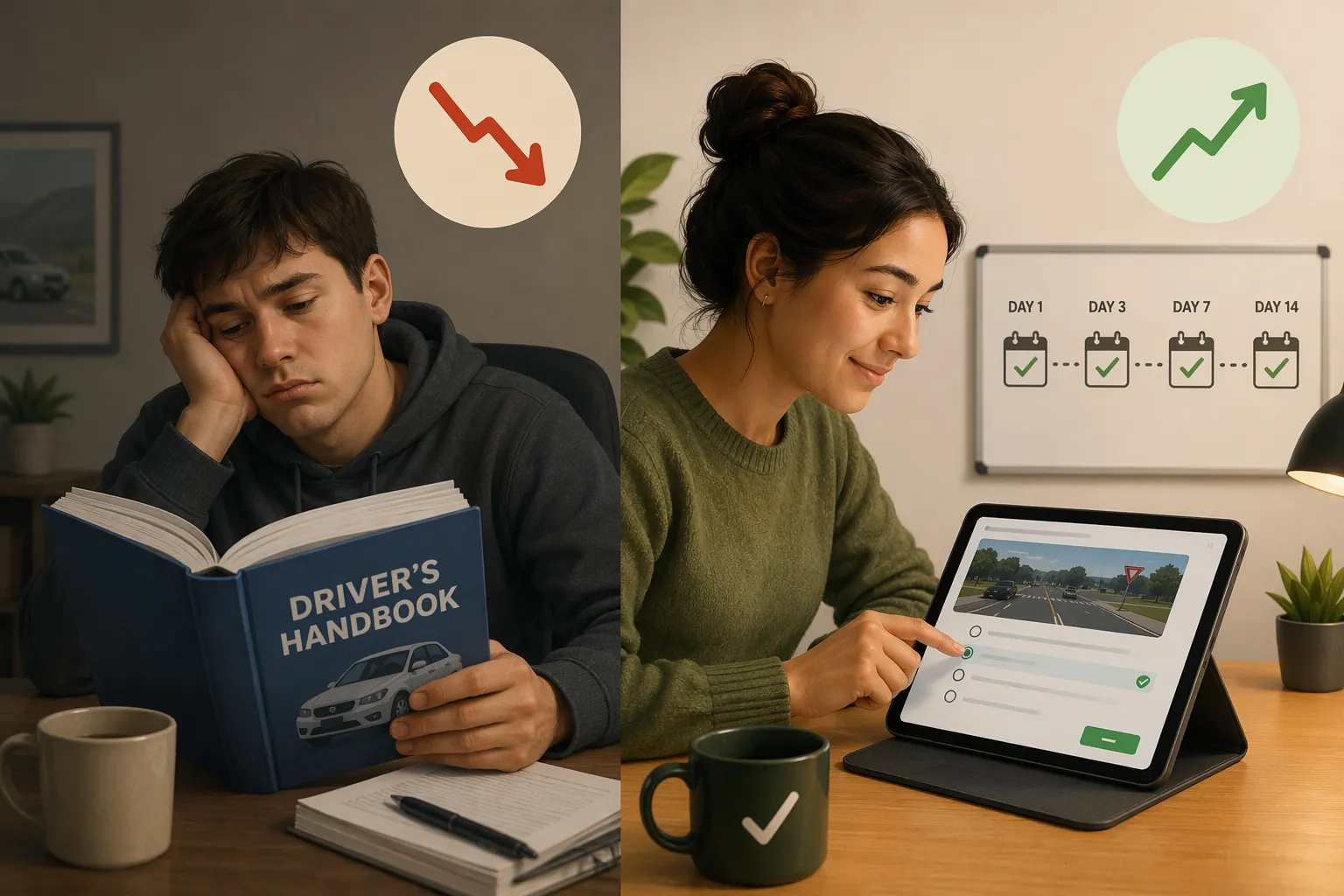
The better question is not “How many more times should I read the handbook?” It is “Which study behaviors match the way this test actually measures memory?” The DMV written test asks you to recognize and apply rules under pressure: right-of-way, signs, alcohol limits, parking colors, speed rules, and California-specific details that are easy to confuse. That makes passive familiarity a weak substitute for retrieval practice.
Know the Format Before You Choose a Study Method
California does not give every applicant the same written-test format. Under-18 applicants are told to answer 46 questions and need 38 correct to pass. Adults 18 and older are told to answer 36 questions and need 30 correct.[2] Because third-party pages sometimes repeat old or conflicting numbers, the official DMV instruction permit page should be the source you check before your appointment.[2]
| Applicant group | Official format to verify | Practical meaning for study |
|---|---|---|
| Under 18 | 46 questions; 38 correct to pass | You can miss 8. A few weak topic clusters can use up the margin quickly. |
| 18 and older | 36 questions; 30 correct to pass | You can miss 6. Practice sessions should be scored, not just completed. |
The retake rules also matter. California DMV materials say you must wait 7 days between knowledge test attempts and that an application allows 3 attempts within 12 months.[2] That turns a bad study method into a real cost: another wait, another appointment problem, and for some people another week of depending on rides.
Evidence Grades for Common DMV Study Methods
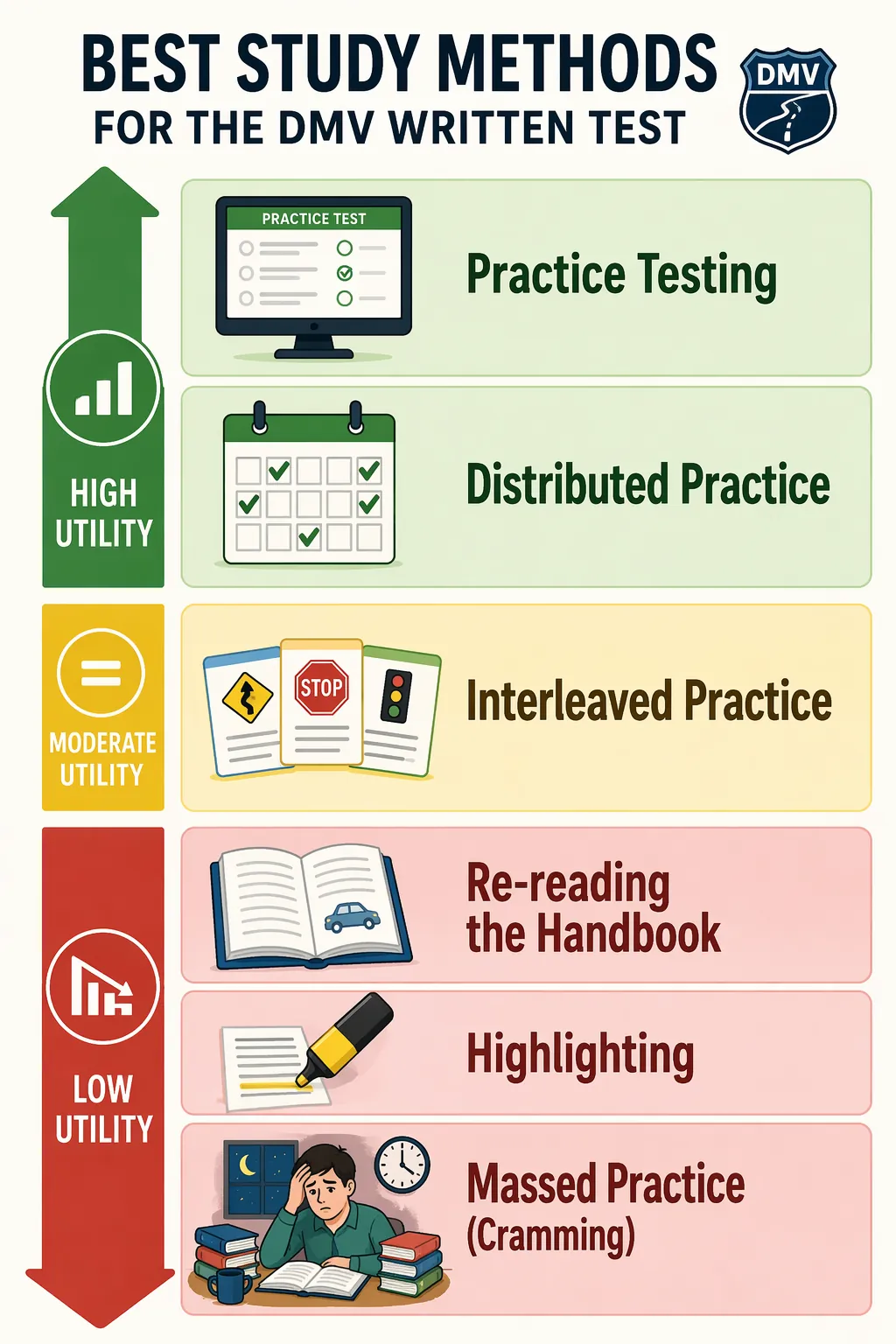
The evidence grades here come from Dunlosky and colleagues’ 2013 review of learning techniques in Psychological Science in the Public Interest. The paper was not a DMV-specific experiment. It reviewed general academic learning, so applying it to permit-test prep is a synthesis. The reason the synthesis is reasonable is that the DMV test still depends on durable memory, discrimination between similar rules, and the ability to retrieve an answer without the handbook open.[3]
| Study behavior | Evidence grade for this use | How it translates to DMV prep |
|---|---|---|
| Practice testing | High utility | Answer questions from memory, score them, and review why wrong answers were tempting. |
| Distributed practice | High utility | Spread short sessions across days instead of doing one long cram session. |
| Elaboration and self-explanation | Moderate utility | Explain why a rule exists, especially for right-of-way, BAC, and parking rules. |
| Interleaved practice | Moderate utility for this use | Mix topic types so signs, speed rules, alcohol limits, and right-of-way do not stay in separate mental boxes. |
| Re-reading the handbook | Low utility when used alone | Use it to repair missed topics, not as the main event. |
| Highlighting | Low utility when used alone | It can mark material, but it does not prove you can retrieve it. |
| Cramming | Low utility | It may create short-term familiarity, but it is a poor match for a test with narrow margins. |
This is the point where a lot of DMV advice goes soft. It tells you to “study the handbook,” “take practice tests,” and “review mistakes” as if those are equal actions. They are not. Re-reading gives you recognition: “I have seen this before.” Practice testing forces retrieval: “Can I produce the answer now, without help?” The DMV exam rewards the second behavior.
Use Practice Tests as Retrieval, Not as a Warm-Up
The DMV provides official sample driver’s license knowledge tests, and those should be your anchor because they come from the agency responsible for the official test materials.[4] Third-party practice tests can still be useful, especially for volume, but they are not official. Treat them as extra retrieval practice, not as proof that you have seen every possible DMV question.
A useful practice-test session has four parts: answer without looking anything up, score immediately, sort every missed question by topic, and write the rule in your own words. The last step is where many test-takers stop too early. If you only memorize that one answer was “C,” you have prepared for that exact item. If you write the rule behind it, you have prepared for nearby questions.
- Bad review: “I missed the intersection question. Remember the answer.”
- Better review: “At an uncontrolled intersection, identify who arrived first, then apply right-of-way rules if vehicles arrive at the same time.”
- Bad review: “I always forget curb colors.”
- Better review: “Make a curb-color grid, then test myself by covering the allowed action column.”
Do not burn the official sample questions all at once. Use a small set early to learn the style, then save some for later checks. If you need more volume, use third-party questions, but keep a visible label in your notes: official DMV sample, DMV handbook rule, or third-party practice item. That separation prevents a commercial explanation from quietly becoming “what the DMV says.”
One third-party platform reported in July 2026 that only 11% of its California practice-test users scored 90% to 100%.[5] That is not statewide DMV data and should not be generalized as if it were. It does, however, fit a familiar pattern: many people can complete practice questions while still sitting close to the passing line.
Spread the Work: A 14-Day Protocol
Distributed practice is the other high-utility method from the Dunlosky framework.[3] It also matches the DMV’s own practical advice to give yourself a few days instead of waiting until the night before.[6] For a permit test, “spaced repetition” does not need to become a complicated flashcard system. It can be a short, dated protocol that makes you retrieve the same rule after forgetting has had time to begin.
| Day | Main action | What to record |
|---|---|---|
| Day 1 | Take a short diagnostic set using official sample questions if available. | Missed topic clusters, not just score. |
| Days 2-3 | Read only the handbook sections connected to misses. | One-sentence rule explanations. |
| Days 4-5 | Take mixed practice sets from memory. | Score and repeat-miss topics. |
| Days 6-7 | Restudy the 2-3 weakest clusters with self-explanation. | Why the correct rule exists or what danger it prevents. |
| Days 8-10 | Run timed mixed practice, including signs and rule questions together. | Whether mistakes come from memory gaps or confusing similar options. |
| Days 11-12 | Return to official DMV samples and handbook language. | Any official wording you keep misreading. |
| Day 13 | Do one final scored mixed set. | Only the last weak items. |
| Day 14 | Light retrieval: missed-rule sheet, signs, curb colors, BAC limits. | No new question marathon. |
The point of this schedule is not that 14 days is magic. It is that the test-taker meets the same rule on more than one day, in more than one format, and without the answer visible. If your appointment is closer, compress the plan by preserving the order: diagnostic, targeted reading, mixed retrieval, official sample check. If your appointment is farther away, add rest days rather than turning every night into a long handbook session.
If you already use study schedules for school or licensing exams, the same logic applies here: past-paper style practice is valuable because it shows what you can retrieve under exam-like conditions, not because paper itself is special. A similar planning approach appears in phased revision with past papers and in building a custom study timetable that works.
Aim Your Practice at the Topics People Actually Miss
Commonly missed California permit-test topics reported across driver-education and practice-test publishers cluster around right-of-way, BAC limits, speed rules, curb colors and parking, sign look-alikes, and light-rail vehicle rules.[7][8][9][10] These sources are not DMV pass-rate audits, so they should be used as diagnostic guidance, not as a ranked official list.
| Failure cluster | Why passive reading misses it | Better practice move |
|---|---|---|
| Right-of-way | The rule feels obvious until several vehicles arrive in a slightly different order. | Draw small intersection sketches and explain who moves first. |
| BAC limits | Similar percentages blur together. | Make a three-row recall card: 21+, under 21, enhanced penalty threshold. |
| Speed rules | Default limits and conditional limits get mixed. | Practice with short scenarios: school zone, residential street, unsafe conditions. |
| Curb colors and parking | Color labels are easy to recognize but harder to act on. | Cover the rule column and retrieve what red, yellow, blue, white, and green allow. |
| Sign look-alikes | Shape, color, and symbol compete for attention. | Mix similar signs in one set instead of studying one sign category at a time. |
| Light-rail rules | Many drivers have little real-life exposure to them. | Read the handbook section, then answer scenario questions from memory. |
This is where elaboration earns its place. For a BAC rule, you may need plain memorization first. For right-of-way, memorization alone is brittle. Ask why the rule reduces conflict: who has already committed to the intersection, who has the clearer path, who is more vulnerable, or what a driver behind you would expect. You are not writing an essay at the DMV kiosk, but the explanation helps the rule survive when the answer choices are worded differently.
Interleaving helps for the same reason. If you study all alcohol rules, then all signs, then all parking colors, you may perform well inside each block because your brain knows the category in advance. The real test does not politely announce, “Now we are doing curb colors.” Mixed sets force you to identify the kind of rule before you answer it.
Be Careful With Claims About Adaptive Difficulty
Some third-party prep materials describe California’s written test as using a LOFT-style system that adjusts questions based on prior answers, including the claim that early wrong answers can trigger harder follow-ups.[5] That claim should not be treated as an official DMV disclosure unless the DMV itself publishes it. The safe study conclusion is narrower: mixed practice is valuable whether or not the live test adapts, because it trains you to switch between rule types without a warm-up.
The DMV does publish the handbook, official preparation pages, and sample knowledge tests.[4][6][11] Use those as the authority for rules and eligibility. Use outside practice banks for extra retrieval only after you accept that their explanations, score claims, and difficulty models are third-party observations.
A Compact Plan for the Week Before the Test
If the appointment is close, do not try to compensate by rereading the entire handbook every night. Use the remaining time to create more retrieval attempts and fewer illusions of familiarity.
- Take one mixed practice set from memory and score it against the correct answers.
- Sort every miss into a cluster: right-of-way, BAC, speed, parking, signs, light rail, or other.
- Read only the official handbook sections tied to those misses.
- Write the corrected rule in your own words, then cover it and retrieve it later.
- Run another mixed set the next day, not five minutes later, so spacing can do its work.
- Use official DMV samples near the end to check wording and format.
For an under-18 applicant, the target is 38 correct out of 46; for an adult, it is 30 correct out of 36.[2] A practice score barely above that line should not be treated as comfortable, especially if the misses come from the same two clusters. A practice score below that line is not a moral failure. It is a useful diagnostic if you respond by changing the method.
No study method can guarantee a pass. But the highest-utility choice is clear enough: replace passive handbook re-reading with spaced practice testing, then use the handbook to repair the misses your practice exposes. That is a better use of the next study hour than highlighting another page you already recognize.
References
- California’s high fail rate of the DMV written knowledge test, The Sacramento Bee, July 2022
- Instruction and Learner’s Permits, California DMV
- Improving Students’ Learning With Effective Learning Techniques, Psychological Science in the Public Interest, 2013
- Sample Driver’s License Knowledge Tests, California DMV
- Free CA DMV Practice Test, Driving-Tests.org, July 2026
- Prepare for Knowledge and Drive Tests, California DMV
- Most-Missed Questions on the California Permit Test, DriversEd.com
- Most Commonly Missed Questions on the California Permit Practice Test, San Diego Magazine
- How to Pass Your CA DMV Written Test in 2026, Zutobi
- 45% Pass/Fail Rate on CA DMV Written Test, DMVCheatSheets
- California Driver’s Handbook, California DMV
Related exhibits & inventory
Verified outcomes
No verified outcomes on file for this exam yet
See Methodology for how outcome evidence is disclosed once logged.
Planners
No planner filed for this exam yet
A downloadable timeline template for this exam hasn't been published yet.
Tool verdicts
AI-tool cautions
No AI tools tested for this exam yet
No hands-on AI-accuracy logs have been filed for this exam.
Questions about this plan
Ask a question about a specific section, timeline, or citation in this plan — or flag something that needs correcting.
Comments
Join the discussion with an anonymous comment.