
MCAT Exam Hub
The Burmese Python Invasion and the Everglades Trophic Cascade
The Burmese python invasion of the Florida Everglades caused declines of 88–100% in multiple mammal species, providing the clearest modern example of an introduced apex predator triggering a trophic cascade — essential ecology evidence for MCAT biology.
- SAT
- ACT
- GRE
- MCAT
- ASVAB
- digital-sat
- adaptive-testing
- registration-fee
- content-outline
- score-target
For MCAT biology, the Burmese python Everglades ecosystem impact is useful because it is not just an invasive-species story. It is a clean field example of an introduced apex predator producing top-down effects: a large predator becomes established, mammal encounter rates collapse, and the decline is strongest where the predator has been present longest and densest. That last part matters most. On an exam passage, the strongest evidence is rarely one shocking number by itself; it is the pattern that makes competing explanations harder to defend.
The load-bearing evidence comes from Dorcas et al. in PNAS. The study compared mammal encounter rates from road surveys before and after Burmese pythons became established, using 56,971 km of surveys across 1996–1997 and 2003–2011. In Everglades National Park, raccoon observations declined by 99.3%, opossum observations by 98.9%, bobcat observations by 87.5%, and white-tailed deer observations by 94.1%; rabbits and foxes were not observed at all after 2003 in those surveys.[1]
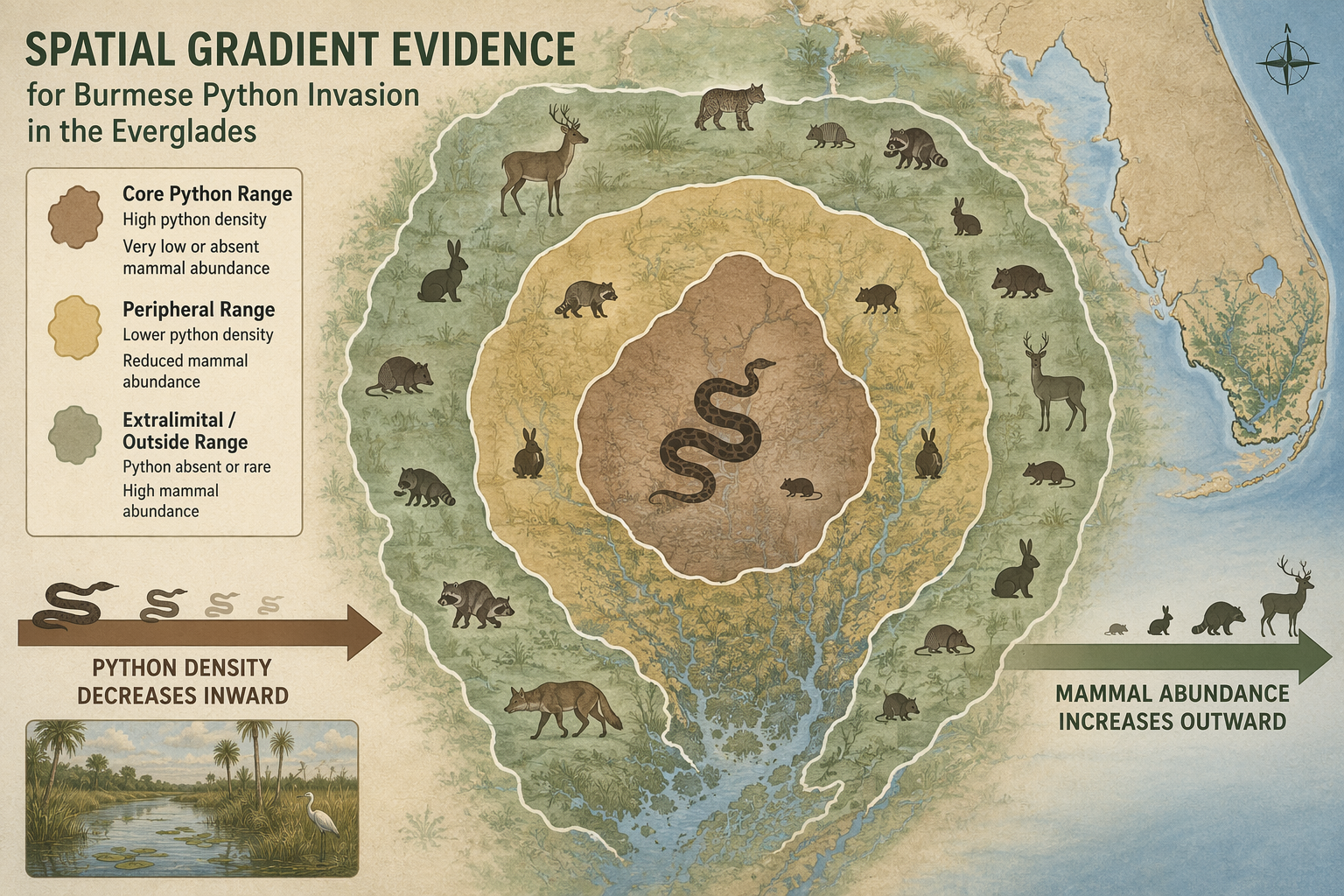
The evidence pattern: not just fewer mammals, but fewer mammals in the right places
If a passage only told you that mammals declined in the Everglades after pythons appeared, you would still need to ask about habitat change, water management, disease, road-survey bias, or some broader regional factor. The Dorcas study is stronger because it gives a spatial gradient. Mammal encounter rates were lowest in the core python range inside Everglades National Park, intermediate at peripheral sites such as Big Cypress National Preserve where pythons arrived later and at lower density, and highest at extralimital sites north of the python range.[1]
That is the kind of design MCAT passages love. The independent variable is not experimentally assigned, but the geography creates a natural comparison. If a disease or region-wide habitat shift were the main driver, you would not expect the cleanest mammal collapse exactly where python establishment was earliest and strongest, with less severe effects at the edge and higher mammal encounter rates outside the range. The pattern does not eliminate every possible confounder, but it moves the python-predation explanation from plausible to strongly supported.
| Evidence item | What it shows | Evidence strength for MCAT use |
|---|---|---|
| Near-total mammal declines in road surveys | Large mammal encounter-rate decreases after python establishment | High |
| Core–peripheral–outside spatial gradient | Declines track python range and establishment intensity | High |
| No comparable native constrictor for roughly 16 million years | Native mammals faced a novel predator type | High |
| Possible changes in turtle or crocodilian nest predation | Indirect effects may follow from raccoon decline | Moderate |
| Reduced mammal prey for Florida panthers | Apex-predator effects may propagate to other predators | Moderate |
Notice what the main numbers measure. They are not population counts of every raccoon, opossum, bobcat, deer, rabbit, or fox in the Everglades. They are encounter rates from standardized road surveys. That distinction matters because an exam answer may try to trap you into treating encounter-rate data as a complete census. The evidence is still strong, but the measurement is sightings per survey effort, not direct enumeration of every individual.
Why Burmese pythons function as a novel apex predator
Burmese pythons are not just another predator added to an already predator-rich wetland. Dorcas et al. note that the Everglades has not had a native constrictor of comparable size for roughly 16 million years.[1] That makes the invasion biologically different from a small increase in a familiar predator. Native mammals may have defenses against alligators, panthers, bobcats, raptors, or human disturbance, but those defenses do not automatically transfer to a large ambush constrictor capable of consuming a wide range of mammal prey.
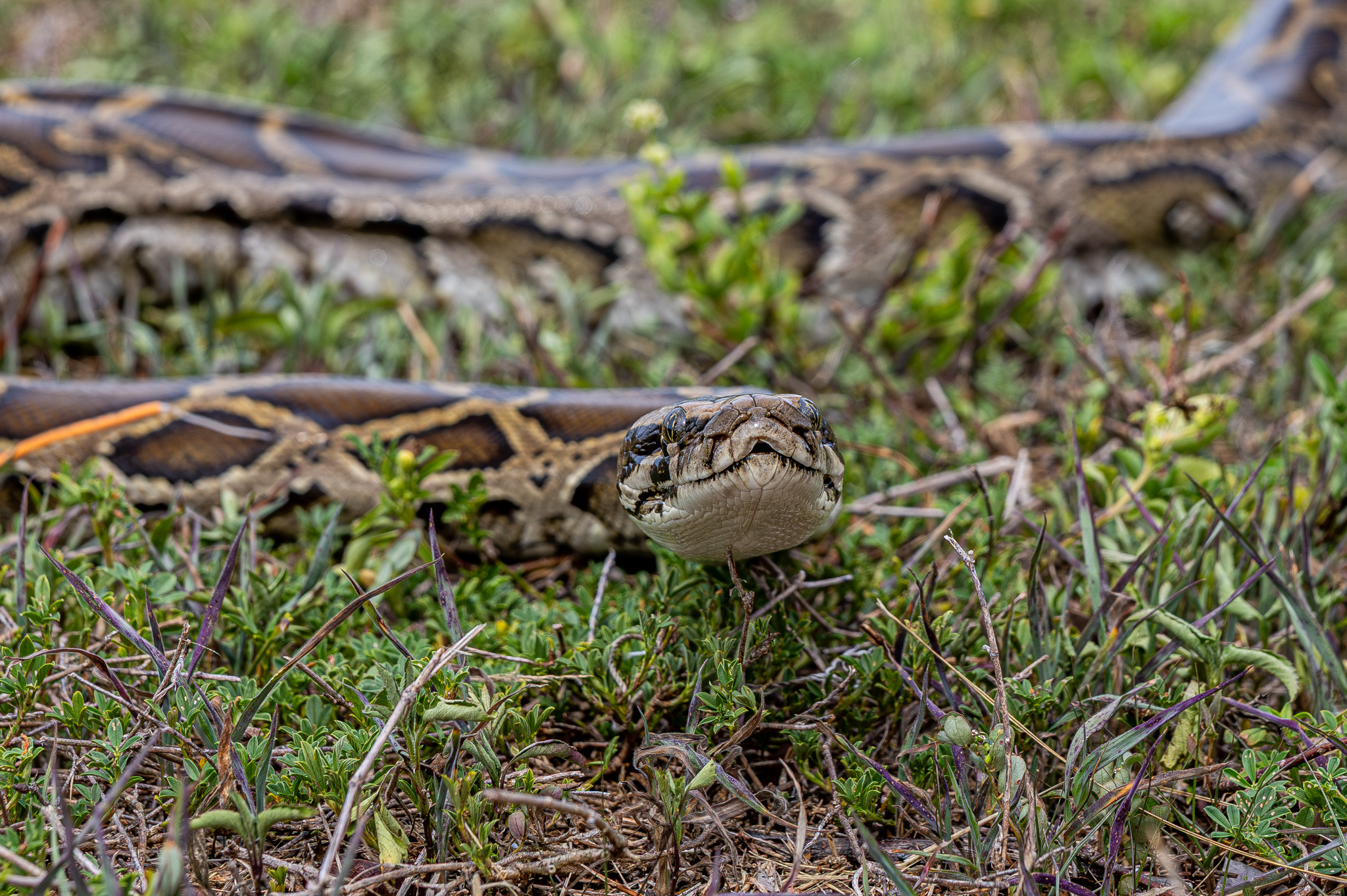
This is where the phrase “introduced apex predator” earns its keep. “Introduced” tells you the species arrived outside its native range. “Apex predator” tells you it occupies a high trophic position with few predators controlling its adult population. “Novel” tells you why prey vulnerability may be unusually high: the prey community did not evolve with that predator’s hunting mode. Put together, those three ideas explain why the python can exert top-down pressure rather than merely joining the background noise of the food web.
How to translate the case into MCAT ecology
The MCAT version of this case is compact:
- Invasive species: Burmese pythons became established outside their native range in the Everglades.
- Predator-prey dynamics: pythons prey on mammals, and mammal encounter rates declined sharply after python establishment.
- Top-down control: a high-level predator changes the abundance of organisms below it in the food web.
- Trophic cascade: changes at one trophic level can propagate to other levels or ecological interactions.
- Confounding-variable reasoning: the spatial gradient strengthens the causal interpretation because the decline tracks python range rather than merely time.
A common student mistake is to memorize “trophic cascade = predator affects plants” because many textbook examples use wolves, deer, and vegetation. That version is too narrow. A trophic cascade means a change at one trophic level causes indirect effects elsewhere in the ecological network. In the Everglades, the direct, high-evidence step is python predation associated with mammal decline. The downstream consequences are more complicated and should be labeled more carefully.
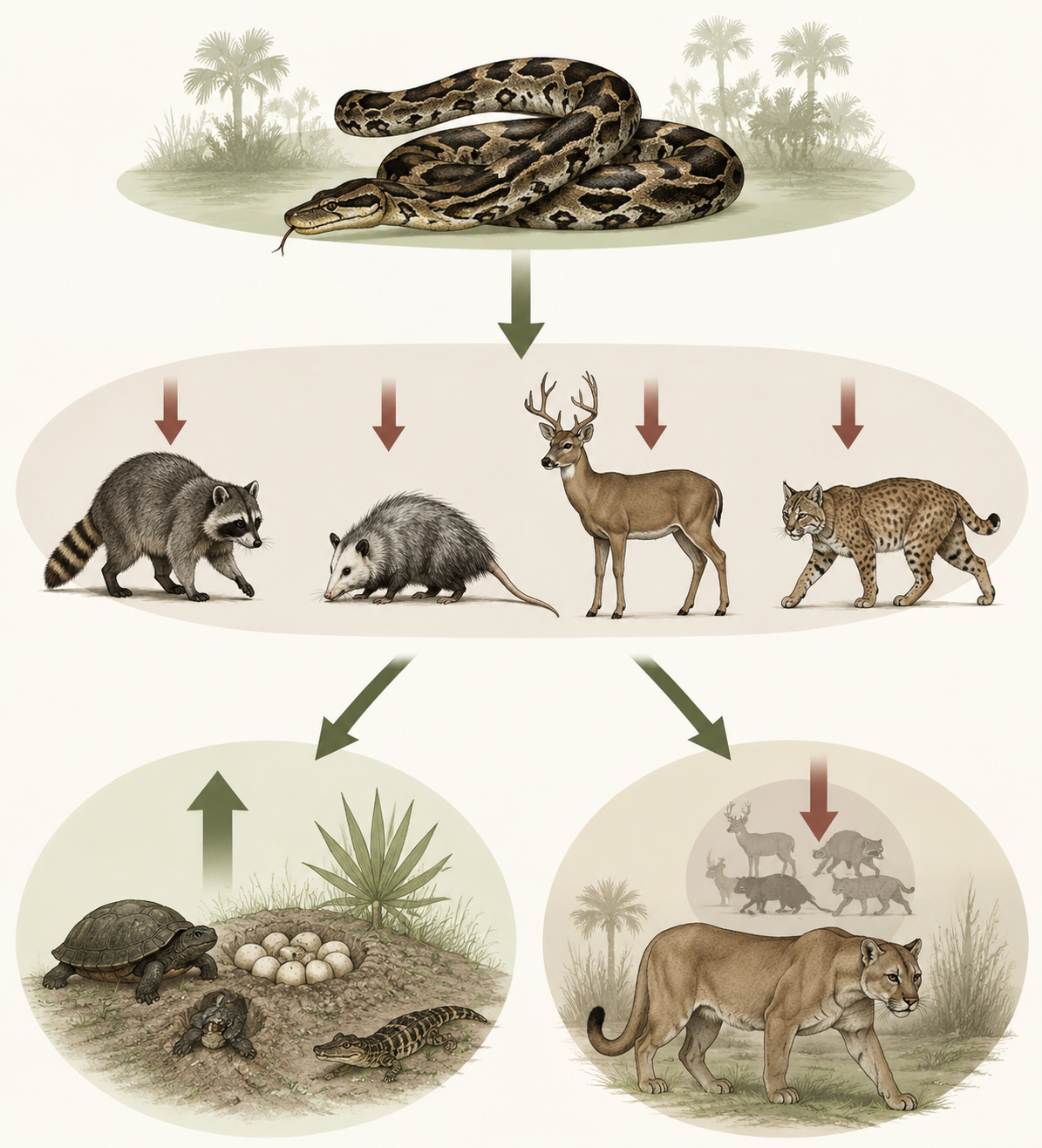
Direct effect: mammal loss is the high-evidence part
The strongest claim is direct: after pythons became established, several mammal species were encountered far less often, and the severity of decline tracked python geography. That is enough for an exam passage to support top-down predation as the primary driver. The raccoon and opossum declines are especially useful anchors because they are nearly complete, while the bobcat and deer declines show the effect is not confined to one small prey type.[1]
Indirect effects: plausible, important, but more inferential
The moderate-evidence part is the cascade beyond those mammals. Raccoons are important nest predators, so a severe raccoon decline could increase nesting success for turtles or crocodilians. At the same time, the loss of medium-sized mammals could reduce prey availability for the endangered Florida panther. Those are reasonable ecological consequences, but they are not the same type of evidence as the road-survey mammal declines. In passage terms, treat them as supported inferences unless the passage gives direct nest-survival or panther-diet data.
That distinction is not nitpicking. MCAT questions often ask whether a conclusion is “supported,” “most strongly supported,” or “requires further evidence.” Python-associated mammal decline is strongly supported by the cited field pattern. A downstream increase in turtle nesting success may be biologically sensible, but without direct measurements in the passage, it remains a next-step hypothesis rather than the central result.
Arrival history is context, not the main proof
The usual backstory is that Burmese pythons entered Florida through the pet trade, with releases and escapes helping establish the population. Hurricane Andrew in 1992 is often discussed as one route by which captive snakes may have been released from damaged facilities, and a breeding population was recognized around 2000. Later policy responses included a 2012 federal import ban under the Lacey Act and Florida’s 2021 Prohibited species classification.
For exam reasoning, that timeline mainly helps you place the before-and-after comparison. It is not the strongest evidence that pythons caused the mammal declines. The stronger evidence is that mammal encounter rates fell after establishment and did so most severely in the core python range.
Why the invasion remains difficult to reverse
One reason this case has not faded into a solved management story is detectability. Reported estimates place detection probability below 1%, which means most pythons present on the landscape are not seen during search efforts. Population estimates are correspondingly wide, often given as roughly 30,000–300,000 individuals rather than a precise count. That range should be read as a warning about uncertainty, not as a clean census result.
Management programs still remove snakes. Scout-snake programs use radio-tagged male pythons to locate breeding females, and recent removal efforts have reported thousands of pounds of python biomass removed and thousands of eggs prevented from hatching. Total removals since 2000 have been reported at more than 15,000 individuals. Those numbers show continued pressure on the population, but they do not imply eradication is likely when detection is so low.
The invasion also illustrates another invasive-species mechanism: pathogen or parasite movement. The Asian lungworm Raillietiella orientalis has been reported in native Florida snakes after spillover from pythons, showing that an introduced predator can matter not only by eating prey but also by moving parasites into new host communities. That is a separate mechanism from the mammal-collapse evidence and should not be blended into the same causal claim.
How this case would appear in an MCAT passage
If the passage gives a table with python density by region and mammal encounter rates by region, the safest move is to look for a gradient. Core python range plus lowest mammal abundance, peripheral range plus intermediate abundance, outside range plus highest abundance: that is the causal shape. A tempting wrong answer may point to “environmental change throughout South Florida,” but a broad regional explanation has trouble explaining why the decline tracks python establishment so closely.
If the question asks for the best definition of top-down regulation, choose the answer in which a predator changes prey abundance or community structure below it. If it asks for a trophic cascade, choose the answer that carries the effect beyond the immediate predator-prey pair, such as altered nest predation after raccoon decline or altered food availability for another predator. If it asks for the strongest evidence of causation, choose the matched timing and geography rather than the largest single percentage.
The reason this example is unusually strong is the alignment of timing, geography, predator novelty, and prey collapse.
References
Related exhibits & inventory
Verified outcomes
Planners
No planner filed for this exam yet
A downloadable timeline template for this exam hasn't been published yet.
Tool verdicts
Questions about this plan
Ask a question about a specific section, timeline, or citation in this plan — or flag something that needs correcting.
Comments
Join the discussion with an anonymous comment.