
SSAT Exam Hub
Your 6-Month Boarding School Entrance Exam Prep Plan
Learn which entrance exam (SSAT, ISEE, or HSPT) you need for boarding school, how to build a structured 6-month study timeline, and key test-taking strategies like handling the SSAT guessing penalty and pacing for the HSPT.
- SAT
- ACT
- GRE
- MCAT
- ASVAB
- digital-sat
- adaptive-testing
- registration-fee
- content-outline
- score-target
Most boarding school preparation tips for students start too late in the wrong place. They tell you how to label clothes, write thank-you notes, decorate a dorm room, and handle homesickness. Those things matter. But six months before applications are due, the more urgent question is usually simpler: which entrance exam are you actually taking?
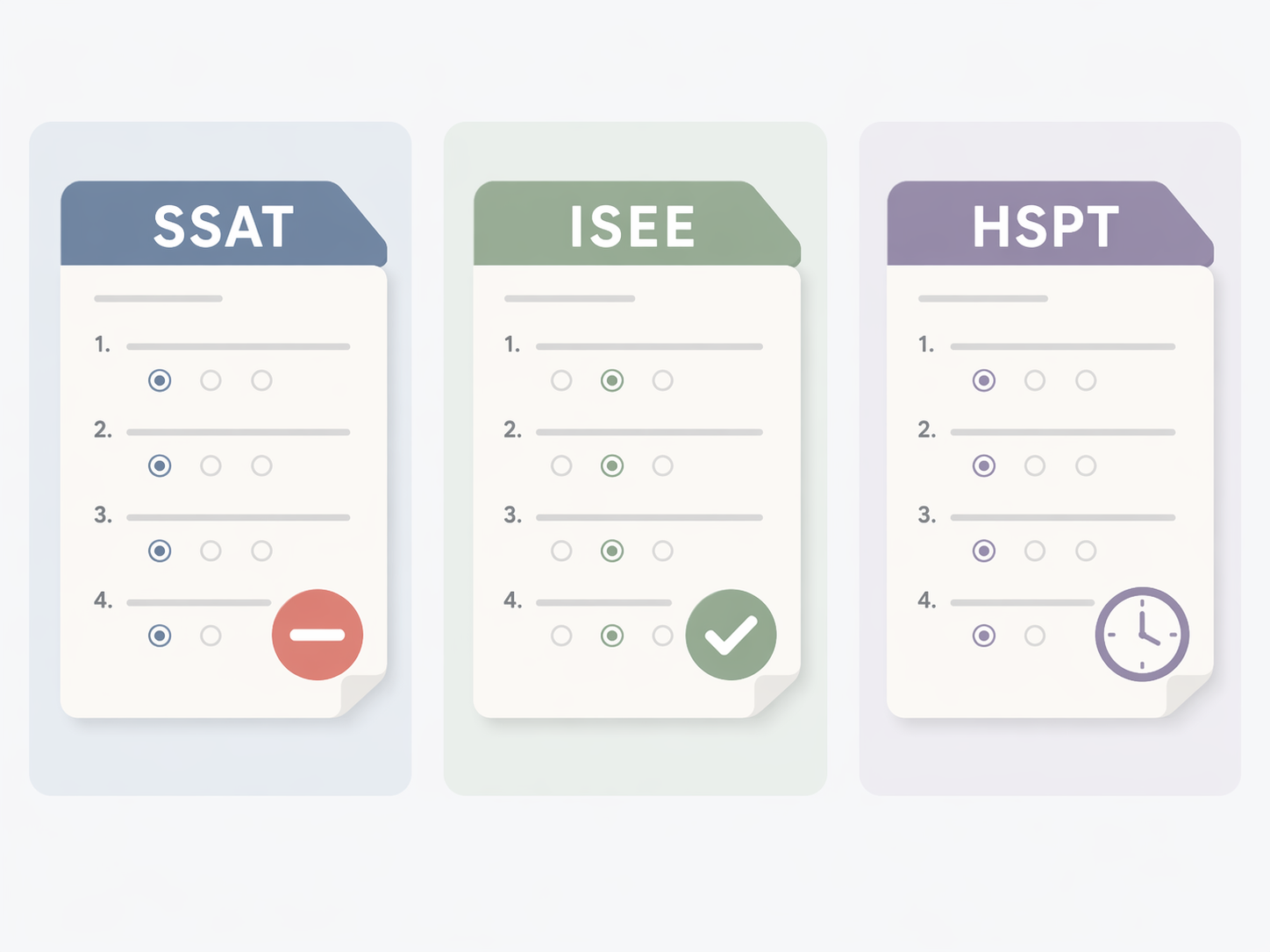
For many U.S. boarding school applicants, that exam is the SSAT, ISEE, or HSPT. The rules are not interchangeable. On the SSAT Middle and Upper Levels, a wrong answer costs 1/4 point; on the ISEE and HSPT, there is no wrong-answer penalty.[1] The HSPT also asks students to move unusually fast: about 298 questions in about 150 minutes, or roughly 40 seconds per question.[1] Those details are not trivia. They change what you practice on a Tuesday afternoon after school.
First, Identify the Exam You Need
Do not build a study plan around “boarding school tests” in general. Start with the admissions pages for each school on your list, then confirm the exam, level, test date options, score-reporting rules, and whether the school accepts more than one exam. If the admissions page is unclear, ask the admissions office directly. This is a parent-helpful task, but the student should still know the answer. You cannot prepare intelligently for a test you cannot name.
| Exam | Rule That Changes Your Prep | What It Means for Study |
|---|---|---|
| SSAT | Middle and Upper Level wrong answers lose 1/4 point.[1] | Practice selective guessing, skipping, and returning instead of filling every bubble automatically. |
| ISEE | No penalty for wrong answers.[1] | Answer every question; pacing practice should include leaving no blanks. |
| HSPT | About 298 questions in about 150 minutes.[1] | Train speed, recognition, and calm decision-making under tight time pressure. |
| TOEFL | For some international applicants, a TOEFL score of 100+ is often required before SSAT scores are evaluated.[2] | Confirm whether English-proficiency testing comes before, alongside, or instead of other testing. |
If you are applying to very selective schools, test scores may also carry more weight than generic advice admits. Cardinal Education reports that schools such as Phillips Exeter, Andover, and Deerfield typically expect SSAT or ISEE scores around the 85th to 90th percentile for competitive applicants.[1] That is not an official published minimum, and it should not be treated like a guarantee or a cutoff. It is still useful context: at that level, “I’ll review a little in the fall” is not much of a plan.
The 6-Month Prep Plan
A 4-to-6-month prep window is a recommended practice from Cardinal Education’s work with families, not a controlled study proving one perfect timeline.[1] Still, it matches the reality of middle school schedules. You need time for schoolwork, sports, family obligations, and the occasional week when you are simply tired. A plan that depends on heroic studying in the final two weeks is not a plan; it is a stress machine.
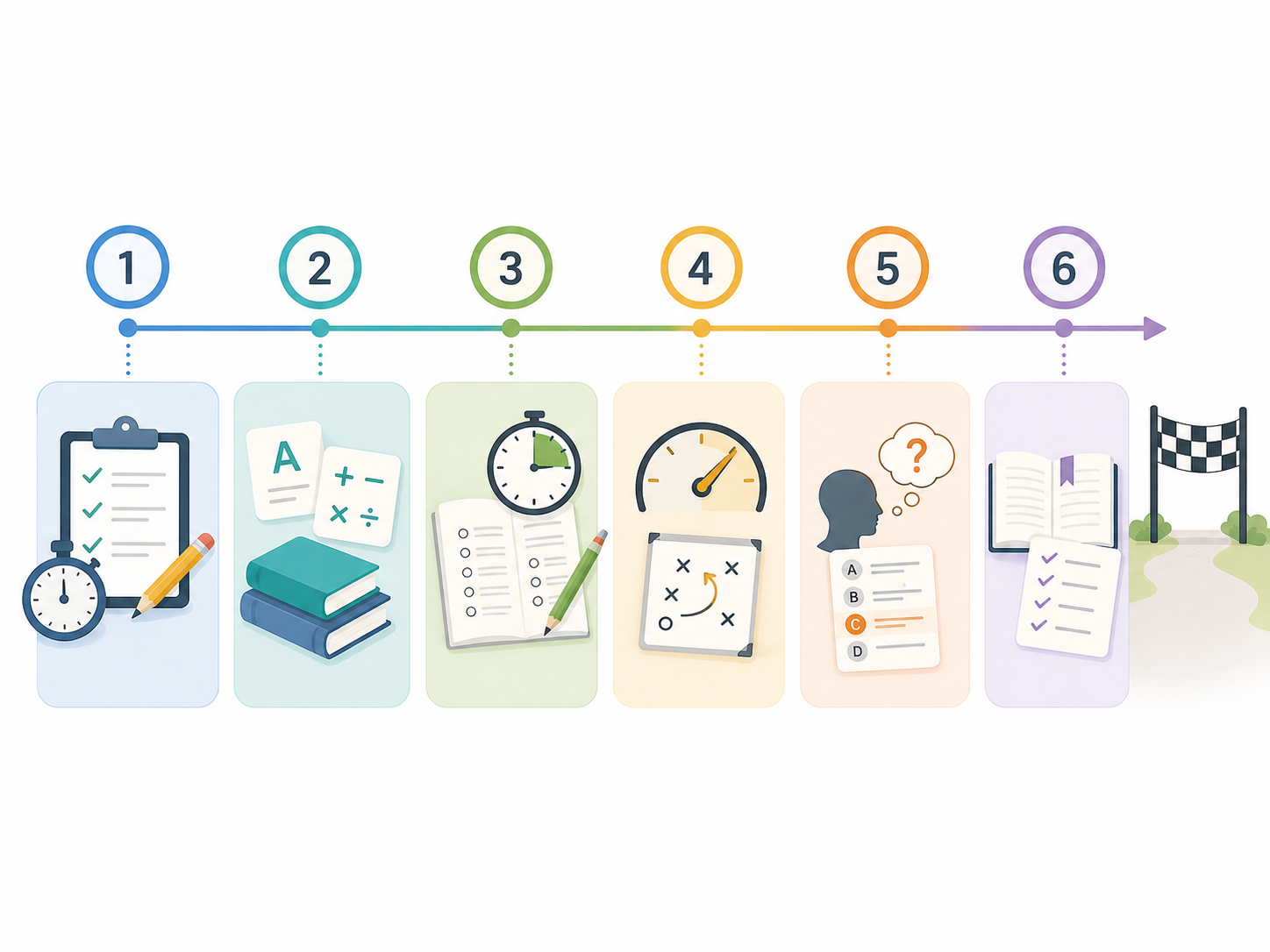
Use the table as the backbone, then adjust it around your actual test date. If you prefer a printable format, put the blocks into a revision timetable. If you live by your phone, a schedule app can work too, as long as it shows missed sessions honestly instead of letting them disappear. The point is not the format; it is that every week has a job.
| Timing | Main Job | What to Do |
|---|---|---|
| 6 months out | Confirm the exam and take a diagnostic | List each school’s required exam, register or choose likely dates, take one full diagnostic or official-style practice test, and write down your section scores and timing problems. |
| 5 months out | Build foundations | Study vocabulary, core math topics, reading accuracy, and grammar or verbal skills before trying to race through full tests. |
| 4 months out | Create a weekly routine | Set 3–5 study blocks per week, rotate sections, and start an error log that records why each missed question happened. |
| 3 months out | Move into timed section practice | Practice one section at a time under time limits, then review slowly enough to find patterns. |
| 2 months out | Rehearse test-specific strategy | Train SSAT skipping decisions, ISEE no-blank behavior, or HSPT speed, depending on your exam. |
| 1 month out | Simulate and stabilize | Take full-length practice tests, fix repeat errors, finalize test-day pacing, and taper heavy studying before the exam. |
6 Months Out: Make the Test Real
The first week is administrative, but it is not optional. Confirm whether each school wants the SSAT, ISEE, HSPT, TOEFL, or another requirement. Put the test date, registration deadline, and score-send deadline in one place. If a parent manages the calendar, ask to see it. You should not be surprised by your own exam date.
Then take a diagnostic. Not after you “study a little first.” Not after you feel ready. The diagnostic tells you what ready will require. It should show your weakest sections, your timing habits, and whether your wrong answers come from content gaps, careless reading, panic, or not knowing the rules.
Keep the diagnostic review simple. For each missed or guessed question, label the reason: content, timing, misread, vocabulary, strategy, or careless work. You are not trying to punish yourself with evidence. You are trying to stop treating “I need to do better” as a study plan.
5 Months Out: Build Vocabulary and Math Before Speed
This is the month when many students get impatient because timed practice feels more official. Resist that for a few weeks. If your vocabulary is thin, the verbal section becomes a guessing game. If your fraction, percent, equation, geometry, or word-problem foundations are shaky, speed practice just teaches you to make the same mistakes faster.
For vocabulary, do not only flip flashcards until words look familiar. Use active recall: see the word, produce the meaning, use it in a phrase, and check whether you were precise. Flashcards can help, but they become a hiding place when you start recognizing card layouts instead of remembering meanings. If you are using a flashcard app, the warning in The Trap of Anki for the MCAT applies here too: tools are useful only when they force retrieval, not when they create the feeling of studying.
For math, keep a running “can’t miss” list. These are not the hardest questions on the test. They are the skills you should be able to perform cleanly because they appear often enough to cost you if they stay weak. Review them in short sets, then mix them with older topics so you do not only perform well when the worksheet title tells you what to do.
4 Months Out: Turn Studying Into a Weekly System
At four months out, your plan should become visible. Three to five study blocks per week is usually more realistic than one giant weekend session. A student with sports might do two 35-minute weekday sessions, one vocabulary review, one math block, and one longer weekend practice set. Another student might prefer shorter daily sessions. Either can work if the schedule survives an ordinary school week.
This is where a planning system matters. A paper calendar makes gaps obvious. A digital planner can handle reminders and rescheduling. If you use an app, read how to use a study schedule app effectively before filling it with perfect-looking blocks you will never follow. A good schedule protects your attention; it does not decorate your anxiety.
Start an error log now. The useful version is small and specific: question type, why you missed it, what rule or concept fixes it, and when you will review it again. If you only write “careless mistake,” you have learned almost nothing. Was it a sign error? A skipped word? A rushed inference? A vocabulary word you thought you knew? That difference tells you what to do next.
3 Months Out: Add Timed Sections Without Abandoning Review
Three months out is when the test begins to feel less theoretical. Add timed sections, but do not turn every session into a race. A timed section gives you data. The review afterward raises your score. If you spend 25 minutes taking a section and 5 minutes checking the answer key, you are mostly measuring yourself, not training yourself.
Use a review cycle: attempt, score, categorize, correct, and retry later. The same process described for SAT practice questions in How to Use SAT Practice Questions to Actually Raise Your Score transfers well to SSAT, ISEE, and HSPT prep. The exam names differ; the learning loop is the same.
A useful weekly pattern at this stage might be one timed verbal or reading section, one math foundations block, one mixed review block, and one short vocabulary or grammar session. If your diagnostic showed a severe weakness, weight the week toward that weakness, but do not ignore the other sections long enough for them to decay.
2 Months Out: Practice the Rules of Your Exam
This is the month when SSAT, ISEE, and HSPT preparation should stop looking the same. Content still matters, but behavior under pressure starts deciding points. You are training the choices you will make when you are unsure, tired, or halfway through a section that is moving faster than you expected.
- SSAT: Practice deciding when to skip. Because wrong answers lose 1/4 point at the Middle and Upper Levels, blind guessing is different from eliminating choices and making a calculated guess.[1]
- ISEE: Practice answering every question. With no wrong-answer penalty, a blank answer is usually a missed opportunity.[1]
- HSPT: Practice speed without letting speed become panic. The question volume means you need quick recognition, clean bubbling, and the ability to move on.[1]
1 Month Out: Simulate, Adjust, and Stop Creating New Chaos
In the final month, take full-length practice seriously. Use the correct timing, breaks, materials, and section order for your exam. If you are taking the test in the morning, do at least one practice test in the morning. Your goal is not to make practice feel dramatic. It is to make the real test feel less strange.
After each full test, choose a small number of fixes. Do not create a 37-item panic list. Pick the errors that are frequent, fixable, and worth points: a recurring math topic, a pacing failure, a vocabulary weakness, a misreading pattern, or a guessing habit that needs adjustment. Then build the next week around those fixes.
The final week should not be a desperate attempt to become a different student. Review your error log, rehearse pacing, sleep normally, prepare test-day materials, and keep your routine boring. Boring is underrated. A 13- or 14-year-old carrying applications, interviews, schoolwork, and family expectations does not need extra surprises.
How Your Strategy Changes by Exam
The biggest mistake is preparing as if all entrance exams reward the same instincts. They do not. A student can be bright, prepared, and still lose points by using the wrong test behavior.
SSAT: Learn When Not to Answer
The SSAT wrong-answer penalty is the rule students need to understand early. At the Middle and Upper Levels, wrong answers lose 1/4 point.[1] That does not mean you should become timid. It means your practice should include decisions about risk.
During review, separate wrong answers into two groups: questions where you had a reason for your answer and questions where you were guessing blindly. The first group may reveal a content gap or misread. The second group is a strategy issue. If blind guesses are dragging your score down, your next practice set should include skipping and returning, not just more content review. For example, you might answer when you can eliminate two choices, skip when you cannot eliminate any, and return only if time remains. Test that rule in practice before trusting it on exam day.
ISEE: Do Not Leave Points Blank
The ISEE has no wrong-answer penalty.[1] That changes the end of every section. If two minutes remain and several questions are blank, your job is not to preserve the purity of your answer sheet. Your job is to make sure every question has an answer.
Practice this directly. In timed ISEE sections, set a checkpoint near the end where you scan for blanks. Learn how long bubbling takes. Learn what it feels like to make a best available choice and move on. Students often think this is too simple to practice. Then they lose points to exactly this simple thing.
HSPT: Speed Is Part of the Content
The HSPT’s pace is not a side detail. With about 298 questions in about 150 minutes, the test gives students roughly 40 seconds per question.[1] That does not allow a long negotiation with every item.
HSPT prep should include rapid mixed practice and short drills with strict time caps. You need to recognize common question types quickly, avoid getting emotionally attached to one hard item, and keep your answer sheet moving. A slow, perfect solution that prevents you from reaching later questions may not be a good test-day trade.
Where Parents Should Help Without Taking Over
Parents can make this process less chaotic by handling the parts that are genuinely adult-sized: registration, fee deadlines, transportation, testing accommodations if applicable, and communication with admissions offices. They can also protect study time from being swallowed by every other application task.
The student still needs ownership of the actual learning loop. That means knowing the weekly plan, writing the error log, noticing patterns, and practicing the test rules. A parent can schedule a diagnostic. A parent cannot take the diagnostic’s lessons into the testing room for you.
If prep format is the sticking point, choose the simplest support that solves the real problem. A book may be enough for a self-directed student. A tutor may help if the student cannot diagnose errors alone. A class may help if structure and accountability are missing. A tool list like Study Tools for Every Learning Style can help you compare formats without pretending one method fits everyone.
Keep the Boarding School Transition in View
Test prep is not the whole boarding school transition. It is just the part that often gets skipped until it becomes urgent. You will still need to think about living away from home, managing your own routines, asking teachers for help, sharing space, and starting over socially.
Boardingschoolreview.com reports that many students begin to feel comfortable within 3 to 6 weeks, while full adaptation may take a full term.[3] That adjustment window is a good reason to finish heavy entrance-exam preparation before the school transition begins. You do not want unresolved test pressure following you into a new campus, new schedule, and new social world.

There is also an admissions uncertainty you cannot study away. A strong score does not guarantee admission, especially at schools where many applicants are academically prepared. What you can control is narrower and more useful: confirm the exam, prepare for its actual rules, review your mistakes, and give yourself enough months that one bad week does not wreck the plan. If anxiety is making everything feel equally urgent, focus on what you can control when studying and let the rest stay outside the study block.
Your Next Four Weeks
If your test is about six months away, do not wait for a perfect master plan. Build the first four weeks now.
- Confirm the required exam for every school on your list: SSAT, ISEE, HSPT, TOEFL, or another requirement.
- Count backward from the test date and mark the 6-month, 3-month, 2-month, and 1-month checkpoints.
- Take one diagnostic under realistic conditions.
- Create an error log with categories for content, timing, misreading, vocabulary, strategy, and careless work.
- Schedule the first four weeks of study blocks before adding interviews, essays, packing lists, and every other boarding school task.
Readiness is not the same as certainty. A structured plan will not promise you a seat at a competitive boarding school. It will reduce the number of avoidable surprises you have to carry into the exam room.
References
- Best Boarding School Entrance Exams Guide, Cardinal Education, 2026
- How to Prepare for Boarding School Entrance Exams: A Parent's Guide, Cardinal Education, 2026
- Preparing Your Child for Boarding School in 2026, Boardingschoolreview.com, 2026
Related exhibits & inventory
Verified outcomes
No verified outcomes on file for this exam yet
See Methodology for how outcome evidence is disclosed once logged.
Planners
No planner filed for this exam yet
A downloadable timeline template for this exam hasn't been published yet.
Tool verdicts
AI-tool cautions
No AI tools tested for this exam yet
No hands-on AI-accuracy logs have been filed for this exam.
Questions about this plan
Ask a question about a specific section, timeline, or citation in this plan — or flag something that needs correcting.
Comments
Join the discussion with an anonymous comment.