
GRE Exam Hub
Use the Biden Recordings Legal Battle as GRE Essay Evidence
Learn how to break down the Biden recordings legal battle into citable evidence for GRE Issue and Argument essays, with four distinct legal frameworks and a dissenting opinion ready for counterarguments.
- SAT
- ACT
- GRE
- MCAT
- ASVAB
- digital-sat
- adaptive-testing
- registration-fee
- content-outline
- score-target
Last reviewed: July 22, 2026. The posture is still live: a stay runs until August 3, 2026, and a Supreme Court petition could still change the record [2].
The GRE payoff is not the political drama. It is the structure: one dispute, four legal handles, and a published dissent, which gives you a compact way to turn a complicated case into usable evidence instead of a fact dump [1].
The case in a few disciplined facts
Biden sued the Justice Department in May 2026 to block release of recordings tied to memoir interviews, relying on executive privilege and Privacy Act claims after the DOJ changed its position under the Trump administration [3]. The recordings came out of Special Counsel Hur's classified-documents investigation, which produced no charges [3]. The D.C. Circuit later affirmed in a 2-1 ruling, so the case is useful to students because it is decided enough to cite, but still open enough to supply a limitation [1][2].
Four legal handles
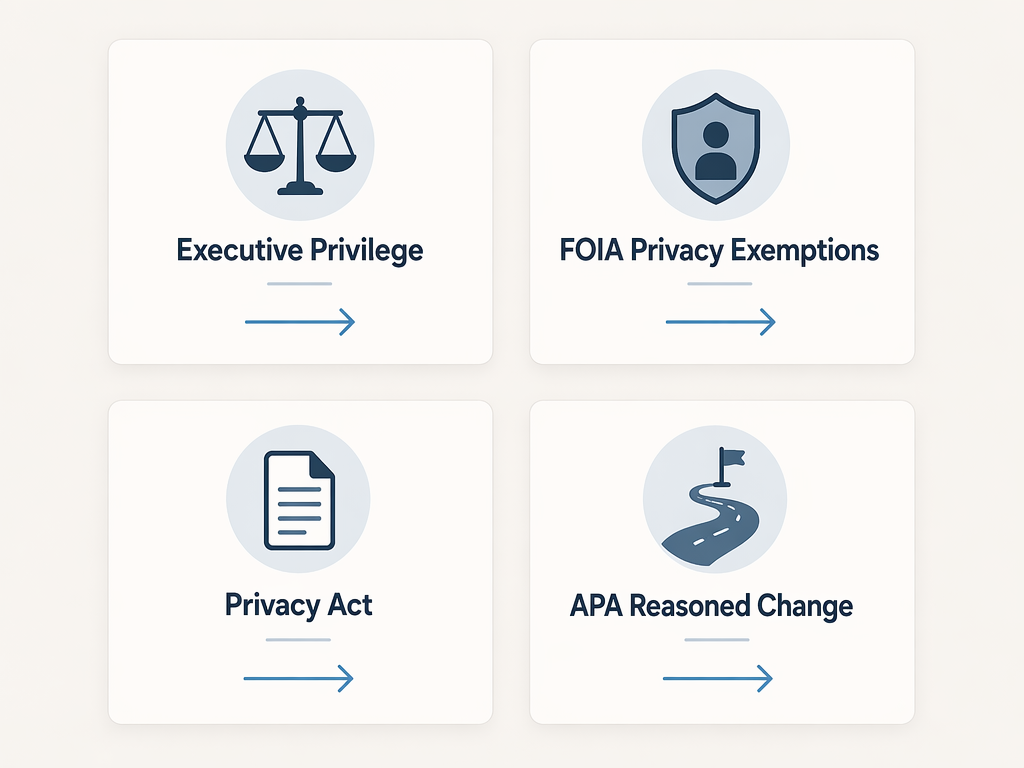
- Executive privilege: This is the cleanest Issue-essay hook. United States v. Nixon says presidential confidentiality matters, but it is presumptive rather than absolute [4][5]. The D.C. Circuit majority used Nixon-style balancing and accepted redactions as enough to protect privacy while still serving the public interest in understanding the Hur investigation's outcome [1]. In an essay, that becomes a point about limits: even important confidentiality claims can yield when accountability interests are concrete.
- FOIA privacy exemptions: These are useful when the prompt asks whether transparency always beats privacy. The case lets you argue that institutions often choose partial disclosure instead of total secrecy, especially when redaction can narrow harm [1]. The limitation is obvious: a redacted release is not the same thing as full openness, so the example supports moderation, not a blanket pro-transparency slogan.
- Privacy Act: This angle is narrower but handy for prompts about personal data, recordkeeping, or the danger of government files being treated as public fodder. Biden's May 2026 suit expressly invoked Privacy Act claims [3], so you can use the case to show that legal systems sometimes protect individuals even when the surrounding issue is politically noisy.
- APA reasoned-change requirements: This is the agency-governance angle. When an agency reverses position, the question is not only whether it may do so, but whether it explains the change in a way that looks reasoned rather than arbitrary. Because the DOJ changed its posture after the administration changed, the case gives you a compact example of why consistency and explanation matter in public administration [3].
A usable paragraph shape
If you are under time pressure, the safest pattern is simple: name the case, name the tension, connect the tension to the prompt, then add the dissent or the stay as a limitation. On a prompt about privacy versus public accountability, this case supports a claim that disclosure can be justified when redaction narrows the privacy cost; on a prompt about executive power, it supports the opposite move that confidentiality is important but not absolute [1][4][5].
Judge Pan's dissent is the counterargument in ready-made form. If you are arguing for disclosure, you can concede that privacy concerns are real and still say the majority found redaction sufficient; if you are arguing for restraint, you can concede the public-interest value of understanding the investigation and still say the dissent shows that reasonable judges saw the balance differently [1].
For a broader evidence bank, pair this case with the GRE hub, the 2026 IP camera hack example, and AI intellectual property theft; the study move is the same even when the subject changes.
References
- “Appeals court denies Biden bid to block release of tapes...” — CBS News — link
- “Appeals court rejects Biden's bid to block release of audio from memoir ghostwriter interviews” — PBS NewsHour — link
- “Biden sues US justice department to block release of recordings” — BBC News — link
- “United States v. Nixon (Tapes Case)” — National Constitution Center — link
- “Executive Privilege” — Legal Information Institute, Cornell Law School — link
Related exhibits & inventory
Verified outcomes
Planners
No planner filed for this exam yet
A downloadable timeline template for this exam hasn't been published yet.
Tool verdicts
AI-tool cautions
No AI tools tested for this exam yet
No hands-on AI-accuracy logs have been filed for this exam.
Questions about this plan
Ask a question about a specific section, timeline, or citation in this plan — or flag something that needs correcting.
Comments
Join the discussion with an anonymous comment.