
Why bear spray outperforms firearms for hunter safety
Hunters often assume their firearm is sufficient for bear defense, but peer-reviewed studies show bear spray stops aggressive bear behavior more reliably. This article reviews the evidence and explains why hunters should carry bear spray as a primary deterrent.
- SAT
- ACT
- GRE
- MCAT
- ASVAB
- digital-sat
- adaptive-testing
- registration-fee
- content-outline
- score-target
The usual objection is fair: a hunter already has a weapon. A rifle, shotgun, handgun, muzzleloader, or bow is not decorative weight. It is there for a reason, and in practiced hands it can stop dangerous animals. But that does not answer the tighter question behind why bear spray is important for hunters: what can you actually get into action when a bear is suddenly close, you are carrying meat or a pack, your hands are not perfectly free, and the encounter is unfolding faster than a clean shot picture?
For most defensive bear encounters, bear spray should be the first tool. The firearm stays in the system as a second layer, not as the only answer. That is not a soft, anti-gun position. It is a hard look at what published outcomes say about close-range bear conflicts and what hunters are actually doing when those conflicts happen.
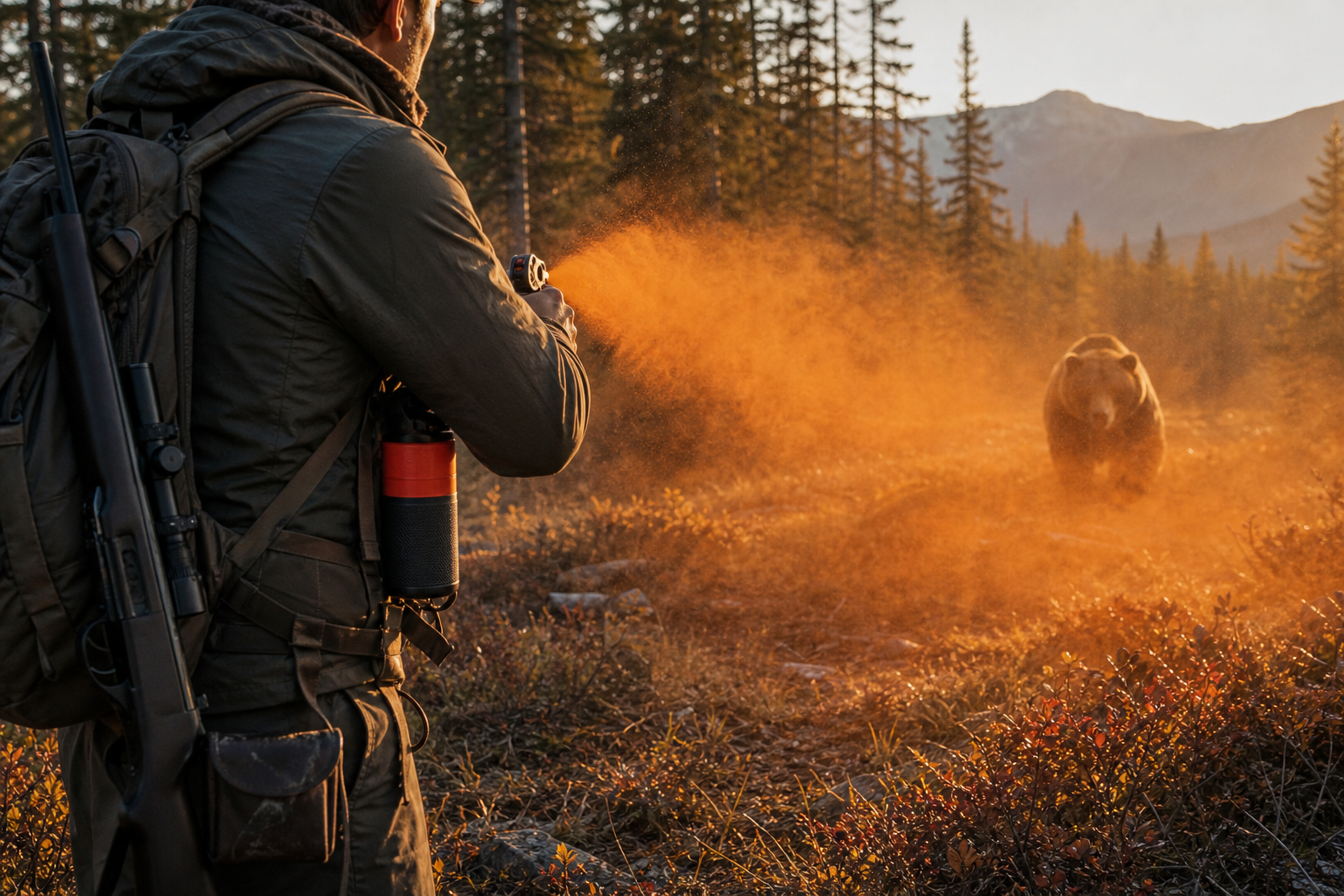
The evidence does not treat “armed” as the same thing as “protected”
The strongest bear spray numbers come from Smith et al.’s Alaska study of bear deterrent spray incidents. In that dataset, bear spray stopped aggressive behavior in 92% of brown bear incidents, 90% of black bear incidents, and 100% of polar bear incidents. The same paper reported that 98% of people carrying spray in close-range encounters escaped uninjured, with only 3 minor injuries across 72 incidents involving 175 people.[1]
Those figures do not prove spray is magic. They come from documented incidents, not a controlled experiment where identical bears charge identical people at identical distances. But they are directly relevant because hunters do not get controlled experiments either. They get surprise, brush, wind, blood scent, fatigue, and imperfect footing.
The firearm comparison is where the gun-alone assumption starts to lose ground. A hunting-specific summary of Smith et al.’s firearm work reports that handguns stopped undesirable bear behavior in 84% of cases and long guns in 76% of cases. More important than the stop rate, the study found that firearm bearers suffered the same injury rates whether or not they used the weapon.[2] That last point is the one a hunter should not skip past. A gun can kill a bear and still fail to reduce the person’s chance of being hurt in the kind of encounter being measured.
The firearm numbers are not always reported identically across secondary sources, and that matters. Some summaries describe a lower overall success rate, while others separate handgun and long-gun outcomes. The useful conclusion is narrower than “guns do not work.” Guns can work. The better conclusion is that documented firearm performance in bear conflicts is less reassuring than many hunters assume, especially when the standard is avoiding injury rather than eventually killing the bear.
Why spray fits the ugly seconds better than a perfect shot
A firearm asks for several things at once. You need access, a safe direction, enough time to shoulder or draw, a sight picture, nerve control, and shot placement that changes the bear’s behavior before contact. A powerful cartridge does not remove those requirements. It only matters after the weapon is out, aimed, and used well enough under pressure.
Bear spray asks for a different kind of performance. The user still has to carry it where it can be reached and know how to deploy it, but the tool creates a cloud rather than a bullet path. That cloud gives a hunter a wider margin when the bear is moving, the encounter is close, or the person is backing away from meat, brush, or a partner. In a fast defensive charge, that difference is not cosmetic. It changes the amount of precision demanded from the human being at the worst moment.
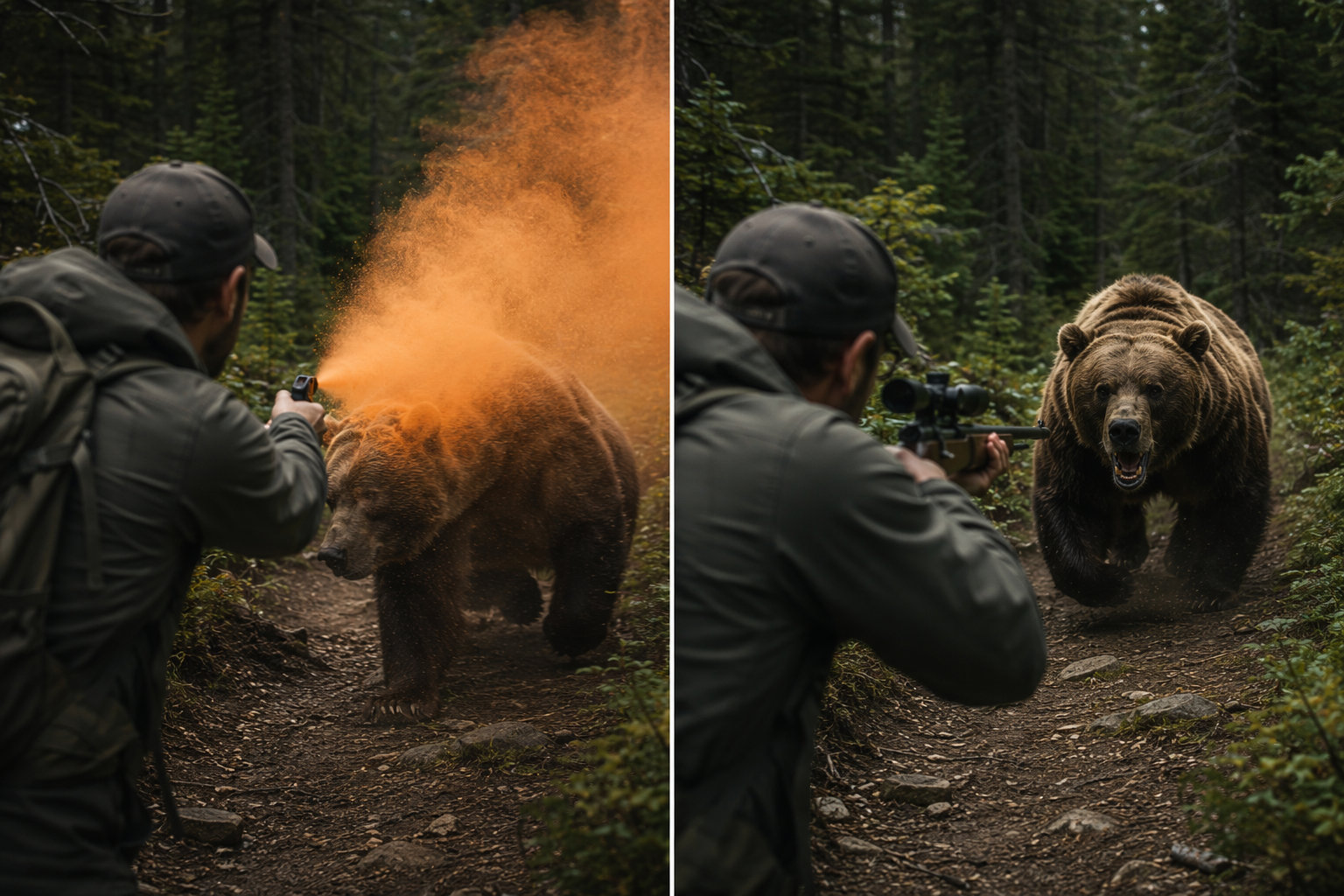
That is also why the “I have a rifle” argument is weaker than it sounds. The rifle may be slung because both hands are on trekking poles, quarters, antlers, a bow, or alder branches. The handgun may be under a bino harness, behind a pack belt, or zipped under rain gear. The shotgun may be leaning against a tree while the hunter breaks down an animal. Bear spray can be staged on the chest or belt for one-hand access without replacing any of those weapons.
Spray also gives a hunter an answer to the common defensive bear problem: a bear reacting to surprise, cubs, food, or a carcass. That is not the same thing as a predatory animal that keeps coming after every deterrent fails. In the defensive case, the job is to stop the approach and create space. A non-lethal deterrent is well matched to that job because it can interrupt aggression without requiring the hunter to choose, in a few seconds, between doing nothing and firing a lethal shot.
Hunters are not just hikers with weapons
The hunter-specific risk profile is not theoretical. Bombieri et al.’s worldwide analysis of brown bear attacks found that hunters accounted for 22% of attacks where the victim’s activity was recorded, 123 of 560 cases. Hunters were second only to leisure hikers in that dataset. The same study reported that 63% of attack victims were alone and that 47% of attacks involved female bears with cubs.[3]
That study has limits. The authors used records that included news reports, which can miss attacks in places with weaker media coverage. It is better read as a broad attack profile than a perfect global census. Still, the pattern is hard to shrug off: hunters are a major share of recorded brown bear attack victims, and many victims are alone.
Hunters earn some of that risk honestly. They move quietly. They glass at dawn and dusk. They follow blood trails. They return to carcasses. They carry meat that smells like exactly what it is. They may be focused on a wounded animal, a GPS track, a pack load, or the fastest way out before dark. None of that means hunters are careless. It means their normal work overlaps with situations bears care about.
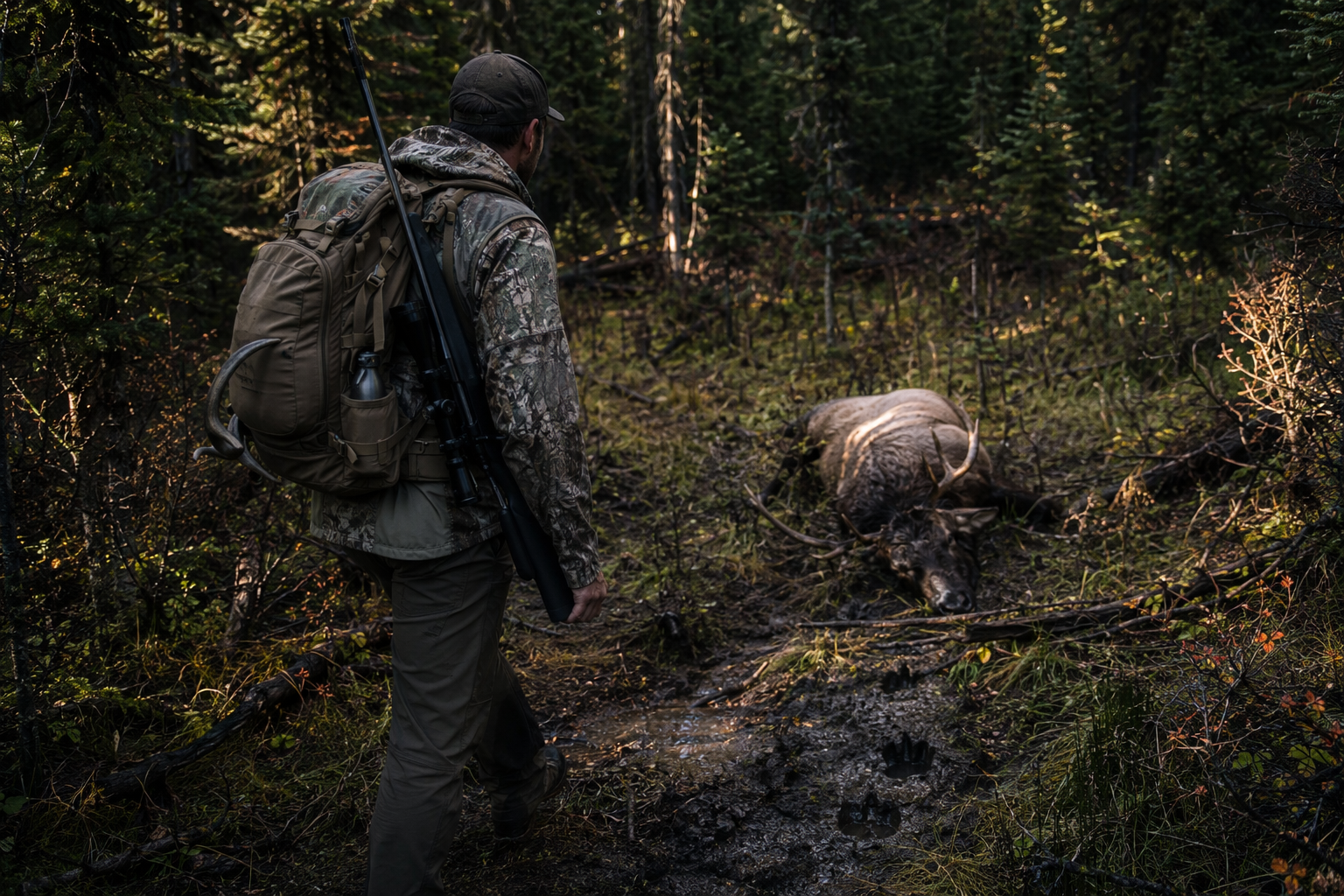
A student hunter squeezing a season between exams, a new elk hunter packing out with one partner, or an experienced bear-country hunter returning alone to a kill site all face the same practical problem: the encounter may begin before the firearm is in hand. Study habits and field habits have one thing in common here. The plan that only works under calm conditions is not much of a plan.
The carcass changes the tool choice
A downed animal is where neat gear debates get less neat. While breaking down game, a hunter may set down the long gun or lay a bow aside. Hands are bloody. Attention drops into knife work. Partners spread out. The pack frame comes off, then goes back on. A bear entering that scene is not arriving at a trailhead demonstration.
That is why bear spray belongs on the body, not in the lid of a pack. Chest-rig carry, belt carry that is not blocked by the pack belt, or another practiced access point matters more than simply owning a can. The same criticism that applies to firearms applies to spray: if you cannot reach it quickly, it is comfort gear, not defensive gear.
On a return trip to meat, spray has another advantage. A hunter may be trying to determine whether a bear has claimed the carcass, not trying to start a fight. The ability to deter an aggressive approach while backing out is often the better first move than trying to solve an ambiguous, fast-changing scene through sights. If spray fails, or if the bear’s behavior shifts into a sustained predatory attack, the firearm is still there as the next layer.
What agencies add, and what they do not prove by themselves
Agency guidance lines up with the study evidence. The National Park Service states that “Bear spray is the most effective means of deterring a bear attack.”[4] The Interagency Grizzly Bear Committee tells people to treat bear spray as the primary deterrent and firearms as a secondary option for proficient users.[5] Those recommendations are useful because they match the outcome data, not because an agency slogan settles the argument.
Hunter-specific agencies make the point in field terms. Alaska Department of Fish and Game’s bear-safety guidance addresses hunting situations including carcass handling, and Montana Fish, Wildlife & Parks recommends that hunters carry bear spray at all times in bear country.[6][7] That is the right level of advice: not “never carry a gun,” and not “the gun is enough,” but carry the tool that is fastest and best matched to stopping aggression before contact.
There are legal and practical boundaries. Bear spray rules are jurisdiction-specific, and hunters need to check the law where they actually hunt before buying or transporting it. Training also matters. A hunter who buys spray and never practices removing the safety clip, judging wind, or deploying from the carry position has only improved the packing list, not the response.
A practical division of labor
The cleanest way to think about bear spray versus firearms is not as a loyalty test. It is a division of labor.
| Situation | First Tool To Think About | Why |
|---|---|---|
| Surprise defensive encounter at close range | Bear spray | It gives a wider margin for error and does not require lethal shot placement before contact. |
| Bear approaches a carcass or meat cache and the hunter needs to leave | Bear spray | The immediate goal is creating space while backing out, not winning possession of the carcass. |
| Spray fails, cannot be deployed, or the attack becomes sustained and predatory | Firearm | A lethal backup may be necessary when deterrence does not stop the threat. |
| Normal hunting, harvesting, and lawful take | Hunting weapon | The firearm or bow still serves its original hunting purpose. |
That table leaves room for judgment because bear encounters do not arrive labeled. Wind can hurt spray performance. Brush can affect both spray and bullets. A partner may be in the line of fire or downwind. A bear may bluff, break off, circle, or keep coming. The point is not to script every second. The point is to stop pretending that the presence of a weapon automatically solves the first few seconds.
For broader encounter-response choices beyond this tool comparison, readers can use the bear safety decision tree. Student hunters or outdoor-minded test-takers planning trips around school schedules may also want the more general bear safety tips for students. The narrower question here is the defensive tool you can get working when the bear is already too close for confidence.
Carry the gun, but do not let it be the whole plan
A hunter who is already carrying a firearm has not solved bear defense. He has one possible answer, and it is an answer that depends heavily on access, time, angle, and accuracy. Bear spray has better documented outcomes for stopping aggressive behavior in close-range incidents, and it fits the defensive encounters hunters are likely to stumble into while moving quietly, handling carcasses, packing meat, or traveling alone.
Where legal, carry bear spray where your hand can reach it immediately. Keep the firearm as a secondary layer for the situations where spray fails, cannot be used, or the threat becomes something more than a defensive bear encounter. The change is not replacing a hunting weapon. It is correcting the false confidence that being armed ends the safety discussion.
References
- Efficacy of Bear Deterrent Spray in Alaska. Journal of Wildlife Management. 2008.
- Firearm Vs. Bear Spray. Bear Hunting Magazine. August 2019.
- Brown bear attacks on humans: a worldwide perspective. Scientific Reports. 2019.
- Bear Spray vs. Firearms. National Park Service.
- Bear Spray. Interagency Grizzly Bear Committee.
- Bear Safety for Hunters. Alaska Department of Fish and Game.
- Hunting and Angling in Bear Country. Montana Fish, Wildlife & Parks.
Related exhibits & inventory
Verified outcomes
No verified outcomes on file for this exam yet
See Methodology for how outcome evidence is disclosed once logged.
Planners
No planner filed for this exam yet
A downloadable timeline template for this exam hasn't been published yet.
Tool verdicts
AI-tool cautions
No AI tools tested for this exam yet
No hands-on AI-accuracy logs have been filed for this exam.
Questions about this plan
Ask a question about a specific section, timeline, or citation in this plan — or flag something that needs correcting.
Comments
Join the discussion with an anonymous comment.