
SAT Exam Hub
Evidence-Based Bear Safety Tips for Hiking and Camping
Bear attacks are exceptionally rare—roughly 1 in 2.1 million odds—yet most incidents are preventable. This guide presents the research behind bear-spray efficacy, food-storage rules, and encounter protocols, correcting common myths so hikers and campers can make informed, evidence-backed decisions.
- SAT
- ACT
- GRE
- MCAT
- ASVAB
- digital-sat
- adaptive-testing
- registration-fee
- content-outline
- score-target
Bear safety tips for hiking and camping should start with a quieter fact than most campfire advice does: the odds of a bear attack are extremely low. The National Park Service has framed the risk in Alaska as about 1 in 2.1 million visitor-days, and Yellowstone has recorded 8 grizzly-caused human fatalities since 1872, fewer than the 7 deaths from falling trees over the same period.[1][2] That does not make bears harmless. It means the useful question is not how to win a dramatic fight with a bear. It is how to avoid becoming the rare case where several preventable mistakes line up.
A secondary compilation of fatal bear attacks in North America lists roughly 180 fatal incidents since 1784, which is a sobering number only if it is kept in scale: it spans more than two centuries, multiple countries, and many kinds of human activity, from hunting and working outdoors to hiking and camping.[3] The more actionable finding is from a study of more than 700 large-carnivore conflicts in North America and Europe from 1955 onward: roughly half were preceded by an identifiable human behavior that increased risk.[4] That is where the work is. Not in pretending the risk is high, and not in pretending it is zero.
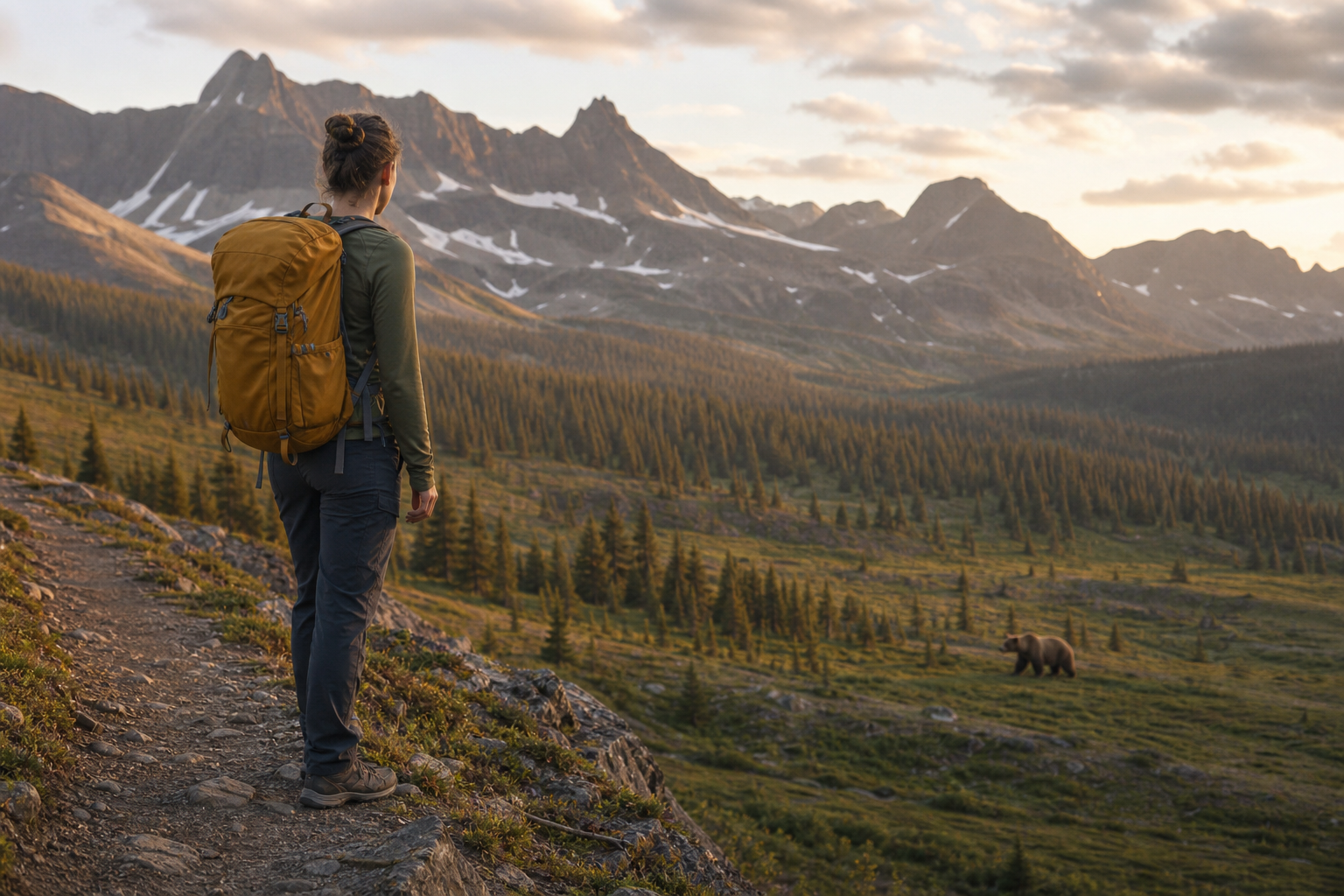
Start With Prevention, Not Bravery
Most bear-safety decisions happen before anyone sees a bear. They happen when a group decides whether to hike quietly around blind bends, where someone cooks dinner, whether toothpaste goes in the tent pocket, and whether bear spray is buried in a pack because it felt awkward on the hipbelt.
The prevention workflow is simple enough to remember, but each part matters for a different reason:
- Avoid surprise: make human presence obvious where visibility or sound is limited.
- Reduce attractants: treat food, trash, cookware, toiletries, and scented items as one storage problem.
- Carry bear spray accessibly: a canister in a backpack does not help during a fast encounter.
- Identify species and behavior: defensive, curious, and predatory encounters call for different responses.
- Do not escalate: running, crowding, feeding, and trying to solve the situation with confidence instead of distance all make the ranger’s job harder later.
If you want a faster field companion, the site’s bear safety decision tree is better for quick choices on trail. This article is the slower version: the research behind why those choices are ordered the way they are.
Avoid Surprise Before You Worry About the Perfect Reaction
A bear that hears a group coming usually has more time to leave. That is the point of noise. It is not to sound fearless, sing constantly, or turn every trail into a performance. It is to keep from stepping silently into a close-distance surprise, especially in brush, near loud water, in low visibility, or around a bend where scent and sound do not travel well.
Group size changes the encounter, too. Groups of 4 or more are commonly treated as a risk-reducing factor, which matches the practical guidance many bear-country instructors use: larger groups make more noise, look less like prey, and are less likely to have one person make a rushed solo decision. That does not mean a group of 4 can ignore food storage or crowd a bear for photos. It means solo hikers and pairs should be more deliberate about visibility, spacing, and communication.
Time of day is another plain but useful variable. Dawn, dusk, and night make it harder for both sides to detect each other early. If you are moving at those times, tighten the routine: keep bear spray reachable, talk before blind corners, avoid wearing earbuds in both ears, and give dense vegetation more room than you think it deserves.
Food Storage Is Bear Safety, Not Camp Choreography
Food management is where many preventable problems begin because nothing feels urgent yet. The tent is pitched, the stove is out, everyone is hungry, and the bear is hypothetical. That is exactly when the system needs to be boring and consistent.
The working rule is separation. National Park Service food-storage guidance treats food and scented items as attractants that should be secured away from sleeping areas, and outdoor-safety guidance commonly uses a 100-foot separation between cooking or food storage areas and the tent when campsite layout allows it.[5][6] One hundred feet is not a magic force field. It is a practical distance that keeps the smellier part of camp from becoming the same place where a sleeping person is zipped into fabric.
| Storage Method | Best Use | Tradeoff |
|---|---|---|
| Bear-resistant canister | Areas where canisters are required or trees are poor for hanging | Bulky and heavier, but simple and reliable when used correctly |
| Ursack-style bear-resistant bag | Trips where regulations allow it and weight matters | Still needs correct closure and anchoring; not accepted everywhere |
| Bear hang | Forested areas with suitable branches and rules that allow hanging | Often done badly; difficult where branches are low, weak, or scarce |
The important word in that table is not the brand name or container type. It is “correctly.” A canister left open while everyone wanders to the creek is not a system. A hang that lets the bag rest against the trunk is not a system. A sealed meal pouch inside the tent because “it is still packaged” is not a system.
Manage attractants as one category: meals, snacks, trash, sunscreen, lip balm, toothpaste, cookware, food wrappers, and clothes heavily soiled with cooking smells. The bear does not care that one item is “food” and another is “toiletries.” If it smells interesting, it belongs with the secured items, not beside your sleeping bag.
Carry Bear Spray Where Your Hand Can Reach It
Bear spray deserves more than a casual “bring some” because the evidence is stronger than the average trail argument about it. In Smith and colleagues’ Alaska bear-spray study, covering 72 incidents involving 175 people and brown, black, and polar bears, spray stopped undesirable bear behavior more than 90% of the time: 92% for brown bears, 90% for black bears, and 100% for polar bears in that incident set.[7] A separate endpoint from the same body of evidence is human injury: 98% of people using spray escaped uninjured.[7]
Those are not the same claim. “Stopped undesirable behavior” means the bear’s action changed. “Escaped uninjured” means the person was not hurt. Mixing them into one vague “bear spray works 98% of the time” sentence sounds tidy, but it blurs what was measured. The better reading is also the calmer one: in documented Alaska incidents, bear spray performed very well on both behavior interruption and human-injury prevention, while still being a tool that has to be accessible and used correctly.
Firearms do not have the same evidence-favored default position in the sources used here. REI’s summary of Smith’s comparative work reports firearms at 76% to 84% effectiveness, with a 24% user-injury rate, compared with a 2% injury rate for spray users.[8] That does not mean a firearm can never stop a bear, and it does not shame someone who has legal training and chooses to carry one. It does mean a gun should not be treated as a shortcut around prevention, identification, distance, and spray access.
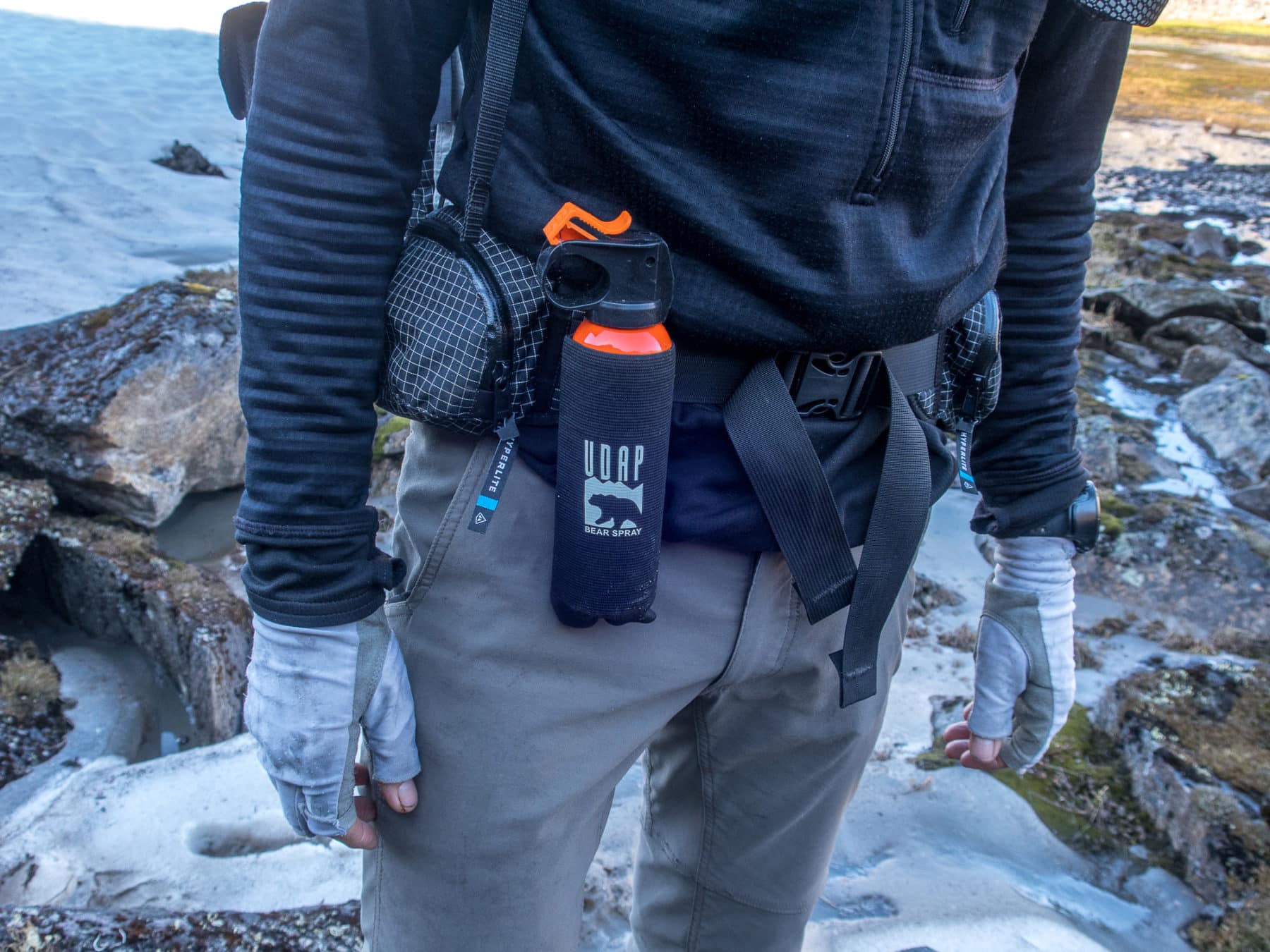
Carry spray in a chest holster, hipbelt holster, or another position you can reach with either hand. A canister under a rain jacket, inside the top lid of a pack, or wedged behind a water bottle is mostly a comfort object. Practice removing the safety clip before the trip. Know the spray pattern. Check expiration dates. If flying, remember that bear spray generally cannot travel on passenger aircraft; plan to buy, ship within legal limits, rent, or borrow at the destination rather than discovering the problem at airport security.
Do Not Identify a Bear by Color Alone
One of the most persistent bad shortcuts is “brown means grizzly, black means black bear.” Fur color is unreliable. Both black bears and grizzly or brown bears can range from blonde to dark, and safety guidance from REI and the Interagency Grizzly Bear Committee warns against using color alone for identification.[8][9]
Better clues include shoulder shape, facial profile, ear shape, tracks, location, and behavior, but even those can be hard to read under stress. If you are uncertain, give the bear more distance and avoid forcing a close decision. Species matters most if an encounter escalates, but prevention does not require perfect taxonomy. A bear near your food storage, a bear with cubs, and a bear that has not noticed you all call for space, not debate.
Running and Tree-Climbing Are Not Escape Plans
Running is one of the worst instincts to indulge. National Park Service and IGBC guidance warn that running can trigger a chase response, and bears can move far faster than a person over short distances.[9][10] “I’ll just sprint” is not a plan; it is a way to turn an uncertain encounter into a pursuit.
Trees are not a reliable solution either. Both black bears and grizzly bears can climb, and even when a bear is less likely to climb well as an adult, you do not want your safety plan to depend on finding the right tree, reaching it first, climbing high enough, and waiting out an animal that already knows where you are.[9][10]
The ordinary protocol is less cinematic: stop, assess, speak in a calm human voice, slowly create distance when possible, keep the bear in view without staring it down aggressively, and prepare spray if the bear approaches within range. “Stay calm” only helps if it is attached to those actions.
Match the Response to What the Bear Is Doing
Encounter advice gets messy because different bear behaviors mean different things. BearWise and IGBC guidance distinguish defensive, curious, and predatory situations, and that distinction is more useful than the generic command to “be big” or “play dead” in every case.[9][11]
| What You See | Likely Situation | Response |
|---|---|---|
| Bear is surprised at close range, may huff, pop jaws, swat ground, or has cubs/food nearby | Defensive | Do not run. Speak calmly, back away if possible, ready spray. If contact occurs with a grizzly or brown bear in a defensive attack, playing dead may reduce injury. |
| Bear notices you, approaches indirectly, stands to smell, or investigates without clear aggression | Curious or food-conditioned | Group up, speak firmly, make yourself identifiable as human, secure food, back away, and use spray if it keeps approaching. |
| Bear follows, approaches persistently, or treats you like prey rather than a threat | Predatory | Do not play dead. Stand your ground, make yourself look large, use spray, and fight back if contact occurs. |
The defensive scenario is the one many hikers picture: a close surprise, a sow with cubs, or a bear guarding a carcass. The bear may be trying to remove a perceived threat rather than eat a person. Your job is to stop being that threat. Back away without turning your back. Give the bear an exit. Do not shout insults at it because you once heard you should “act dominant.” If it charges, use bear spray when the bear is within effective range and aim low enough that the cloud rises into its path.
A curious or food-conditioned bear is different. It may have learned that packs, coolers, campsites, or people produce calories. Here, sloppy food storage has already changed the problem. Do not feed it, drop food as a distraction, or leave a pack behind unless human safety requires it in the moment. Those decisions can train the bear to repeat the behavior with the next party.
Predatory encounters are rare, but the response changes sharply. A bear that follows persistently, tests your movement, or makes contact in a way that is not defensive should be treated as a direct threat. In that situation, playing dead is the wrong script. Use spray, make yourself difficult to approach, and fight back if contact occurs.
A Practical Hiking and Camping Routine
A good bear-country routine is not complicated. The hard part is doing it when everyone is tired, cold, hungry, or eager to make miles.
- Before the trip, check the land manager’s current bear rules, food-storage requirements, recent closures, and whether canisters are mandatory.
- Pack bear spray for each responsible adult, then carry it where it can be drawn quickly rather than stored inside the pack.
- On trail, make noise where surprise is likely: blind corners, brush, berry patches, loud streams, windy ridges, and low-visibility terrain.
- Hike in a group when possible, especially in higher-risk terrain or during dawn, dusk, or low visibility.
- At camp, cook and store attractants away from the tent, using the required canister, approved bear-resistant bag, locker, vehicle storage, or properly executed hang.
- Before sleep, sweep the tent area for wrappers, lip balm, toothpaste, drink mixes, and clothing or gear that smells strongly of food.
- If you see a bear, stop the group, keep people together, prepare spray, assess behavior, and create distance without running.
For younger hikers or first-time backpackers who need a lighter version of the same habits, the student-focused bear safety primer strips the routine down to the basics. The rules do not change; only the amount of explanation does.
What the Evidence Does and Does Not Promise
The numbers should lower your pulse, not erase your attention. A 1-in-2.1-million risk frame does not help if it becomes permission to cook beside the tent. A bear-spray success rate does not help if the canister is unreachable. A canister does not help if it is left open. A rule about not running does not help if nobody in the group has talked through what they will do when a bear appears on the trail.
The best bear safety tips for hiking and camping are not heroics. They are the small, repeatable habits that remove predictable errors: prevent surprise, manage attractants, carry accessible bear spray, and match your response to the bear’s species and behavior. That hierarchy respects both halves of the evidence: attacks are rare, and many of the conditions that make them dangerous are under human control.
References
- Staying Safe Around Bears, National Park Service, https://www.nps.gov/subjects/bears/safety.htm
- Bear-Inflicted Human Injuries and Fatalities in Yellowstone, National Park Service, https://www.nps.gov/yell/learn/nature/injuries.htm
- List of fatal bear attacks in North America, Wikipedia, https://en.wikipedia.org/wiki/List_of_fatal_bear_attacks_in_North_America
- Human behaviour can trigger large carnivore attacks in developed countries, Scientific Reports, 2016, https://www.nature.com/articles/srep20552
- Storing Food, National Park Service, https://www.nps.gov/subjects/bears/storingfood.htm
- Food Handling and Storage for Campers and Backpackers, REI Expert Advice, https://www.rei.com/learn/expert-advice/food-handling-storage.html
- Efficacy of Bear Deterrent Spray in Alaska, BearWise, https://bearwise.org/wp-content/uploads/2017/12/efficacy-of-bear-spray.pdf
- Bear Spray: How to Choose and Use It, REI Expert Advice, https://www.rei.com/learn/expert-advice/bear-spray.html
- Bear Spray, Interagency Grizzly Bear Committee, https://igbconline.org/programs/bear-spray/
- Bear Safety, National Park Service, https://www.nps.gov/subjects/bears/safety.htm
- Bear Encounters, BearWise, https://bearwise.org/bear-safety-tips/bear-encounter/
Related exhibits & inventory
Verified outcomes
No verified outcomes on file for this exam yet
See Methodology for how outcome evidence is disclosed once logged.
Planners
No planner filed for this exam yet
A downloadable timeline template for this exam hasn't been published yet.
Tool verdicts
AI-tool cautions
No AI tools tested for this exam yet
No hands-on AI-accuracy logs have been filed for this exam.
Questions about this plan
Ask a question about a specific section, timeline, or citation in this plan — or flag something that needs correcting.
Comments
Join the discussion with an anonymous comment.