
MCAT Exam Hub
How Bald Eagle Rehab Case Studies Build MCAT Passage Skills
This article walks through real published bald eagle rehabilitation case studies to teach MCAT test-takers how to read and interpret experimental/research passages on the BBLS section, using a structured framework to extract intervention, control, endpoint, and sample limitations.
- SAT
- ACT
- GRE
- MCAT
- ASVAB
- digital-sat
- adaptive-testing
- registration-fee
- content-outline
- score-target
A bald eagle rehabilitation case study looks friendly at first. It has an animal, an injury, a treatment, and an ending you can picture. Then the MCAT-style work begins: what was the intervention, what counted as evidence of success, what comparison was missing, and how far can the conclusion travel before it becomes nonsense?
That is why bald eagle rehabilitation is a useful biology passage practice topic. The biology is real, the stakes are concrete, and the evidence comes in different sizes: one surgical case, one multi-center survival analysis, one large administrative dataset, and one systematic review. If you read all of them as “rehab works” or “rehab does not work,” you are doing the exact thing MCAT passages punish.
Start With the Cleanest Case: One Eagle, One Joint, One Release
The most compact passage starts at the Louisiana State University Wildlife Hospital: a bald eagle with a metacarpophalangeal joint luxation was treated with complete arthrodesis, then released after post-release monitoring confirmed the outcome. The PubMed abstract describes it as the first published case of a bald eagle released after complete arthrodesis for that injury pattern.[1]
For MCAT practice, do not begin by admiring the surgery. Begin by labeling the passage.
| Passage element | What the eagle case gives you | What you should not add |
|---|---|---|
| Problem | A metacarpophalangeal joint luxation in a bald eagle | A general statement that most eagle wing injuries can be surgically corrected |
| Intervention | Complete arthrodesis of the affected joint | A comparison among multiple surgical techniques |
| Endpoint | Successful release, with post-release monitoring confirming the outcome | Long-term population contribution |
| Sample limit | A single published case | A species-wide estimate of rehabilitation success |
That table is not busywork. It is the difference between reading a science passage and reading a wildlife story. The intervention is not “rehabilitation” in the vague motivational sense. It is complete arthrodesis. The endpoint is not “the eagle was saved” in some unmeasured ecological sense. It is release after treatment, with post-release monitoring used to confirm that the bird made it past the immediate hospital-to-wild transition.
The missing comparison matters just as much. This case does not tell you whether arthrodesis outperforms another surgical approach, whether similar injuries usually fail without surgery, or whether this technique would work across rehab centers. A test writer loves that gap. A wrong answer choice can sound reasonable by smuggling in the comparison the study never made.
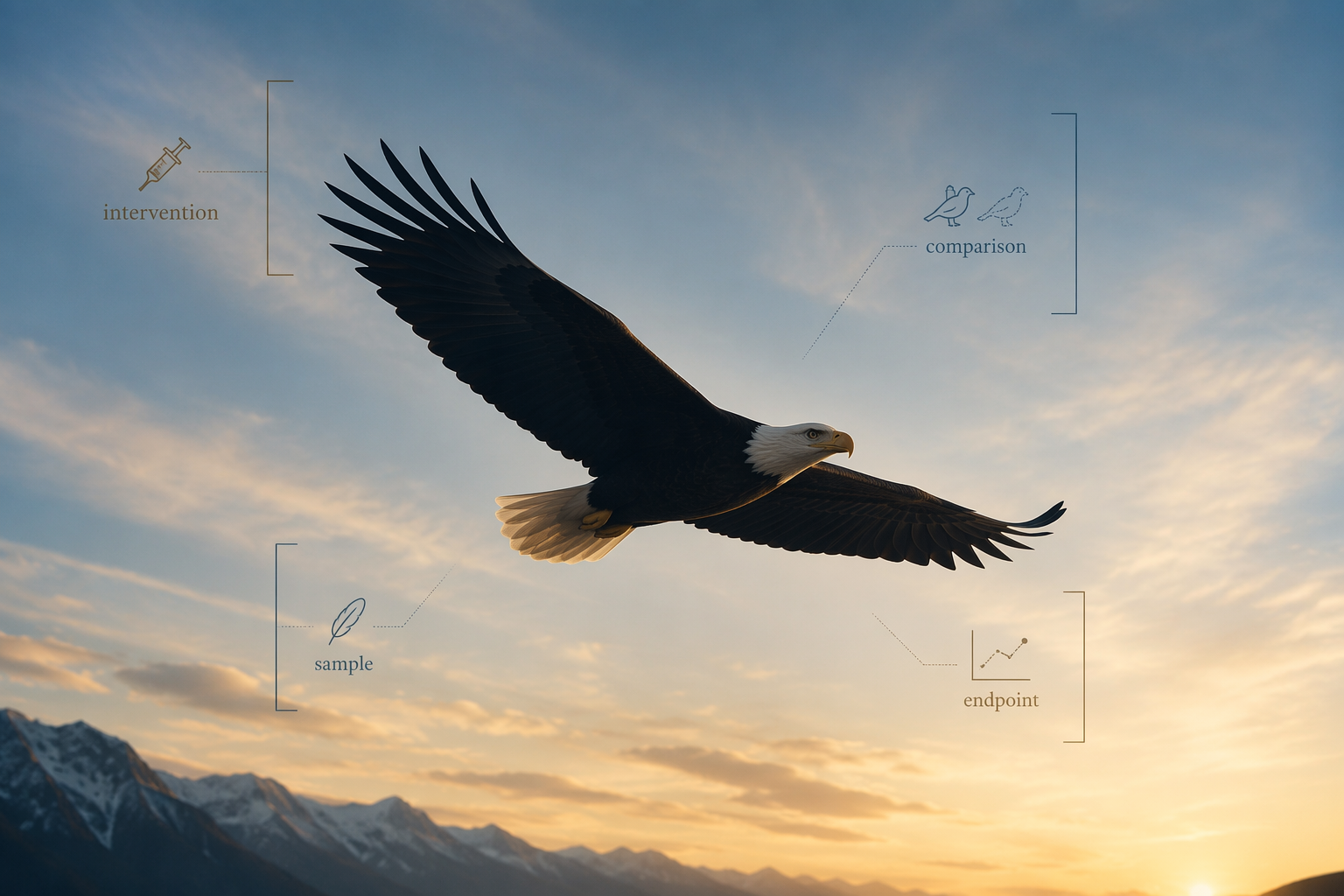
A disciplined student would annotate this case in four moves: intervention, comparison, endpoint, constraint. In this case, the comparison is essentially absent, and the constraint is severe: n = 1. That does not make the case useless. It makes it a case report. Case reports are good at proving that something can happen under described conditions. They are weak at proving how often it happens, whether it should become the default treatment, or whether it changes population outcomes.
The Exam Skill Hiding Inside the Surgery
On the BBLS section, a passage like this could ask for the best-supported conclusion. The tempting answer would inflate the result: complete arthrodesis restores flight capacity in bald eagles with severe wing joint trauma. Too broad. The safer answer would stay closer to the data: in this reported case, complete arthrodesis was followed by release and monitored post-release survival. Less dramatic, more correct.
It could also ask what additional evidence would strengthen the claim. Now you are not hunting for animal trivia. You are thinking like a passage reader. You would want multiple similar cases, defined inclusion criteria, standardized functional endpoints, longer post-release monitoring, and some comparison group: untreated, differently treated, or historically treated birds with similar injuries.
That is the basic move: respect the case without letting it become a fairy tale. The rehabilitators did the hard, specific thing. Your job is to keep the conclusion equally specific.
Now Widen the Frame: Survival After Release Is a Different Question
The next study level changes the passage task. Goodell et al. studied 17 raptor species across 24 rehabilitation centers in the United States, and a Wildlife Society summary reports that rehabilitated raptors had post-release survival comparable to wild birds.[2] That is not the same kind of claim as the LSU arthrodesis case. Now the endpoint is survival after release across many birds and many centers, not the clinical outcome of one injured bald eagle.
This is where skepticism often gets sloppy. Some biologists have treated wildlife rehabilitation as emotionally satisfying but ecologically minor. The Goodell summary challenges that dismissal, but it does not license the opposite overclaim. Comparable post-release survival, if measured well, supports the idea that released raptors can survive at rates similar to wild birds in the comparison group. It does not, by itself, prove that rehabilitation has already lifted a population in the field.
| Question | Single eagle surgery case | Goodell raptor survival analysis |
|---|---|---|
| What is being evaluated? | A surgical intervention for one injured bald eagle | Post-release survival of rehabilitated raptors |
| What is the comparison? | No strong comparison in the abstracted case report | Survival compared with wild birds, as summarized by The Wildlife Society |
| What is the scale? | One published case | 17 raptor species across 24 US rehabilitation centers |
| What can go wrong in interpretation? | Turning a successful release into proof of general efficacy | Turning comparable survival and modeling into field-proven population recovery |
The modeling claim is the part that most needs clean reading. The Wildlife Society article reports that adding even about 0.5% annually can compound to exponential growth in long-lived species such as golden eagles.[2] Notice the words “modeling claim.” A model can show that a small annual addition could matter under specified assumptions. It is not the same thing as catching the population recovering because rehab centers released birds.
Also notice the source layer. Here, the accessible material is a journalist’s summary and interview-based report about the study, not the full peer-reviewed paper in front of us. That does not make the numbers unusable, but it does lower how confidently you should talk about methods that are not visible in the summary. On the MCAT, this distinction shows up as the difference between what the passage directly states and what an answer choice quietly assumes.
A Good MCAT Reader Separates Three Claims
- Interview-summary claim: The Wildlife Society article reports the main conclusions and selected figures from Goodell et al.
- Survival claim: Rehabilitated raptors had post-release survival comparable to wild birds, according to that summary.
- Population-model claim: A small annual addition could compound in long-lived species under the model’s assumptions.
- Field-proof claim: Rehabilitation has empirically caused population recovery at scale. The provided material does not establish this.
Those are not pedantic distinctions. They are the passage. When students miss experimental-design questions, it is often because they collapse those layers into one emotional conclusion. The MCAT is less interested in whether you like rehabilitation than whether you can tell measured survival from modeled population effect.
Large Datasets Help, but They Do Not Magically Remove Limits
Hanson et al. give a useful counterweight because the sample is large and the conclusion is less tidy. The study analyzed 58,185 wildlife rehabilitation cases in New York State from 2012 to 2014 and found an overall release rate of 50.2%.[3] Bald eagles had a 45.5% release rate in that dataset.[3]
Now you have a different kind of endpoint. Release rate is not the same as long-term survival, breeding success, or population growth. It is a hospital-system outcome: admitted animals came in, and some proportion were released. That is valuable, but it stops where the measurement stops.
The eagle-specific lead poisoning result is a good example of why large-N papers still contain small cells. Hanson et al. reported lead poisoning as the admission cause for 12.7% of eagles, with only 3 of 7 surviving to release.[3] The percentage looks clean. The denominator makes it fragile. If an MCAT passage gave you that result, the correct reaction would not be “lead poisoning always has a 42.9% release outcome.” It would be: the study flags a serious admission category, but this particular eagle subgroup is small.
There is also a time-window problem. New York State data from 2012 to 2014 are not automatically a 2026 estimate for all rehabilitation centers, all states, or all eagle populations. Old data can still teach structure. It just cannot be casually promoted into current national truth.
Reviews Change the Question Again
Cope et al. move the reader from individual cases and regional datasets into cross-study comparison. Their systematic review covered 112 articles on wildlife rehabilitation outcomes and found that mammals and birds were equally likely to survive rehabilitation.[4] That finding is already broader than the eagle surgery case and different from the New York administrative dataset.
The geographic result is the useful trap. Cope et al. reported that North American birds had the worst long-term post-release survival, 6%, compared with 72% in Africa.[4] A lazy reader turns that into “North American bird rehabilitation fails.” A better reader asks what species were included, how post-release survival was tracked, whether studies used similar follow-up methods, and how publication bias or sample composition might affect the comparison.
The review does not erase the LSU case. It does not refute the Goodell summary. It changes the level of analysis. A systematic review asks whether patterns hold across many studies, regions, and taxa. That is exactly where definitions start to matter: survival during rehabilitation, release rate, short-term post-release survival, long-term survival, and population contribution are not interchangeable endpoints.
The Framework You Should Actually Practice
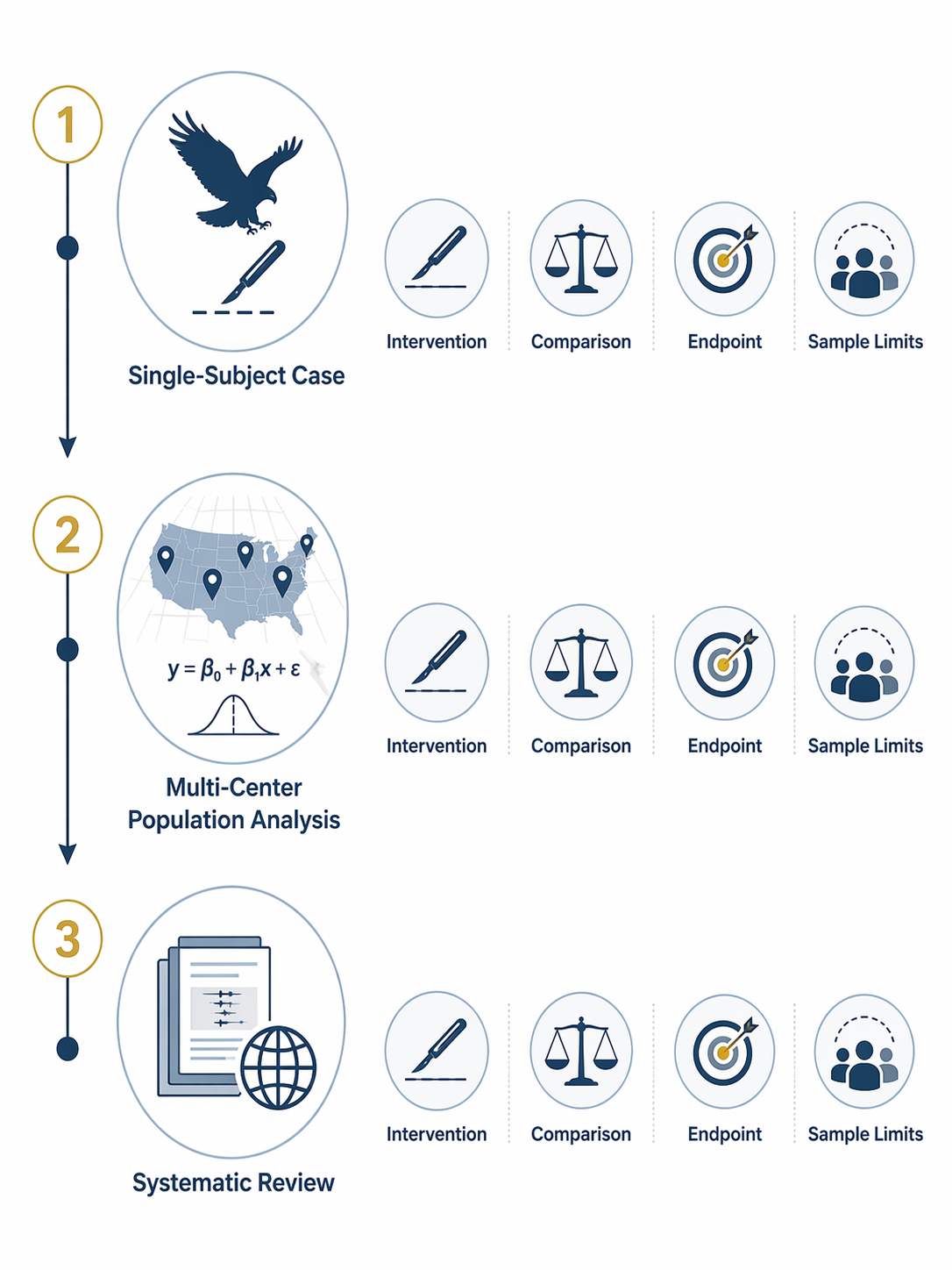
You do not need to memorize bald eagle rehabilitation facts for the MCAT. You need to practice the reflex that real biology passages demand: isolate design before opinion. The same four labels work across the materials, but they do not produce the same conclusion each time.
| Study type | Intervention or exposure | Comparison | Endpoint | Main limit |
|---|---|---|---|---|
| Single-subject surgical case | Complete arthrodesis for one injured bald eagle | No strong comparison in the abstracted case | Release with post-release monitoring | One case cannot estimate general success |
| Multi-center survival analysis | Rehabilitation and release of raptors | Wild-bird survival comparison, as summarized | Post-release survival and modeled population effect | Modeling suggests possibility; it does not prove field recovery |
| Large regional dataset | Wildlife rehabilitation cases in New York State | Differences by species and admission cause | Release rate | Older regional data and small eagle subgroups |
| Systematic review | Rehabilitation studies across taxa and regions | Cross-study, cross-region comparisons | Survival during and after rehabilitation | Study design and geography change what “works” means |
This is better passage practice than generic advice because the material fights back. If you overgeneralize from the surgical case, the sample size stops you. If you dismiss rehab after seeing low survival in one subgroup, the multi-center survival analysis complicates that. If you accept the model as field proof, the source layer and endpoint definitions pull you back. That is a much closer simulation of BBLS reasoning than reading another paragraph that says to “read actively.”
Use content tools for content. Anki can help keep physiology, biochemistry, genetics, and ecology facts available when a passage demands them. If you need that side of the system, the StudyMethod guides to Anki flashcards for the MCAT and MCAT Anki decks are the natural companion resources. But retention and passage reading are not the same job. Flashcards help you remember what arthrodesis, survival, poisoning, and population growth mean. Case studies make you decide what the data actually support.
That is the point of using a bald eagle rehabilitation case study in biology practice. The animal makes the passage readable. The study design makes it useful. The answer choices, if written well, will punish every conclusion that outruns the endpoint.
References
- Complete arthrodesis of a metacarpophalangeal joint luxation in a bald eagle. PubMed.
- Could treating injured raptors help lift a population?. The Wildlife Society.
- Evaluation of wildlife rehabilitation in New York State. PLOS ONE. 2021.
- A systematic review of factors affecting wildlife survival during rehabilitation and release. PLOS ONE. 2022.
Related exhibits & inventory
Verified outcomes
Planners
No planner filed for this exam yet
A downloadable timeline template for this exam hasn't been published yet.
Tool verdicts
Questions about this plan
Ask a question about a specific section, timeline, or citation in this plan — or flag something that needs correcting.
Comments
Join the discussion with an anonymous comment.