GRE Exam Hub
AI Investment Analysis Skills Roadmap for Business Students
This roadmap shows business students which AI skills matter most for investment analysis roles, backed by evidence on employer demand, salary premiums, and the critical caveats needed to use AI safely in finance.
- SAT
- ACT
- GRE
- MCAT
- ASVAB
- digital-sat
- adaptive-testing
- registration-fee
- content-outline
- score-target
AI investment analysis for business students does not require becoming a data scientist. Employers are rewarding something narrower: enough AI fluency to move faster, plus enough control to know when the answer is wrong. Finance functions already use AI in 59% of cases, up from 37% in 2023 [1], and 78% of CFOs say their teams need stronger AI skills [2]. Wall Street Prep also relays a 42% salary premium for finance professionals with AI fluency, but that figure comes through a PwC/AWS survey chain whose original methodology was not independently verified in the provided materials [2].

The five-skill stack
| Skill | What it looks like in practice | Why it matters |
|---|---|---|
| Prompt engineering | Asking for earnings-call summaries, comparable-company screens, and assumption checks instead of vague "analyze this stock" prompts | Better prompts create usable work faster |
| Data literacy | Checking units, dates, source consistency, and whether a claim can be traced back to filings or datasets | This is where you catch polished nonsense before it reaches a deck |
| Tool familiarity | Working repeatedly in one research or note-taking tool rather than sampling every platform | Recruiters care more about a usable workflow than a tool list |
| Failure-mode awareness | Knowing where hallucinations, stale data, and fake precision show up | Verification is part of the job, not a safety note |
| Cautious communication | Explaining what AI helped with, what you checked, and what remains uncertain | This is what makes a junior analyst credible under pressure |
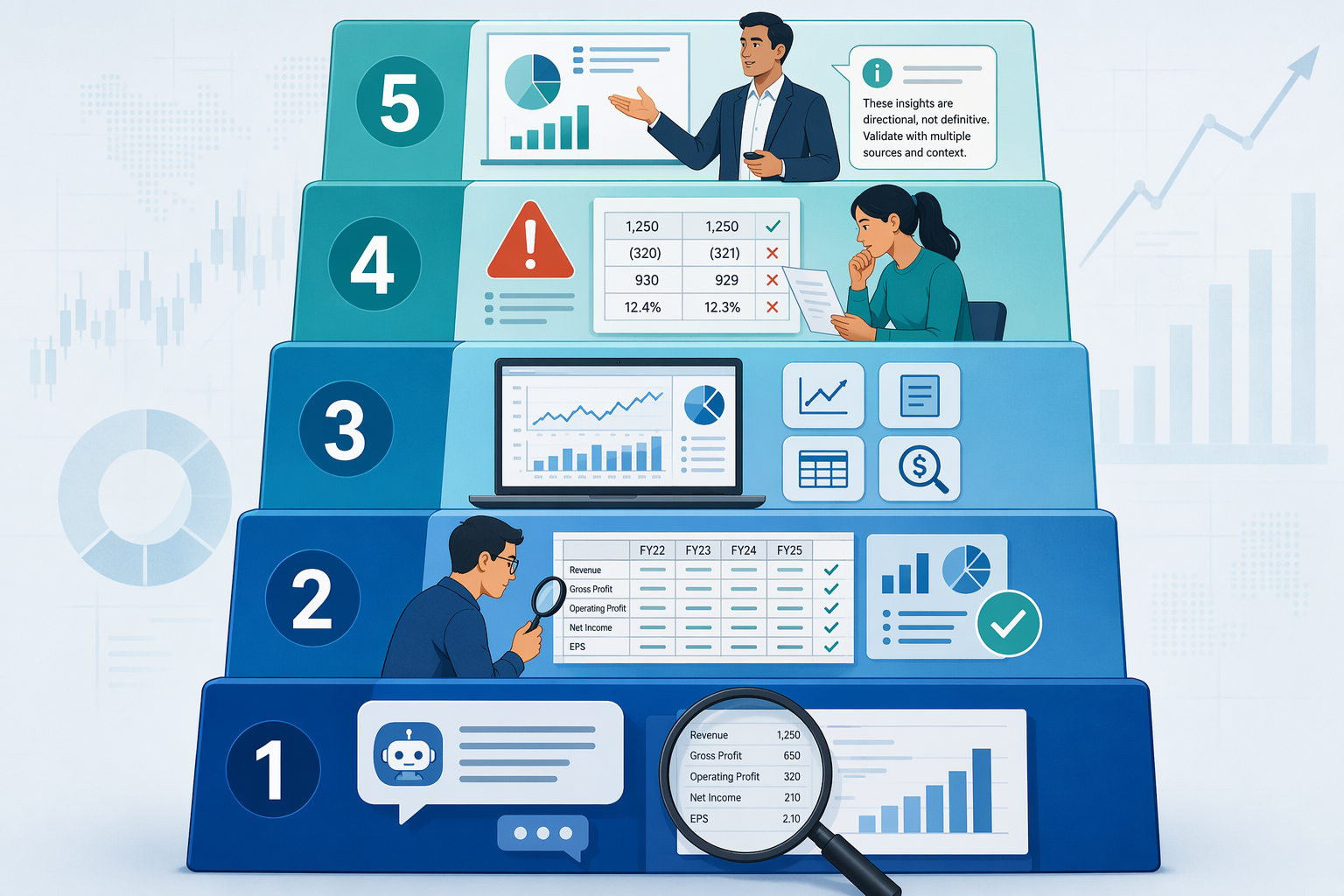
Data literacy and failure-mode awareness deserve the most time. A student who can spot a missing assumption, a mismatched time frame, or a claim that does not trace back to a source is already doing analyst work. That is also the place for the AI Hallucination Checklist for Students, because the habit needs a repeatable method, not a one-time warning. In one 100-question test reviewed by finance professionals, ChatGPT gave wrong or misleading answers on about 35% of finance questions; the sample is modest and newer models may behave differently, but the result is still a useful reminder that verification is part of the skill itself [3].
What to learn first
Start with prompt engineering that sounds like real investment work. Ask for a thesis summary from a 10-K, the drivers behind revenue changes, a margin bridge comparison, or a list of questions for a management call. The goal is not to ask for a stock pick; it is to force the model into a form you can inspect.
Then pick one tool and learn its limits. ChatGPT can help with synthesis and drafting, Koyfin can speed up market and company research, and Barebone AI's student-focused comparisons can help you choose a workflow, but treat any vendor evaluation as a claim to test, not a verdict to repeat. AI-powered stock products are not automatically better; Investopedia notes that the AIEQ ETF underperformed the S&P 500 through January 2025, which is enough to keep the marketing noise in perspective [4].
The last skill is communication. In an interview or pitch, say what AI produced, what you checked against filings or market data, and what still depends on judgment. That sounds less impressive than saying the model "did the analysis," but it is what makes a junior person usable when a manager has five minutes and a real decision to make. If you can state the caveat clearly without sounding tentative, you look prepared rather than defensive. If you are still on the business-school path, keep the GRE Prep Hub in the loop so admissions prep does not swallow recruiting prep; for many students, the right path is still exam readiness first, then AI fluency for internships, not a detour into computer science.
References
- Top AI Courses for Finance Leaders in 2026 — Datarails — 2026
- Best AI Courses for Finance & Business Professionals (2026) — Wall Street Prep — 2026
- Best AI Finance Tools for Students and Interns (2026) — Barebone AI — 2026
- 7 Ways AI Can Revolutionize Investment Strategy — Investopedia — 2025
Related exhibits & inventory
Verified outcomes
Planners
No planner filed for this exam yet
A downloadable timeline template for this exam hasn't been published yet.
Tool verdicts
AI-tool cautions
No AI tools tested for this exam yet
No hands-on AI-accuracy logs have been filed for this exam.
Questions about this plan
Ask a question about a specific section, timeline, or citation in this plan — or flag something that needs correcting.
Comments
Join the discussion with an anonymous comment.