
How to Beat the 270-Day Student Loan Default Clock
Understand the 270-day federal student loan default timeline and learn specific actions to take at each stage — from the first missed payment to collections — to prevent or reverse default.
- SAT
- ACT
- GRE
- MCAT
- ASVAB
- digital-sat
- adaptive-testing
- registration-fee
- content-outline
- score-target
Last reviewed: July 22, 2026. This guide is written around federal Direct and FFEL loans first, because those are the loans with the standard 270-day default clock. For these federal loans, default generally happens after you fail to make payments for at least 270 days; before that, the loan is delinquent, not yet in default.[1] The earlier deadline to respect is day 90, when delinquency can be reported to the credit bureaus.[2]
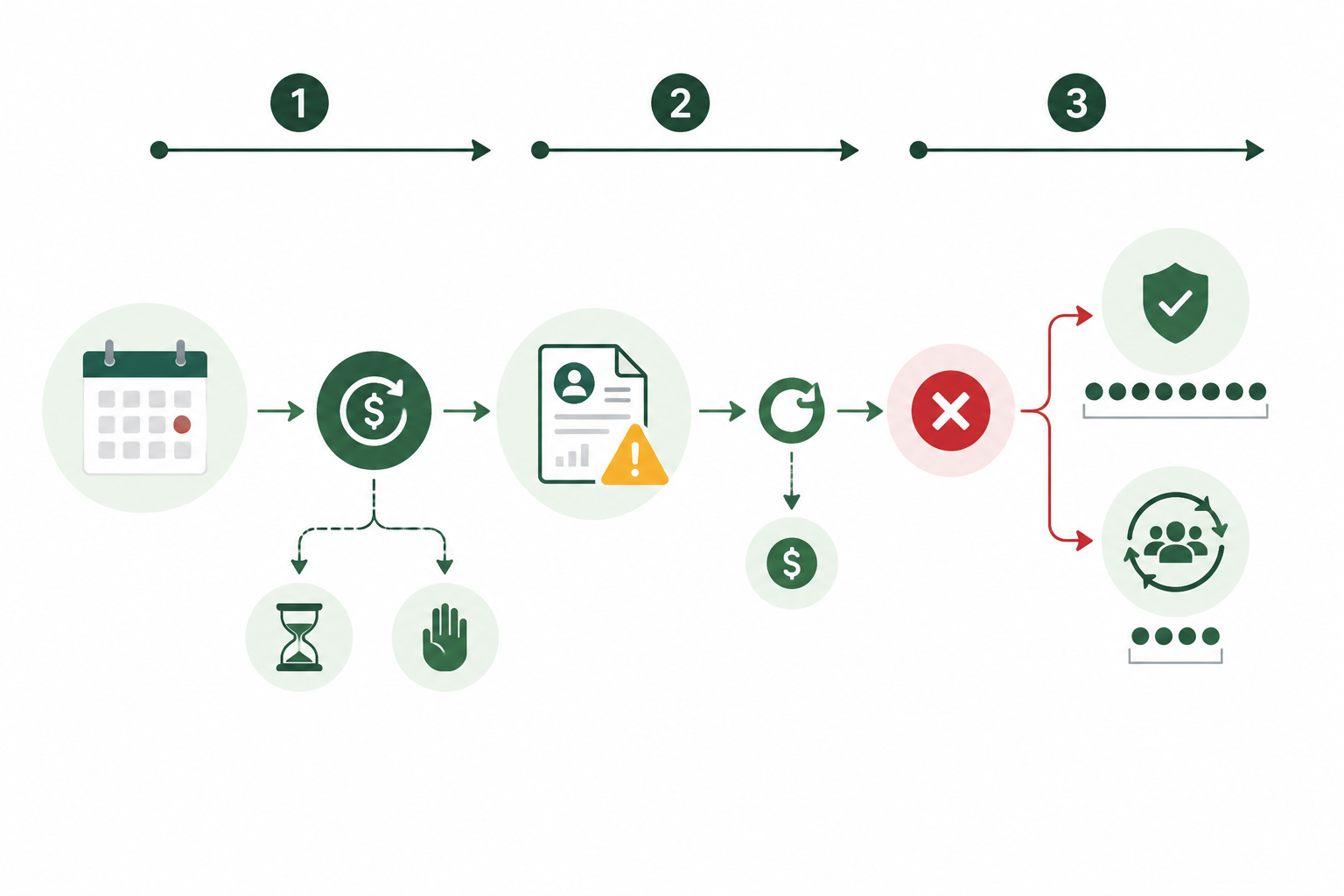
That means the student loan default deadline is not one cliff at day 270. It is a staircase. On the lower steps, you may still be able to pay, change plans, request deferment or forbearance, fix autopay, or reset the clock with one full on-time payment. On the upper steps, you are mostly choosing between slower, messier repairs.

Private student loans do not have to follow this 270-day federal timeline. Their default rules come from the promissory note, and some private loans may default much earlier, including after as few as 90 days or even one missed payment depending on the contract.[2] If you have a private loan, the first action is not to memorize the federal clock. It is to open the loan agreement and find the default clause.
First, find your number: how many days late is the loan?
Do this before calling anyone. Log in to your servicer portal and write down four things: loan type, payment due date, amount past due, and whether the account says current, delinquent, or default. If you have more than one servicer, repeat this for each one. A borrower who is 12 days late and a borrower who is 112 days late may both feel “behind,” but they do not have the same choices.
| Where you are | What it usually means for federal Direct/FFEL loans | Next move |
|---|---|---|
| Day 1–89 late | Delinquent, but usually before credit-bureau damage | Pay the missed amount if possible, or ask for deferment, forbearance, or an available income-driven repayment option before the account reaches day 90. |
| Day 90–269 late | Delinquency may be reported to credit bureaus; default has not yet occurred under the 270-day Direct/FFEL rule | Act before day 270. A full on-time payment during delinquency can reset the 270-day clock.[1] |
| Day 270 and after | Federal Direct/FFEL loan is generally in default | Choose a formal default exit: rehabilitation, consolidation, or full repayment. Simply making regular payments again does not automatically cure default.[1] |
If the loan is a Perkins Loan, do not assume the 270-day rule protects you. Perkins Loans can enter default after a single missed scheduled payment, depending on the loan terms.[2] The rest of this guide focuses on Direct and FFEL loans because that is where the 270-day clock applies most directly.
Day 1–89: fix the payment before the credit report gets involved
This is the cleanest part of the timeline. It may not feel clean if your checking account is empty or you have been avoiding the servicer emails, but the loan has not yet reached the main public damage point. Your job is to stop the account from aging into the 90-day zone.
If you can pay the missed amount, pay through the servicer portal and save the confirmation number. Then check whether autopay is still active. Autopay can fail after a bank-card change, bank-account closure, servicer transfer, or insufficient funds. Do not assume a successful payment today means next month is handled.
If you cannot pay, the useful question is not “Can you help me?” It is: “What options can stop this loan from becoming more delinquent before day 90?” Ask specifically about deferment, forbearance, and available income-driven repayment plans. If the servicer says you qualify for something, ask whether it applies retroactively to the missed payment period or only going forward. That detail decides whether the past-due amount actually disappears or still sits there aging.
- If you are back in school at least half time, ask whether an in-school deferment should already be applied.
- If your income dropped, ask which income-driven repayment options are currently available for your loan type.
- If the problem is temporary, ask whether forbearance would cover the missed period and what interest consequences come with it.
- If you thought autopay was active, ask when it failed and whether a manual payment today will bring the account current.
This is also the stage where a boring screenshot matters. Save the payment receipt, the application confirmation, and the chat transcript or call notes. Write down the date, the representative’s name or ID if provided, and the exact phrase they used about delinquency status. You are building a paper trail in case the account ages incorrectly.
Day 90–269: the loan is not in default yet, but the damage can start
Day 90 is the deadline that gets underestimated. A Direct or FFEL loan generally has not defaulted yet, but the delinquency can be reported to the major credit bureaus around this point.[2] That can affect apartment applications, auto loans, credit cards, and any situation where someone checks whether you pay bills on time.
The practical difference between day 89 and day 91 is not just emotional pressure. Before credit reporting, the fix is mostly internal to the loan account. After credit reporting, you may still prevent default, but you are also dealing with a mark other lenders and landlords may see.
The action here is to force a status answer from the servicer. Ask: “How many days delinquent is this loan today, and what exact payment or approved plan would stop it from reaching default?” If the servicer gives you a payment amount, ask whether that amount brings the loan current or only reduces the past-due balance.
A key federal rule still helps here: making one full on-time payment during delinquency can reset the 270-day default clock.[1] That does not mean a token payment fixes everything. Ask the servicer what counts as the full on-time payment for your account, pay through a trackable method, and save the confirmation.
Do not wait until day 269 to submit an income-driven repayment application and hope processing finishes instantly. If a plan-change application, deferment request, or forbearance request is pending, keep checking whether the account is protected while it is pending. Pending is not the same as approved.
What to ask on the call or in chat
- “What is the current delinquency age in days?”
- “Has this delinquency already been reported to any credit bureau?”
- “What exact amount would reset or stop the default clock?”
- “If I apply for deferment, forbearance, or an income-driven plan today, will it cover the missed-payment period?”
- “What date will the loan reach default if nothing changes?”
Day 270: default changes the repair job
At about 270 days of missed payments, a Direct or FFEL loan generally enters default.[1] This is where a lot of borrowers make a painful mistake: they start paying again and assume the default is gone. For federal loans, default is a status. Regular payments may reduce the balance, but they do not automatically remove the loan from default.[1]
Default also changes who may be involved. The loan can be sent to collections, collection costs can be added, and federal collection tools may become available. The CFPB says collection costs on defaulted federal student loans can be as high as 25% of the principal and interest.[3]
The national numbers are not here to shame anyone. They are here to make clear that default is not rare or limited to people who “should have known better.” A 2026 NY Fed analysis found that credit scores for newly defaulted federal student loan borrowers dropped by an average of 91 points, and nearly 40% of newly defaulted borrowers with auto loans were also past due on those auto loans.[4] Protect Borrowers estimated that during 2025, a student loan borrower defaulted every 9 seconds, totaling 3.6 million new defaults.[5]
The same NY Fed analysis noted that the average newly defaulted borrower was about 39 years old.[4] That matters for students and recent graduates because it shows default risk does not only live in the first messy year after leaving school. It can show up later, after a job change, a medical bill, a family move, or a long stretch of avoidance.
After default: rehabilitation and consolidation are different fixes
Once a federal loan is in default, the main practical choice is usually rehabilitation or consolidation. Full repayment also resolves default, but most students and recent graduates searching for deadline help are not sitting on the full balance in cash.
| Option | What you do | Time and credit-report consequence |
|---|---|---|
| Rehabilitation | Make 9 required on-time payments within 10 months under a rehabilitation agreement. | Slower, but after successful rehabilitation, the default is removed from your credit report.[1][6] |
| Consolidation | Combine the defaulted federal loan into a new Direct Consolidation Loan, usually after agreeing to repay under an eligible plan or making required payments first. | Faster; StudentAid.gov describes consolidation processing as generally taking 4–6 weeks, but the record of default is not removed from your credit history.[1][6] |
Rehabilitation is the option to ask about if the credit-report treatment matters most and you can handle a months-long payment sequence. The catch is discipline: miss the rehabilitation structure and you may lose time. Ask for the required monthly amount, the due date, where to pay, and what counts as “on time.” Then set reminders before the due date, not on the due date.
Consolidation is often the option to ask about if speed matters more: for example, if you need to regain access to federal repayment options sooner. The tradeoff is that consolidation does not erase the history of default from the credit report.[6] It can get the loan out of default faster, but it is not the same credit cleanup that rehabilitation can provide.
When you contact the Default Resolution Group or the assigned collector, use plain questions: “Am I eligible for rehabilitation?” “Am I eligible for consolidation?” “What will happen to the default notation on my credit report under each option?” “Will collection costs be added or waived?” “When will I regain eligibility for federal repayment plans?” Write down the answer before agreeing.
The 2026 SAVE and RAP issue: important, but not a new default clock
As of this review, repayment-plan choice is more confusing than usual. The Department of Education announced next steps for borrowers enrolled in the SAVE plan after SAVE was struck down, and the new Repayment Assistance Plan, or RAP, launched on July 1, 2026.[7] Borrowers on SAVE are being moved through a transition process, including notices to select a new plan within a 90-day window.[7]
That matters if you are trying to lower a payment before delinquency turns into default. It does not change the basic mechanics in this article: Direct and FFEL default still generally turns on the 270-day missed-payment clock, credit reporting can matter around day 90, and post-default recovery still depends on formal rehabilitation, consolidation, or repayment.[1][2]
There is also a collections wrinkle. The Department of Education announced federal student loan collections activity in 2025, and later collection activity has been subject to pauses and policy changes.[8] A pause in active collection does not mean the default status vanishes. Credit damage, loss of access to normal repayment tools, and possible collection-cost issues can still matter while policy details shift.
If you only have ten minutes today
Do not spend the ten minutes reading every repayment-plan debate online. Spend them finding the date that controls your next move.
- Log in to StudentAid.gov and your servicer portal.
- Confirm whether the loan is Direct, FFEL, Perkins, or private.
- Find the oldest missed due date and calculate how many days late the account is.
- If it is under 90 days late, pay, request deferment or forbearance, or apply for an available income-driven plan before credit reporting becomes the issue.
- If it is 90–269 days late, ask what exact action prevents default and whether one full on-time payment will reset the clock.
- If it is already in default, compare rehabilitation and consolidation before sending random payments.
- Save every confirmation number, transcript, and notice.
- Set a reminder several days before the next due date, not after it.
Early action preserves options. Late action can still work, but it usually costs more time, more paperwork, and more credit damage than the borrower expected when the first payment slipped.
References
- Student Loan Default and Collections: FAQs, Studentaid.gov
- Student Loan Default: What It Is and How to Recover, NerdWallet
- What happens if I default on a federal student loan?, CFPB
- Federal Student Loan Defaults Return After Pandemic Pause, NY Fed/Liberty Street Economics
- A Student Loan Borrower Defaulted Every Nine Seconds in 2025, Protect Borrowers
- Getting Out of Default, NCLC
- Next Steps for Borrowers Enrolled in the Unlawful SAVE Plan, ED.gov
- Federal Student Loan Collections, ED.gov
Related exhibits & inventory
Verified outcomes
No verified outcomes on file for this exam yet
See Methodology for how outcome evidence is disclosed once logged.
Planners
No planner filed for this exam yet
A downloadable timeline template for this exam hasn't been published yet.
Tool verdicts
AI-tool cautions
No AI tools tested for this exam yet
No hands-on AI-accuracy logs have been filed for this exam.
Questions about this plan
Ask a question about a specific section, timeline, or citation in this plan — or flag something that needs correcting.
Comments
Join the discussion with an anonymous comment.