
OTHER Exam Hub
Memorize 26 Ağustos Büyük Taarruz With These Exam Notes
This study sheet condenses the Büyük Taarruz (26 Ağustos 1922) into a small memorizable set: the carrier dates, commanders, force and casualty figures, and the consequence chain that runs from Dumlupınar to İzmir to Lozan. Memory hooks and labeled confusion traps keep 26 Ağustos, 30 Ağustos, and Sakarya from blurring together on exam day.
- gre
- mcat
- asvab
- sat
- act
- digital-adaptive
- official-material
- section-strategy
- test-date-timeline
Use this 26 Ağustos Büyük Taarruz ders notu as a recall sheet, not as a shortened campaign narrative. Start with three carrier dates—26 Ağustos, 30 Ağustos, and 9 Eylül—then attach one command and one consequence chain.
Evidence note: The available source base is heavily dependent on Turkish- and English-language Wikipedia pages. Dates and broad chronology are suitable for building the worksheet, but conflicting force and casualty figures are kept attributed rather than silently combined. MEB curriculum materials or academic campaign studies should replace or supplement these sources if they become available.
The complete recall sheet
| Carrier | What to retrieve | Memory cue |
|---|---|---|
| 26 Ağustos 1922 | Büyük Taarruz began from Kocatepe.[1] | 26 = opening |
| 30 Ağustos 1922 | Başkomutanlık Meydan Muharebesi at Dumlupınar ended in decisive victory.[1] | 30 = decisive victory |
| 9 Eylül 1922 | Turkish forces entered İzmir.[1] | 9 September = destination |
| Command | “Ordular! İlk hedefiniz Akdeniz'dir. İleri!”[1] | After Dumlupınar, continue west |
| Result chain | Occupation ends → diplomatic position strengthens → victory becomes a national commemoration.[1][2] | Military → diplomatic → commemorative |
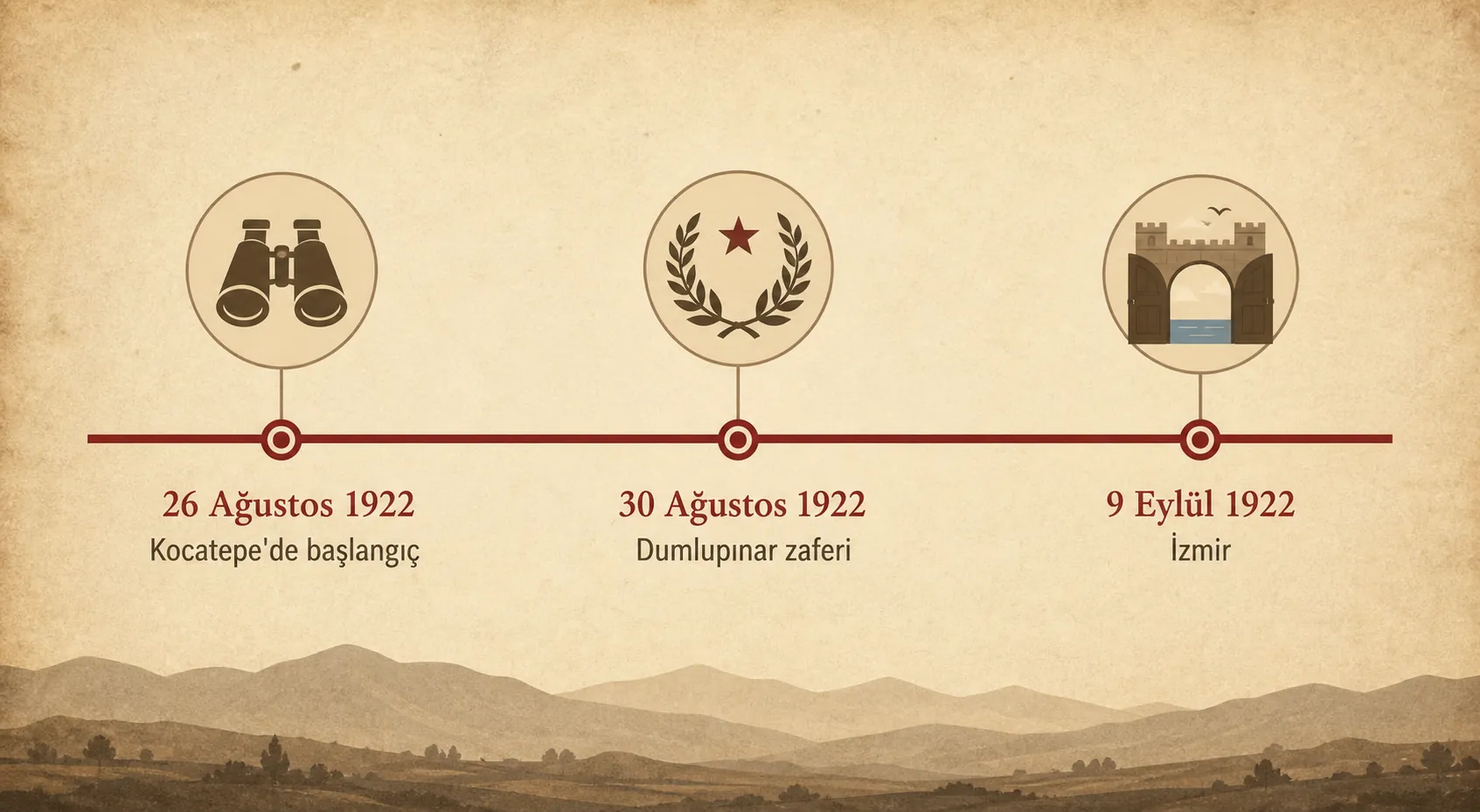
Memorize the distinction inside the dates: 26 Ağustos is the beginning; 30 Ağustos is the decisive victory. If those two jobs remain attached to their dates, the rest of the chronology has somewhere stable to sit.
Build the chronology around the three carrier dates
The attack began from Kocatepe on 26 Ağustos 1922. Afyonkarahisar was retaken on 27 Ağustos, but 27 Ağustos should remain a supporting date: it shows the advance developing after the opening rather than replacing the three-date spine.[1]
The decisive point came on 30 Ağustos at Dumlupınar, in the battle remembered as Başkomutanlık Meydan Muharebesi. This is why 30 Ağustos carries the victory label. It does not mark the opening of the Büyük Taarruz.[1]
Mustafa Kemal Paşa’s command—“Ordular! İlk hedefiniz Akdeniz'dir. İleri!”—belongs after that decisive success in the memory sequence. Its function is to connect Dumlupınar with the continued pursuit toward the west. Turkish forces reached İzmir on 9 Eylül, and the liberation of Western Anatolia was completed by 18 Eylül 1922.[1]
- 26 Ağustos: the offensive opens at Kocatepe.
- 27 Ağustos: Afyonkarahisar is retaken; keep this as a supporting date.
- 30 Ağustos: decisive victory at Dumlupınar.
- The command directs the armies westward.
- 9 Eylül: İzmir.
- 18 Eylül: liberation of Western Anatolia is completed.
A short verbal hook is enough: “Kocatepe opens, Dumlupınar decides, İzmir completes the westward drive.” This is study guidance, not a historical quotation.
Three confusion traps to separate before the exam
Sakarya 1921 and Büyük Taarruz 1922
| Topic | Date and function | Keep it separate by remembering |
|---|---|---|
| Sakarya Meydan Muharebesi | 22 Ağustos–13 Eylül 1921; a defensive battle. Mustafa Kemal received the Gazi title and rank of Mareşal afterward.[3] | 1921 = defense at Sakarya |
| Büyük Taarruz | Began 26 Ağustos 1922; a general offensive intended to defeat the opposing army and remove it from Anatolia.[1][3] | 1922 = offensive from Kocatepe |
Do not merge these into one long battle. Sakarya belongs to 1921 and the defensive phase; Büyük Taarruz belongs to 1922 and the final general offensive. The year-and-function pair is more dependable than trying to retrieve every detail of both battles at once.
26 Ağustos and 30 Ağustos
Assign one verb to each date: 26 Ağustos began; 30 Ağustos decided. Zafer Bayramı is observed on 30 Ağustos because that date represents the decisive victory, not because the offensive started then.[1][2]
Mudanya and Lausanne
| Agreement | Date | Function in the sequence |
|---|---|---|
| Mudanya Ateşkes Antlaşması | 11 Ekim 1922[2] | Armistice: the military conflict stops. |
| Lozan Barış Antlaşması | 24 Temmuz 1923[2] | Peace settlement: the postwar international settlement is established. |
The usable sequence is Büyük Taarruz and Dumlupınar → Mudanya armistice → Lausanne peace treaty. Mudanya and Lausanne are therefore consequences in the political-diplomatic sequence, but they do different jobs and occur on different dates.
What the victory changed
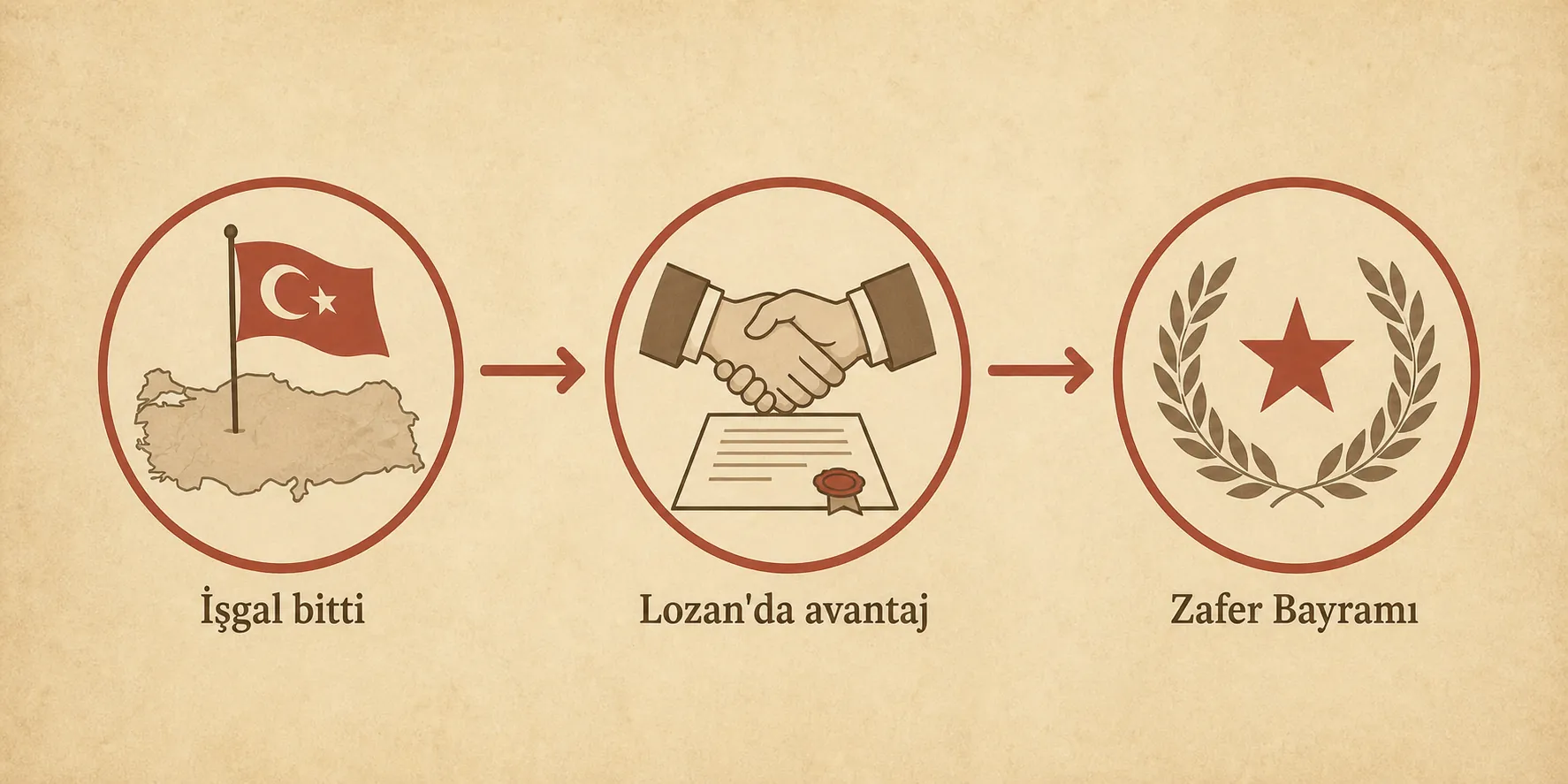
The military result came first: the Greek army was defeated at Dumlupınar, the advance reached İzmir, and the occupation of Western Anatolia ended. That result improved the Turkish side’s position before the armistice and peace negotiations that followed.[1][2]
Keep the consequence chain in three categories rather than mixing every event into one sentence:
- Military: decisive victory and the end of the occupation in Western Anatolia.
- Diplomatic: Mudanya, followed by the Lausanne peace settlement.
- Commemorative: 30 Ağustos becomes Zafer Bayramı.
The victory was first celebrated in 1924 under the name “Başkumandan Zaferi.” A law dated 1 Nisan 1926 established the name Zafer Bayramı.[2] These are commemoration-history dates; they should not displace the campaign dates in the main memory line.
Force and casualty figures: keep the source label attached
Published summaries do not supply one uncontested pair of totals. The safest worksheet records who reports each number and what period the number measures.
| Measure | Turkish forces | Greek forces | Source and boundary |
|---|---|---|---|
| Infantry and cavalry | Approximately 98,670–103,000 infantry and 5,286 cavalry | Approximately 130,000 infantry and 1,300 cavalry | Great Offensive, English Wikipedia.[4] |
| Total-strength comparison A | 186,000 | 195,000 | Büyük Taarruz, Turkish Wikipedia.[1] |
| Total-strength comparison B | 207,941 | 224,996 | Başkomutanlık Meydan Muharebesi, Turkish Wikipedia.[5] |
| Turkish casualties, 26 Ağustos–9 Eylül | 13,476 total: 2,318 killed, 9,360 wounded, 1,697 missing, and 101 captured | — | Büyük Taarruz, Turkish Wikipedia.[1] |
| Greek loss estimate A | — | Approximately 73,000 | Büyük Taarruz, Turkish Wikipedia.[1] |
| Greek loss estimate B | — | Approximately 50,000 by 7 Eylül: 35,000 killed or wounded and 15,000 captured | Battle of Dumlupınar, English Wikipedia.[6] |
These figures should not be averaged into a supposedly cleaner answer. The strength totals may reflect different scopes or counting methods, while the Greek loss estimates do not necessarily cover the same time window. If a question supplies a source or table, answer from that source’s figures. For free recall, retain the broad imbalance and one clearly labeled figure rather than pretending the disagreement does not exist.
The ox-cart image is useful because it explains a constraint
The Turkish army relied on ox carts and lacked a motorized supply fleet.[4] This detail deserves space because it creates a concrete picture of the logistical difficulty behind the offensive. Use the image to support the chronology—supplies moving slowly toward an operation prepared in secrecy—rather than allowing it to become a detached anecdote.
Why Trikoupis should not carry the timeline
Greek commander Nikolaos Trikoupis was captured with approximately 6,000 men near Uşak, but the available sources disagree on the surrender date. The English Great Offensive page gives 29 Ağustos, while the Turkish Büyük Taarruz page places the surrender at Uşak on 2 Eylül.[1][4]
Remember the episode as evidence of the Greek army’s collapse after the breakthrough, but do not use its disputed date as a primary anchor. The dependable carriers remain 26 Ağustos, 30 Ağustos, and 9 Eylül.
Active-retrieval worksheet
Close the notes and complete the blanks. If you are working toward a fixed test date, place this short retrieval exercise into a countdown study plan instead of rereading the full chapter each time.
| Blank | Your answer |
|---|---|
| The Büyük Taarruz began on ________ from ________. | |
| The supporting event on 27 Ağustos was ________. | |
| The decisive victory at ________ occurred on ________. | |
| Complete the command: “Ordular! İlk hedefiniz ________. ________!” | |
| Turkish forces entered ________ on 9 Eylül 1922. | |
| The liberation of Western Anatolia was completed by ________. | |
| Military result → ________ Ateşkesi → ________ Barış Antlaşması | |
| 1921 and defense = ________; 1922 and offensive = ________. |
Confusion-trap prompts
- Did the Büyük Taarruz begin on 26 Ağustos or 30 Ağustos?
- What happened on 30 Ağustos if the offensive had already begun?
- Which battle belongs to 1921, and was its principal function defensive or offensive?
- Which agreement was the armistice, and which was the peace treaty?
- Why should the disputed Trikoupis surrender date remain outside the three-date spine?
Answer check
- 26 Ağustos 1922; Kocatepe.
- Afyonkarahisar was retaken.
- Dumlupınar; 30 Ağustos 1922.
- “Akdeniz'dir. İleri!”
- İzmir.
- 18 Eylül 1922.
- Mudanya; Lozan.
- Sakarya Meydan Muharebesi; Büyük Taarruz.
- 26 Ağustos.
- The decisive victory at Dumlupınar.
- Sakarya Meydan Muharebesi; defensive.
- Mudanya is the armistice; Lausanne is the peace treaty.
- The available sources disagree on whether Trikoupis surrendered on 29 Ağustos or 2 Eylül, so the episode is a supporting fact rather than a reliable date anchor.
The topic is secure when you can reconstruct the three carrier dates, place the command after Dumlupınar, and move from military victory to Mudanya and Lausanne without reopening the narrative chapter.
References
- Büyük Taarruz — Vikipedi
- 30 Ağustos Zafer Bayramı — Vikipedi
- Sakarya Meydan Muharebesi — Vikipedi
- Great Offensive — Wikipedia
- Başkomutanlık Meydan Muharebesi — Vikipedi
- Battle of Dumlupınar — Wikipedia
Related exhibits & inventory
Verified outcomes
No verified outcomes on file for this exam yet
See Methodology for how outcome evidence is disclosed once logged.
Planners
No planner filed for this exam yet
A downloadable timeline template for this exam hasn't been published yet.
Tool verdicts
AI-tool cautions
No AI tools tested for this exam yet
No hands-on AI-accuracy logs have been filed for this exam.
Questions about this plan
Ask a question about a specific section, timeline, or citation in this plan — or flag something that needs correcting.
Comments
Join the discussion with an anonymous comment.