
GRE Exam Hub
Can You Still Afford Grad School? 2026 Student Loan Relief Options
The July 2026 One Big Beautiful Bill Act eliminated Grad PLUS loans and capped graduate borrowing. This article explains how those changes affect GRE and MCAT takers' funding strategies and why test scores, assistantships, and scholarship applications are now essential financial tools.
- SAT
- ACT
- GRE
- MCAT
- ASVAB
- digital-sat
- adaptive-testing
- registration-fee
- content-outline
- score-target
Current as of Q3 2026: the July 1, 2026 federal loan overhaul has changed the affordability math for graduate and professional school applicants, but some implementation details remain legally and administratively unsettled. Before you submit deposits or assume a repayment plan will work, verify your exact program classification and loan eligibility with studentaid.gov or your school’s financial aid office.
The short answer for GRE and MCAT takers is uncomfortable but useful: federal loans are now less likely to cover the full cost of graduate school, medical school, or other professional programs by themselves. The old backup plan — “I’ll borrow what the program costs if I get in” — is no longer a safe planning assumption for new borrowers.
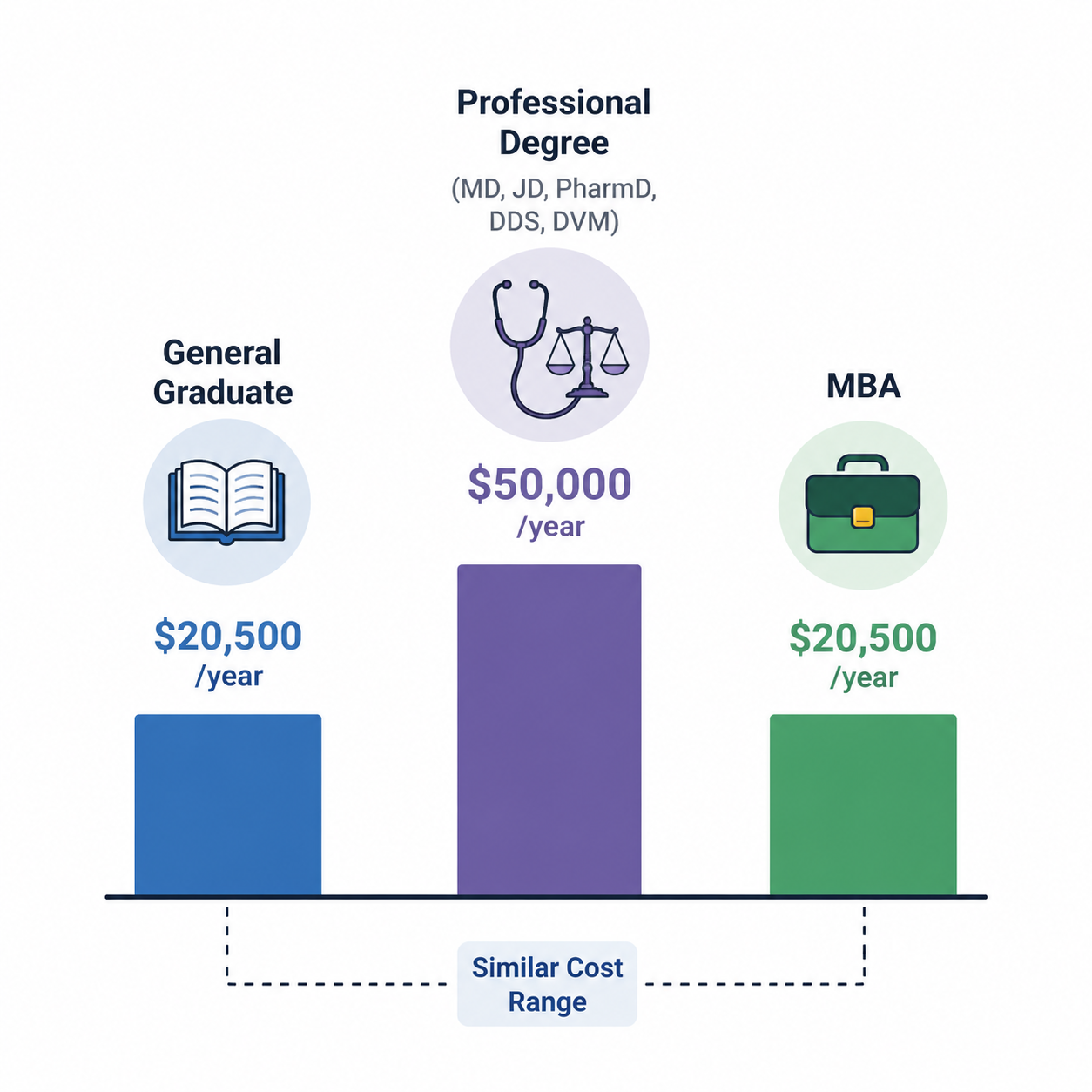
The biggest break from the old system is the elimination of Grad PLUS loans for new borrowers as of July 1, 2026. Before that, graduate and professional students could use Grad PLUS to borrow up to the full cost of attendance after other aid. Under the new structure, annual federal borrowing is capped at $20,500 for general graduate programs and $50,000 for professional-degree programs, with a $257,500 aggregate lifetime cap across undergraduate and graduate borrowing.[1][2]

The old full-cost borrowing assumption is gone
This is the part to check before paying application fees, not after acceptance letters arrive. A program can admit you, offer a respectable aid package, and still leave a gap that federal loans cannot fill. That gap may have to come from scholarships, assistantships, school-based grants, savings, income, family help, employer support, private loans, or a different admissions list.
The new caps are not minor paperwork details. They decide whether a student can use federal borrowing to bridge tuition, fees, insurance, housing, transportation, and exam-to-enrollment costs. A master’s student in a high-cost city, an MBA applicant looking at a private program, and a medical student with no family contribution may all be reading the same policy change, but the consequence is different for each one.
| Program type | New federal annual cap for new borrowers | Planning consequence |
|---|---|---|
| General graduate programs, including MA, MS, MBA, and non-clinical PhD programs | $20,500/year | Federal loans may fall well below total cost of attendance, especially at private or high-cost programs. |
| Professional degrees, including MD, JD, PharmD, DDS, and DVM | $50,000/year | The cap is higher, but many programs can still cost more than federal loans will cover. |
| All undergraduate and graduate borrowing combined | $257,500 aggregate lifetime cap | Prior undergraduate debt now matters more because it reduces remaining federal borrowing room. |
That table is also why relief now has to include the admissions stage. Relief is not only what happens after graduation. It starts with reducing the amount you need to borrow in the first place.
MBA applicants have a classification problem
The most expensive misunderstanding in the new system may be assuming that “professional-sounding” means “professional-degree cap.” Under the new rules described by ETS, MBA programs are classified under the general graduate cap, not the professional-degree cap. That puts MBA borrowers at the $20,500 annual limit, not the $50,000 professional-degree limit.[1]
For MBA-curious seniors, this changes the way a school list should be built. A lower-cost public option, employer-sponsored part-time route, stronger scholarship target, or delayed application after work experience may be financially different from a full-time private program with the same federal loan ceiling. The prestige conversation and the borrowing conversation now have to happen at the same time.
There is also a legal wrinkle to watch: the definition of which programs count as “professional degrees” has faced court activity in 2026, including a temporary pause on a stricter Education Department definition noted in the research landscape. That is not a reason to guess optimistically. It is a reason to ask the financial aid office, in writing if possible, which annual cap they expect to apply to your specific program.
Medical school still gets the higher cap, but the gap may survive
MCAT takers should not hear “$50,000 professional-degree cap” and stop reading. MD programs fall into the higher professional-degree category, but the cap is still a cap. If tuition, fees, living costs, required equipment, insurance, and relocation push cost of attendance beyond federal eligibility, the remaining amount has to come from somewhere else.
Debt is already common in the medical path. Education Data Initiative reports that 76.2% of medical doctors have student loan debt, and that the average graduate degree holder owes up to $102,790 in cumulative federal student loan debt.[3] Those numbers do not prove what any individual applicant will borrow under the new caps, but they do make one point hard to ignore: the margin for casual financial planning is thin.
A medical school list now needs three columns next to the usual mission-fit and admissions-stat columns: estimated cost of attendance, expected federal borrowing room, and scholarship or service-program possibilities. If you already borrowed heavily as an undergraduate, the lifetime aggregate cap also belongs in that same spreadsheet.
Your GRE or MCAT score is part of the funding strategy now
No test score guarantees aid. It is worth saying that plainly, especially when one of the clearest public explanations of the new loan rules comes from ETS, the organization behind the GRE. ETS has an obvious interest in emphasizing the value of test performance. Still, the bounded version of the claim is useful: a stronger admissions profile can improve access to merit scholarships, fellowships, assistantships, and more affordable program choices.[1]
That means test prep is no longer only about crossing an admissions threshold. For GRE applicants, a score that moves you from “admissible” to “competitive for funding” can change the amount you need to borrow. For MCAT applicants, a stronger score can support applications to schools where merit aid, in-state tuition, or institutional scholarships are more realistic. The score is not the whole file, but it can affect which financial doors are worth knocking on.
If you are still building your study calendar, treat financing milestones as part of the same calendar. A useful sequence looks like this:
- Before choosing a test date, estimate the cost of attendance for realistic programs, not only dream programs.
- Before finalizing a score goal, check whether your target schools publish scholarship ranges, assistantship expectations, or funded cohort norms.
- Before submitting applications, confirm whether each program falls under the $20,500 general graduate cap or the $50,000 professional-degree cap.
- Before accepting an offer, compare the net price against federal loan eligibility after accounting for existing undergraduate debt.
For GRE planning, start with the GRE exam hub and build backward from both application deadlines and funding deadlines. For MCAT planning, use the MCAT exam hub the same way: not just to decide when to test, but to decide when scholarship applications, transcript requests, recommendation letters, and financial aid questions must be finished.
Assistantships and tuition waivers are no longer side perks
For many general graduate applicants, especially master’s and PhD-bound GRE takers, assistantships are now one of the most important affordability tools left. A teaching or research assistantship may reduce tuition, provide a stipend, or both. The exact package depends on the institution and department, so this is not something to assume from a university-wide admissions page.
Ask direct questions early:
- Are admitted master’s students considered for assistantships, or only PhD students?
- Does the assistantship include a tuition waiver, a stipend, health insurance support, or only hourly pay?
- Is funding guaranteed for one year, renewable, competitive each semester, or unavailable to first-year students?
- Does applying by an earlier deadline improve funding consideration?
- Are GRE scores, undergraduate GPA, research experience, or faculty match used in funding decisions?
This is where a first-generation applicant can get hurt by hidden timing. A department may technically offer assistantships, but only to applicants who apply by a priority deadline, contact faculty early, or submit an additional funding form. Missing that step can turn an admit into an unfunded admit, which matters more when federal borrowing stops at $20,500 per year for general graduate programs.[1]
What relief options still exist if you borrow?
The loan changes did not erase every repayment and forgiveness path. They did, however, make it more important to choose a path before the debt is already fixed. If your degree points toward public service, nonprofit work, teaching, medicine, government, or a lower-paid residency period, repayment strategy should be part of your admissions decision.
Public Service Loan Forgiveness
Public Service Loan Forgiveness remains active and tax-free. The basic structure still centers on qualifying public service employment and 120 qualifying payments.[4] For a future physician, public defender, government analyst, public health worker, or nonprofit professional, PSLF can change which salary path is financially tolerable after graduation.
The catch is that PSLF does not make an unaffordable enrollment decision harmless. You still have to get through school, stay in qualifying employment, and make the required payments under the rules that apply to your loans. If you are comparing two programs and one leaves a much smaller uncovered gap, PSLF does not erase that upfront difference.
Income-Based Repayment
Income-Based Repayment is also still part of the relief map. Forbes reported that IBR forgiveness resumed in fall 2025, but forgiveness is federally taxable after December 31, 2025.[4] That tax treatment matters for long-term planning: a lower payment path may protect monthly cash flow, but the final forgiveness event can still carry a tax consequence.
For applicants entering programs with modest expected salaries relative to debt, IBR is worth understanding before borrowing. It should not be treated as a vague promise that “income-driven repayment will handle it.” Ask what your likely first-year salary, residency salary, public-sector salary, or nonprofit salary would do to payments under the available plans.
Repayment Assistance Plan
The new Repayment Assistance Plan, or RAP, is another option to watch. ETS describes RAP as offering 30-year forgiveness, a $10 monthly minimum payment, and an interest waiver for borrowers who pay on time. RAP is not available for Parent PLUS loans.[1]
RAP may help some borrowers keep payments manageable, but a 30-year forgiveness timeline is not a small commitment. If a program requires private borrowing on top of federal loans because the cap is too low, RAP will not automatically solve the private-loan portion. That is one more reason to separate “federal loan eligible” from “actually affordable.”
Borrower defense, TPD discharge, and Teacher Loan Forgiveness
Borrower defense, total and permanent disability discharge, and Teacher Loan Forgiveness remain important, but they are narrower tools. Borrower defense is tied to school misconduct. TPD discharge is tied to disability status. Teacher Loan Forgiveness depends on qualifying teaching service. They are not general affordability strategies for a student choosing among programs this cycle.
That does not make them irrelevant. A future teacher comparing graduate education programs should understand Teacher Loan Forgiveness and PSLF before borrowing. A student harmed by institutional misconduct should know borrower defense exists. But these options are best treated as specific relief pathways, not substitutes for closing the funding gap before enrollment.
SAVE is gone, and current undergraduate borrowers need to pay attention
The end of SAVE matters most for readers who already carry undergraduate debt. The SAVE plan was vacated by a federal court on March 10, 2026, and 7 million to 7.5 million enrolled borrowers were being notified that they had 90 days to choose a new repayment plan, according to a July 17, 2026 legal guide from Tate Law.[5]
If you are applying to graduate or medical school while already in repayment, do not let the exam calendar push this into the background. A missed repayment transition can affect cash flow right when you are paying for test registration, score reports, applications, travel, and deposits. It can also distort your sense of what you can afford to borrow next.
How to use this before your next test date
A GRE or MCAT score target is now partly a financial target. Before you decide that your score is “good enough,” compare it with the funding reality at the schools on your list. If a slightly stronger application could make you competitive for a tuition waiver, assistantship, scholarship, or lower-cost program, the payoff is not only admissions pride. It may be less debt.
Use four checks before committing to an application list:
- Identify the federal cap for each intended degree: $20,500 for general graduate programs, including MBAs, or $50,000 for professional degrees such as MD and JD programs.
- Compare the cap with the full cost of attendance, not only tuition.
- Build merit aid, assistantship, scholarship, and waiver deadlines into the same timeline as GRE or MCAT prep.
- Verify repayment assumptions — PSLF, IBR, RAP, or another path — before accepting debt, not after graduation.
The applicant who sees the cap early still has choices: retake the test, widen the school list, apply earlier for funding, ask sharper questions, or choose a program whose net cost matches the career it leads to. The applicant who discovers the cap after admission may only have worse choices left.
References
- Student Loan Changes 2026, ETS, July 1, 2026
- How the One Big Beautiful Bill Act Affects Students, Citizens Bank
- Student Loan Debt Statistics, Education Data Initiative, 2026
- These 8 Sweeping Student Loan Forgiveness Changes Happen In 2026, Forbes, January 15, 2026
- How to Apply for Student Loan Forgiveness, Tate Law, July 17, 2026
Related exhibits & inventory
Verified outcomes
Planners
No planner filed for this exam yet
A downloadable timeline template for this exam hasn't been published yet.
Tool verdicts
AI-tool cautions
No AI tools tested for this exam yet
No hands-on AI-accuracy logs have been filed for this exam.
Questions about this plan
Ask a question about a specific section, timeline, or citation in this plan — or flag something that needs correcting.
Comments
Join the discussion with an anonymous comment.