
2026 Green Card Interview Tips for F-1 Students
A practical guide for F-1 international students facing a 2026 USCIS green card interview, covering document checklists, common questions, and the F-1-specific vulnerabilities that generic interview advice misses.
- SAT
- ACT
- GRE
- MCAT
- ASVAB
- digital-sat
- adaptive-testing
- registration-fee
- content-outline
- score-target
Why F-1 students should assume the interview may happen in 2026
If you are an F-1 student preparing for adjustment of status, the safest 2026 green card interview tip is not “just relax.” It is: prepare from the file USCIS already has. That applies whether your I-485 is based on marriage to a U.S. citizen or permanent resident, or on an employment-based petition after OPT or STEM OPT.
Marriage-based applicants have the sharpest reason to take this seriously. Immigration Fleet, an immigration practitioner source, reported that marriage-based green card interview waivers dropped from over 90% before 2026 to roughly 6–9% in 2026, citing USCIS data; the same report put employment-based waivers at about 72%, which still leaves about 28% of employment-based filers attending interviews.[1] Those figures should be treated as practitioner-reported data rather than a direct USCIS statistical release, but the preparation consequence is straightforward: a student applicant should not build a plan around being waived.

The useful way to prepare is narrower than most online question lists suggest. RN Law Group says approximately 95% of green card interview questions come directly from the applicant’s own I-485.[2] That does not mean officers never ask about the relationship, the job, prior visa history, or missing documents. It means your first study material is not a random list of 100 questions. It is your own signed application.
USCIS interview policy also explains why the form matters: an interview is used to verify identity, confirm eligibility, review answers, and resolve issues in the record.[3] For an F-1 student, the record is rarely just one clean immigration category. It may show school transfers, CPT, OPT, STEM OPT, travel during school breaks, an address near campus, an address with a spouse, an employer address, and a filing date that may sit close to a U.S. entry. Generic advice usually skips those pressure points.
Use the I-485 as your source document
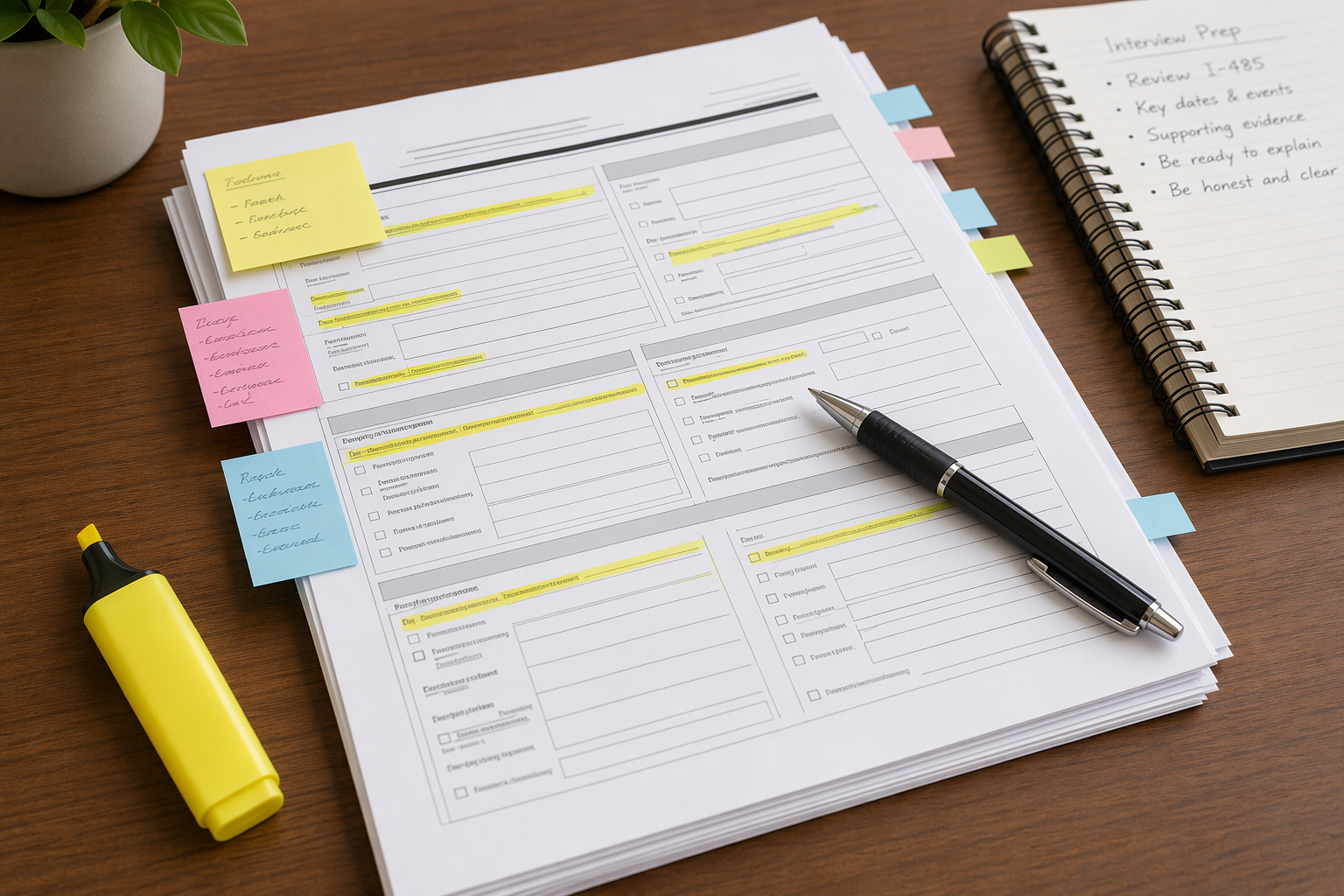
Print the exact I-485 copy that was filed, not a blank form and not a newer version you found online. If an attorney filed it, ask for the full filing copy, including attachments. Then review it the way you would review a high-stakes exam passage: line by line, with a highlighter, and with supporting documents beside it.
| I-485 area | What to check before the interview | Why it matters for an F-1 student |
|---|---|---|
| Name, date of birth, country of birth, A-number, passport information | Match the I-485 against your passport, visa, I-94, EADs, prior approval notices, and interview notice. | Small identity mismatches can slow identity verification even when the underlying case is approvable. |
| Current and prior addresses | Build a month-by-month address history and mark campus housing, spouse’s address, employer relocation, and mailing addresses. | Address inconsistency is a common source of confusion in marriage cases and may also affect notices, jurisdiction, and credibility. |
| Entries and exits | Compare every listed arrival and departure with I-94 records, passport stamps, travel history, and school breaks. | Your last entry date can affect questions about intent, especially if you filed soon after entering on F-1. |
| School history | Bring I-20s, transcripts if available, enrollment verification, and evidence of SEVIS continuity where relevant. | The officer may need to see that the student record makes sense before and after the adjustment filing. |
| Employment history | Reconcile CPT, OPT, STEM OPT, unpaid work, internships, job title, employer name, worksite, and dates. | Unauthorized employment concerns can appear through simple date gaps or employer-name mismatches. |
| Admissibility questions | Read every yes/no question exactly as answered and know the facts behind each answer. | These questions are not small talk; they go to eligibility and may lead to follow-up if an answer is unclear. |
| Prior immigration filings | List prior visas, change-of-status filings, extensions, petitions, denials, withdrawals, and pending applications. | Students often forget older filings because a school or employer handled them. |
Do not correct an error casually at the window as if you are fixing a typo on a class form. If you find a mistake before the interview, mark it, gather proof, and ask your attorney if you have one how to address it. Some errors are harmless clarifications. Others change eligibility, admissibility, work authorization history, or the timeline of immigrant intent.
Your goal is not to memorize a script. It is to avoid being surprised by your own filing. If the form says you lived at one address while your lease, bank statements, or spouse’s documents show another, you need the explanation ready before the officer asks. If the form lists an employer under one corporate name and your pay statements show a different payroll entity, put both names in your notes. If a trip abroad appears in your passport but not in your memory, reconstruct it now.
The F-1 issues general green card guides usually miss
F-1 status is a nonimmigrant student classification. Adjustment of status is an immigrant process. That does not make an F-1-to-green-card case automatically improper, but it does make timing, travel, and status maintenance more visible.
The 90-day rule is a risk factor, not an automatic denial
Boundless describes the 90-day rule as creating a rebuttable presumption of preconceived immigrant intent when someone files for adjustment within 90 days of the most recent U.S. entry, and notes that the clock resets after each new entry.[4] For an F-1 student, that matters because the entry was made in a nonimmigrant category.
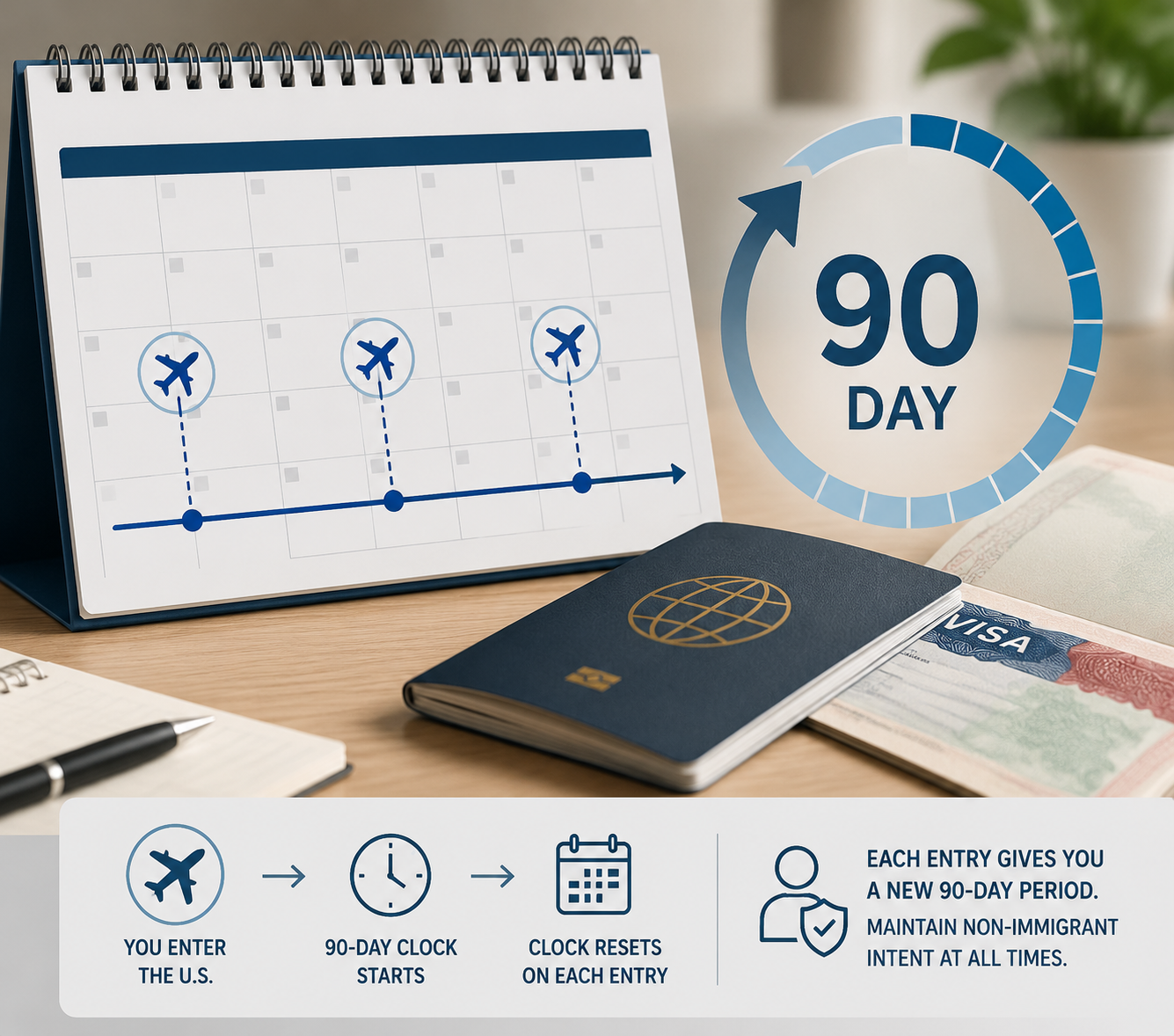
This is not a statutory bar that mechanically defeats every case filed inside 90 days. It is a scrutiny point. If you entered the United States as an F-1 student and soon after married, filed I-485, stopped attending classes, changed address, or took steps inconsistent with your stated student purpose at entry, expect the officer to look at the sequence. The preparation task is to build a clean timeline: last entry date, purpose of entry, school status at entry, when the relationship or job-based green card path developed, when the I-485 was filed, and what changed after entry.
If your last entry was after a prior engagement, marriage plan, labor certification, I-140 filing, or other immigrant-step event, do not try to smooth that over with vague answers. This is exactly the kind of fact pattern where qualified immigration counsel is worth more than internet reassurance.
Pending I-485 does not make your F-1 history disappear
Once the I-485 is pending, students often focus on the adjustment case and forget that the officer can still ask how they maintained status before filing and what work authorization supported each job. If you were on OPT or STEM OPT, bring the EAD cards, I-20s showing the recommendation, employer information, and dates of employment. Boundless states that F-1 OPT holders who file I-485 can keep working under OPT or CPT as long as F-1 status and OPT authorization remain valid, and that a new unrestricted EAD after I-485 filing arrives in about 150 days.[4]
That estimate is not a promise for your case. The point is practical: know which card or authorization covered which period. Do not mix up an OPT EAD, a STEM OPT EAD, and an adjustment-based EAD. They may all look like work authorization to a busy applicant, but they rest on different legal bases.
Marriage-based F-1 cases: prepare for the relationship and the student timeline
Marriage-based applicants should prepare more heavily for in-person questioning in 2026 because of the reported waiver collapse. A normal marriage green card interview is not supposed to punish a student for falling in love while studying in the United States. It is supposed to test whether the marriage is bona fide and whether the applicant is otherwise eligible. The difficulty is that some perfectly ordinary student facts can look messy on paper: separate leases before graduation, temporary campus housing, long-distance semesters, parents paying tuition, one spouse moving for a job, or a wedding close to an F-1 entry.
Boundless lists core marriage interview materials such as identity documents and relationship evidence, including joint financial records, leases, photos, and affidavits.[5] For a student, the binder should also explain transitions: when you moved from campus housing, when you began living together, why one address was used for school or mail, and how the relationship developed around semesters, OPT, or employment.
- Identity and status: passports, current and expired visas, I-94 records, EADs, I-20s, interview notice, government IDs, and copies of filed forms.
- Marriage proof: marriage certificate, joint lease or mortgage records, joint bank or credit accounts, insurance, tax documents if available, utility bills, photos across time, travel records, messages if appropriate, and affidavits from people who know the relationship.
- Address explanation: a one-page address timeline showing campus housing, spouse’s residence, mailing address, and any period when you lived apart for school, work, lease timing, or family reasons.
- Timing explanation: a short timeline from first meeting to dating, engagement or decision to marry, marriage, last F-1 entry, I-485 filing, and any major travel.
The address timeline is not decoration. Address mismatches are one of the easiest ways for a real marriage to look uncertain. If your I-485 says one address, your spouse’s driver’s license says another, your bank statements went to campus housing, and your lease started after the wedding, that may all be explainable. It is much harder to explain cleanly if the first time you notice it is during questioning.
If spouses are separated for questioning
A Stokes interview refers to a more intensive marriage interview process associated with Stokes v. INS, 393 F. Supp. 24 (S.D.N.Y. 1975), where spouses may be questioned separately and their answers compared.[6] Charles International Law identifies triggers such as a large age gap, marriage soon after F-1 entry, and address mismatches; Immigration Fleet’s 2026 report also says many field offices separate spouses as standard practice, not only in escalated cases.[6][1]
Separate questioning is stressful because it turns ordinary memory differences into a transcript. Couples should not rehearse fake answers. They should review real shared facts: where each person sleeps, who pays which bills, how rent is paid, daily schedules, family names, important dates, recent trips, holidays, and how the household actually works. If one spouse is a full-time student and the other works nights, say that. If you lived apart during a semester or internship, document it and explain it plainly.
| Question type | Examples you might hear | What the officer is testing |
|---|---|---|
| Relationship history | How did you meet? When did the relationship become serious? Who proposed or how did you decide to marry? | Whether the relationship account is plausible and consistent. |
| Living arrangements | Where do you live now? Which side of the bed do you sleep on? Who else has keys? Why did you use a campus address? | Whether the couple shares a real household or has a credible reason for temporary separation. |
| Financial life | Do you have joint accounts? Who pays rent? How do you split groceries, tuition, insurance, or car expenses? | Whether the documentary evidence matches the claimed marital life. |
| F-1 timing | When did you last enter the United States? Were you already planning marriage? Were you still enrolled? | Whether the student entry and later adjustment timeline raise immigrant-intent concerns. |
A student marriage case can be strong even if it does not look like a settled mid-career household. Younger couples may have fewer assets, student debt, shared apartments with roommates, or financial help from family. The binder should show the relationship you actually have, not the relationship you think a government file prefers.
Employment-based F-1 cases: connect the degree, job, petition, and I-485
Employment-based applicants may be more likely to receive a waiver than marriage-based applicants under the practitioner-reported 2026 figures, but “more likely” is not “safe to ignore.” If you are called in, the officer may ask about education, job duties, employer, immigration history, and I-485 admissibility questions.
MMHPC describes employment-based interview preparation as including education verification, job duties alignment with the PERM labor certification, and review of I-485 admissibility questions. It also notes an important boundary: the officer cannot simply re-adjudicate the approved I-140 at the interview, but may refer the petition for revocation if serious issues arise.[7]
- Education: degree certificates, transcripts if available, credential evaluations if used, and documents showing the degree required for the sponsored role.
- Employment: current employment letter, recent pay statements, job title, job duties, worksite, supervisor or HR contact, and evidence of continued job offer where applicable.
- PERM and petition consistency: a copy of the PERM, I-140 approval notice, and a plain-English description of how your actual duties match the sponsored position.
- F-1/OPT work authorization: I-20s, OPT or STEM OPT EADs, employer reporting records if available, and a timeline showing no unexplained employment gaps or unauthorized work.
For OPT and STEM OPT students, the employment timeline deserves special care. A job title may evolve after filing. A company may change names. A worksite may be remote, hybrid, or moved after a restructuring. None of those facts is automatically disqualifying on its own, but the officer is entitled to ask what job exists now and whether it matches the basis for the green card process.
| Question type | Examples you might hear | Preparation note |
|---|---|---|
| Education | What degree did you earn? When did you graduate? How is your degree related to this job? | Know the degree, major, graduation timing, and any credential evaluation used in the case. |
| Job duties | What do you do day to day? Who is your employer? Where do you work? | Use language that matches your real work and does not contradict the PERM description. |
| Work authorization | When did you start working? Were you on OPT, STEM OPT, or an adjustment EAD? | Match every work period to the correct authorization document. |
| Admissibility | Have you ever worked without authorization? Have you ever violated status? Have you ever been denied a visa? | Review the I-485 yes/no answers and bring documents for any answer that needs explanation. |
Build a document binder that answers predictable doubts
A good binder is not a pile of everything you have ever scanned. It is organized so the officer can verify a point quickly. Put originals and copies in separate sections if you can. Use tabs. Keep the interview notice and IDs easy to reach. Do not hand over extra material unless asked or unless it directly resolves a concern.
| Binder section | Marriage-based student | Employment-based student |
|---|---|---|
| Interview basics | Interview notice, passport, visa, I-94, government ID, birth certificate, marriage certificate, filed forms. | Interview notice, passport, visa, I-94, government ID, birth certificate, filed forms, I-140 approval notice. |
| F-1 record | I-20s, EADs if any, enrollment proof, transcripts if useful, travel records. | I-20s, CPT/OPT/STEM OPT records, EADs, employment reporting materials if available, travel records. |
| Core eligibility | Relationship evidence, joint residence, joint finances, photos, affidavits, spouse’s status documents. | Job offer or employment letter, pay statements, PERM/I-140 materials, degree and credential documents. |
| Problem-solving tab | Address timeline, 90-day timing explanation if relevant, evidence for any prior visa denial or status issue. | Work authorization timeline, employer-name explanation, job duty comparison, evidence for any prior visa denial or status issue. |
The problem-solving tab is where over-preparation helps. If the officer never asks, fine. If the officer asks why your bank statement, lease, and I-485 do not line up, you can answer from a document instead of from panic.
What to say when the answer is imperfect
There are ordinary imperfections, and then there are eligibility problems. Do not treat them the same.
- Ordinary imperfection: you do not remember the exact date you opened a joint bank account. Say you do not remember the exact date and offer the statement.
- Ordinary imperfection: your spouse remembers the first restaurant and you remember the second date more clearly. Answer honestly; real couples do not share identical memory files.
- Potential eligibility issue: you worked before your OPT start date, after OPT expired, or for an employer not covered by your authorization. Get legal advice before the interview.
- Potential eligibility issue: you entered on F-1 and filed I-485 very soon after entry after already planning marriage or immigrant processing. Get legal advice before trying to explain it alone.
- Potential credibility issue: your I-485, testimony, and documents tell different address or employment stories. Reconcile the record before the interview.
The best interview answers are usually short, accurate, and attached to a document when a document exists. If you do not know, say you do not know. If you need to correct something, state the correction clearly and provide evidence. Guessing creates more trouble than admitting a memory limit.
Interview-day basics, without pretending they are the hard part
Arrive early. Dress neatly. Bring the interview notice. Bring originals and copies. Answer the question asked. Do not volunteer a speech for every yes/no question. If you do not understand the officer, ask for clarification. These are important, but they are not where most F-1-specific risk lives.
The harder part is entering the room already knowing the paper trail: how your student record moved into adjustment, which authorization covered which work period, where you lived, when you traveled, and why the path makes sense.
After the interview: approval, RFE, or NOID
Not every interview ends with an immediate decision. RN Law Group describes possible post-interview outcomes including approval, a Request for Evidence with an 87-day response window, or a Notice of Intent to Deny with a 30-day response window.[2] If you receive an RFE or NOID, calendar the deadline immediately and do not wait until the final week to start gathering documents.
A marriage-based AOS timeline from F-1 status may run 8–18 months according to Khunkhun Law, but law-firm timelines are estimates, not USCIS guarantees.[8] Delays after interview can happen because of missing evidence, background checks, supervisor review, fraud review, visa availability in some categories, or unresolved inconsistencies. The only useful response is to keep copies of everything submitted and answer any request precisely.
A practical preparation order for F-1 students
- Review the filed I-485 line by line and mark every answer that depends on a date, address, trip, job, school record, prior filing, or yes/no admissibility issue.
- Create one timeline covering F-1 entries, school attendance, CPT/OPT/STEM OPT, employment, marriage or job sponsorship, I-485 filing, travel, and address changes.
- Assemble a path-specific binder: bona fide marriage evidence for marriage-based cases; education, PERM/I-140, job-duty, and work-authorization evidence for employment-based cases.
- Identify weak spots before the interview: 90-day timing, address mismatches, employment gaps, unauthorized work concerns, prior denials, name variations, or separated-household facts.
- Practice answering from the record, not from a script. Use your actual I-485 and documents as the question bank.
- Get qualified immigration counsel if your facts involve possible misrepresentation, unauthorized employment, status violations, rapid post-entry filing, criminal history, prior removal issues, or suspected marriage-fraud concerns.
This article is practical preparation guidance for students, not legal advice. In 2026, marriage-based F-1 applicants should be ready for an interview rather than counting on a waiver, and employment-based applicants should still prepare because waivers are not universal. The officer is likely to test the same trail your documents already created: student status, entry dates, work authorization, address history, relationship or job eligibility, and the answers on the I-485.
References
- Mandatory Green Card Interviews 2026, Immigration Fleet
- What to Expect at Your Green Card Interview, RN Law Group
- USCIS Policy Manual, Chapter 5 — Interview Guidelines, USCIS
- How to Switch from an F-1 Visa to a Marriage Green Card, Boundless
- The Marriage Green Card Interview, Explained, Boundless
- Stokes Interview Preparation, Charles International Law
- Employment-Based Green Card Interview Prep, MMHPC
- Timeline for F-1 to Marriage Green Card AOS, Khunkhun Law
Related exhibits & inventory
Verified outcomes
No verified outcomes on file for this exam yet
See Methodology for how outcome evidence is disclosed once logged.
Planners
No planner filed for this exam yet
A downloadable timeline template for this exam hasn't been published yet.
Tool verdicts
AI-tool cautions
No AI tools tested for this exam yet
No hands-on AI-accuracy logs have been filed for this exam.
Questions about this plan
Ask a question about a specific section, timeline, or citation in this plan — or flag something that needs correcting.
Comments
Join the discussion with an anonymous comment.