
MCAT Exam Hub
Use the 2026 Cyclospora Outbreak as Your Exam Case Study
Walk through the 2026 cyclospora outbreak investigation step by step using the CDC field epidemiology 10-step framework. This case study highlights unique challenges of Cyclospora, including incubation period limitations and lack of genomic subtyping, to help you prepare for outbreak questions on CPH, NBPHE, and MCAT exams.
- gre
- mcat
- asvab
- sat
- act
- digital-adaptive
- official-material
- section-strategy
- test-date-timeline
For public-health exam practice, treat the 2026 U.S. Cyclospora investigation as a dated, preliminary field case—not as a finished food-safety story. Its value is that it lets you walk through the outbreak-investigation sequence the way an examiner would: detection, confirmation, case definition, case finding, descriptive epidemiology, hypothesis generation, analytic testing, traceback, control, and communication. The CDC field investigation framework supplies the route; the 2026 Cyclospora investigation supplies the messy evidence that makes the route worth learning. [1]

Start with the dated outbreak snapshot
As of July 20, 2026, public reporting described 4,173 confirmed cyclosporiasis cases across 41 states, with more than 7,400 additional suspect cases under investigation. Among confirmed cases, 308 of 4,173 were hospitalized, a 9% hospitalization proportion. No deaths had been reported as of July 24. The median age was 44 years, 56% of cases were female, and the median illness-onset date was June 26, 2026. The investigation identified iceberg lettuce as the leading vehicle, with traceback linked to iceberg lettuce from Taylor Farms de Mexico in central Mexico and a recall issued on July 17, 2026. [2]
Those numbers are useful only if you keep their date stamp attached. CDC cyclosporiasis surveillance includes an approximately 6-week reporting lag, so late-July counts should not be read as final outbreak totals. [3] On an exam, that lag is not a footnote. It changes how you interpret the epidemic curve, the apparent geographic spread, and whether a “current count” is a stable denominator.
Map the 10-step investigation before you memorize facts
The common mistake is to turn the outbreak into a list of numbers. The better exam move is to ask what each number is doing inside the investigation. A confirmed case count belongs to confirmation and case finding. A median onset date belongs to descriptive epidemiology. A lettuce exposure belongs first to hypothesis generation, then to analytic testing, and only later to traceback and control.
| Investigation step | Exam meaning | 2026 Cyclospora application |
|---|---|---|
| 1. Prepare | Assemble people, tools, jurisdictional contacts, specimen and interview plans. | A multistate foodborne investigation required coordination among CDC, state and local health departments, clinicians, laboratories, and food-safety partners. |
| 2. Confirm the outbreak and diagnosis | Verify that reported illness is real, above expectation, and correctly diagnosed. | Cyclosporiasis cases were confirmed through laboratory testing, including stool PCR in the public case definition. |
| 3. Define cases | Create criteria for who counts as a case, usually by person, place, time, clinical features, lab status, and exposure link. | The 2026 public-health materials distinguished confirmed cases from probable cases using laboratory and epidemiologic criteria. |
| 4. Find cases systematically | Search for additional cases beyond those first reported. | Health alerts and public-health reporting expanded detection across states while thousands of suspect cases remained under investigation. |
| 5. Describe by time, place, and person | Build the epidemic curve and characterize who is affected and where. | The case distribution across 41 states, median onset date, age, sex distribution, and hospitalization proportion helped define the outbreak pattern. |
| 6. Generate hypotheses | Use interviews and exposure histories to identify plausible sources. | Food histories pointed investigators toward fresh produce and then toward iceberg lettuce. |
| 7. Evaluate hypotheses analytically | Compare exposures among ill and non-ill people, or cases and controls. | The meaningful question became whether iceberg lettuce exposure was more common among cases than among comparison groups. |
| 8. Trace back the source | Follow the implicated food through distribution and supply chains. | Traceback linked the iceberg lettuce signal to Taylor Farms de Mexico in central Mexico. |
| 9. Implement control measures | Remove exposure or interrupt transmission before every uncertainty is resolved. | A recall was issued on July 17, 2026. |
| 10. Communicate findings | Warn clinicians, health departments, laboratories, industry, and the public while updating uncertainty. | CDC issued HAN00531 on July 14, 2026, and continued public outbreak updates as the investigation evolved. |
Preparation and confirmation are short, but not optional
Preparation is where the field team decides who will interview patients, who will handle laboratory reporting, who will coordinate with state partners, and how information will move quickly enough to matter. In a multistate produce outbreak, preparation also means expecting jurisdictional friction: patients live in one place, buy food in another, and consume a product that may have moved through a national distribution chain.
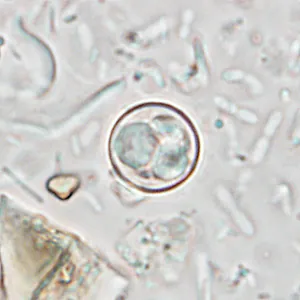
Confirmation has two parts that exam questions often separate. First, investigators establish that the number or pattern of cases is unusual. Second, they verify the diagnosis. CDC’s July 2026 health advisory used laboratory confirmation and epidemiologic linkage in its case definitions; confirmed cases required a positive stool PCR, while probable cases could be based on compatible clinical illness plus an epidemiologic link. [4]
Case definition and case finding do the heavy sorting
A case definition is not a diagnosis written in prettier language. It is the rule for inclusion. In this outbreak, that distinction matters because the public record included both confirmed cases and thousands of suspect cases still under investigation. If an exam stem gives you a large pool of “reports” or “suspected cases,” the next move is usually not traceback. It is to define who qualifies and then find cases consistently.
Case finding then asks whether the surveillance system is seeing the outbreak or only the easiest-to-detect edge of it. CDC’s July 14 Health Alert Network advisory was part of that process: it alerted clinicians and public-health officials to increased cyclosporiasis reports and gave guidance on diagnosis, treatment, and reporting. [4] State and territorial health officials also had to coordinate interviews, reporting, and prevention messaging across jurisdictions rather than treating each state’s reports as isolated events. [5]
Descriptive epidemiology turns counts into direction
The person-place-time description is where the outbreak starts to acquire shape. The 41-state distribution pushes the investigation away from a single restaurant kitchen and toward a widely distributed food item. The median onset date of June 26 helps place illnesses in time, while the hospitalization proportion tells you something about severity among confirmed cases—not among all exposed people, and not necessarily among all eventual cases. [2]
That last distinction is exam material. A hospitalization proportion calculated from confirmed cases is not the same as a risk of hospitalization among everyone who ate the implicated food. Confirmed cases are affected by who seeks care, who gets tested, which laboratories report, and where surveillance is strongest.
Hypothesis generation starts with imperfect food histories
Cyclospora makes hypothesis generation harder than a short-incubation foodborne illness. Symptoms usually begin about 1 to 2 weeks after ingestion, so investigators are asking patients to remember meals, salads, garnishes, grocery purchases, and restaurant orders after the ordinary details have blurred. [4] The interviewer’s job is to convert those blurred memories into analyzable exposure data.
That is why “food history” should not be treated as casual conversation. Investigators use structured questions, menu prompts, shopping histories, and repeated interviews when needed. A patient may not remember “iceberg lettuce” as a named exposure, but may remember a chopped salad, a sandwich topping, a restaurant bowl, or a meal kit. The point is not to produce certainty from one interview. The point is to find repeated exposure patterns that can be tested.
The absence of person-to-person transmission also matters here. CDC materials describe cyclosporiasis as not spread directly from one person to another. [4] That pushes investigators toward a contaminated food or water vehicle rather than toward a household transmission chain. If two household members become ill, the exam-safe interpretation is shared exposure first, not direct spread.
Analytic testing is where “many ate lettuce” becomes evidence
A list of foods eaten by cases is not yet an analytic study. If many cases ate iceberg lettuce, that may be important—or it may simply reflect that many people eat lettuce. The analytic step asks whether the exposure is meaningfully more common among cases than among an appropriate comparison group. In a case-control frame, the question is not “Did cases eat lettuce?” but “Were cases more likely than controls to have eaten iceberg lettuce during the relevant exposure window?”
For exam purposes, this is the hinge of the case. Descriptive epidemiology can suggest a distributed food source. Interviews can generate iceberg lettuce as a hypothesis. An analytic comparison can support that hypothesis. Traceback then asks whether the implicated lettuce has a plausible common source. Public outbreak materials linked the 2026 investigation to iceberg lettuce and traced it to Taylor Farms de Mexico in central Mexico. [2]
Traceback and recall are related, but they answer different questions
Traceback is not just a dramatic ending to an outbreak story. It is a separate evidentiary task. Investigators follow the food product backward through distributors, suppliers, processors, farms, and growing regions. The analytic study asks whether an exposure is associated with illness. Traceback asks whether the product pathway can explain the distribution of cases.
The July 17 recall belongs to control, not to final proof. [2] Public-health action often comes before every scientific uncertainty is resolved because the consequence of waiting is continued exposure. An exam question may describe a strong epidemiologic signal and ask what to do next; if the implicated product is still in commerce, control measures may be correct even while additional laboratory, traceback, or case-finding work continues.
Communication is part of the investigation, not an afterthought
CDC’s July 14 HAN advisory is a good example of communication before closure. [4] It did not mean the investigation was finished. It meant clinicians, laboratories, and health departments needed current instructions while the outbreak was still being characterized. For an exam, communication includes what is known, what is not known, what actions different audiences should take, and how uncertainty will be updated.
Three Cyclospora-specific traps exam writers like
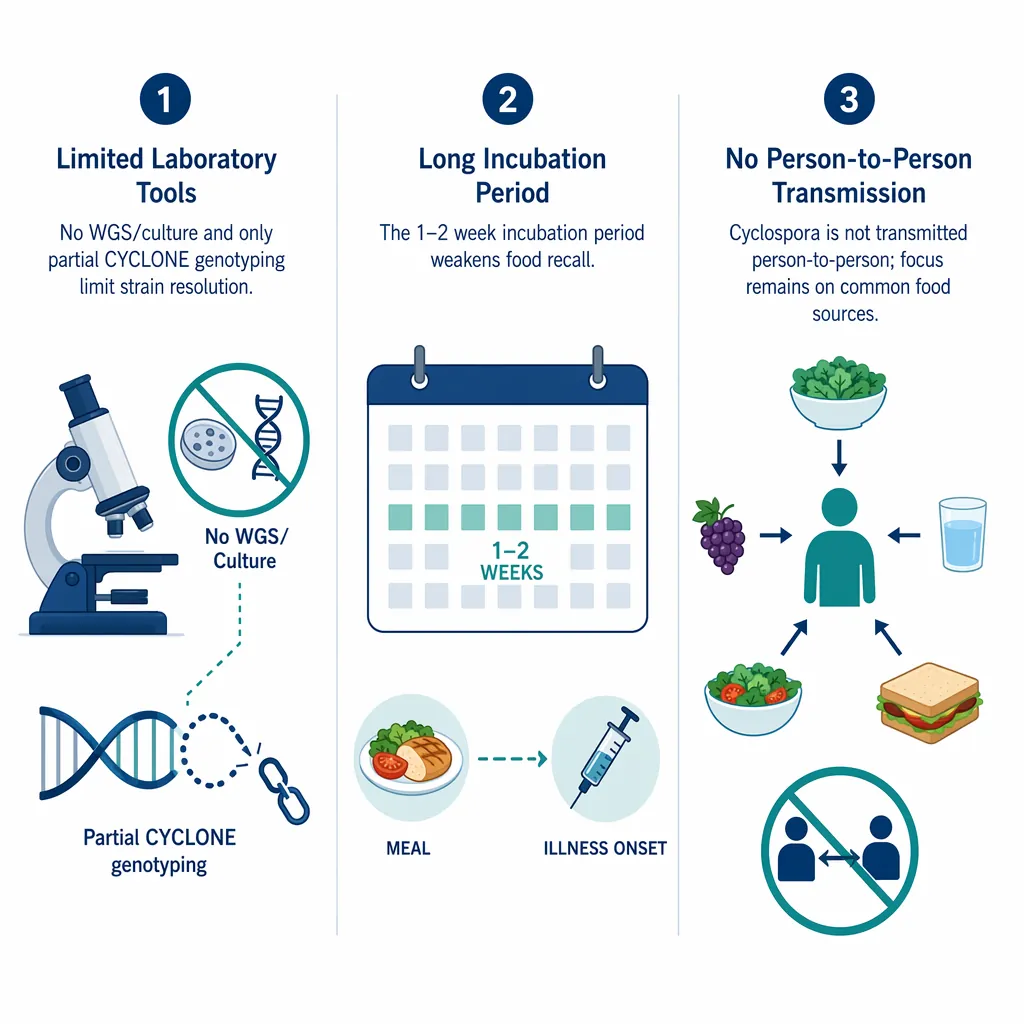
Cyclospora is not investigated exactly like a bacterial outbreak with easy culture and high-resolution genomic subtyping. The public-health investigation still follows the same broad framework, but the evidence available at each step is different. That is where many exam questions hide the answer.
1. No culture and no WGS shortcut
Cyclospora cannot be cultured in the routine way used for many bacterial foodborne pathogens, and whole-genome sequencing is not available as a standard outbreak subtyping shortcut. Public reporting has described the CYCLONE genotyping system as using 8 markers, with full-marker usable data obtained for only about 34% of specimens. [6]
That limitation changes the evidentiary balance. In a Salmonella-style exam stem, genomic clustering may strongly connect patients and food isolates. In a Cyclospora stem, the better answer may rely more heavily on epidemiologic association, exposure timing, and traceback. Do not choose “confirm the cluster by WGS” if the organism and public-health context do not support that tool.
2. The incubation period damages recall
A 1- to 2-week incubation period creates a practical interview problem. [4] The patient is not being asked about yesterday’s potluck. The patient is being asked about a range of meals that may include groceries, restaurants, prepared foods, salads, and mixed ingredients from one or two weeks earlier.
The exam implication is straightforward: weak recall does not make investigation impossible, but it does make unstructured interviews less useful. Better approaches include standardized food-history instruments, ingredient-level probing, comparison groups, and analytic study designs that can test whether a suspected exposure appears more often among cases than expected.
3. No person-to-person transmission points back to exposure
Because cyclosporiasis is not spread directly from person to person, clusters among people who know each other should be read carefully. [4] A household cluster, workplace cluster, or group of friends may share meals, restaurants, produce purchases, or catered food. The clustering does not by itself imply transmission from one infected person to another.
That is a common distractor. If an exam option says to isolate contacts to stop person-to-person spread, it is probably borrowing logic from a different disease. For Cyclospora, the stronger outbreak question is usually: what common food or water exposure links the cases?
How to read the case stem under exam pressure
When a question stem gives you a Cyclospora outbreak, first locate the step of the investigation. Most wrong answers are wrong because they jump ahead.
- If the stem says clinicians are reporting unusual diarrhea cases, think confirmation, diagnostic testing, and comparison with expected surveillance patterns.
- If the stem says many possible cases have been reported but not classified, think case definition and systematic case finding.
- If the stem gives age, sex, state distribution, onset dates, or an epidemic curve, think descriptive epidemiology.
- If the stem gives food interviews but no comparison group, think hypothesis generation.
- If the stem compares lettuce exposure among cases and controls, think analytic epidemiology.
- If the stem follows the product through suppliers, processors, farms, or countries of origin, think traceback.
- If the stem asks what to do while the product may still be reaching consumers, think recall, removal, and risk communication.
- If the stem offers WGS as the decisive next step, check whether the organism supports that method. For Cyclospora, that is the trap.
As of the late-July 2026 public record, the investigation is strong enough to serve as a complete framework case study, but not because every uncertainty has disappeared. Its best lesson is the opposite: outbreak investigation often works with delayed surveillance, incomplete recall, partial subtyping, and decisions that must be made before a single definitive laboratory fingerprint settles the case.
References
- Conducting a Field Investigation, CDC Field Epidemiology Manual.
- CDC Cyclospora Outbreak Page, CDC, July 26, 2026.
- Surveillance of Cyclosporiasis, CDC.
- CDC HAN Advisory HAN00531, CDC, July 14, 2026.
- Tracking Cyclosporiasis: Understanding the Current Outbreak, Case Investigations, and Prevention Efforts, ASTHO, 2026.
- What we truly know about the huge US Cyclospora outbreak—and what we don’t, CIDRAP, July 2026.
Related exhibits & inventory
Verified outcomes
Planners
No planner filed for this exam yet
A downloadable timeline template for this exam hasn't been published yet.
Tool verdicts
Questions about this plan
Ask a question about a specific section, timeline, or citation in this plan — or flag something that needs correcting.
Comments
Join the discussion with an anonymous comment.