
Comparison
White House Statues: An Art History Study Guide for Students
This guide identifies the most significant sculptures in the White House collection and explains their role in American art history, helping AP Art History students connect specific works to stylistic periods, artist intentions, and national identity.
Verdict panel
- Compared
- not specified
- Target exam
- not specified
- Best for
- not specified
- Pricing last reviewed
- pricing currency unconfirmed
For students studying White House statues in art history, the mistake is to treat the collection as a set of famous objects scattered around a famous address. It becomes useful for AP Art History when it is arranged as a timeline: early marble busts using classical authority, 19th-century and early 20th-century works that build American subjects into sculpture, mid-century modern pieces that interrupt likeness and memorial habits, and contemporary installations that widen the question of who belongs in public memory.
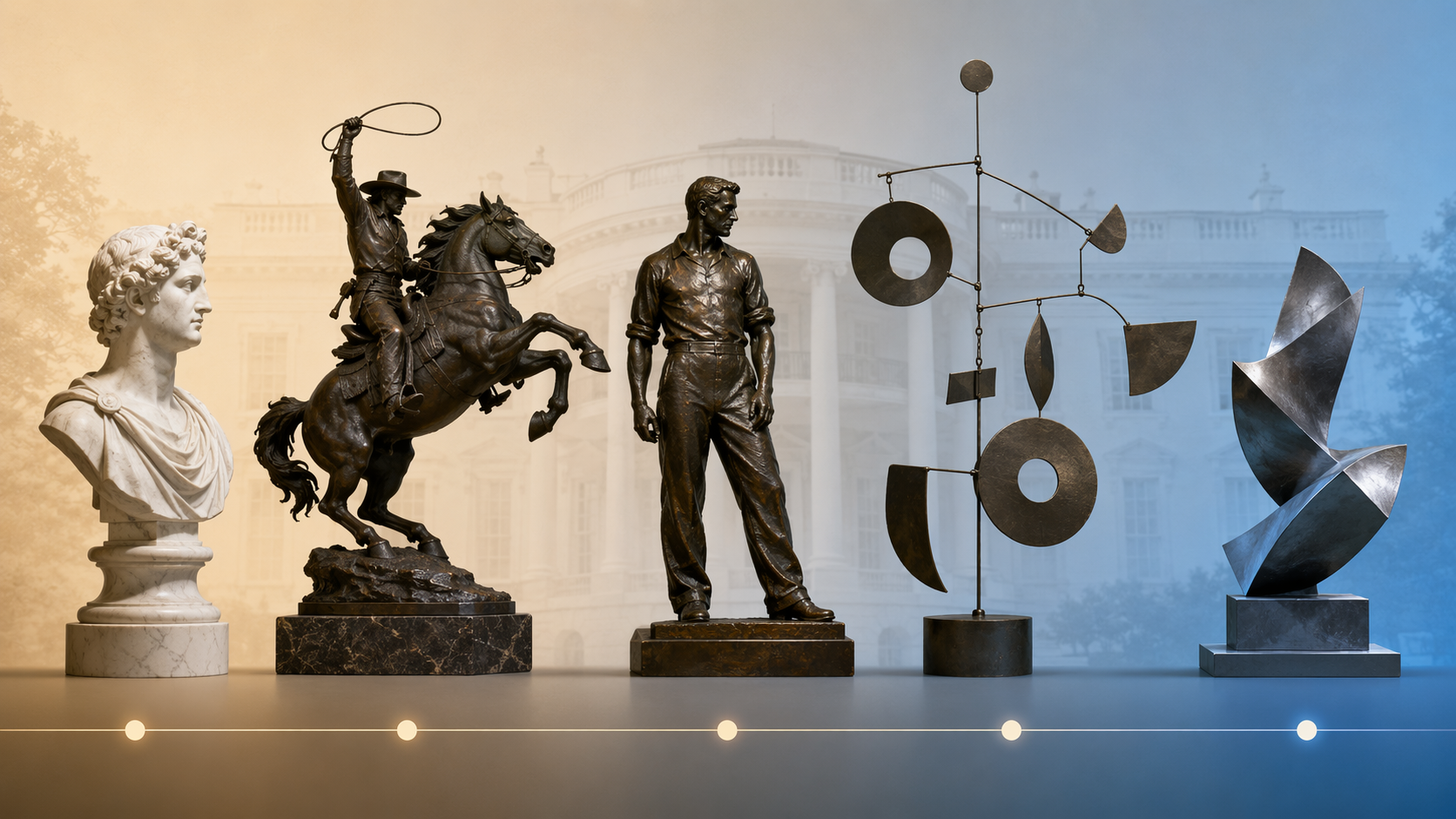
That sequence matters more than memorizing room locations. A bust of Washington teaches one kind of visual argument; Remington’s bronze rider teaches another; Calder and Noguchi ask a different set of questions altogether. The collection is also not merely household decoration. In 1961, Public Law 87-286 designated the White House as a museum, and Jacqueline Kennedy established the Office of the Curator, with Lorraine Waxman Pearce as the first curator; later summaries describe the White House collection as a registered museum collection of more than 65,000 catalogued objects, including decorative arts, furniture, ceramics, paintings, and sculpture.[1][2]
For study purposes, that institutional fact should be kept short but firm. It explains why the White House can be studied as a curated public collection rather than only as a residence. It does not mean every object deserves equal exam time.
A working timeline for students
| Period or shift | White House sculpture examples | What to practice seeing |
|---|---|---|
| Neoclassical beginnings | Giuseppe Ceracchi’s marble busts of George Washington, Christopher Columbus, and Amerigo Vespucci, c.1790–1794 | Classical costume, marble finish, civic virtue, and the use of antiquity to authorize a new republic |
| 19th-century taste and American subjects | Hiram Powers, Joel Hart, John Rogers; later Frederic Remington’s The Bronco Buster | The move from elite marble likeness toward popular narrative, genre subjects, and bronze images of national identity |
| Early modern public sculpture | Gutzon Borglum’s Lincoln; Adolph Weinman’s Descending Night and Rising Day; Cyrus Dallin’s Appeal to the Great Spirit | Memorial language, allegorical figure, public monumentality, and Native representation through a non-Native sculptural lens |
| Mid-century abstraction | Alexander Calder’s Five Rudders; Isamu Noguchi’s Floor Frame | Balance, void, industrial material, movement, and sculptural form without portrait likeness |
| Contemporary expansion | 1994–1998 sculpture garden exhibitions with works by artists including Calder, Noguchi, George Segal, Louise Bourgeois, Willem de Kooning, and Allan Houser | Plural definitions of American art, temporary display, identity, and the difference between a permanent collection and an exhibition program |
| Recent additions | 2025–2026 installations of Washington, Jefferson, Franklin, and Columbus statues on White House grounds | Continuing national image-making, with caution about uncertain attribution and incomplete public documentation |
Neoclassical beginnings: marble, founders, and borrowed antiquity
Start with Giuseppe Ceracchi because his busts establish the collection’s earliest sculptural language. The White House collection includes Ceracchi’s marble busts of George Washington, Christopher Columbus, and Amerigo Vespucci, dated around 1790–1794, and these are described as the earliest sculptures in the collection, acquired before the White House itself was finished.[1]

This is where a student should stop naming and start comparing. Ceracchi’s Washington is not simply “a sculpture of Washington.” It is Washington translated into a classical civic type. Marble matters because it carries associations of permanence, refinement, and Greco-Roman precedent. Classical drapery matters because it moves the sitter away from ordinary 18th-century clothing and into the visual vocabulary of republican virtue. The bust format matters because it concentrates authority in the head, profile, shoulders, and surface.
In an exam comparison, Ceracchi helps with the phrase students often use too loosely: “inspired by antiquity.” Here, antiquity is not a decorative reference. It is a political tool. A new nation with fragile institutions borrows the visual grammar of ancient republican Rome to make its leaders appear stable, principled, and historically weighty. That does not make the bust neutral. It makes it a carefully staged argument about legitimacy.
Columbus and Vespucci add another layer. Their presence links national identity not only to the Founding generation but also to European exploration and hemispheric naming. For study, they are useful because they remind us that early American civic imagery often framed the nation through selective historical ancestry: classical Rome, European discovery, and republican leadership compressed into polished marble.
The 19th-century turn: from marble authority to American subjects
The next shift is not an overnight rejection of neoclassicism. American sculpture in the 19th century keeps using marble, portraiture, and idealized bodies, but the subject field begins to widen. White House collection summaries identify works by Hiram Powers, Joel Hart, and John Rogers among the 19th-century sculptural holdings.[1] Those names are worth knowing less as a list than as evidence of changing taste.
Powers and Hart keep students close to the world of formal sculpture: carved or modeled likeness, elite patronage, and a belief that sculptural form can elevate its subject. Rogers points in a different direction. The Rogers Groups were popular 19th-century sculptural groupings, and their importance for a student is that they pull sculpture toward narrative, domestic display, and middle-class recognition rather than only monumental commemoration.[1]
This is a helpful comparison pair: Ceracchi’s Washington on one side, a 19th-century narrative group on the other. One asks how sculpture manufactures civic authority through classical form. The other asks how sculpture enters everyday culture through recognizable scenes and accessible storytelling. Both are “American,” but they train different visual skills.
Remington and the bronze West
Frederic Remington’s The Bronco Buster, dated around 1903 in White House collection discussions, gives the timeline a sharper material and cultural turn. It belongs to the American Western bronze tradition and has been associated with White House display beginning in the Theodore Roosevelt era.[2]
For AP Art History, bronze is not just a darker material than marble. Bronze permits wiry extensions, suspended limbs, taut diagonals, and repeated casts in ways that make a rearing horse and rider visually plausible. The lost-wax casting process matters here because it allows the sculptor to preserve dynamic modeling and surface energy in metal.[2]
The subject also changes the national story. Ceracchi’s Washington looks backward to Rome to stabilize a republic. Remington’s rider looks westward and turns motion, risk, and masculine control into a national image. A student does not have to celebrate that mythology to analyze it. In fact, the best answer will notice that the bronze Western idiom turns the frontier into a compact, collectable drama.
Early modern public sculpture: memorial bodies and allegorical figures
By the early 20th century, White House sculpture gives students a bridge between 19th-century commemorative habits and modern public sculpture. Collection summaries name Gutzon Borglum’s Lincoln, Adolph Weinman’s Descending Night and Rising Day, and Cyrus Dallin’s Appeal to the Great Spirit among notable works.[1]
Borglum’s Lincoln belongs to the problem of presidential image-making: how a historical leader becomes a public icon through sculptural mass, pose, expression, and memorial association. Weinman’s Descending Night and Rising Day ask students to read allegory. These are not portraits of named citizens; they are personifications, bodies used to make time, mood, or cosmic order visible.
Dallin’s Appeal to the Great Spirit requires more care. It is useful for studying Native representation in American public sculpture, but it should not be treated as an uncomplicated Native voice. The work is by Cyrus Dallin, a non-Native sculptor, and its value for study lies partly in that tension: it shows how early 20th-century American sculpture could monumentalize Indigenous presence while still filtering it through non-Native artistic conventions and public expectations.
This group is not as stylistically radical as the modernist works that follow, but it is exam-useful. It teaches how public sculpture builds memory through recognizable bodies: presidents, allegorical figures, and symbolic Native subjects. The key skill is to connect form to public use.
Modern abstraction enters the garden
Alexander Calder’s Five Rudders, made in 1964, is one of the cleanest ways to show students that White House sculpture does not stop at portrait busts and commemorative bronzes. It is a mobile: painted steel elements balanced so that air and motion become part of the work. Sculpture Magazine’s account of the White House sculpture garden notes the memorable practical consequence of that mobility: helicopter wash once spun the work so vigorously at the White House that staff nearly panicked.[3]
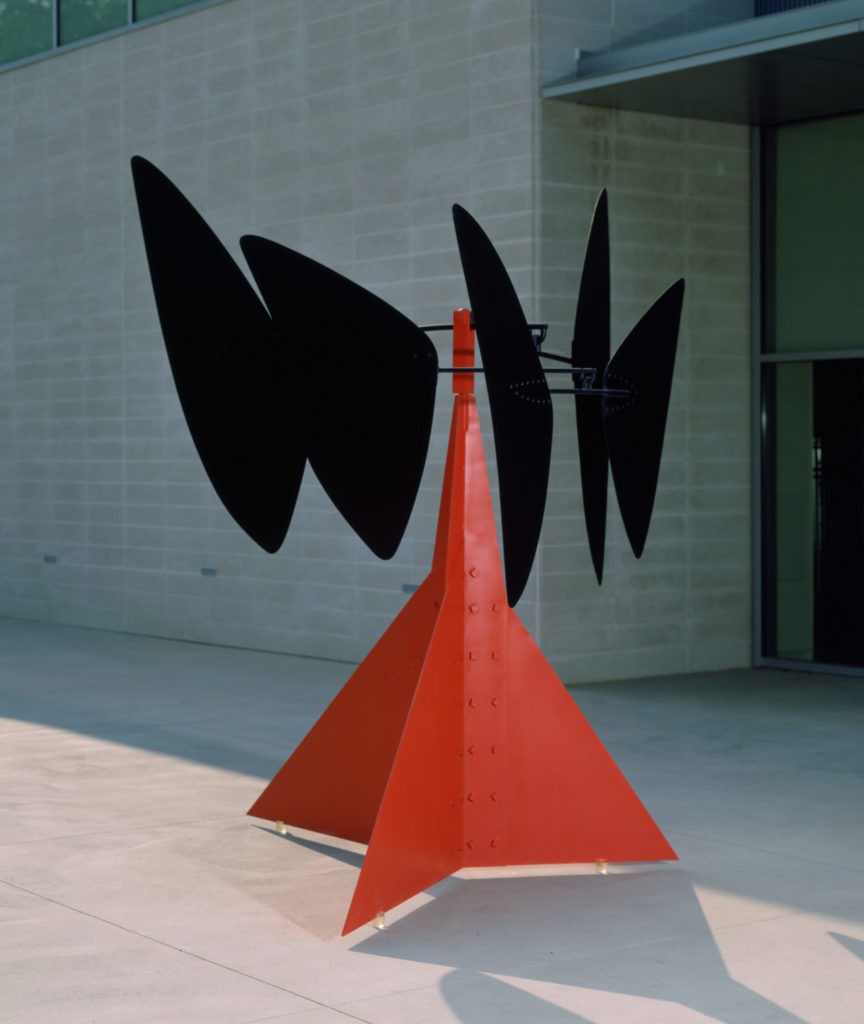
That anecdote points to the work’s sculptural logic. Five Rudders is not asking the viewer to identify a person. It asks the viewer to notice balance, engineering, negative space, and real movement. If Ceracchi’s marble claims permanence, Calder’s steel accepts change. If Remington compresses motion into a bronze rider, Calder lets motion actually happen.
Isamu Noguchi’s Floor Frame, made in 1962, extends the interruption. When it was installed in the White House garden in 2020, it became the first work by an Asian American artist in the permanent White House collection.[3] For students, that fact matters in two ways: it marks a representational milestone inside the collection, and it points to a different sculptural vocabulary from the heroic bust or the mounted bronze.
Noguchi’s title is a good study clue. Floor Frame directs attention downward and outward, toward the relationship between object, ground, and surrounding space. Rather than presenting sculpture as a self-contained figure on a pedestal, it treats sculpture as a spatial proposition. The viewer has to think about placement, void, and bodily movement around the object.
Put Calder and Noguchi beside a neoclassical bust and the difference becomes memorable. The modern works do not abandon seriousness; they relocate it. National collections can include abstraction, experiment, and artists whose identities complicate older definitions of American art.
The 1994–1998 sculpture garden exhibitions widened the field
The strongest contemporary turn comes with the “Twentieth-Century American Sculpture at the White House” exhibitions in the Jacqueline Kennedy Garden. From 1994 to 1998, the exhibitions brought 83 works to the White House grounds, with artists including Calder, Noguchi, George Segal, Louise Bourgeois, Willem de Kooning, and Native American sculptor Allan Houser; the official Clinton White House page states that more than 6 million visitors saw the garden exhibitions.[4][5]
Those years are important because they move the study question from “Which permanent sculptures are in the house?” to “What counts as American sculpture when a public site invites broader modern and contemporary work onto its grounds?” The answer becomes more complicated. Segal brings the ghostly presence of ordinary bodies. Bourgeois brings psychological and bodily intensity. De Kooning brings a painterly modernist sensibility into sculptural form. Houser makes Native American modern sculpture visible in a setting long shaped by presidential and national symbolism.
Temporary exhibition is not the same as permanent acquisition, and students should keep that distinction clear. But temporary display still matters for art history. It changes what visitors can encounter, and it can reframe a public site without pretending that every work has become part of the permanent collection.
This is also where contemporary representation becomes a study issue rather than a side note. The White House setting loads sculpture with national meaning. When artists outside the older Founding Father and presidential portrait tradition appear there, the collection’s story becomes less tidy and more accurate as a record of American art’s expansion.
How to use these works in an AP Art History answer
A strong answer should not sound like a room inventory. Build the sentence around what the work proves. If the question is about neoclassicism, Ceracchi is evidence for classical costume, marble finish, and republican virtue. If the question is about American national identity, Remington is evidence for the frontier myth in bronze. If the question is about modernism, Calder and Noguchi are evidence for abstraction, movement, space, and non-portrait sculpture.
- For period: name the stylistic moment before naming every biographical detail.
- For medium: explain what marble, bronze, painted steel, or spatial installation allows the sculpture to do.
- For patronage or setting: connect the White House to public memory, national identity, and curated display.
- For artist intention: avoid guessing psychology; stay with visible choices such as costume, pose, abstraction, movement, scale, and placement.
- For comparison: pair unlike works. Ceracchi and Calder make a stronger study pair than two similar busts because the contrast forces you to explain change over time.
A practical study route is to make one card per work, but the back of the card should not be a biography dump. Use five prompts: period, medium, form, national meaning, and comparison partner. For more practice turning sculpture and presidential imagery into flashcards, visual-analysis notes, and spaced repetition, use How to Study American Sculpture and Presidents for AP Art History.
Recent additions: useful, but handle attribution carefully
Recent statue installations on the White House grounds show that the site remains active as a place of national image-making. In October 2025, a bronze reproduction of Jean-Antoine Houdon’s full-length George Washington was installed in the Rose Garden; Houdon’s original Washington, made in 1788–1792 for the Virginia State Capitol, is the only full-length Washington statue based on a life mask taken at Mount Vernon in 1785.[6]
In 2026, reported additions included statues of Thomas Jefferson, Benjamin Franklin, and Christopher Columbus on White House grounds.[7] Those works can be mentioned as evidence that presidents and their administrations continue to shape the symbolic landscape around the White House. They should not be memorized with confident artist attributions unless those attributions are securely documented in the source your class is using.
That caution is not academic fussiness. In art history, uncertain attribution changes the kind of claim you can make. “A statue of Jefferson was installed” is a safer statement than assigning the work to an artist without reliable confirmation. “A Houdon reproduction of Washington” is more specific because the source supports that connection.
The useful endpoint is the timeline itself. The White House sculpture collection lets students watch American sculpture move from neoclassical civic ideals to 19th-century taste, Western bronze, early modern memorial language, mid-century abstraction, and contemporary representation debates. Study the works in that order, and the collection stops being a prestigious blur. It becomes evidence.
References
- Art in the White House, Wikipedia.
- Everything You Need to Know About the White House Art Collection, Artprice.
- At the White House: The First Lady's Sculpture Garden, Sculpture Magazine.
- Twentieth-Century American Sculpture at the White House, Clinton White House Archives.
- Hillary Rodham Clinton Column on Sculpture Garden, Clinton White House Archives.
- White House adds a George Washington statue to the Rose Garden, NBC News.
- Trump Rose Garden statue unveilings, Newsweek.
Back to the exam this applies to
Target exam not specified — see all exam hubs.
Comments
Join the discussion with an anonymous comment.