
Comparison
Howard Professor's Environmental Justice Book and the Evidence Behind It
This article examines Lemir Teron's 'Unlearn Power' (May 2026) — a new environmental justice book from a Howard University professor — and shows readers how to evaluate its claims by analyzing its evidence base: a peer-reviewed study of the I-81 Syracuse redevelopment, community fieldwork, and congressional testimony. It also connects this evaluation framework to GRE reading comprehension and critical reasoning skills.
Verdict panel
- Compared
- Howard University announcement, Bloomsbury Academic page, Teron's prior peer-reviewed I-81 article, congressional testimony and workshops
- Target exam
- GRE
- Best for
- GRE test-takers and critical reasoning students
- Pricing last reviewed
A book published in May 2026 and announced by Howard University on July 22, 2026 cannot honestly be reviewed as though a settled scholarly conversation already surrounds it. Lemir Teron's Unlearn Power: Strengthening Communities in the Age of Environmental Crisis is too new for that. What can be reviewed now is something narrower and more useful: the argument the book is described as making, the research Teron has already published, the public-science practices attached to the project, and the institutional setting in which the book appears.[1][2]
That distinction matters because environmental justice books often arrive with strong moral claims, and strong moral claims can be mishandled in two opposite ways. One reader treats urgency as proof. Another treats moral language as if it weakens the analysis. Neither response is careful reading. The better question is: what kind of claim is being made, and what kind of evidence would actually support it?
Teron's central claim, as presented by Howard and the publisher, is that environmental crisis cannot be addressed adequately through individual consumer substitutions such as solar panels and electric cars alone. The book instead emphasizes systemic power, including community solar, labor-centered climate policy, urban green space, and structural approaches to communities already carrying the costs of environmental decision-making.[1][2]

What Kind of Review Is Possible This Soon?
For a very recent academic book, praise from an institution, a publisher description, an author website, and a peer-reviewed article do not perform the same job. They can all be useful, but they answer different questions. Howard's announcement establishes institutional framing and recency. Bloomsbury establishes publication facts and series placement. The author site gives a view of the book's self-description and public-facing materials. A peer-reviewed article supplies the strongest inspectable evidence for Teron's method.
| Material | What It Can Support | What It Cannot Yet Support |
|---|---|---|
| Howard University announcement | Book framing, Teron's Howard context, examples emphasized by the university | Independent scholarly reception |
| Bloomsbury Academic page | Publication date, publisher, series context | Proof that the book's claims are correct |
| Teron's prior peer-reviewed I-81 article | Method, source handling, infrastructure justice analysis | A full review of every chapter in the new book |
| Congressional testimony, workshops, field sites | Public-science orientation and applied commitments | The same evidentiary weight as peer-reviewed causal research |
That source-role discipline is especially important here because Unlearn Power is not being introduced as a narrow technical monograph. It is presented as a book that moves across energy policy, urban forestry, environmental planning, labor, and community practice, drawing on more than a decade of Teron's work.[1] A reader has to resist the temptation to compress all of that into one verdict.
The I-81 Study Is the Evidentiary Spine
The most important available evidence behind the book's larger argument is Teron's 2022 peer-reviewed article, "Deconstructing Inequality: Cumulative Impacts, Environmental Justice, and Interstate Redevelopment," published in the Richmond Public Interest Law Review. The article examines the I-81 redevelopment process in Syracuse, New York, and analyzes a draft environmental impact statement of more than 10,000 pages through environmental justice and restorative justice frameworks.[3]
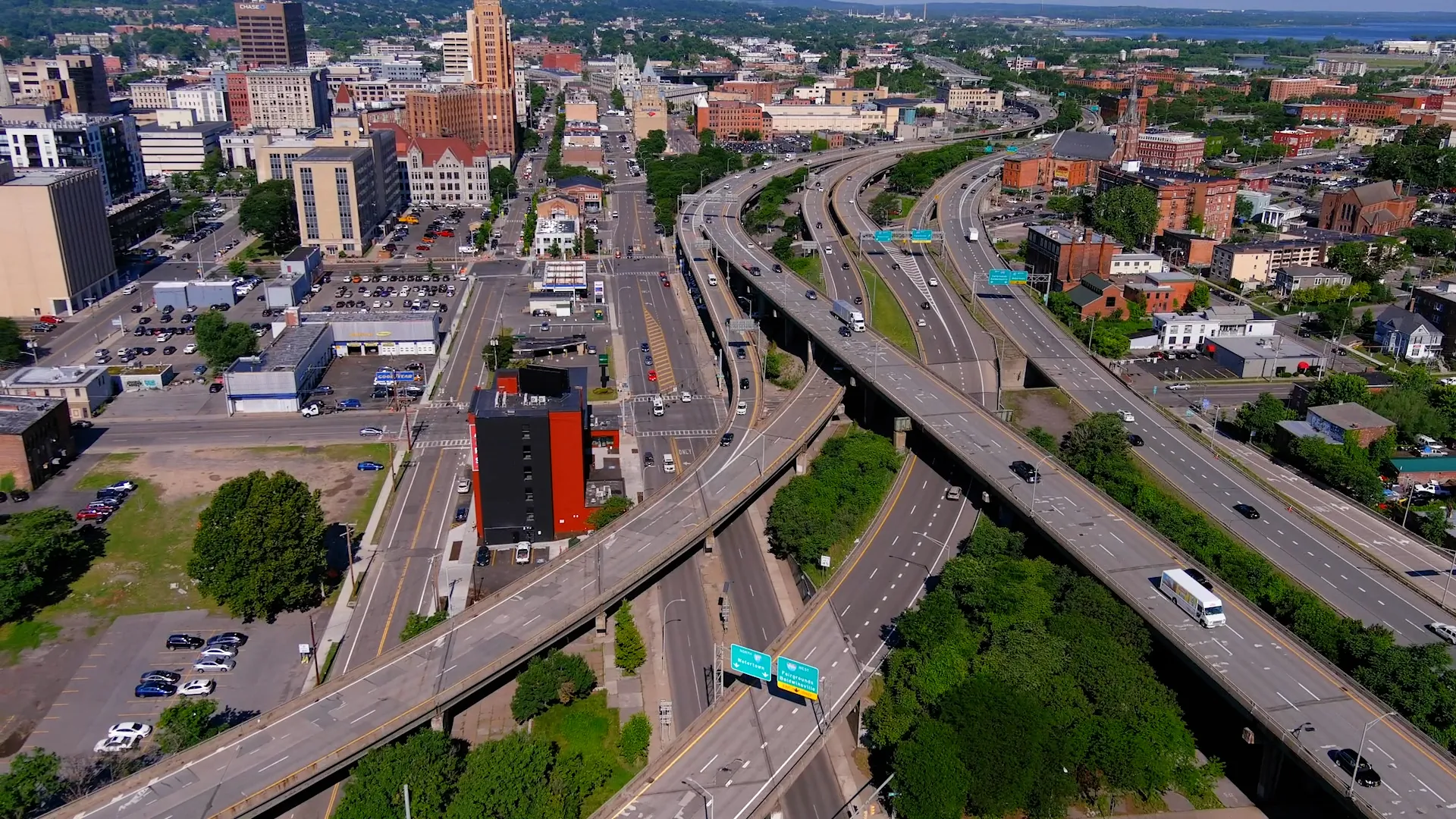
The Syracuse case matters because highway redevelopment is not an abstract setting for environmental justice. Interstate construction and replacement projects decide who breathes pollution, who loses land value, who is cut off from services, who receives promised mitigation, and who is asked to trust a process after earlier processes helped produce the injury. A long environmental impact statement may look procedurally thorough while still failing to ask whether the affected community is being repaired.
Teron's article uses that gap as its point of pressure. Ordinary environmental review can catalogue effects, alternatives, traffic changes, and mitigation measures. A restorative justice lens asks a more demanding set of questions: what harm was caused, who was harmed, who benefited, what obligations follow, and whether the remedy addresses accumulated injury rather than merely softening the next round of damage. In the I-81 study, Teron argues that environmental analysis should employ restorative justice frameworks to address harm from racist urban planning.[3]
That move supports the larger book claim more strongly than a general statement about "systemic change" would. It shows how a power-centered environmental justice argument can be operationalized against a real planning archive. The 10,000-plus-page draft environmental impact statement becomes not a symbol of bureaucracy but an object of analysis: a document large enough to appear comprehensive, yet still open to critique if it does not confront cumulative harm and repair.[3]
This is also where readers should be precise about what the study proves. It does not, by itself, prove every claim in Unlearn Power. It does not show that every infrastructure process fails in the same way. It does show that Teron's systemic language is not merely decorative. At least in this major published case, he has built an argument by reading institutional procedure against the historical distribution of harm.
Restorative Justice Raises the Standard of Environmental Review
The I-81 article is useful for evaluating Unlearn Power because it clarifies a difference students often miss when reading policy scholarship: a critique can be procedural, causal, interpretive, and normative at the same time, but those layers are not interchangeable.
A procedural claim asks whether an agency followed or improved a decision process. A causal claim asks whether a policy produced identifiable effects. An interpretive claim asks what a planning document includes, excludes, or assumes. A normative claim asks what justice requires after harm has been produced. Teron's restorative justice framework does not merely say that the I-81 process should sound more inclusive. It asks whether redevelopment analysis can be considered adequate if it leaves the historical injury structurally under-addressed.[3]
That is the bridge from the article to the book. If Unlearn Power argues that environmental solutions must move beyond individual action, the I-81 work shows one reason why. A resident living beside a harmful infrastructure legacy cannot solve that legacy by buying a cleaner product. The injury is spatial, institutional, and cumulative. The remedy, if it is to be a remedy at all, has to operate at a comparable scale.
The Public-Science Materials Show Method, Not Just Outreach
The book's public-science orientation is another important part of the evidence base, though it should not be confused with the peer-reviewed status of the I-81 article. Howard's announcement and the author materials describe community forestry workshops, on-site teaching at urban farms and microgrid facilities, farmworker food justice programs, congressional testimony, op-eds, and blog posts connected to Teron's work.[1][4]
Those materials support a practical and methodological claim: Teron is not treating environmental justice only as a literature to be interpreted from a distance. The sites named around the book place knowledge production in contact with people who manage heat, food access, trees, energy infrastructure, and policy hearings as lived constraints. That does not automatically validate every conclusion, but it does tell the reader something important about the book's intended audience and method.
The appendix, as described by the book's author site, extends the project beyond conventional academic chapters by compiling congressional testimony, op-eds, and blog posts.[4] An appendix like that is not a substitute for peer review. It is a record of translation: how an academic argument is carried into public venues where decisions, budgets, and political language matter.
The extreme heat example makes this public-facing method easier to see. Howard's announcement presents the book as framing extreme heat not only as an environmental problem but also as an organized-labor issue, with particular concern for delivery, factory, outdoor, and farmworkers.[1] That is a shift in analytical placement. Heat is not only a temperature exposure; it is also a workplace condition, a scheduling problem, a bargaining issue, and a policy failure when the people most exposed have the least control over the terms of exposure.
Here again, the claim should be read at the right level. The available materials support the conclusion that the book treats heat through a labor-centered environmental justice frame. They do not, from the descriptions alone, allow a reader to verify the full empirical range of the book's heat analysis. That verification would require reading the chapter evidence directly.
Howard Is the Setting, Not the Whole Argument
Teron is an associate professor in Howard University's Department of Earth, Environment and Equity, known as E3.[5] Howard launched the E3 department in 2024; in its first year, the department exceeded 100 enrolled students across three majors: B.A. Environmental Studies, B.S. Environmental Science, and B.S. Atmospheric Science. Its first graduating class was expected in spring 2026.[6]
That institutional context is relevant because Unlearn Power appears from within a university ecosystem that has been building environmental and climate justice infrastructure. Howard's School of Law also houses the Environmental and Climate Justice Center, adding another institutional node to the university's environmental justice work.[7]
Still, institutional context should not be mistaken for proof. A Howard affiliation helps explain the book's intellectual and educational setting. It does not, by itself, establish the strength of the book's arguments. For that, the reader has to return to method, evidence, and the relationship between case studies and claims.
One small clarification is worth making because environmental justice coverage sometimes blurs institutional affiliations. Robert Bullard is foundational to the environmental justice canon, but he is associated with Texas Southern University's Bullard Center, not Howard. Howard's environmental justice work should be evaluated on its own institutional record rather than by importing someone else's affiliation.
What the Book Appears to Contribute
The contribution of Unlearn Power, based on the available materials, is not that it invents environmental justice as a field or simply repeats the familiar claim that marginalized communities face unequal environmental burdens. Its more specific contribution appears to be the linking of power analysis to several applied arenas at once: interstate redevelopment, community solar, urban forestry, food justice, labor exposure, and public testimony.[1][4]
That breadth is promising, but it also creates the main question a careful reader should bring to the full book. Does each arena receive evidence appropriate to the claim being made? A chapter about a highway redevelopment process can lean heavily on planning documents and restorative justice theory. A chapter about heat and labor would need different evidence: workplace exposure, labor policy, occupational risk, or worker testimony. A chapter about community solar would need still another mix of institutional, technical, and distributive evidence.
The available descriptions suggest a coherent framework rather than a random collection of topics. The recurring question is who has power to define the environmental problem, who has power to choose the remedy, and who is left managing the consequences when earlier decisions fail. That is a serious environmental justice question, and the I-81 article shows that Teron has already worked through it in a detailed, published case.
A Reading Method for Academic Claims
For readers approaching this as an academic case study, the transferable skill is to separate four things that often get merged in fast book coverage: thesis, evidence type, method, and reception status.
- Thesis: environmental justice requires structural repair and power analysis, not only individual consumer choices.
- Evidence type: peer-reviewed infrastructure analysis, public testimony, community workshops, teaching sites, and institutional materials.
- Method: reading policy and planning systems through environmental justice, restorative justice, and public-science practice.
- Reception status: newly published in May 2026, so not yet supported by a settled body of independent academic reviews.
This is close to the work required in difficult GRE reading comprehension passages. A passage may present a persuasive social-science argument, but the test will often ask what the evidence actually establishes. Does a cited case prove a general rule, illustrate a mechanism, challenge an assumption, or supply historical context? The wrong answer choices usually overextend the evidence.
Applied to Teron's book, that habit produces a more calibrated judgment. The I-81 study gives the strongest support for the claim that environmental justice analysis must confront cumulative infrastructural harm. The public-science materials support the claim that Teron's scholarship is oriented toward communities, teaching sites, and policy venues. The Howard and Bloomsbury materials establish timeliness, affiliation, and framing. None of those sources yet establishes settled scholarly reception, because the book has only just entered circulation.
The Calibrated Verdict
As a new environmental justice book by a Howard University professor, Unlearn Power appears to build a serious systemic argument on identifiable research and public-science materials. Its strongest presently inspectable foundation is Teron's peer-reviewed I-81 work, where the language of structural repair is tied to a concrete redevelopment archive rather than left as aspiration.
The book should not be treated as already canonized, and it should not be dismissed because its claims are openly normative. The right standard is more demanding than either reaction. Readers should evaluate how Teron connects each claim to its evidence, whether the method fits the question, and where public testimony, community practice, and peer-reviewed research are doing different kinds of work.
References
- Howard University Professor Lemir Teron Examines Environmental Justice — The Dig at Howard University, July 22, 2026.
- Unlearn Power — Bloomsbury Academic Publishing, May 2026.
- Deconstructing Inequality: Cumulative Impacts, Environmental Justice, and Interstate Redevelopment — Richmond Public Interest Law Review, 2022.
- Unlearn Power — Author Site.
- Lemir Teron | Howard Profiles — Howard University.
- Elevating Environmental Protection and Our Priorities — Howard Magazine, Spring 2024.
- The Environmental and Climate Justice Center — Howard University School of Law.
Comments
Join the discussion with an anonymous comment.