Comparison
How the Treasury policy shift affects your student loans
The Treasury Department is taking over federal student loans in phases. This article breaks down the three-phase timeline, explains what actually changes for borrowers today, and what to watch for in the coming years — with no panic, just the facts.
Verdict panel
- Compared
- not specified
- Target exam
- not specified
- Best for
- not specified
- Pricing last reviewed
- pricing currency unconfirmed
If your federal student loan is current and you are making payments through your usual servicer, you do not need to switch portals, call Treasury, fill out new loan paperwork, or change your repayment behavior because of this policy shift. In Q3 2026, the practical answer for most borrowers in good standing is still: use the same servicer, the same payment portal, and the same FAFSA process unless you receive an official notice saying otherwise.[1][2]
That is the starting point for understanding the Treasury policy shift as a student borrower. The Treasury Department’s new role is real, and it is large. The federal student loan portfolio is about $1.7 trillion, a scale Forbes compared to the size of the fifth-largest U.S. bank and larger than the GDP of most countries.[3] But scale does not automatically mean every borrower’s Monday-morning payment routine has changed.
The shift is happening in phases. The first phase is already affecting borrowers in default. The later phases are not the same thing as completed changes, and that distinction matters if you are trying to decide whether to act or simply watch.
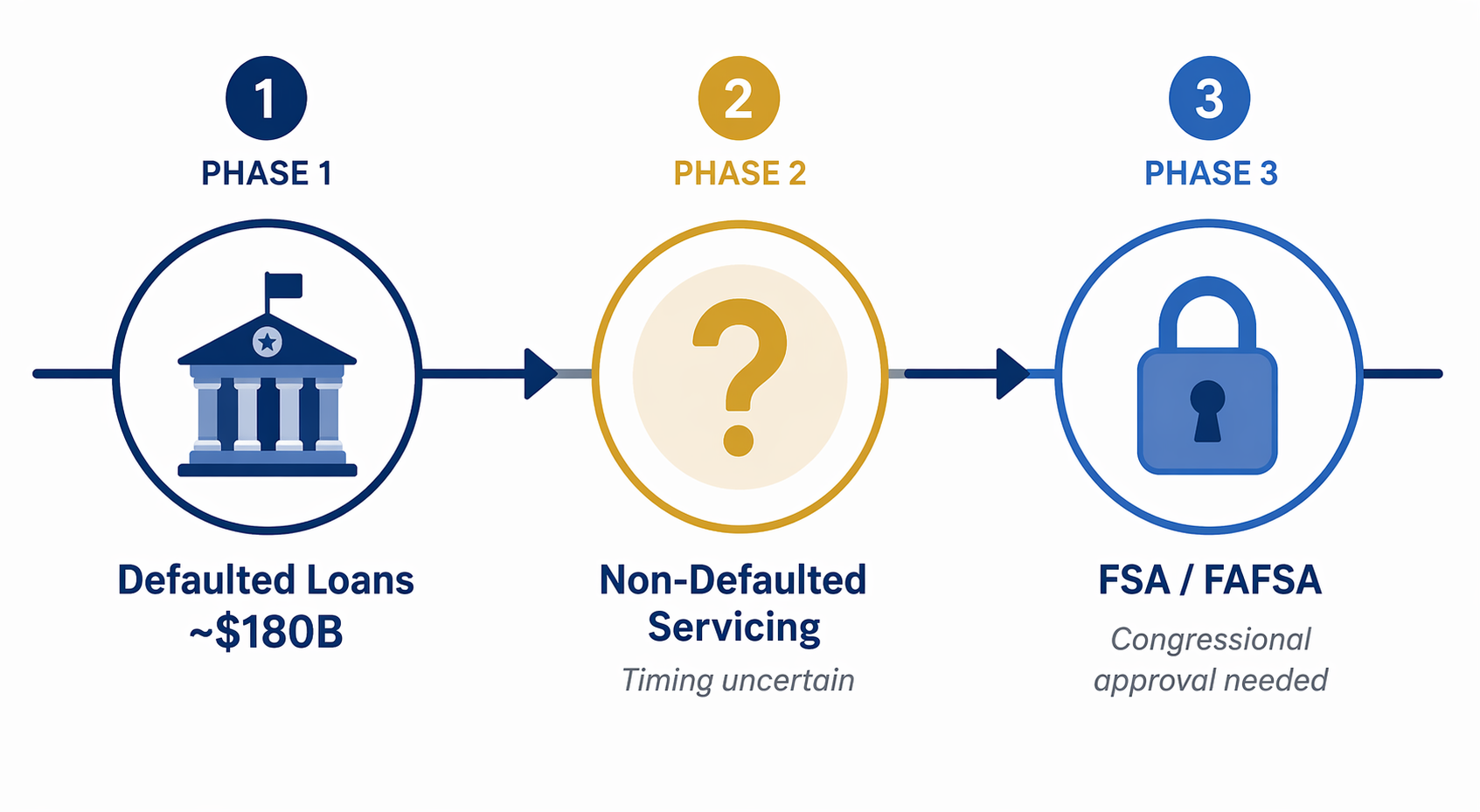
The Three Phases, Without Treating Them as Equal
| Phase | What it covers | Status in Q3 2026 | What borrowers should do |
|---|---|---|---|
| Phase 1 | Defaulted federal student loans | Already underway after a March 2026 interagency agreement; Treasury is handling roughly $180 billion in defaulted loans across 7.7 million borrowers.[4][5] | If you are in default, read official notices carefully and verify who is contacting you. |
| Phase 2 | Servicing for non-defaulted loans | Planned only “to the extent lawful and practical,” with no firm timeline.[4] | If you are current, keep using your existing servicer unless official instructions change. |
| Phase 3 | Possible FAFSA administration and other Federal Student Aid functions | A possible future move that would require Congressional approval.[4] | Keep using the current FAFSA process for now. |
The table is simple on purpose. Phase 1 is a current administrative reality. Phase 2 is the part to monitor. Phase 3 is not a current borrower instruction.
What Has Already Changed: Defaulted Loans
The clearest change is for borrowers already in default. In March 2026, an interagency agreement began moving collection responsibility for defaulted federal student loans from the Education Department to the Treasury Department.[4] Community College Daily described the first phase as Treasury handling about $180 billion in defaulted student loans across 7.7 million borrowers.[5]
That $180 billion is about 11% of the federal student loan portfolio.[5] It is not the whole system, but it is not a small corner either. If you are one of the borrowers in that defaulted-loan group, Treasury involvement is not a distant headline. It may affect who contacts you, how collection activity is administered, and what kind of official notice you need to pay attention to.
This is also where the administration’s stated pressure point comes from. Forbes reported that fewer than 40% of borrowers are actively repaying and almost 25% are in default.[3] Those figures are not a character judgment on borrowers. They are the numbers being used to justify reorganizing a system that has left millions of people somewhere other than ordinary monthly repayment.
For someone in default, the safest posture is neither to ignore letters nor to trust every urgent message. Defaulted loans already involve higher-stakes communication, and a major administrative transfer creates room for confusion. Borrowers should check whether notices come through official channels, compare the information with their federal student loan account, and avoid giving payment information to anyone whose identity they have not verified.
What Has Not Changed for Borrowers in Good Standing
If your loan is not in default, the most important fact is the least dramatic one: your existing servicer remains your point of contact for now. American Action Forum and PBS both reported that current borrowers should continue using the same loan servicers and payment systems while the transition develops.[1][2]
That means no preemptive portal migration. No automatic change in repayment plan. No need to resubmit FAFSA because of the Treasury announcement. No reason to stop autopay just because you saw a headline saying Treasury is “taking over” student loans.
There is a difference between a government changing who may eventually administer a program and a borrower receiving a binding instruction about a loan account. Until the second thing happens through official channels, your current loan obligations continue under the terms already attached to your account.
For current students, the FAFSA process also remains the same for now.[1] That matters because financial aid timing is unforgiving. A student does not need to miss a school deadline because a future phase of a federal reorganization might someday move FAFSA administration.
Phase 2 Is the Part to Watch Carefully
Phase 2 is where confusion is most likely to grow. It concerns non-defaulted loan servicing, meaning the ordinary accounts used by borrowers who are in school, in grace periods, in repayment, in deferment, in forbearance, or otherwise not in default. NASFAA reported that this shift is supposed to happen only “to the extent lawful and practical,” and sources have not given a firm date for it.[4]
That phrase — “lawful and practical” — is doing real work. It signals that the plan is conditional. It depends on legal authority, operational capacity, technology, contracts, staffing, and probably more borrower-facing details than any announcement can settle in one press release.
A real Phase 2 indicator would look different from commentary. It would be an official change to servicing instructions, a direct borrower notice, a published implementation timeline, updated guidance from the Education Department or Treasury, or a clear announcement from your current servicer explaining what happens to your account and when.
- Treat official account notices as more important than political commentary or social media summaries.
- Save copies of payment confirmations, repayment-plan approvals, income-driven repayment correspondence, and servicer messages.
- Check that your contact information is current with your loan servicer and your StudentAid.gov account.
- Do not change repayment behavior based only on a proposed phase with no firm date.
The temptation is to act early so you are not caught off guard. But with Phase 2, acting early can create its own problems. A borrower who stops paying, switches off autopay without a plan, or delays an income-driven repayment recertification because they expect a new Treasury system may end up creating the very account trouble they were trying to avoid.
Why Implementation May Be Harder Than the Announcement
There are two reasons to be cautious about clean, confident timelines. The first is performance history. PBS reported that a 2015 Treasury pilot involving defaulted borrowers had a lower success rate than the Education Department’s private collection agencies.[2] That does not prove Treasury cannot administer a larger role now. It does mean one prior test raised a serious capacity question rather than settling the issue.
The second reason is legal uncertainty. NASFAA reported questions around the legal authority for the interagency agreement, and Protect Borrowers argued that moving student loan collections from the Education Department to Treasury may exceed statutory bounds without Congressional action.[4][6] Those are contested legal claims, not borrower instructions. Still, they help explain why later phases should be treated as conditional until they are formally implemented.
This is the uncomfortable middle ground: the policy shift is significant enough to watch closely, but unfinished enough that borrowers should resist filling in the blanks themselves. A headline can make the transfer sound complete. The actual timeline says otherwise.

Phase 3 Is Not a FAFSA Change Today
Phase 3 is the broadest and least immediate part of the plan. It could eventually involve FAFSA administration and other core Federal Student Aid functions, but available reporting describes that as years away and dependent on Congressional approval.[4]
For students applying for aid, that means the instruction is boring but important: keep using the existing FAFSA process. Follow current school deadlines. Respond to your college’s financial aid office if it asks for verification documents. Do not wait for a future Treasury-run process that does not currently exist for your aid application.
How to Monitor Without Overreacting
The borrower-facing question is not whether the Treasury shift matters. It does. The better question is whether it changes your next required action. In Q3 2026, that answer depends mostly on whether your loan is in default.
- If you are in default, Treasury’s role is already relevant. Watch official notices closely and verify collection communications before responding.
- If you are current on payments, keep paying through your existing servicer unless official instructions change.
- If you are in school or applying for aid, keep using the current FAFSA process and your school’s financial aid office.
- If you see claims about Phase 2, look for an implementation date, legal authority, and direct borrower instructions before treating them as operational changes.
There is no virtue in pretending this is small. Moving responsibility for pieces of a $1.7 trillion loan system is a historic administrative change.[3] But there is also no benefit in behaving as if every loan account has already moved. For borrowers in default, the change deserves immediate attention. For borrowers making payments on time, the calmer posture is the more accurate one: watch, verify, and keep using the systems currently assigned to your loan.
If this policy shift is making you revisit your broader money habits, it may help to step back into basic student financial literacy rather than refreshing policy updates every day. But for the Treasury transition itself, the practical monitoring list is short: read official notices, keep records, stay current if you can, use your existing servicer and FAFSA process for now, and pay attention to Phase 2 indicators instead of speculation.
References
- The Treasury Takes Over Student Loans — American Action Forum
- Treasury Department begins taking over federal student loans from Education Department — PBS News
- Treasury Takes On Higher Ed: The End Of A Broken System? — Forbes, March 26, 2026
- Trump Administration Begins Moving Student Loan Responsibilities to Treasury Department — NASFAA
- Treasury to handle defaulted student loans — Community College Daily
- 'I Broke It, YOU Buy It': On Linda McMahon's Reported Plan to Move Student Loan Collections From ED to Treasury — Protect Borrowers
Back to the exam this applies to
Target exam not specified — see all exam hubs.
Comments
Join the discussion with an anonymous comment.