
Comparison
Tau Protein's Surprising Role in Memory Formation
New 2026 research shows tau protein is essential for forming lasting memories, not just a pathological hallmark of Alzheimer's. This article explains the mechanism of tau phosphorylation in engram cell recruitment and why it matters for neuroscience students.
Verdict panel
- Compared
- not specified
- Target exam
- not specified
- Best for
- not specified
- Pricing last reviewed
- pricing currency unconfirmed
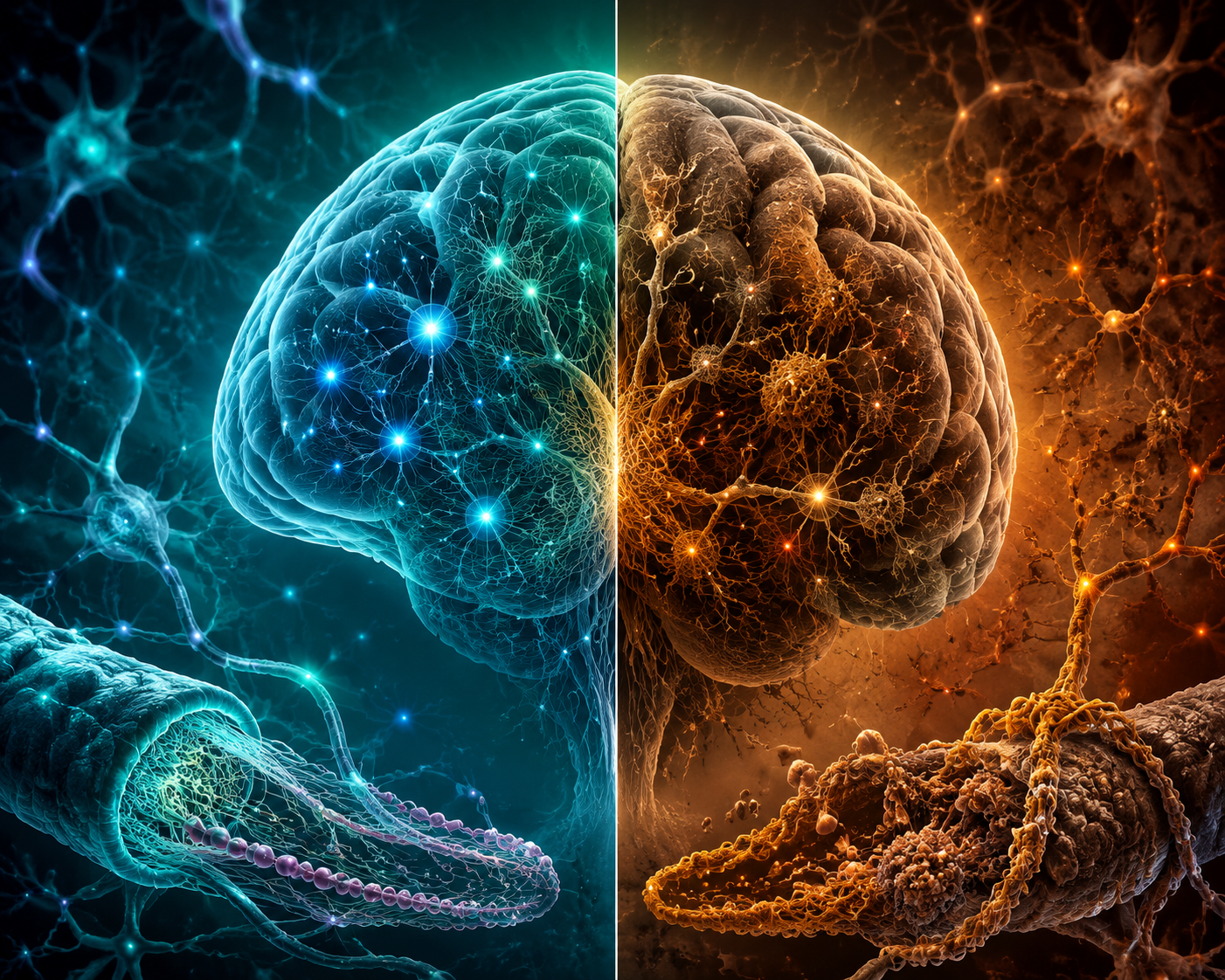
Most students meet tau protein in the Alzheimer’s disease unit, usually right beside amyloid plaques and neurofibrillary tangles. That first exposure is not wrong, but it is incomplete. The updated tau protein role in memory formation neuroscience is more awkward, and more useful: the same protein associated with disease pathology also appears to help healthy brains form memories that last.
The key result from Kosonen et al., published in Nature Communications in July 2026, is simple enough to state but not simple enough to sloganize. Mice lacking tau could learn and retrieve recent memories normally, yet failed when those memories had to be recalled later. That pattern appeared across cued fear conditioning at days 21 and 42, Morris water maze spatial memory at 4 months, and appetitive touchscreen discrimination at 2 months.[1]
That is the clue worth slowing down for. If tau were just necessary for learning anything at all, the mice should have struggled immediately. If the memory were never stored, recent recall should have been poor too. Instead, recent memory looked intact while remote memory failed. Something about tau was helping a memory survive the transition from a recently accessible trace to one that natural cues could still retrieve later.
The distinction students have to keep clean
Tau is often introduced as a microtubule-associated protein that becomes abnormally phosphorylated and aggregates into tangles in Alzheimer’s disease. That disease framing matters. Pathological tau hyperphosphorylation and aggregation remain central to the Alzheimer’s model students learn in introductory neuroscience.
The 2026 result does not erase that model. It adds a second, physiological layer: controlled phosphorylation of tau at threonine-205, or T205, helps organize lasting memory traces. The word controlled is doing real work here. A specific phosphorylation event during learning is not the same thing as broad hyperphosphorylation across many sites in disease.
This is where the usual “tau is bad” shortcut breaks. The better model is conditional: tau’s role depends on context, phosphorylation pattern, and dosage. In a healthy learning circuit, tau can support memory organization. In Alzheimer’s disease, abnormal tau modification and aggregation are destructive. Those two claims can both be true.
Recent memory survived; remote memory did not
The behavioral design matters because it rules out a lazy interpretation. Tau knockout mice were not globally unable to learn. They could acquire tasks and retrieve memories shortly after learning. The failure emerged later, when recall depended on remote memory.[1]
| Memory test | What tau-deficient mice showed |
|---|---|
| Cued fear conditioning | Recent recall was preserved, but remote cued recall was impaired at days 21 and 42.[1] |
| Morris water maze | Spatial learning could occur, but remote spatial memory was impaired at 4 months.[1] |
| Appetitive touchscreen discrimination | Performance showed the same recent-versus-remote split, with impairment at 2 months.[1] |
For an exam answer, that phenotype is gold. “Normal recent memory, impaired remote memory” points away from a broad sensory, motor, or motivational problem. It also points away from a simple encoding failure. The animals could learn, and the memory was available early. The question becomes more precise: why can a recent trace be accessed, while a remote one becomes hard to retrieve through ordinary cues?
Remote memory is not just an old version of recent memory. As a trace matures, the brain has to preserve access to the relevant neuronal ensemble while avoiding interference from irrelevant activity. That is where the study moves from behavior into engram biology.
Tau helped sharpen the engram
An engram is the neuronal population whose activity is linked to a specific memory. In the 2026 study, tau-deficient mice still formed tagged engrams. The machinery for marking memory-related cells was not simply absent. The problem was precision: recall activated too much background activity and too little of the proper memory ensemble.[1]
Kosonen et al. found that tau-deficient mice had excess activation of non-engram cells, measured by increased c-Fos-positive activity outside the tagged engram. At the same time, fewer of the active cells during recall belonged to the original engram population.[1]
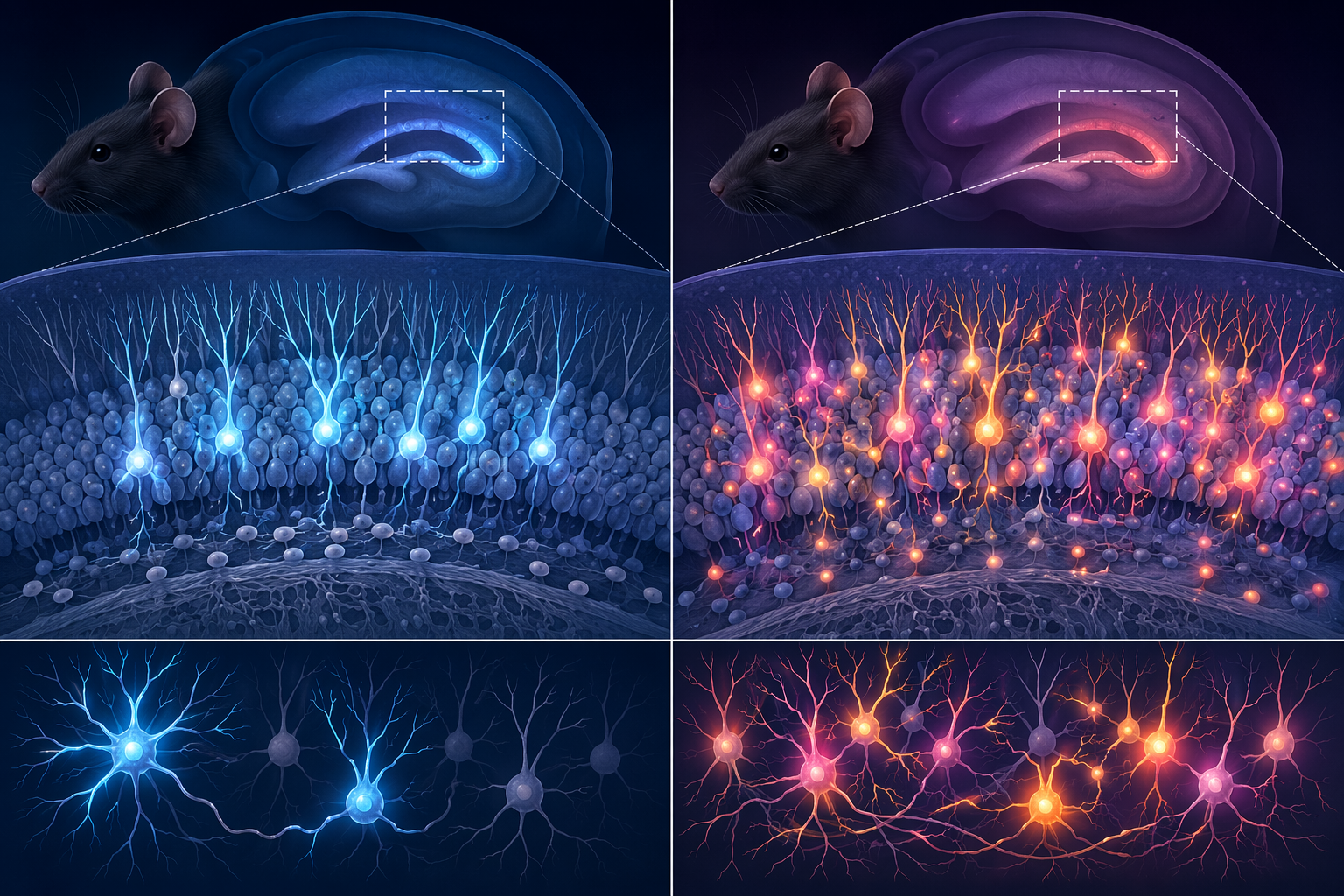
That detail changes the story. Tau was not acting like a generic memory fuel. It was helping the circuit keep the memory trace sparse and specific. Without it, the brain still had a tagged trace, but natural recall cues recruited a noisier pattern. More cells fired, but fewer of the right cells dominated the response.
A hypothetical classroom analogy is useful as long as it stays hypothetical. Imagine a professor asks for the students who worked on one lab project to raise their hands. In a precise recall pattern, the correct group responds and the room stays mostly quiet. In a noisy pattern, half the room raises a hand, including many students who were never on the project, while some of the actual project group remain quiet. The information is not gone, but the signal-to-noise ratio has collapsed.
That is why the c-Fos and engram-tagging data are more than decorative molecular evidence. They explain the behavioral split. Recent memory can tolerate some instability because the trace is fresh and cue access is easier. Remote memory appears to need better control over which cells participate in retrieval.
T205 phosphorylation turned tau into a control point
The study’s most important molecular move is its focus on threonine-205. During spatial learning, T205 was the highest-abundance tau phosphorylation site induced, and about 47% of tau-positive dentate gyrus granule cells showed T205 phosphorylation at day 1 of spatial acquisition.[1]
That number matters because it puts the phosphorylation event in the right place and time. The dentate gyrus is a hippocampal region heavily involved in separating similar experiences into distinct representations. Seeing T205 phosphorylation in tau-positive granule cells during early spatial acquisition makes the site look less like a biochemical footnote and more like part of the circuit’s selection process.
The kinase link tightened the mechanism further. The researchers identified the post-synaptic kinase p38γ, also called MAPK12, as mediating this T205 phosphorylation.[1]
So the mechanism is not just “tau is present during memory.” It is more specific: learning engages a post-synaptic kinase pathway that phosphorylates tau at T205, and that modification helps regulate which dentate gyrus neurons are recruited into a lasting memory trace. For students used to memorizing phosphorylation sites as labels, this is the rare case where the label earns its keep.
There is an important nuance here. T205 can also be discussed in Alzheimer’s disease contexts, because it is one of the tau sites that may be hyperphosphorylated in pathology. The same site name does not mean the same biological state. Controlled phosphorylation during learning and pathological hyperphosphorylation in disease are different patterns embedded in different cellular contexts.
The proof came from convergence, not one clever assay
The strongest part of the paper is not any single result. It is that three different perturbations landed on the same behavioral pattern: tau knockout, T205A phospho-blocking mutation, and p38γ deletion all preserved recent memory while impairing remote memory.[1]
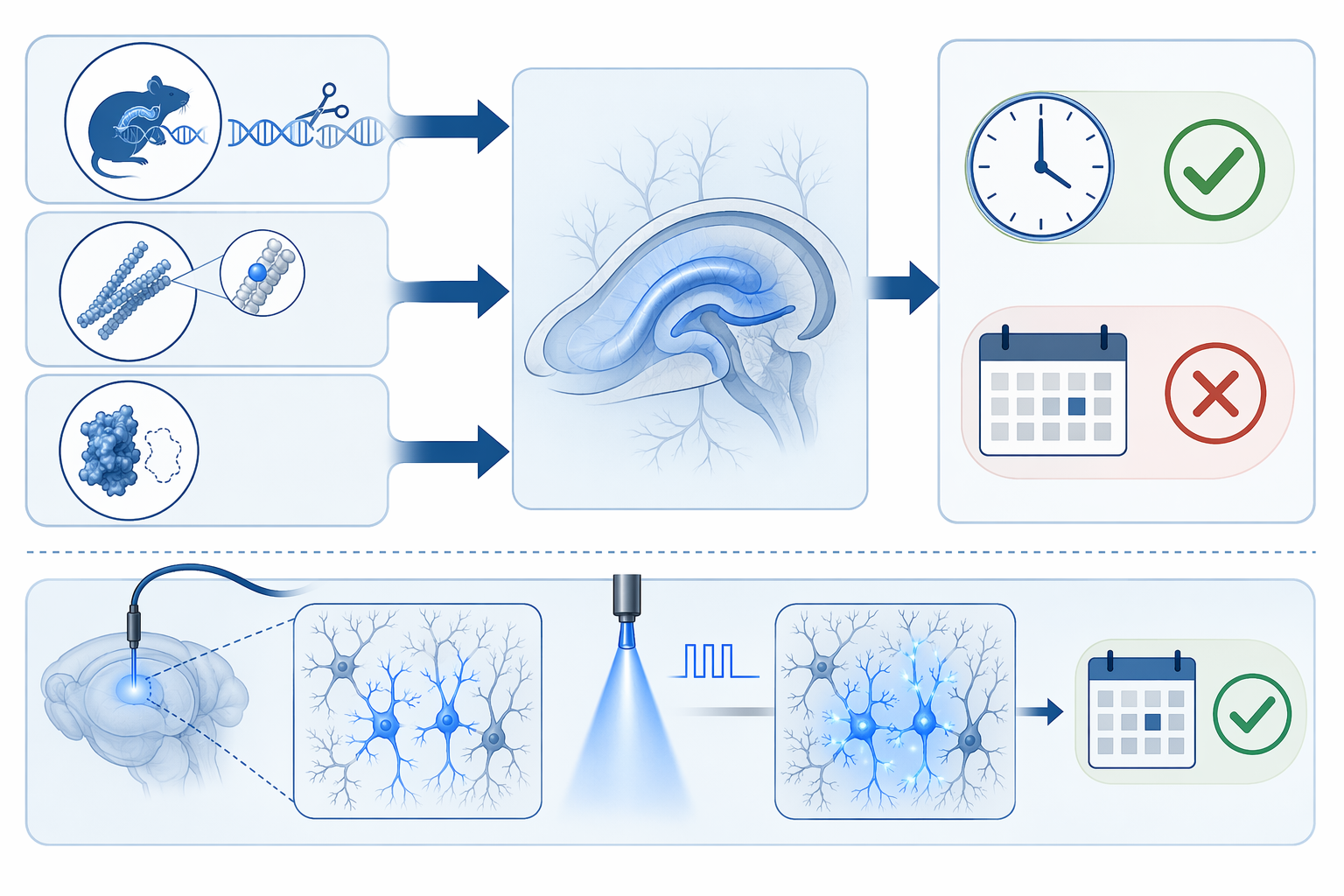
Those perturbations hit different levels of the proposed mechanism. Removing tau tests whether the protein is needed. Blocking T205 phosphorylation tests whether that specific modification matters. Deleting p38γ tests whether the upstream kinase link is part of the same pathway. When all three produce the same recent-versus-remote split, the argument becomes harder to dismiss as an artifact of one genetic model.
| Perturbation | Level tested | Shared outcome |
|---|---|---|
| Tau knockout | Protein requirement | Recent memory preserved; remote memory impaired.[1] |
| T205A mutation | Phosphorylation-site requirement | Recent memory preserved; remote memory impaired.[1] |
| p38γ deletion | Kinase-pathway requirement | Recent memory preserved; remote memory impaired.[1] |
This is the kind of convergence that should make a neuroscience student update a model. The result is not merely that tau-deficient mice performed badly on one memory task. The result is that behavior, phosphorylation biology, kinase manipulation, and engram-cell activation pointed toward the same function: tau helps make remote memories naturally retrievable by keeping engram recruitment precise.
Optogenetic rescue showed the memory trace was still there
The optogenetic experiment is the clarifying turn. In tau knockout mice, direct stimulation of engram cells could retrieve remote memories even when natural cues failed.[1]
That finding narrows the interpretation. The remote memory was not simply erased. The stored trace could still drive recall if researchers bypassed normal cue processing and stimulated the engram cells directly. Tau therefore seems to help couple natural sensory cues to the correct stored trace.
This also explains why “memory impairment” is too blunt a phrase. There are different ways for memory to fail. A trace may never be encoded. It may decay. It may be stored but inaccessible. It may be drowned out by competing activity. The tau knockout phenotype, especially after optogenetic rescue, fits best with impaired natural access to a stored remote memory trace.
Pathogenic tau disrupted the trace from inside the engram
Once healthy tau’s role is visible, the pathogenic experiment becomes easier to interpret. Kosonen et al. targeted P301S mutant tau to engram cells and found disruption in both directions: anterograde amnesia during encoding and retrograde amnesia during recall.[1]
That does not mean normal tau and pathogenic tau are opposites in a cartoon sense, where one is good and one is bad. It means the same memory system that uses regulated tau activity can be damaged when tau becomes disease-associated and disrupts the cells carrying the trace. The physiological function makes the pathology more consequential, not less.
For students, this is a better exam distinction than “tau causes tangles.” Pathogenic tau can interfere with memory traces because tau normally participates in the organization of those traces. Disease does not merely add a toxic object to an otherwise tau-free memory circuit. It alters a protein already embedded in the circuit’s memory machinery.
What this does and does not say about Alzheimer’s therapy
The therapeutic implication is real, but it has to be kept at the right scale. The 2026 study was conducted in mice, and the authors noted that the findings have not been directly confirmed in human memory or Alzheimer’s disease.[1]
So this is not proof that a specific human tau-lowering therapy will impair memory. It is a design constraint. If physiological tau helps recruit precise engram cells and suppress background neural noise, then a treatment strategy that simply reduces or eliminates tau without preserving useful tau functions could create risks for the memory processes it aims to protect.
The more careful direction is tau modulation rather than tau elimination. A therapy would ideally reduce pathological hyperphosphorylation, aggregation, or disease-associated tau effects while sparing the controlled phosphorylation and circuit-level functions involved in memory formation. That is easier to write than to engineer, but it is the distinction the biology now demands.
Tau is neither just the villain protein nor newly redeemed as a hero molecule. It is a protein whose function depends on context. Controlled T205 phosphorylation supports remote memory formation by helping the brain recruit the right engram cells and suppress background noise. Pathological tau hyperphosphorylation and aggregation remain part of Alzheimer’s disease. Keeping those two ideas separate is not a nuance for specialists; it is the updated model students should carry into neuroscience coursework.
References
- Tau T205 phosphorylation modulates engram cell recruitment and remote memory in mice. Nature Communications, July 2026.
Back to the exam this applies to
Target exam not specified — see all exam hubs.
Comments
Join the discussion with an anonymous comment.