
Comparison
How Aeroelastic Flutter Brought Down the Tacoma Narrows Bridge
An exam-ready engineering case study of the 1940 Tacoma Narrows Bridge collapse, explaining the aeroelastic flutter cause, design flaws, and lasting structural engineering lessons. Understand why the bridge failed and how it changed bridge design standards.
Verdict panel
- Compared
- not specified
- Target exam
- not specified
- Best for
- not specified
- Pricing last reviewed
- pricing currency unconfirmed
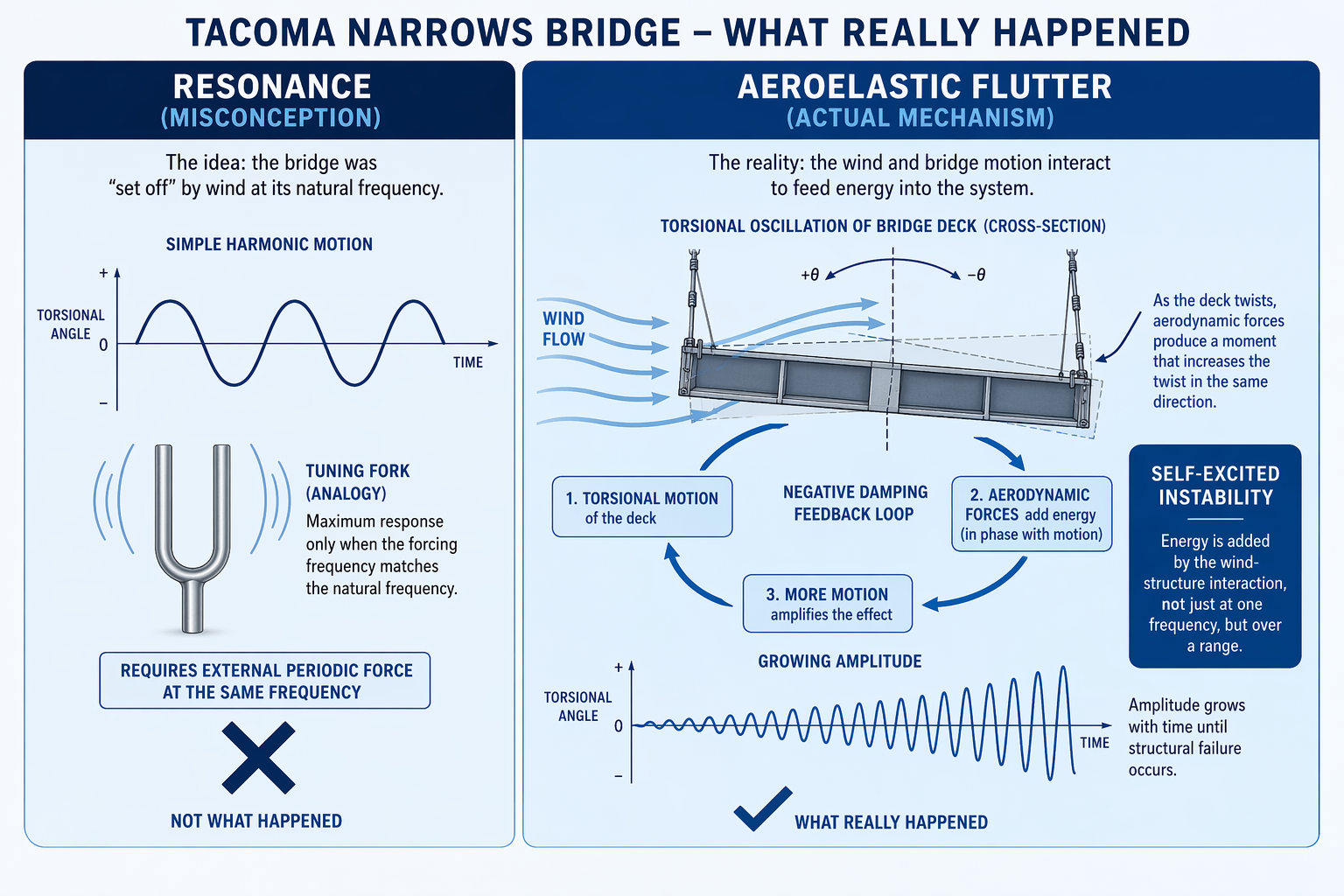
If an exam asks for the Tacoma Narrows Bridge collapse engineering case study, the safest first move is to avoid the tempting one-word answer: resonance. Simple mechanical resonance is not the best explanation for the 1940 failure. The collapse is better understood as aeroelastic torsional flutter, a self-excited instability in which wind-generated aerodynamic forces fed energy into the bridge’s twisting motion instead of damping it out.
The essential case facts are short. The first Tacoma Narrows Bridge opened on July 1, 1940, after oscillations had already been noticed during construction and early public use. It collapsed on November 7, 1940, in winds usually reported around 40 to 42.5 mph. The only fatality was Tubby, a cocker spaniel trapped in a car on the bridge.[1][2] Those details matter for recall, but they are not the mechanism.
The Failure Was a Damping Problem Before It Was a Strength Problem
The bridge did not fail because its towers, cables, or piers were simply too weak to carry ordinary vertical loads. The trouble was that the deck system made the structure extremely flexible and aerodynamically awkward. Once the wind and the bridge motion became coupled, the motion could grow from one cycle to the next.
For a dynamics answer, that phrase “from one cycle to the next” is doing real work. Ordinary damping removes energy from motion. Negative aerodynamic damping does the opposite: the moving deck changes the airflow around it, and the altered airflow applies forces that reinforce the motion. The bridge is then no longer just being pushed by an outside periodic force. It is participating in a feedback loop.
That is why the Tacoma Narrows film is so easy to misread. Dramatic oscillation looks like resonance to anyone searching for a familiar word. But an engineering answer has to ask what supplied the energy, what mode grew, and whether the relevant frequencies actually match.
The Design Left Very Little Aerodynamic Margin
The original bridge was unusually slender. Its depth-to-span ratio was about 1:350, and its width-to-span ratio was about 1:72, making it the most flexible long-span suspension bridge of its era.[1] Slenderness was not automatically a defect; engineers were trying to build efficiently. But flexibility changes the scale of the problem. A bridge deck that moves easily gives the wind more opportunity to interact with its motion.
The more exam-useful design change is the deck form. Clark Eldridge’s earlier concept used a 25-ft open truss. Leon Moisseiff’s final design substituted 8-ft solid plate girders, producing a shallower and more economical deck; the change is commonly reported as saving about $1.6 million.[3] That substitution matters because a solid side girder behaves very differently in wind from an open truss.
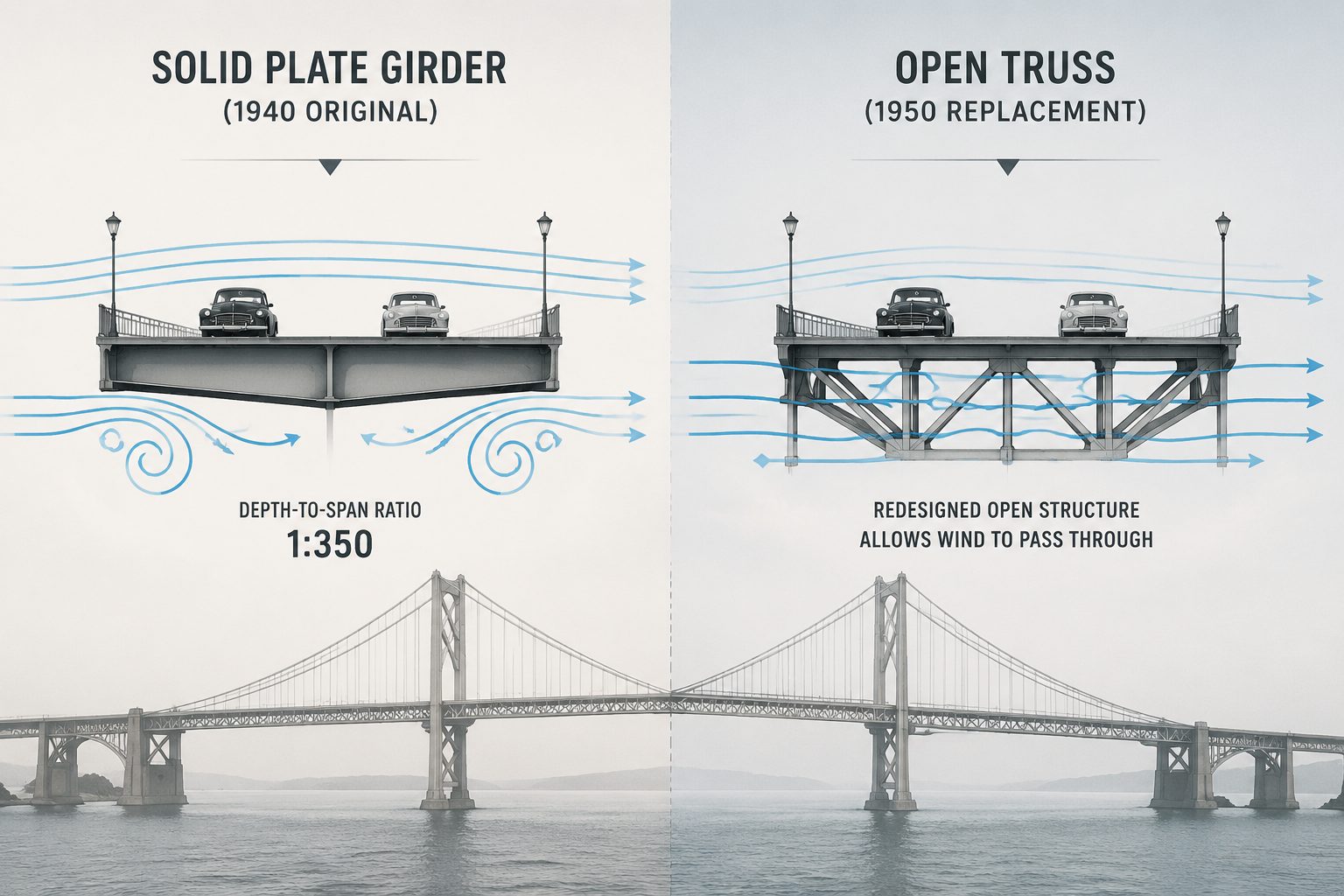
An open truss gives air pathways through the deck. The 1940 plate-girder deck forced wind above and below the roadway instead. That made the bridge prone to alternating pressure patterns and torsional response. The deck did not merely sway as a passive object in a gust; its shape helped organize the airflow that then acted back on the deck.
| Feature | Why it mattered mechanically |
|---|---|
| Very shallow, flexible deck | Lower stiffness meant larger motion could develop under wind-structure interaction. |
| 8-ft solid plate girders | Wind was diverted around the deck rather than passing through an open truss. |
| Long, narrow span | The deck was more susceptible to coupled vertical and torsional motion. |
| Low inherent aerodynamic margin | Once motion began, airflow could reinforce the torsional mode instead of dissipating it. |
What Aeroelastic Torsional Flutter Means Here
Flutter is an instability, not just a large vibration. In the Tacoma Narrows case, wind passing the deck created unsteady aerodynamic forces. Those forces interacted with the bridge’s torsional mode, the twisting mode visible in the collapse footage. Once the interaction became unstable, each twist could set up aerodynamic forces that helped drive the next twist.
Vortex shedding still belongs in the explanation, but not as the whole answer. Flow separated around the deck and shed vortices. At some conditions, vortex-induced motion can lock in with a structural mode. The engineering distinction is that the final destructive growth is usually described as aeroelastic torsional flutter: a coupled wind-structure instability with negative aerodynamic damping, not a simple external forcing at one matching frequency.[1][4]
Specialists still debate the precise transition language. WSDOT notes that experts disagree, and some accounts emphasize vortex-induced vibration transitioning into flutter while others emphasize torsional flutter more directly.[1] For an undergraduate exam, that nuance should not blur the central distinction: the accepted explanation is self-excited aeroelastic instability, not ordinary resonance.
Why “Resonance” Loses Points
Simple resonance is a frequency-match story. A periodic external force acts near a structure’s natural frequency, and the response grows if damping is low enough. That model is useful in many dynamics problems. It is not the clean model for Tacoma Narrows.
The key mismatch is numerical. The destructive torsional motion was around 0.2 Hz, while vortex shedding at roughly 42 mph was around 1 Hz.[1][4] Those are not close enough to support the simple claim that vortex shedding matched the bridge’s torsional natural frequency and resonated it to failure.
| Explanation | What it would require | Tacoma Narrows evidence |
|---|---|---|
| Simple mechanical resonance | External forcing frequency approximately matches a natural frequency. | The destructive torsional mode was about 0.2 Hz, while vortex shedding was about 1 Hz at roughly 42 mph. |
| Aeroelastic torsional flutter | Aerodynamic forces couple with deck motion and add energy through negative damping. | The bridge developed growing torsional oscillations under wind-structure interaction. |
This is also why a video caption can be a bad teacher. The bridge’s motion was periodic-looking and spectacular, so “resonance” feels natural. But the mechanism was not a metronome-like wind force striking the bridge at exactly the right beat. The important part was that the moving bridge altered the aerodynamic forces in a way that sustained and amplified the motion.
The official post-collapse investigation supports that reading. The Carmody Board, which included Theodore von Kármán and Othmar Ammann, concluded that resonance was “very improbable” and attributed the failure to aerodynamic instability, commonly summarized as aeroelastic flutter.[1][4] That conclusion is more meaningful after the frequency mismatch is on the page; otherwise it is just an authority quote.
The Bridge Warned Its Designers Before It Failed
Tacoma Narrows was not calm until one unlucky morning. Its “Galloping Gertie” nickname came from visible movement before the collapse, including oscillations during construction and public use.[1][2] The name is folklore, but the observed motion is engineering evidence: the bridge was already showing that wind response had not been solved.
Several mitigation attempts were tried. Tie-down cables were installed but snapped during construction. Cable stays were added and proved ineffective. Hydraulic buffers were intended to control motion, but they were damaged during sandblasting before they could operate as planned.[2][3] None of those fixes changed the underlying deck aerodynamics enough to remove the instability.
Professor Frederick Burt Farquharson’s testing is the painful timing detail. He used a 1:200 full-bridge model and a 1:20 sectional model to study the motion. On November 2, 1940, five days before the collapse, he identified fairing solutions that could have improved the deck’s aerodynamic behavior.[1][2] The finding was technically useful and practically late.
There had also been professional concern before completion. David Steinman publicly predicted failure at an ASCE meeting in 1938 while Moisseiff was present.[3] That detail should not be turned into a simple hero-versus-villain story. It is more useful as evidence that aerodynamic behavior was already an engineering concern, even though the final design culture still trusted slender elegance too far.
What Changed After the Collapse
The replacement bridge shows the lesson in steel. The 1950 Tacoma Narrows Bridge reused the original undamaged piers, cable anchorages, and tower pedestals, but it did not repeat the same deck concept. It used an open truss design, giving wind a more permeable structure instead of a shallow solid-sided deck.[5]
The broader design lesson was not that suspension bridges are unsafe. It was that long-span bridges cannot be checked by static strength calculations alone. Aerodynamic behavior has to be investigated as part of the design, especially when the structure is flexible, slender, and lightly damped.
WSDOT summarizes one of the lasting institutional consequences: wind tunnel testing became mandatory for all federally funded bridges after the Tacoma Narrows failure.[1] That is the standard-making lesson worth carrying forward. The bridge was strong enough in many conventional senses, but it was not stable under coupled wind-structure interaction.
Exam-Ready Distinctions
- Cause to write: aeroelastic torsional flutter, or self-excited aerodynamic instability with negative damping.
- Cause to avoid as the main answer: simple mechanical resonance from vortex shedding matching the bridge’s natural frequency.
- Design features to name: extreme flexibility, about 1:350 depth-to-span ratio, narrow deck proportions, and 8-ft solid plate girders replacing a deeper open truss.
- Frequency distinction: destructive torsional motion around 0.2 Hz versus vortex shedding around 1 Hz at roughly 42 mph.
- Professional lesson: wind tunnel testing and aeroelastic evaluation became part of long-span bridge design practice.
A compact exam answer can be this: the 1940 Tacoma Narrows Bridge collapsed because its very flexible, shallow plate-girder deck allowed wind forces to couple with torsional motion, producing aeroelastic flutter and negative aerodynamic damping. Vortex shedding was involved in the aerodynamic environment, but the collapse is not explained by a simple resonance frequency match. Resonance is a forced-vibration frequency story; Tacoma Narrows is a self-excited aeroelastic damping story.
References
- Lessons from failure, WSDOT.
- Tacoma Narrows Bridge (1940), Wikipedia.
- Aeroelastic Flutter, Bridge Masters.
- Physics History, American Physical Society.
- Tacoma Narrows Bridges, ASCE Historic Landmarks.
Back to the exam this applies to
Target exam not specified — see all exam hubs.
Comments
Join the discussion with an anonymous comment.