
Comparison
How to Study American Sculpture and Presidents for AP Art History
Learn a layered study approach that combines visual analysis of form and material with flashcards and spaced repetition to master American presidential sculptures for AP Art History and other exams.
Verdict panel
- Compared
- not specified
- Target exam
- not specified
- Best for
- not specified
- Pricing last reviewed
- pricing currency unconfirmed
Presidential sculpture looks friendly until the exam stops asking, “Who is this?” and starts asking, “How do form, material, scale, site, and public memory work together?” Recognizing Lincoln’s beard or Washington’s profile is only the first inch of the answer. Studying American sculpture and presidents well means building a system that makes you look longer, attach the right facts, and practice explaining why the monument looks the way it does.
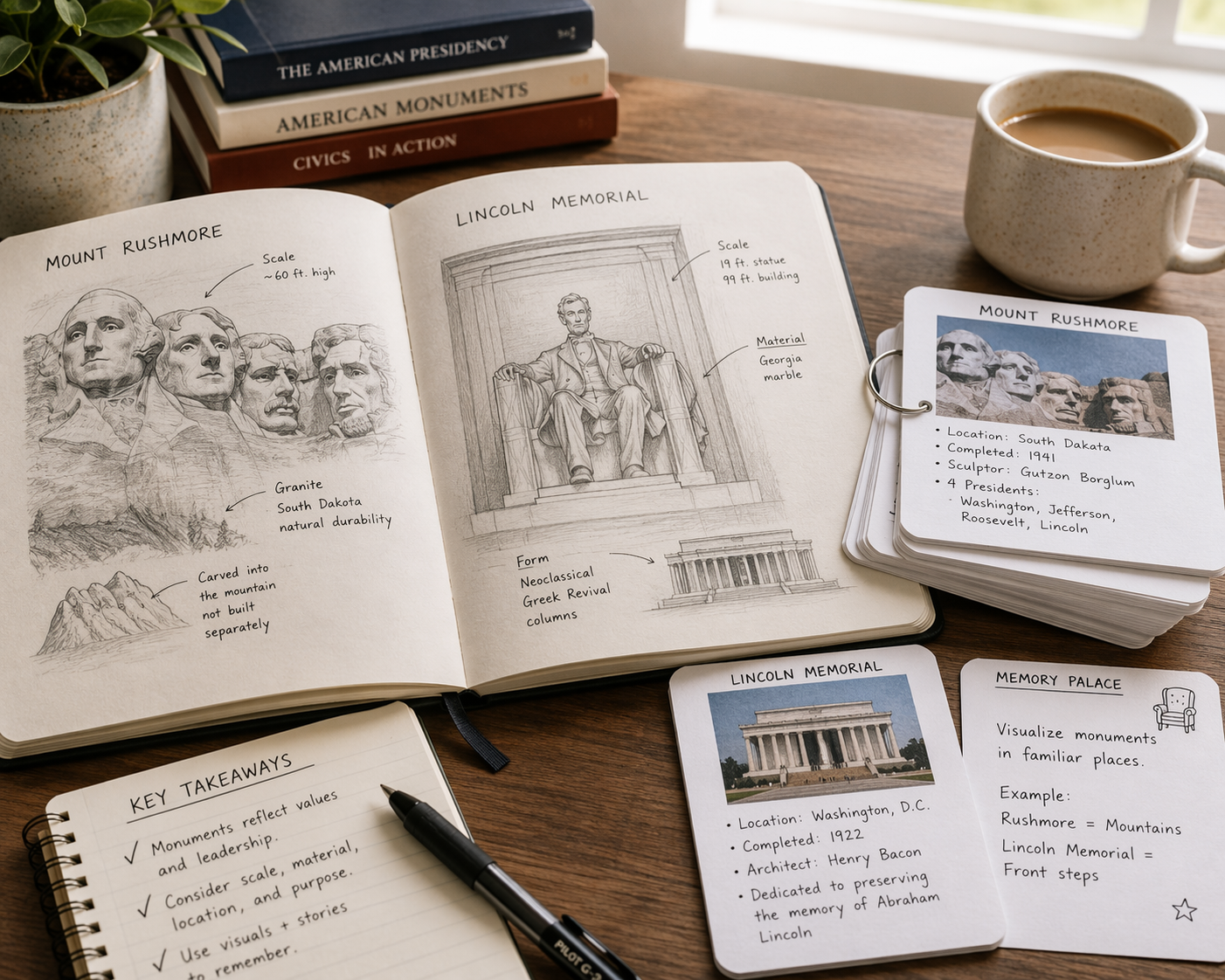
Use a four-layer routine: first, slow down and describe what is visible; second, attach identification facts; third, connect the monument to a presidential theme or civic purpose; fourth, retrieve the information on a schedule instead of rereading it once. Mount Rushmore is the easiest model to practice on because it gives you unusually concrete study hooks: four 60-foot granite heads, carved between 1927 and 1941, designed by Gutzon Borglum, made with roughly 400 workers, and costing about $990,000.[1]
Start With What the Sculpture Makes You See
The first pass should not be a biography quiz. Before you write “Lincoln = Civil War” or “Jefferson = Louisiana Purchase,” make yourself describe the object. Is the president seated, standing, walking, carved into a mountain, placed inside a temple-like interior, or installed at street level? Is the material marble, granite, bronze, or something else? Does the work invite close viewing, distant viewing, walking around, or looking up?
For Mount Rushmore, the obvious subject is four presidents. The better observation is that the presidents are colossal granite heads merged with the mountain itself. That changes the meaning. A painted portrait can suggest personality; a mountain carving suggests permanence, national myth, and landscape. The 60-foot scale is not a decorative fact to memorize separately from the image. It is part of the image’s argument.[1]

A useful first card or notebook entry for Rushmore should force that relationship:
- Visible form: four frontal presidential heads, no full bodies, carved high into a granite mountain.
- Material and scale: granite and colossal size make the work feel durable, immovable, and public.
- Site: the mountain setting matters; this is not a statue that can be mentally separated from its landscape.
- Exam move: explain how scale and material help turn individual presidents into national symbols.
Now compare that with the Lincoln Memorial. Daniel Chester French’s seated Lincoln is a 19-foot marble statue placed inside a classical memorial interior.[3] The body is present. The chair, hands, face, and architectural frame matter. You are not just identifying Abraham Lincoln; you are reading a seated figure whose stillness, mass, and temple-like setting turn political leadership into civic reverence.
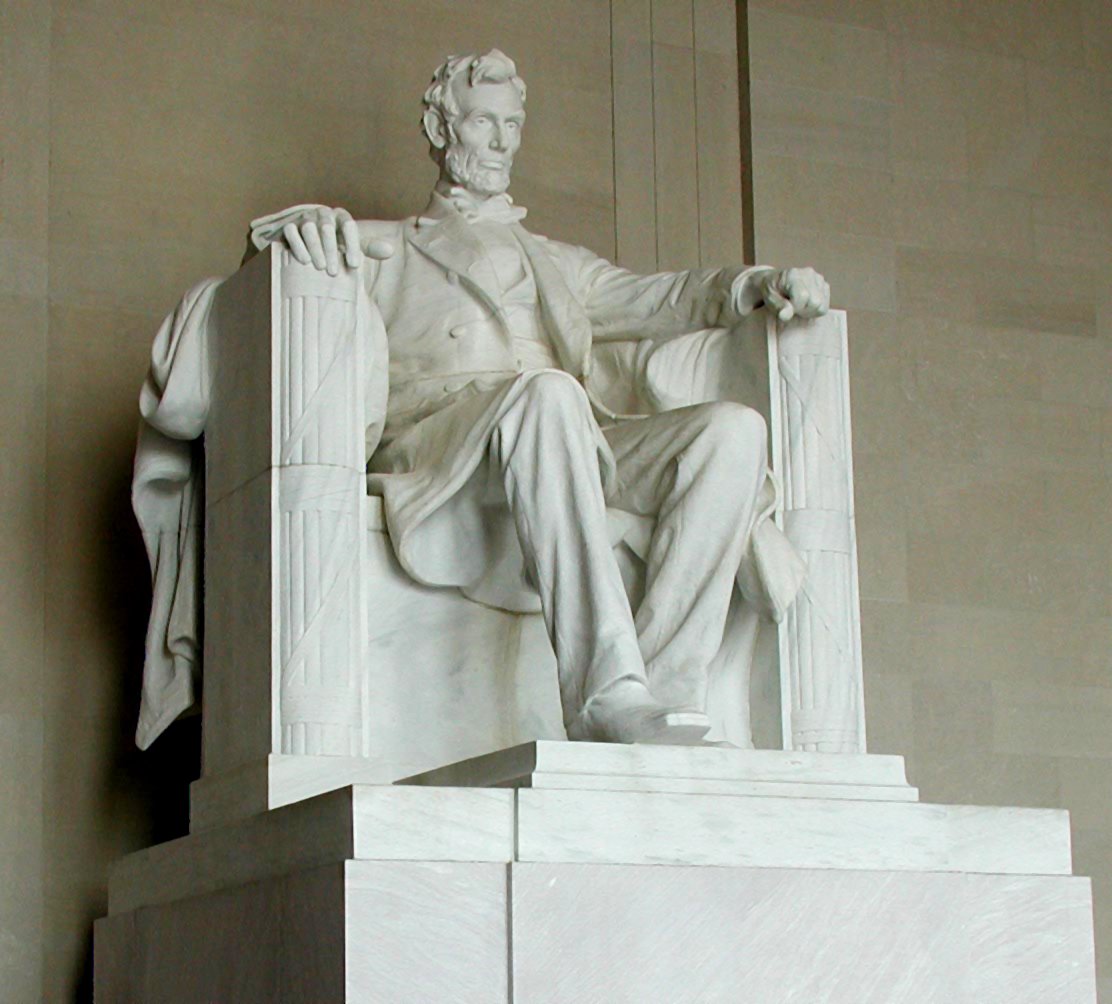
That is the difference between recognition and analysis. “Lincoln Memorial, marble, Daniel Chester French” is useful, but it is not yet an answer. A stronger exam response says that the seated pose, enlarged body, marble surface, and classical setting present Lincoln as solemn, enduring, and worthy of public contemplation. The State Department’s ShareAmerica article gives an estimate of 7 million annual visitors for the Lincoln Memorial; treat that as a helpful sense of public scale, not as a deeply documented scholarly statistic.[3]
Attach Facts After the Image Has a Shape
Students often put identification facts on flashcards too early. A card that says “Mount Rushmore / Gutzon Borglum / 1927–1941 / South Dakota” can help with recall, but it does not teach you to see. Put the image or a sketch on the front first. Make yourself name what is happening visually before you flip to the factual layer.
| Layer | Question to answer | Mount Rushmore example |
|---|---|---|
| Visual | What do I see before naming it? | Four colossal presidential heads carved into granite. |
| Identification | Who made it, when, where, and from what? | Gutzon Borglum; 1927–1941; granite; Mount Rushmore. |
| Symbolic | Why these presidents, in this arrangement of public memory? | NPS frames Washington as birth, Jefferson as expansion, Roosevelt as development, and Lincoln as preservation.[2] |
| Comparison | What changes if I compare it with another presidential monument? | Rushmore uses distant mountain scale; the Lincoln Memorial uses a seated marble figure inside architecture. |
The National Park Service’s explanation of the four Rushmore presidents is especially useful for study because it keeps the symbolic claims compact: George Washington represents birth, Thomas Jefferson expansion, Theodore Roosevelt development, and Abraham Lincoln preservation.[2] Do not memorize those words as a substitute for visual analysis. Use them as the bridge between what you see and what the monument asks the presidents to represent.
For example, if a prompt asks why Lincoln belongs in a comparison between Rushmore and the Lincoln Memorial, the answer should not stop at “he preserved the Union.” At Rushmore, Lincoln becomes one part of a four-president national sequence carved into granite. In the Lincoln Memorial, he becomes a single monumental body inside a contemplative civic space. Same president, different sculptural strategy.
Build Flashcards That Make You Look Twice
Good sculpture flashcards are not tiny fact dumps. They are prompts that make your eyes do work. If the front of the card shows only a title, you are practicing verbal recall. If the front shows the image and asks for visible evidence, you are practicing art history.
A strong image-based card for Mount Rushmore could ask: “Identify the work, then explain how material and scale shape its meaning.” The back can include Borglum, 1927–1941, granite, 60-foot heads, roughly 400 workers, and the NPS symbolic sequence of birth, expansion, development, and preservation.[1][2] That card tests recognition, facts, and analysis in one pass.
Make different cards for different kinds of retrieval. One card should not carry the entire course unit.
- Image identification card: show the monument; answer with title, artist or designer if required, date range, material, and location.
- Visual analysis card: show the monument; answer with three visible features before any historical explanation.
- Meaning card: ask how one formal choice, such as granite scale or seated pose, supports a civic message.
- Comparison card: pair two monuments and ask what changes in material, viewing position, scale, or public function.
- Chronology card: ask where the monument fits relative to other American sculpture or memorial works in your class list.
Digital tools such as Anki are useful here because they can show images and schedule cards automatically, but the tool matters less than the design of the prompt. A bad digital card is still bad if it only asks you to recite “artist/date/location.” A strong card makes you retrieve the fact and the visual reason it matters. If you already use a finals-week spaced repetition plan, fold these cards into that schedule instead of creating a separate panic deck two nights before the test.
Use Repetition to Keep Chronology From Sliding Around
Presidential monuments are easy to mix up because the names are familiar. Familiarity is the trap. You may know that Washington, Jefferson, Roosevelt, and Lincoln are on Rushmore, but still forget the construction window, the designer, or the reason those four were selected. Spaced repetition fixes that by making you retrieve the card just as it starts to become less automatic.
A simple review rhythm works well for this topic: review new cards the same day you make them, then again after a short gap, then again later in the week, and finally in a mixed set with non-presidential sculpture. The mixed set is important. If all your cards are presidential monuments, the answer is too predictable. Put Rushmore next to a non-presidential American sculpture or a different memorial type so you have to identify visual evidence, not just guess from the unit theme.
| Study moment | What to do | What it protects against |
|---|---|---|
| First pass | Make image-first cards from class materials and notes. | Passive recognition without analysis. |
| Same day | Answer without looking at notes; correct the back of the card if it is vague. | Cards that memorize labels but not visible features. |
| Later review | Shuffle presidential monuments with other sculpture and architecture. | Guessing from category instead of evidence. |
| Before exam | Practice two-minute comparison answers out loud or in writing. | Freezing when the prompt asks for meaning, not just title. |
When a card feels too easy, do not delete it immediately. First make it harder. Change “What is this?” to “What formal feature would you use as evidence in a comparison?” Change “Who is represented?” to “How does the monument turn a president into a public symbol?” That small change moves the card from name recognition to exam preparation.
Let the Monument Landscape Explain What Repeats
Once the method is working, the larger pattern becomes useful. The 2021 Mellon Foundation National Monuments Audit found that Lincoln and Washington were the most-monumented presidents in its dataset, with 193 monuments for Lincoln and 171 for Washington.[4] That does not explain the meaning of any single sculpture by itself. It does explain why these figures keep appearing in study lists, public squares, memorial interiors, and comparison prompts.
Use that repetition carefully. If Lincoln appears again and again, your job is not to write the same sentence about him every time. Ask what each monument does differently. A seated marble Lincoln inside a memorial interior is not the same study problem as Lincoln’s head carved into a granite mountain. Washington on Rushmore is not the same study problem as a freestanding statue or an obelisk-associated memorial landscape.
This is also where lesser-used practice material helps. Rapid City’s City of Presidents is described by Visit Rapid City as the only place with life-size bronze statues of every U.S. president on one walking trail, with 46 statues as of 2025.[5] That makes it useful for comparison practice because the viewing experience changes completely: instead of a distant mountain carving or a temple-like memorial, the presidents appear at pedestrian scale in an urban walking route.
Foreign presidential statues can stretch the same skill. A Wikipedia list identifies statues of 17 U.S. presidents in other countries across six continents.[6] Treat that as a prompt for site and audience: what changes when an American president is represented outside the United States? The question is not whether every statue has the same purpose. The point is to practice asking who is meant to see the work, where it stands, and what kind of public memory it supports.
Practice Comparison Without Turning Every Monument Into a Mini-Biography
Comparison questions reward selection. You do not need to unload everything you know about every president. Choose the formal difference that actually answers the prompt. If the question is about scale, compare mountain carving, seated monumentality, obelisk form, life-size bronze, or walk-through memorial space. If the question is about material, compare granite, marble, bronze, and architectural setting. If the question is about civic purpose, compare commemoration, national origin stories, mourning, leadership, or democratic accessibility.
| Comparison angle | Useful monuments to pair | What to look for |
|---|---|---|
| Scale | Mount Rushmore and City of Presidents | Colossal mountain heads versus life-size pedestrian statues. |
| Pose and body | Lincoln Memorial and Mount Rushmore | Full seated body versus disembodied carved heads. |
| Material | Lincoln Memorial and Mount Rushmore | Marble interior sculpture versus granite mountain carving. |
| Presidential theme | Rushmore presidents | Birth, expansion, development, and preservation as a symbolic sequence.[2] |
| Public setting | City of Presidents and major national memorials | Street-level encounter versus destination memorial. |
The Jefferson Memorial, Washington Monument, FDR Memorial, and Eisenhower Memorial can all enter this practice, but they do not need equal-length encyclopedia entries in your notes. Give each one a job. One might help you practice architectural form. Another might help you practice memorial space. Another might help you think about how a president’s legacy is broken into scenes, inscriptions, or symbolic elements. The study question is always: what does this monument make visible, and how?
A Practical Review Routine for Presidential Sculpture
For one study session, do not start by rereading a chapter. Start with images. Put three to five presidential monuments in front of you and spend one minute per image writing only what you can see. Then add the identification facts. Then write one sentence connecting a formal choice to presidential legacy. Only after that should you check your notes.
- Choose the images your class is actually using, especially anything on your instructor’s review sheet or the current AP Art History documentation.
- For each image, write three visible observations before naming the historical context.
- Add the identification layer: title, artist or designer when required, date or date range, material, site, and represented president.
- Add one meaning sentence that connects form to civic purpose or presidential legacy.
- Turn the image into at least two flashcards: one for identification, one for analysis or comparison.
- Review the cards on a spaced schedule, then mix them with other American sculpture and architecture.
Before the exam, verify the current AP Art History required image list against College Board documentation for the 2025–2026 course year. Even if a specific presidential monument is not on the required list, the same method still works for class review: look first, attach facts second, connect form to meaning third, and keep retrieving until the image produces an explanation instead of just a name.
References
- Mount Rushmore, Wikipedia
- Why These Four Presidents?, National Park Service
- Monumental Presidents, ShareAmerica
- National Monuments Audit, Mellon Foundation, 2021
- City of Presidents, Visit Rapid City
- List of statues of presidents of the United States, Wikipedia
Back to the exam this applies to
Target exam not specified — see all exam hubs.
Comments
Join the discussion with an anonymous comment.