
Comparison
How to Study Senate Candidates Using AP Gov Concepts
Learn how to apply AP Government concepts like incumbency advantage and campaign finance to systematically research real 2026 Senate candidates — turning exam prep into informed voting.
Verdict panel
- Compared
- not specified
- Target exam
- not specified
- Best for
- not specified
- Pricing last reviewed
- pricing currency unconfirmed
If you already studied incumbency advantage, campaign finance, voter behavior, and candidate messaging for AP Gov, you do not need a totally separate brain for researching Senate candidates. You need a better filing system. The same concepts that show up in congressional elections questions can tell you what to check about a real candidate, where to check it, and what not to overclaim from one source.
That last part matters. No single voter guide, campaign website, debate clip, or ratings page gives the whole answer. A campaign site is useful for seeing what the candidate wants you to notice. It is not a voting record. A fundraising page is useful for seeing who is paying attention. It is not proof that the candidate will vote a certain way. A race rating can explain competitiveness. It is not a prediction you should treat like a weather forecast.
So the practical question is not “who should you vote for?” It is: what would an AP Gov student know to look for that a casual voter might miss?
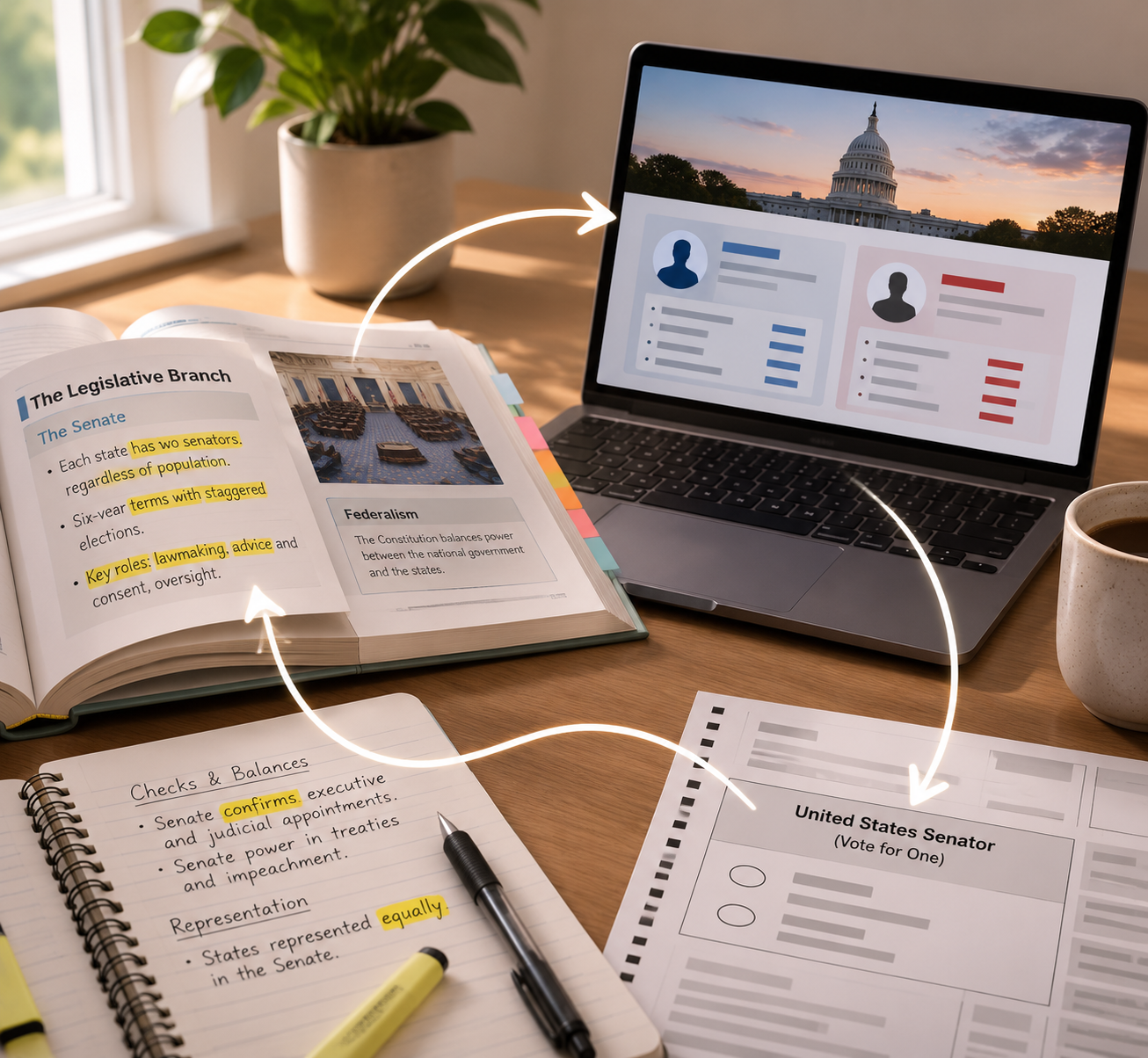
Start With the Ballot, Not the Internet Rabbit Hole
The first step in studying U.S. Senate election candidates is embarrassingly easy to skip: identify the actual race and candidates on your ballot. Do that before watching ads, reading national pundit takes, or searching a candidate’s name on social media.
A personalized ballot tool such as VOTE411 is built for this job. The League of Women Voters describes VOTE411 as a tool that gives voters election information, including candidate information and ballot details, and says it serves tens of millions of voters annually.[1] That makes it a reasonable first stop because it starts from your location instead of from whatever race is getting the most national attention.
For AP Gov purposes, this is also where the exam material stops being abstract. “Congressional elections” is not just a unit heading. It becomes: Which Senate seat is up? Is there an incumbent? Is there a primary? Is this a general election? Are there third-party or independent candidates? Are you comparing candidates in the same party or across parties?
Do not build a research file around “the 2026 Senate races” in general until you know your specific race. National context is useful later. The ballot comes first.
Turn AP Gov Concepts Into Research Questions
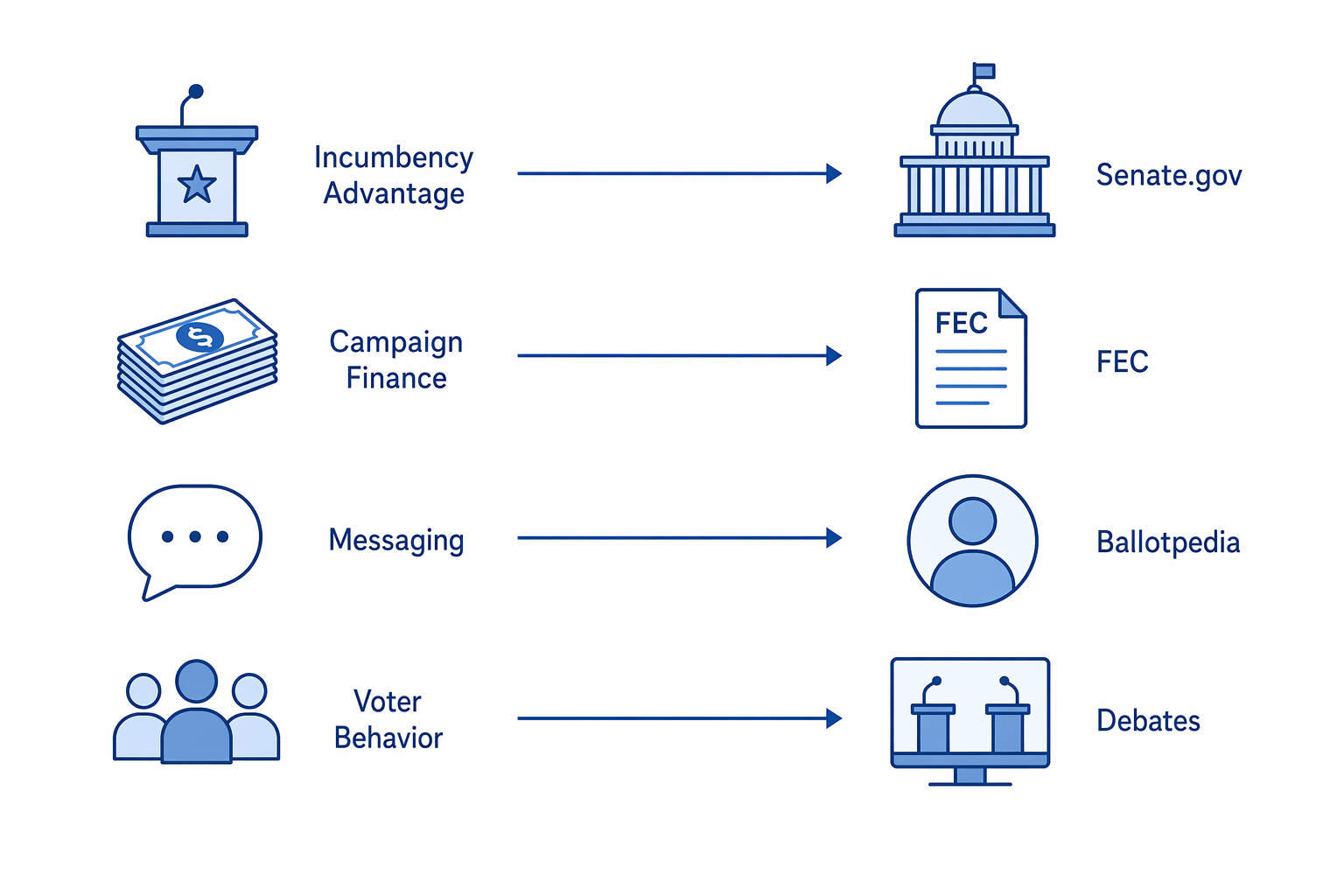
The AP Gov move is to stop treating “research candidates” like a vibe and turn each course concept into a question you can answer with evidence. This is the basic map:
| AP Gov concept | What to ask about a Senate candidate | Best places to look |
|---|---|---|
| Incumbency advantage | Does one candidate already hold the seat, and what advantages come with that? | Senate.gov, official Senate pages, voting-record tools, local coverage |
| Campaign finance | Who is giving money, who is spending independently, and how much of the campaign depends on outside support? | FEC, OpenSecrets |
| Candidate messaging | What does the candidate emphasize, avoid, simplify, or distort? | Campaign site, debates, questionnaires, ads, voting record |
| Voter behavior | Which voters is the campaign trying to mobilize, persuade, or reassure? | Debates, issue pages, ads, local news, turnout context |
| Midterm elections | Is the race happening in a national environment that usually pressures the president’s party? | Race ratings, historical context, polling with caution |
That table is the whole trick. You are not looking for “the truth” in one dramatic source. You are matching the concept to the source that can actually answer it.
Use Incumbency Advantage as a Checklist, Not a Vocabulary Word
In AP Gov review, incumbency advantage is often taught as a reason members of Congress usually win reelection. For Senate races, the advantage is real but weaker than in House races: one AP Gov review source summarizes Senate incumbent reelection rates at roughly 75–85%, compared with about 90% for House incumbents.[2] That difference is worth noticing because senators run statewide. They cannot rely on a carefully drawn district in the same way a House member might.
For candidate research, the useful question is not “Does incumbency matter?” It is “What form is incumbency taking in this race?” Check four things.
- Casework: Does the incumbent emphasize helping constituents with federal agencies, veterans’ benefits, disaster aid, passports, immigration services, or Social Security problems?
- Visibility: Does the incumbent appear frequently in local media, official newsletters, town halls, committee announcements, or state-specific federal funding announcements?
- Voting record: Does the incumbent’s actual roll-call record match the image used in campaign messaging?
- Statewide vulnerability: Is the incumbent running in a state where party balance, turnout patterns, or a national midterm environment could weaken the usual advantage?
The first two checks explain why incumbents can feel familiar before voters have compared policy details. Casework lets an office build a reputation for solving specific constituent problems. Official communication and public events keep the senator’s name in circulation. That does not prove the incumbent is the better candidate. It explains why challengers often have to spend so much time just becoming recognizable.
The voting-record check is where the research gets less fluffy. GovTrack can help students find bills, votes, sponsorships, and legislative activity for members of Congress, while Voteview uses congressional voting data to estimate ideological positions through DW-NOMINATE scores.[3] A score is not a personality test, and it will not tell you whether you like the senator’s explanation for a vote. It does give you a way to compare the candidate’s “I am independent,” “I am bipartisan,” or “I fight for my party’s agenda” language against an observable record.
For a challenger, use the same concept in reverse. If they say the incumbent is out of touch, look for the evidence they choose: missed votes, unpopular votes, donor ties, age, residence, committee priorities, national party alignment, or failure to deliver for the state. Some attacks are policy-based. Some are image-based. Some are just trying to puncture name recognition.
Separate Candidate Money, PAC Money, and Super PAC Money
Campaign finance is one of those AP Gov topics where students memorize categories and then forget to use them. Do not do that here. The categories are the research method.
Start with the Federal Election Commission. The FEC’s public records tools let users research federal candidates, committees, receipts, disbursements, debts, and filings.[4] That is where you check the candidate’s own campaign committee: how much it raised, how much it spent, how much cash it has available, and where the money is coming from by contribution type.
Then use OpenSecrets to make the donor patterns easier to interpret. OpenSecrets tracks money in politics, including candidate and officeholder fundraising, industries, PACs, and outside spending.[5] Some OpenSecrets features or pages may require account access, and availability can change, so treat it as a strong research tool rather than a magic answer machine.
The practical distinction looks like this:
| Money category | What it can tell you | What it cannot prove by itself |
|---|---|---|
| Candidate committee fundraising | How much direct support the campaign has and what kinds of donors are contributing | That every donor controls the candidate’s future votes |
| PAC contributions | Which organized interests are supporting the candidate through regulated contributions | That the candidate agrees with every position held by that PAC |
| Super PAC spending | Which outside groups are trying to influence the race, often through independent expenditures | That the candidate legally directed that spending |
| Independent expenditures | Who is spending to support or oppose a candidate outside the campaign’s direct control | That the spending is coordinated with the campaign |
Competitive Senate races can involve campaign spending in the millions, with a rough range from about $3 million to more than $30 million. The responsible AP Gov move is to use that as a reason to inspect fundraising and spending, not as proof that the better-funded candidate is more popular, more ethical, or guaranteed to win.
A clean research note might say: “Candidate A raised more through the campaign committee; Candidate B benefited from more outside spending; OpenSecrets lists heavy support from a particular industry; FEC filings show the timing and source categories.” That is much better than “Candidate A is bought” or “Candidate B has grassroots energy” unless the evidence actually supports those claims.
Read Candidate Messaging Against Other Records
Campaign websites are allowed to be persuasive. That sounds obvious, but people still treat them like neutral summaries. Use them anyway. They show what the candidate thinks will work with voters: inflation, immigration, abortion, democracy, crime, foreign policy, energy, farming, unions, veterans, public schools, or whatever else is central in that state.
The mistake is stopping there. A campaign issue page should be compared with at least one source that the candidate does not fully control.
- If the candidate is an incumbent, compare the issue page with roll-call votes and bill sponsorships.
- If the candidate completed a questionnaire, compare the polished website language with direct answers.
- If the candidate participated in a debate, compare scripted claims with answers under pressure.
- If outside groups are spending heavily, compare the campaign’s message with the attacks and themes those groups are amplifying.
Vote Smart is useful here because its Political Courage Test asks candidates to state positions on specific policy questions, which can expose details that campaign pages often blur.[6] Ballotpedia’s Candidate Connection is also designed to let candidates answer questions in their own words, though current candidate pages should be verified close to publication because 2026 entries can change during the cycle.
Debates add another layer. C-SPAN and local broadcasters often make candidate forums easier to review than social clips do. When watching, do not only write down whether you “liked” an answer. Track whether the candidate answered the question, shifted to a different issue, attacked the opponent, used a statistic without context, or claimed credit for something that requires a voting-record check.
Build the Candidate File in This Order
Here is the workflow I would actually give someone making a serious review sheet. It is not fancy. It just keeps you from confusing five different kinds of evidence.
- Identify your Senate race and candidate list with VOTE411 or another ballot lookup tool.
- Choose your priority issues before reading campaign material.
- Collect each candidate’s stated positions from campaign sites, questionnaires, and debates.
- For incumbents, check voting record, casework messaging, committee work, and visibility.
- Use FEC and OpenSecrets to separate direct fundraising from outside spending.
- Interpret competitiveness with incumbency and midterm concepts instead of treating ratings or polls as final answers.
- Write a short evidence note for each candidate, including what you still cannot verify.
The second step deserves more respect than it usually gets. The League of Women Voters’ candidate evaluation advice recommends deciding which issues and leadership qualities matter to you, then comparing candidates against those priorities instead of reacting to campaign noise.[7] That is basically an AP free-response discipline: define the criteria before you evaluate the evidence.
A simple candidate file can be a spreadsheet, a document, or a notebook page. Use columns like these:
| Category | Candidate A | Candidate B | Evidence source |
|---|---|---|---|
| Ballot status | Incumbent/challenger/party | Incumbent/challenger/party | VOTE411 or state election site |
| Top issue position | Short summary | Short summary | Campaign site plus questionnaire or debate |
| Voting record | Key votes if incumbent | Key votes if incumbent | GovTrack, Voteview, Senate records |
| Funding pattern | Main donor or spending pattern | Main donor or spending pattern | FEC, OpenSecrets |
| Messaging pattern | Main themes and attacks | Main themes and attacks | Website, debate, ads, local news |
| Unverified questions | What still needs checking | What still needs checking | Publication-date note |
If you want a more guided practice version before using real candidates, iCivics’ Cast Your Vote game teaches candidate evaluation through a simulated election environment.[8] Rock the Vote also offers a beginner-friendly walkthrough for researching a ballot, and Citizens Count provides a detailed candidate research guide with a more state-level emphasis.[9][10] Those tools are supports. The candidate file is where you make the evidence usable.
Use Race Ratings as Context, Not as a Substitute for Research
Senate elections in a midterm year should be read with national context in mind. AP Gov materials commonly teach that the president’s party tends to face losses in midterm elections, and the research base for this article identifies an average Senate loss of about 4–5 seats for the president’s party. That does not mean every race moves the same way. It means the national environment belongs in the file.
This is where race ratings from outlets such as Cook Political Report can help. A rating can tell you whether analysts see a race as safely partisan, competitive, or especially vulnerable. But ratings may sit behind account access, may update often, and should be checked close to publication. Also, “competitive” describes the race environment. It does not tell you which candidate has the stronger policy case.
Polls deserve the same treatment. A poll can show attitudes at a point in time, with a specific sample and method. It is not the same thing as turnout, persuasion, or a final result. If your AP Gov teacher has ever corrected someone for treating correlation like causation, this is that same correction wearing campaign merch.
Do Not Pretend the File Captures Everything Voters Care About
A structured research file is better than vibes. It is still not the whole election. Voters respond to party identification, local identity, trust, anger, enthusiasm, economic conditions, candidate biography, community networks, and sometimes one issue that outweighs everything else. Some of those things show up in records. Some show up more clearly in interviews, local news, endorsements, or turnout patterns.
The point is not to remove judgment from politics. The point is to make your judgment traceable. If you say a candidate is experienced, point to offices held, committee work, or policy record. If you say a candidate is extreme or moderate, compare rhetoric with votes, endorsements, issue positions, and ideological measures. If you say money matters in the race, distinguish candidate fundraising from outside spending.
Newer tools may make that traceability easier. CivicAlign, for example, presents candidate stances with links to floor votes, public statements, or FEC filings, according to its candidate research platform.[11] That kind of sourcing is exactly the habit to copy, whether or not you use that specific site: do not just save a conclusion; save the evidence trail.
Check Currency Before You Trust Your Own Notes
Because this article is being written in July 2026, every live-election source needs a freshness check. Candidate lists can change. Primary winners can replace crowded candidate fields. Ballotpedia entries can update. VOTE411 data may become more complete closer to Election Day. FEC filings arrive on reporting schedules. OpenSecrets and Cook pages may change access rules or update their summaries. Debate footage may appear late.
The AP Gov side needs the same caution. If you are using this for the May 2027 exam, compare your teacher’s materials with the current AP U.S. Government and Politics Course and Exam Description. The concepts named here are standard congressional-election material, but curriculum wording and emphasis can shift.
A good final candidate note should therefore include a date: “Checked on July 21, 2026.” That one line keeps you from treating a moving campaign as if it were a finished textbook chapter.
If you can explain incumbency advantage, midterm dynamics, campaign finance, voter behavior, and messaging on the AP exam, you can use those same ideas to build a disciplined candidate research file for a real Senate race. That is how to study U.S. Senate election candidates without pretending one website, one debate clip, or one campaign slogan did the work for you.
References
- VOTE411, League of Women Voters, https://www.lwv.org/elections/vote411
- Congressional Elections: AP US Government Review, Albert.io, https://www.albert.io/blog/congressional-elections-ap-us-government-review/
- Voteview, UCLA, https://voteview.com/
- How to research public records: candidates, Federal Election Commission, https://www.fec.gov/introduction-campaign-finance/how-to-research-public-records/candidates/
- Candidates & Officeholders, OpenSecrets, https://www.opensecrets.org/candidates-officeholders
- Vote Smart, Vote Smart, https://www.votesmart.org/
- How to Judge a Candidate, League of Women Voters, https://www.lwv.org/blog/how-judge-candidate
- Cast Your Vote, iCivics, https://ed.icivics.org/games/cast-your-vote
- How to Research Your Ballot, Rock the Vote, https://www.rockthevote.org/explainers/how-to-research-your-ballot/
- How do I thoroughly research my candidates?, Citizens Count, https://www.citizenscount.org/how-to/vote/how-do-i-thoroughly-research-my-candidates
- Candidates, CivicAlign, https://www.civic-align.com/candidates
Back to the exam this applies to
Target exam not specified — see all exam hubs.
Comments
Join the discussion with an anonymous comment.