Comparison
Travel Alerts and Safety Steps for Studying Abroad
Before studying abroad, students need to understand official travel alert systems and take concrete safety steps. This guide covers the State Department's Travel Advisory system, STEP enrollment, essential insurance checks, and a documented communication plan to reduce common risks.
Verdict panel
- Compared
- not specified
- Target exam
- not specified
- Best for
- not specified
- Pricing last reviewed
- pricing currency unconfirmed
Once a study abroad acceptance is real, safety planning should move from “my parents are worried” to “I know which systems will reach me, who I contact first, and what my insurance actually covers.” For study abroad travel alerts and safety, the useful work starts before departure: read the official advisory, enroll in STEP, ask your provider specific emergency questions, verify insurance gaps, and write down the communication plan you hope you never need.
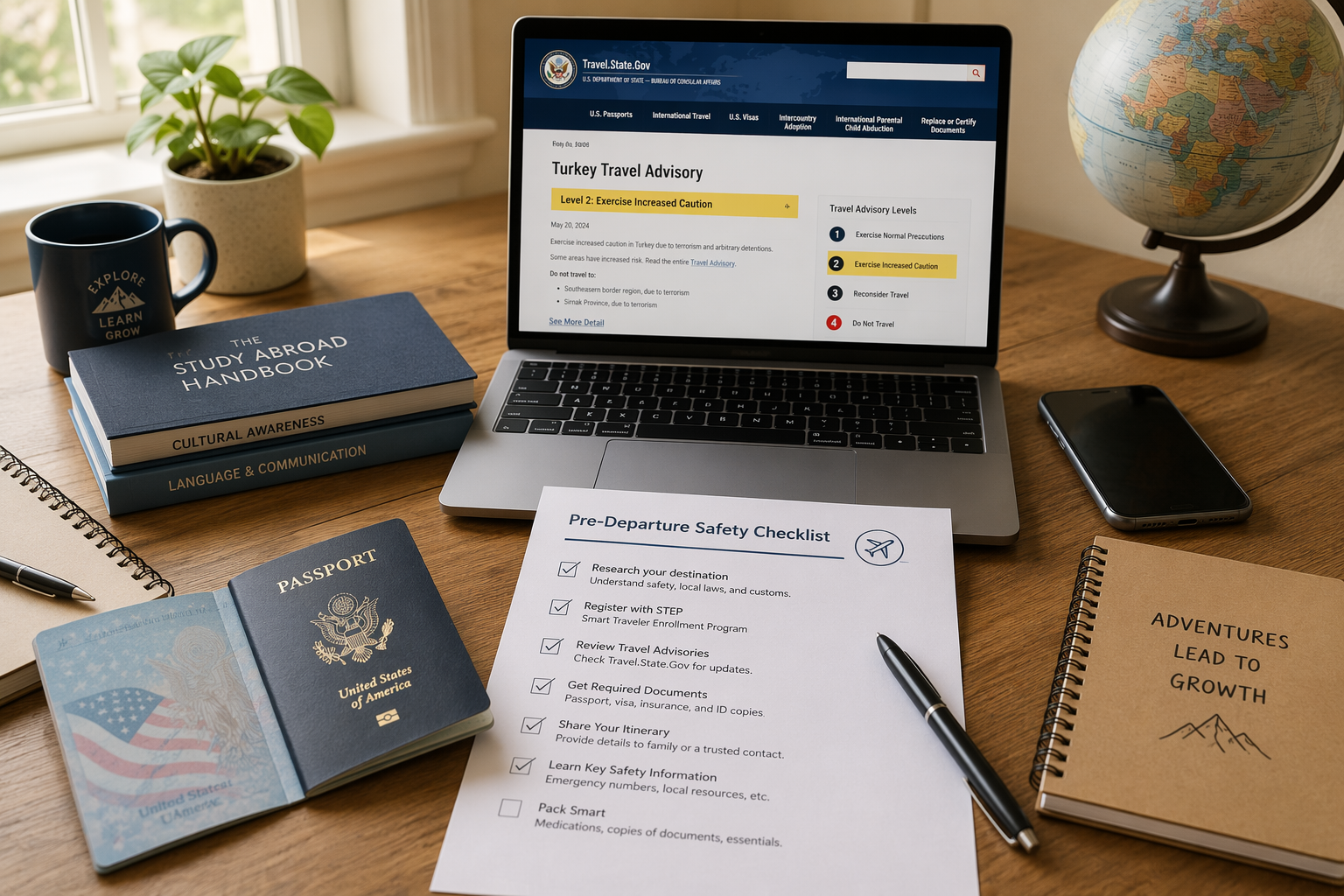
That checklist is not about making study abroad sound dangerous. It is about removing the most avoidable friction from ordinary problems: a stolen phone, a clinic visit, a delayed train after dark, a night out where someone needs help, or a local disruption that changes how students should move around the city.
Start With The Official Travel Advisory
The U.S. State Department assigns every country a Travel Advisory Level from 1 to 4. Level 1 means “Exercise Normal Precautions,” Level 2 means “Exercise Increased Caution,” Level 3 means “Reconsider Travel,” and Level 4 means “Do Not Travel.” Advisories for Level 1 and Level 2 countries are reviewed at least annually, while Level 3 and Level 4 advisories are reviewed at least every six months.[1]
Read the advisory for your host country before you book nonrefundable side trips. Then read the details, not just the number. A Level 2 country can have region-specific warnings, crime notes, health information, terrorism concerns, civil unrest alerts, or transportation cautions that matter more to your weekly routine than the headline level.
A Travel Advisory is not the same thing as a program cancellation notice. Your university or provider may still run a program in a country with an elevated advisory, or may suspend travel for reasons that are more specific than the national advisory. Treat the State Department page as the official baseline, then ask your program how it applies that information to housing, excursions, curfews, local transportation, and emergency communication.
| Before departure | What to do with it |
|---|---|
| Country advisory level | Confirm the current Level 1–4 rating and read the country-specific notes. |
| Regional warnings | Check whether any city, border area, route, or excursion destination has separate guidance. |
| Program policy | Ask when the provider would modify, relocate, or cancel activities. |
| Parent or emergency-contact update | Share the advisory link and explain what it does and does not mean. |
Enroll In STEP So Alerts Can Actually Reach You
Reading the advisory is the information step. Enrolling in the Smart Traveler Enrollment Program, usually called STEP, is the contact step. STEP is a free State Department service that sends safety alerts to enrolled travelers and helps the U.S. embassy or consulate contact and assist them in an emergency.[2]
Enroll after you know your host city, dates, and local address or program housing information. If those details change, update the enrollment. A student who moves from a residence hall to a homestay, adds independent travel, or changes phone numbers has not “done STEP” in a useful way unless the record still reflects where they can be reached.
- Create or sign in to your STEP account before departure.
- Enter your destination country, travel dates, host city, local address if known, email, and phone number.
- Add side trips that take you to another country, especially over long weekends or breaks.
- Save the nearest U.S. embassy or consulate contact information in your phone and in a document that can be accessed offline.
- Tell your emergency contact that STEP alerts may go to you first, not to them.
That last point prevents a very common communication mismatch. Parents may assume an official alert will automatically reach them. Usually, the enrolled traveler is the one receiving the location-specific information. If a parent wants visibility, the student can forward alerts, add a shared email where appropriate, or agree that certain alerts trigger a quick “I’m safe” message.
Ask Your Program Questions That Require Specific Answers
A good program should not expect students to accept “we take safety seriously” as a complete answer. NAFSA and The Forum on Education Abroad frame health and safety as a shared responsibility among the student, the program provider, and the host institution, and their guidance encourages students to ask specific questions before selecting or joining a program.[3]
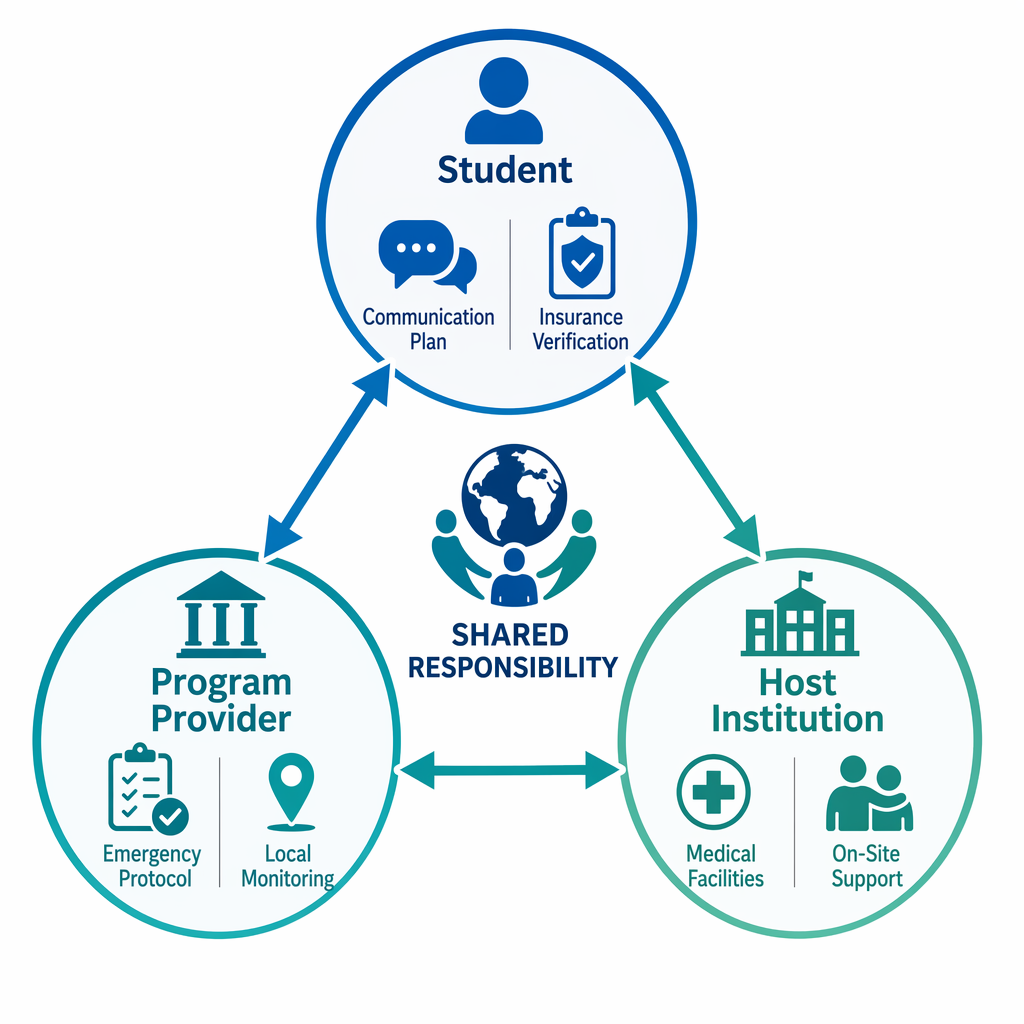
This is where students get to act like adults instead of being treated like luggage with a passport. Ask the questions in writing, preferably by email, so the answer is searchable later. You are not trying to catch anyone out. You are trying to know what happens at 11 p.m. on a Saturday when the student services office is closed and someone needs help.
- How do you monitor local conditions before and during the program?
- Who decides whether to modify housing, excursions, class locations, or transportation because of a safety concern?
- What is the emergency communication protocol, and how quickly should students expect a response?
- Which number should students call first for urgent help: local emergency services, resident staff, campus police, the provider hotline, or another contact?
- Which medical facilities do you use for routine care, urgent care, mental health care, and after-hours emergencies?
- How are students briefed on local transportation risks, nightlife expectations, alcohol or drug policies, and reporting options after an incident?
- What information is shared with a parent or emergency contact, and what requires the student’s consent?
If you are still choosing among programs, safety readiness is only one part of that decision. App features, counseling models, and admissions support belong in a separate comparison, such as this guide to study abroad platform apps. Once a program is chosen, the more important question becomes whether its emergency systems are clear enough for a tired student to use under pressure.
Let The Data Change What You Prioritize
Students often imagine safety abroad as mostly a crime issue. Theft matters, especially because a stolen phone can also mean lost maps, payment apps, two-factor authentication, and emergency contacts. But travel health data points to a less glamorous risk that deserves more attention: transportation.
The CDC Yellow Book 2026 identifies motor vehicle crashes as the leading cause of non-natural death for U.S. citizens abroad, accounting for 26% of all non-natural deaths in 2019–2021. In that period, 402 U.S. citizens died abroad in road traffic crashes; 62% were car occupants and 19% were on motorcycles.[4]
That figure covers U.S. citizens abroad generally, not study abroad students only, so it should not be stretched into a student-specific rate. It still belongs in a study abroad checklist because students make transportation decisions constantly: airport transfers, late-night rides, weekend buses, scooter rentals, rideshares, taxis, and friends-of-friends offering a lift.
- Ask the program which transportation options it recommends and which it discourages.
- Decide before arrival whether scooters, motorcycles, or informal rides are off-limits for you.
- Save a safe late-night route home before the first night out, not during it.
- Keep enough local payment access for a licensed taxi, rideshare, or transit alternative.
Alcohol and drugs belong in the same practical category: not as a morality lecture, but as a planning variable. UC Davis Global Learning Hub states that “the overwhelming majority of accidents and injury that occur on study abroad programs are related to the legal or illegal use of alcohol or drugs.”[5] CIEE’s 2016–2021 Health, Safety, and Security Data Report also described alcohol as a notable factor in sex offenses and some violent crimes reported in its program data.[6]
Those sources do not mean every student who drinks is unsafe, and their data definitions are not interchangeable. They do mean the communication plan should cover nights out, buddy expectations, consent and reporting options, safe transportation, and the point at which a friend calls staff instead of waiting to see if things improve.
Verify Insurance Instead Of Assuming It Is Handled
Most students hear “the program includes insurance” and stop there. Do not stop there. Ask for the policy summary, emergency assistance number, claims process, and exclusions. Then check the three gaps that create the most confusion when something actually happens: medical evacuation, mental health services, and pre-existing conditions.[3][6]
| Insurance question | Why it matters before departure |
|---|---|
| Does the plan cover medical evacuation? | Emergency evacuation can involve coordination beyond a routine clinic visit, and students need to know who authorizes it. |
| Are mental health services covered abroad? | A student who already uses therapy or medication should know whether care, referrals, telehealth, or crisis support is available. |
| How are pre-existing conditions handled? | Coverage may depend on documentation, stability periods, medication supply rules, or exclusions. |
| Who pays first? | Some plans require the student to pay upfront and seek reimbursement; others coordinate directly with providers. |
| What number works after hours? | A claims email is not an emergency plan. |
For mental health, do this check early enough to make appointments at home before leaving. If you take prescription medication, ask your clinician and program what documentation is needed, whether the medication is legal in the host country, and how much you can bring. Do not rely on being able to refill a familiar prescription abroad.
Parents can help here without taking over. The student should be the one who knows the card, the portal, the emergency number, and the first step for care. A parent can keep backup copies and help compare coverage, but the person standing at the clinic desk abroad needs to know what to show.
Write The Communication Plan Before Anyone Is Upset
A communication plan is not a promise to text constantly. It is a short agreement about what happens when normal contact breaks, when an official alert appears, or when the student needs help. It protects independence better than vague reassurance because everyone knows the difference between “busy with class” and “time to escalate.”
| Situation | Student does | Parent or emergency contact does |
|---|---|---|
| Routine week | Sends the agreed check-in on the agreed channel. | Does not treat a delayed casual reply as an emergency. |
| STEP or local safety alert | Confirms location and whether plans changed. | Waits for the agreed “I’m safe” message before calling multiple people. |
| Lost phone or wallet | Uses backup access to contact program staff and emergency contact. | Helps freeze cards or restore account access if asked. |
| Medical visit | Contacts program staff or insurer using the saved number. | Keeps available for records, payment support, or follow-up. |
| No contact beyond agreed window | If able, sends a short status update. | Follows the escalation order: roommate or friend, program contact, university contact, then local or embassy resources if appropriate. |
Put the plan in a shared document and make an offline copy. Include the student’s local address, program emergency number, university contact, nearest embassy or consulate, insurance assistance number, passport copy location, medication list if the student is comfortable sharing it, and the names of local friends or roommates who may notice a problem first.
The plan should also say who gets called first. In a true immediate emergency, local emergency services come first. For a program-related issue, resident staff or the provider hotline may be the fastest route. For a lost passport, the embassy or consulate becomes relevant. For a missing check-in, a roommate may know more in two minutes than a parent can learn from another country in two hours.
The Pre-Departure Safety Checklist
This is the version to finish before the airport. It is intentionally practical. If an item does not change what you would do during a problem, it probably belongs somewhere else.
- Read the State Department Travel Advisory for your host country and any side-trip countries.
- Enroll in STEP and update it when your address, dates, phone number, or side trips change.
- Save embassy or consulate contact information offline.
- Ask your program how it monitors local conditions and communicates during emergencies.
- Confirm which medical facilities the program uses for routine care, urgent care, mental health, and after-hours help.
- Verify insurance coverage for medical evacuation, mental health services, and pre-existing conditions.
- Save insurance cards, emergency numbers, and claims instructions on your phone and offline.
- Decide your transportation rules before arrival, including late-night rides and motorcycles or scooters.
- Set expectations for nights out: buddy system, safe ride home, and when to call staff.
- Write and share a communication plan with escalation steps.
None of this eliminates risk abroad. It does make the predictable problems less chaotic. The student gets more freedom because the basics are handled, and the parent gets something better than reassurance: a plan with names, numbers, systems, and decisions already made.
References
- Travel Advisories, U.S. Department of State
- Smart Traveler Enrollment Program, U.S. Department of State
- Finding Your Study Abroad Program: Health, Safety, and Security, NAFSA
- Injury and Death During Travel, CDC Yellow Book 2026
- Advisory of Student Risk, UC Davis Global Learning Hub
- CIEE Health, Safety, and Security Data Report 2016–2021, CIEE
Back to the exam this applies to
Target exam not specified — see all exam hubs.
Comments
Join the discussion with an anonymous comment.