Comparison
How to See the 2026 Solar Eclipse and Perseid Meteor Shower in One Day
August 12, 2026 brings a rare alignment of a total solar eclipse and the Perseid meteor shower peak. This guide explains where and when to see each event, how to observe them safely, and what to expect whether you're in the eclipse path or watching a partial eclipse from your region.
Verdict panel
- Compared
- not specified
- Target exam
- not specified
- Best for
- not specified
- Pricing last reviewed
- pricing currency unconfirmed
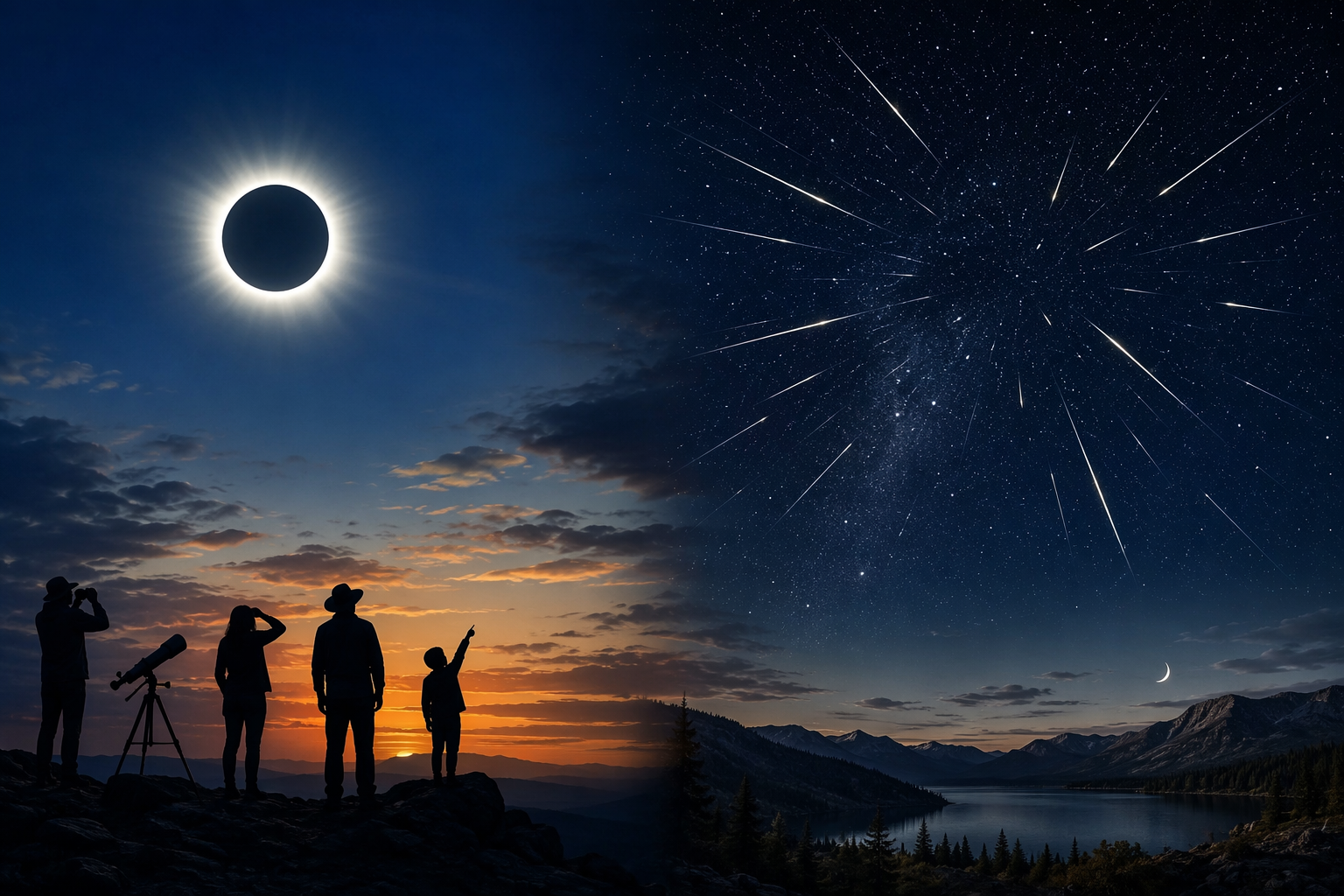
August 12, 2026 is a skywatching double-header, not one blended event. A total solar eclipse crosses a narrow path through Greenland, Iceland, and Spain in the late afternoon and early evening, while the Perseid meteor shower reaches its best viewing hours later, under a new moon, before dawn on August 13.[1][2][3]
That distinction matters. The Perseids do not become stronger because of the eclipse, and the eclipse does not make nighttime meteors visible in the afternoon. For almost everyone, this is two observing sessions on the same calendar date: solar viewing first, meteor watching after midnight.
The Clean Plan for August 12
If you only remember one thing, make it this: eclipse glasses are for the Sun, not meteors; dark skies are for meteors, not the eclipse. The solar eclipse is location-sensitive and safety-critical. The Perseids are time-sensitive and darkness-critical.
| Event | Best time | Where it is visible | What you need |
|---|---|---|---|
| Total solar eclipse | Late afternoon or early evening on August 12, depending on location | Only inside the path of totality through parts of Greenland, Iceland, and Spain | ISO 12312-2 eclipse glasses for all partial phases; totality can be viewed without filters only while the Sun is fully covered |
| Partial solar eclipse | During the same eclipse window on August 12 | Large parts of North America, Europe, northern Africa, and nearby regions, with depth varying by location | ISO 12312-2 eclipse glasses or a safe indirect viewing method for the entire event |
| Perseid meteor shower | Best after midnight, especially pre-dawn on August 13 | Dark sites across the Northern Hemisphere, weather permitting | No eye protection; wide sky view, darkness, patience, and warmth |
The meteor side of the night gets a rare gift: the new moon falls on August 12 at 17:37 UTC, so moonlight will not wash out faint Perseids during the best overnight viewing window.[3] That does not guarantee a storm of meteors over every backyard. It means the sky background is as favorable as the Moon can make it.
Where the Eclipse Is Total, Partial, or Out of Reach
NASA’s eclipse map is the starting point for travel decisions, because totality is not a regional vibe; it is a narrow strip on Earth’s surface. On August 12, 2026, that strip crosses the Arctic and North Atlantic, including Greenland, Iceland, and Spain, while much wider areas see only a partial eclipse.[1]
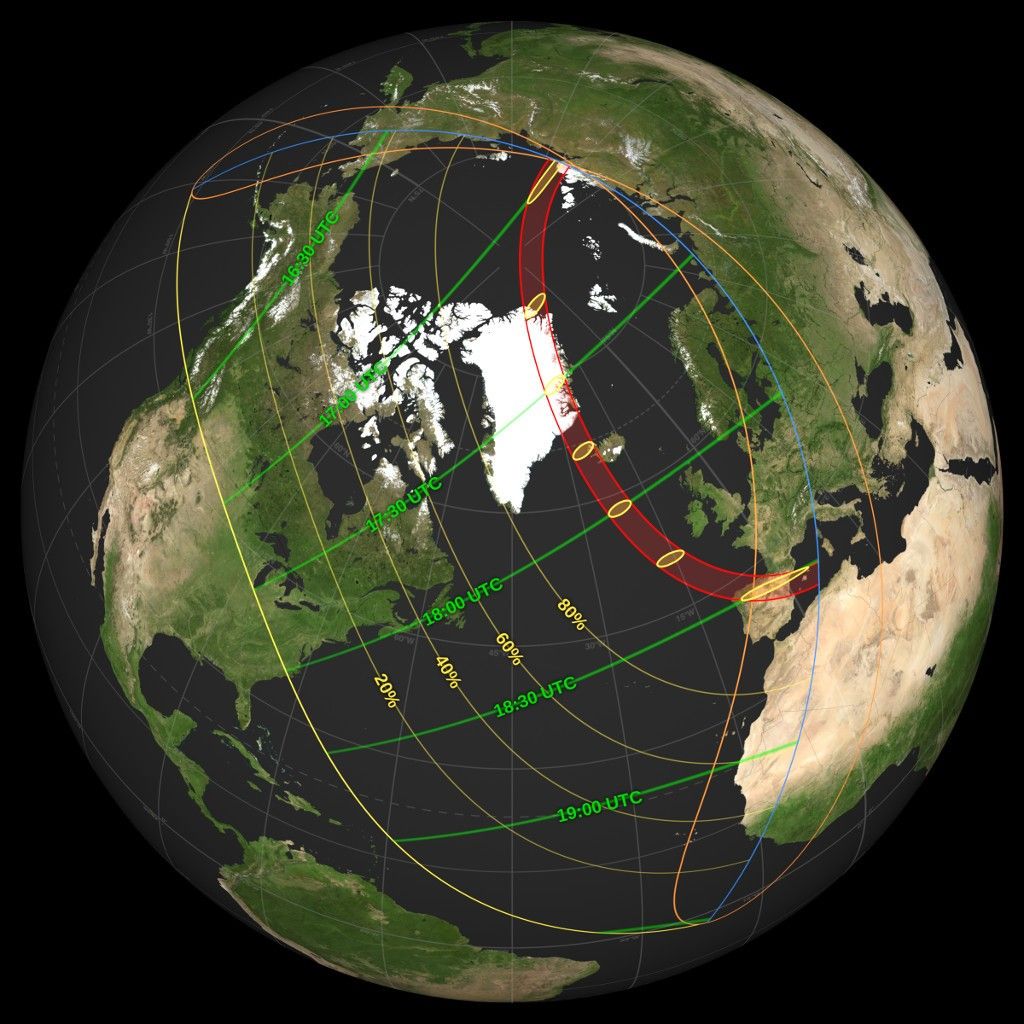
Inside the path, the Sun is completely covered for a short time. NASA lists the maximum duration of totality at about 2 minutes 18 seconds, occurring off Iceland’s coast.[1] That is the only interval when it is safe to look at the eclipsed Sun directly. Before totality begins, and immediately after it ends, the eclipse is back to being a partial solar eclipse, which means certified solar viewing protection goes back on.
Outside the path, a partial eclipse can still be memorable. Space.com’s regional breakdown notes that parts of eastern North America, Europe, and northern Africa will see varying coverage, with the deepest partial views generally closer to the path.[4] A partial eclipse is not failed totality. It is its own event, but it never creates the fully darkened sky or naked-eye corona that totality does.
Greenland, Iceland, and Spain
If you are chasing totality, the practical question is not simply “which country?” but “am I actually inside the path?” NASA provides city-level eclipse data and path information, which should decide your observing site before hotels, scenery, or wishful thinking do.[1] A site just outside the path can experience a deep partial eclipse while missing the central event completely.
Spain will be the most accessible totality destination for many travelers, while Iceland and Greenland offer more northerly options with different weather, infrastructure, and horizon considerations. Those differences are real, but the first filter remains blunt: path, weather prospects, safe viewing, and an unobstructed view toward the Sun at eclipse time.
United Kingdom and Europe
BBC Sky at Night Magazine describes the date as a notable pairing for UK and European observers, with the eclipse occurring on August 12 and the Perseids peaking the same night.[6] For the UK, this is primarily a partial-eclipse day unless the observer travels into the path of totality. The same basic rule applies across Europe: check the local eclipse circumstances, not just the headline map.
A deep partial eclipse can change the quality of the afternoon light, sharpen shadows, and make the day feel abruptly strange. It still requires solar filters from start to finish. The Sun is not safe to look at just because most of it is hidden.
North America
North America is not in the path of totality, but parts of the continent can see a partial eclipse, especially farther east and north. Space.com’s U.S. and Canada guide points to northeastern and Atlantic-side locations as better partial-eclipse prospects, while also noting that many of those same places can serve as Perseid viewing sites later if the sky is dark enough.[5]
That pairing is useful for anyone who cannot travel overseas. You can make August 12 a real observing day from North America: safely watch the partial eclipse if it is visible from your location, then choose a darker site for the overnight meteor shower. The two plans may use the same town, but they do not use the same observing conditions.
Solar Safety Comes First
For the eclipse, ordinary sunglasses are useless. Use eclipse glasses or handheld solar viewers that meet ISO 12312-2, or use an indirect method such as a pinhole projector. Cameras, binoculars, and telescopes need proper solar filters on the front of the optics; putting eclipse glasses behind magnified sunlight is not a safe workaround.
The narrow exception is totality. If you are inside the path of totality and the Sun is completely covered, you may look without solar filters during that brief total phase. The moment a bright part of the Sun returns, the glasses go back on. If you are outside the totality path, there is no naked-eye interval at all.
- Check your exact local eclipse circumstances using NASA’s path and timing data before making plans.[1]
- Buy certified eclipse glasses early, inspect them for scratches or damage, and keep a spare pair if you are sharing.
- Practice with children before the eclipse: glasses on before looking up, eyes down before glasses come off.
- Do not use eclipse glasses for meteor watching. The Perseids are nighttime objects and require unaided, dark-adapted eyes.
Why the Perseids Are So Well Placed in 2026
The Perseids are already one of the most reliable annual meteor showers, but 2026 gives them unusually clean lighting. EarthSky’s guide places the shower’s peak around the night of August 12 into the morning of August 13 and notes a zenithal hourly rate around 100 under ideal conditions.[2] The important phrase is “under ideal conditions.” ZHR is a standardized way to compare showers, not a promise that one person will count 100 meteors from a suburban driveway.
The best viewing window is after midnight, especially from about 2 a.m. to dawn local time on August 13, when your side of Earth is turned more directly into the stream of meteoroid debris.[2] Earlier evening can still produce Perseids, but the pre-dawn hours usually give the stronger show.
NASA identifies the Perseids as debris from Comet Swift-Tuttle, and notes that Perseid meteors enter Earth’s atmosphere at about 37 miles per second.[8] That speed is why the shower can produce bright, fast streaks and occasional fireballs. You do not need to know the comet’s orbital history to enjoy the shower, but it helps explain why tiny particles can look so dramatic.
How to Do Both Without Spoiling Either One
The easiest way to ruin this day is to treat it as one long event. It is better planned as a reset: afternoon solar observing, dinner and rest, then a separate overnight meteor session.
| Phase of the day | What to do | What not to assume |
|---|---|---|
| Before eclipse day | Confirm your eclipse visibility, totality status, local times, weather options, and viewing gear. | Do not assume a country, state, or city is “in totality” without checking the exact path. |
| Eclipse afternoon | Set up early, keep solar filters on during all partial phases, and watch the light and shadows change. | Do not expect Perseid meteors to appear as the normal eclipse experience. |
| Totality, if you are inside the path | Remove filters only when the Sun is fully covered, then replace them before totality ends. | Do not stretch the naked-eye interval beyond the true total phase. |
| After the eclipse | Eat, rest, relocate if needed, and let the day stop being a solar event. | Do not keep staring west and waiting for meteors. |
| After midnight | Go to the darkest safe site you can, face a broad open sky, and give your eyes time to adapt. | Do not wear eclipse glasses or stare only at the Perseid radiant. |
Scientific American’s coverage makes the same practical separation: the eclipse and meteor shower align on the calendar, but ordinary observers should plan for the eclipse in the afternoon or evening and the meteor shower overnight.[7] The only romantic loophole is the possibility of a bright daytime Perseid during totality. It is possible enough to mention and rare enough not to plan around.
For the meteor session, choose darkness over altitude unless altitude also gives you darkness and a clear horizon. A rural field with an open sky is often better than a scenic overlook lit by traffic, phone screens, and people constantly turning on headlamps. Lie back, look at a large patch of sky, and let your eyes adjust for at least 20 minutes.
- Bring layers; pre-dawn August can feel colder than the afternoon eclipse crowd expects.
- Use a red light sparingly if you need to move around.
- Put phones away or dim them fully, because one bright screen can reset dark adaptation.
- Give the shower real time. Ten minutes is a glance; an hour is an observing session.
If You Cannot Travel to Totality
Traveling into the eclipse path is the only way to see totality, and totality is the headline. But August 12 is not reserved for people with passports, rental cars, and perfect weather luck. A partial eclipse plus a moonless Perseid peak is still a serious observing plan.
Start with what your location can honestly offer. If your region gets a partial eclipse, make the solar viewing safe and local. If your eclipse prospects are poor or the Sun is too low, put your energy into the overnight Perseids. Because the meteor shower is visible across broad Northern Hemisphere dark-sky locations, the night portion of the day is far less tied to the narrow eclipse path.
Clouds are the shared enemy, but they matter differently. For the eclipse, clouds at the wrong minutes can erase a once-in-a-location event. For the Perseids, broken clouds may still leave useful viewing windows across several hours. Build flexibility into both plans, but do not use the same backup strategy for both.
A Few Facts Worth Keeping in Perspective
The August 12, 2026 eclipse belongs to Saros 126, and it will be the first total solar eclipse visible from mainland Europe since 1999.[9] Those facts help explain why the date will draw attention, especially in Spain. They should not replace the practical question of whether your chosen site is in the path and whether you can view safely.
Likewise, the Perseids’ reputation should not turn ZHR into a personal forecast. Dark sky, clear weather, local obstructions, light pollution, radiant height, and patience all affect what one observer actually sees. The new moon removes one major problem; it does not remove the rest.
So the decision is simple. Chase totality if you can do it safely and realistically. If not, watch the partial eclipse with proper protection from wherever it is visible. Then stop, reset, and go outside again before dawn on August 13 for the Perseids under a dark, moonless sky.
References
- Total Solar Eclipse on August 12, 2026, NASA
- Everything you need to know: Perseid meteor shower, EarthSky
- Perseid Meteor Shower 2026 Will Peak Under A Perfect New Moon, The Weather Channel, July 16, 2026
- The biggest skywatching day of 2026 is coming, Space.com
- 10 places in the US and Canada, Space.com
- August 2026 solar eclipse and Perseid meteor shower, BBC Sky at Night Magazine
- The Perseid Meteor Shower Aligns with a Total Solar Eclipse, Scientific American
- Perseids, NASA
- Solar eclipse of August 12, 2026, Wikipedia
Back to the exam this applies to
Target exam not specified — see all exam hubs.
Comments
Join the discussion with an anonymous comment.