
Comparison
What Actions Get You a Red Card in Soccer?
This study guide explains the seven IFAB sending-off offenses, immediate match consequences, post-match suspensions, and tactical impact of red cards in soccer. Perfect for new fans, student athletes, and anyone needing a clear reference.
Verdict panel
- Compared
- not specified
- Target exam
- not specified
- Best for
- not specified
- Pricing last reviewed
- pricing currency unconfirmed
A red card in soccer is not a warning. It is the referee’s order for a player, substitute, substituted player, or team official to leave the field vicinity and technical area. If the dismissed person is a player on the field, that player cannot be replaced, so the team plays with one fewer player for the rest of the match under IFAB Law 12.[1]
That one card often gets mixed together with three separate ideas: the action that earns the card, the immediate match consequence, and any suspension that follows after the final whistle. To learn soccer red card rules cleanly, keep those layers apart. The law tells the referee when to send someone off. The match rules explain what happens to the team right away. The competition’s disciplinary code decides the later ban.

Quick-Reference Offense Table
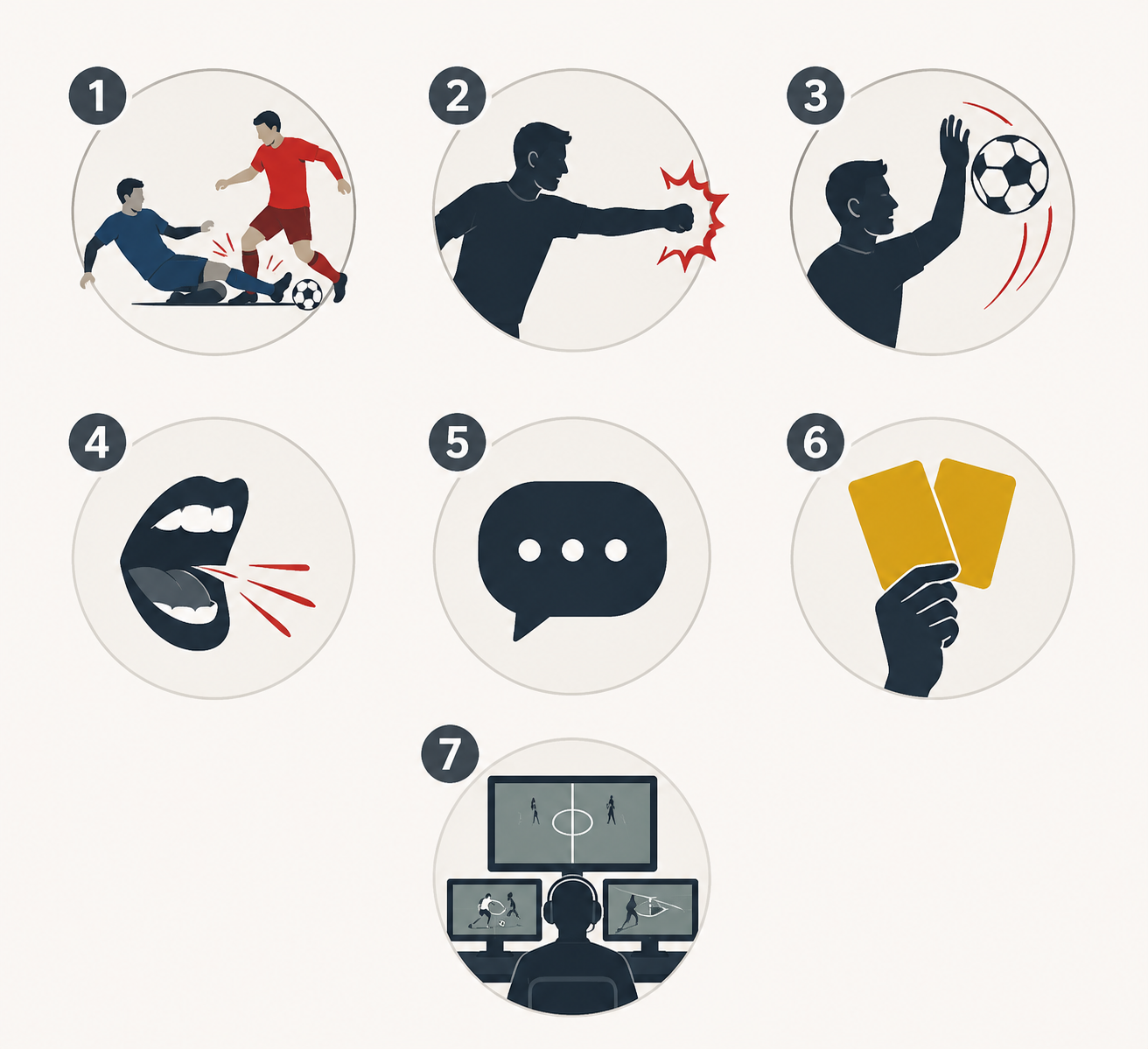
The most reliable starting point is IFAB Law 12, with current national-law pages such as The FA’s Law 12 page useful as a check that the wording has not drifted in local explainers.[1][2] For study purposes, the sending-off offenses are easiest to group into seven buckets.
| Sending-off bucket | Plain-English meaning | Beginner mistake to avoid |
|---|---|---|
| Serious foul play | A player challenges for the ball with excessive force or endangers an opponent’s safety. | Do not treat every hard foul as serious foul play; the key is danger or excessive force during a challenge for the ball. |
| Violent conduct | A person uses or attempts to use excessive force or brutality when not fairly challenging for the ball. | Do not confuse it with serious foul play just because both can look aggressive. |
| DOGSO by handball or foul | A player denies an obvious goal-scoring opportunity by deliberately handling the ball or by committing a free-kick offense. | Do not call every last-defender foul a red; the opportunity must be obvious. |
| Biting or spitting | A person bites or spits at someone. | Do not look for a separate injury standard; the act itself is treated as a sending-off offense. |
| Offensive, insulting, or abusive language, gestures, or actions | A person crosses the line from dissent or frustration into abusive misconduct. | Do not assume words are only yellow-card behavior. |
| Second caution in the same match | A person who already has a yellow card commits another cautionable offense. | Do not describe it as the same thing as a straight red; the dismissal route is different. |
| Entering the video operation room | A player, substitute, substituted player, or team official enters the VAR video operation room. | Do not confuse this with arguing for a review near the field; the specific location matters. |
The table is short on purpose. A player does not have to memorize famous incidents first. The better study order is category, condition, consequence. Once those are stable, examples become easier to classify instead of louder to argue about.
Serious Foul Play vs. Violent Conduct
Serious foul play and violent conduct are the pair beginners most often blur together. The difference starts with the ball. Serious foul play is tied to a challenge for the ball. Violent conduct covers excessive force or brutality when the action is not a fair challenge for the ball, including conduct away from active play.[1]
A late, studs-up tackle that endangers an opponent can fall under serious foul play. A punch, elbow, kick-out, or off-ball strike is more likely to be judged as violent conduct. Accessible rule explainers often teach the same split this way because it gives learners a first question to ask: was the person making a football challenge, or was the action outside that kind of challenge?[3]
That first question does not decide everything. A player can be challenging for the ball and still be sent off if the challenge uses excessive force or endangers safety. The point is not to excuse contact because the ball is nearby. The point is to classify the misconduct correctly.
DOGSO: The Red Card That Depends on the Opportunity
DOGSO means denying an obvious goal-scoring opportunity. Law 12 recognizes DOGSO by deliberate handball and DOGSO by an offense punishable by a free kick.[1] This is why a foul near midfield can look cynical but still not be a red card, while a less violent foul near goal can become a sending-off offense.
For a learner, the word to slow down on is “obvious.” The referee is not only judging whether a foul happened. The referee is judging whether the foul or handball took away a clear chance to score. Field position, direction of play, control of the ball, and the presence of covering defenders all matter to that decision.
The common sideline shortcut, “last defender equals red,” is too loose. A defender can be the last outfield player and still not deny an obvious goal-scoring opportunity if the attacker is moving away from goal or has poor control. A different defender may commit a non-violent foul and still be sent off if the foul wipes out a clear path to goal.
Second Yellow Is a Dismissal, Not a Straight Red
A second yellow card in the same match produces a red-card dismissal, but it is not the same route as a straight red. The player is first cautioned for a second cautionable offense, then shown the red card and sent off.[1] On the field, the team consequence is the same: the player leaves and cannot be replaced. In disciplinary records, competitions often distinguish second-yellow dismissals from straight-red offenses.
This distinction matters because a second yellow can come from two ordinary cautionable offenses rather than one severe act. A player who delays a restart after already being cautioned can still leave the team short. That does not make the second action “violent” or “serious foul play.” It means the player has exhausted the match’s warning system.
What Happens Immediately After a Red Card
Inside the match, the basic consequence is stable. The dismissed person must leave the field area. If the dismissed person was one of the players, that team continues with fewer players. A coach cannot use a substitution to restore the team to eleven.
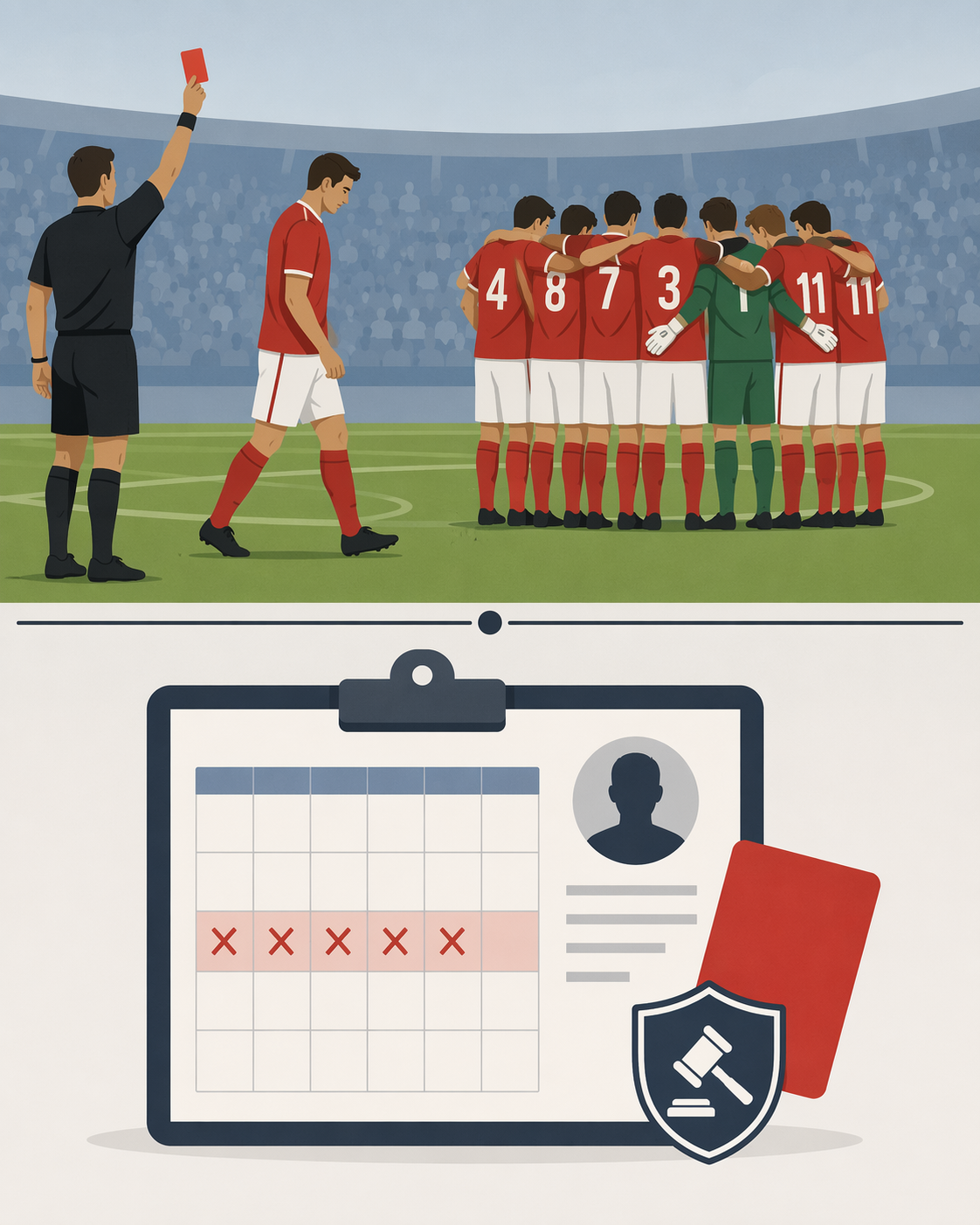
The numbers can become more than tactical if dismissals pile up. A match cannot continue if a team has fewer than seven players, a rule commonly summarized in misconduct explainers and tied to the minimum-player requirement in association football.[4] That is rare compared with a single send-off, but it explains why red cards are not just individual punishments. They can threaten the match itself.
The restart depends on the underlying offense, not on the color of the card by itself. A DOGSO handball, violent conduct during play, and offensive language after the whistle can all lead to dismissals, but the restart is decided by where and how the offense occurred under the Laws.
What Suspension Follows?
This is where many casual explanations become too confident. The Laws of the Game define sending-off offenses, but suspension length is set by the competition or governing body. A World Cup, a domestic league, a school competition, and a youth tournament can all use different disciplinary rules.
For the 2026 World Cup, USA Today’s tournament explainer reported that a straight red carries an automatic one-match ban, while FIFA’s disciplinary process can affect further punishment depending on the incident.[5] That is a World Cup context, not a universal law for every soccer match.
Domestic-league discipline can be more detailed. The PFSA’s football discipline explainer describes Premier League-style examples in which a second yellow or professional foul can lead to a one-match suspension, dissent can bring a two-match suspension, and violent conduct can bring three matches or more, with harsher treatment possible for repeat offenders.[6] Those examples are useful because they show the pattern: the ban usually tracks the type and seriousness of misconduct. They should not be copied into another competition without checking that competition’s rules.
| Layer | Question to ask | Where to check |
|---|---|---|
| Offense | What action caused the dismissal? | IFAB Law 12 and the match referee’s report |
| In-match consequence | Does the team continue short? | The Laws of the Game |
| Post-match ban | How many matches, and can the ban be extended? | The competition’s disciplinary code |
The 2026 Additions to Know After the Core Framework
The 2026 rule environment added a few items that are easy to remember for the wrong reason if they are learned as trivia first. Put them after the Law 12 framework, not before it.
One new red-card offense concerns covering the mouth during a confrontation to conceal discriminatory language. Yahoo Sports described the rule in its 2026 World Cup red-card explainer and noted that disciplinary authorities can extend bans beyond the automatic punishment.[7] The Athletic reported that Miguel Almirón of Paraguay became the first World Cup player sent off under the mouth-covering rule on June 19, 2026.[8] Because the 2026 World Cup is still ongoing as of July 20, 2026, that kind of example is useful as a confirmed precedent, not as a final tournament pattern.
Another 2026 addition makes deliberately leaving the field in protest of a referee’s decision a red-card offense. Reports have linked the change to a high-profile walk-off protest earlier in 2026, while identifying April 2026 as the approval point for the new rule.[7] The safer learning point is the one the rule itself gives: protest does not become protected conduct just because it happens by walking away instead of shouting.
VAR also changed in a way that matters to red-card study. Coaching American Soccer’s summary of rule changes for World Cup 2026 states that VAR authority expanded to review second-yellow red cards as well as straight-red decisions.[9] That does not mean every yellow-card argument becomes a video review. It means the dismissal consequence created by the second caution can now fall within the review environment in that competition context.
A Short Memory Aid for the Seven Buckets
If you are studying rather than just reading, reduce the list to a recall prompt you can rebuild without looking:
- Dangerous ball challenge: serious foul play.
- Brutality outside a fair challenge: violent conduct.
- Clear scoring chance taken away: DOGSO.
- Biting or spitting: automatic sending-off category.
- Abusive words, gestures, or actions: language can be a red.
- Two cautions: second yellow becomes dismissal.
- VAR room entry: do not enter the video operation room.
Then test yourself with classification, not outrage. A hypothetical example is enough: a defender clips an attacker near the penalty area, another player punches someone after the whistle, and a cautioned midfielder delays a restart. Name the bucket before naming the punishment. The first might require a DOGSO analysis, the second points toward violent conduct, and the third is a possible second-yellow dismissal.
Why One Red Card Changes the Game
Tactically, a red card usually forces the short-handed team to choose what it can live without. A forward may be substituted so a defender can enter. A midfield line may drop deeper. Pressing may become more selective because one missed run now leaves extra space behind it.
The opponent’s choices change too. The team with more players may circulate the ball more patiently, stretch the field wider, or force the short-handed team to defend repeated switches of play. None of that changes the law, but it explains why a red card feels larger than a foul. The card changes personnel, space, fatigue, substitution plans, and risk tolerance at once.
For a player, the practical lesson is plain: avoid the actions that remove your team’s ability to replace you. For a parent or new fan, the practical lesson is just as important: argue less from the size of the collision and more from the rule category. Was it a dangerous challenge for the ball, violent conduct away from a fair challenge, DOGSO, abusive conduct, a second caution, or one of the specific rulebook offenses?
The Clean Way to Study Red Cards
Start with the IFAB sending-off categories. Learn the difference between a straight red and a second-yellow red. Separate the match consequence from the later suspension. Then check the disciplinary code for the competition you are actually watching or playing in before assuming the ban length.
That order prevents the most common mistake: treating “red card” as one universal punishment package. The send-off is immediate. The team plays short. The suspension that follows belongs to the competition’s rules.
References
- Fouls and misconduct, IFAB, Laws of the Game 2025/26.
- Law 12 - Fouls and Misconduct, The FA, 2026-27.
- Red cards, Bundesliga.
- Fouls and misconduct (association football), Wikipedia.
- World Cup 2026 yellow and red card rules, suspensions explained, USA Today, June 10, 2026.
- Football Discipline: Yellow Cards, Red Cards and Suspensions Explained, The PFSA.
- 2026 World Cup red card and suspension rules, Yahoo Sports, 2026.
- Red and yellow cards explained at the World Cup, The Athletic / NYT, June 21, 2026.
- Soccer Rule Changes World Cup 2026, Coaching American Soccer.
Back to the exam this applies to
Target exam not specified — see all exam hubs.
Comments
Join the discussion with an anonymous comment.