
Comparison
Why Both Too Little and Too Much Sleep May Signal Alzheimer's Tau Risk
New research shows that both short and long sleep are linked to elevated tau protein, a key Alzheimer's biomarker — but through different pathways. This article explains the U-shaped relationship, what the evidence says about causation versus correlation, and what the optimal sleep range might be for brain health.
Verdict panel
- Compared
- not specified
- Target exam
- not specified
- Best for
- not specified
- Pricing last reviewed
- pricing currency unconfirmed
The unsettling part of the latest sleep-and-Alzheimer’s research is not simply that poor sleep looks bad for the brain. It is that both ends of sleep duration can point toward higher tau, one of the protein signals researchers watch closely in Alzheimer’s disease. In the 2026 Framingham Heart Study analysis of 2,410 participants, blood p-tau181 began rising around 8.5 hours of sleep, with the steepest increase beyond 10 hours; the association remained after adjustment for age, sex, APOE ε4 status, sleep apnea, depression, and kidney function.[1]
That does not mean six hours and ten hours are dangerous in the same way. The curve may be U-shaped, but the two arms of the U probably carry different meanings. Short sleep has a plausible chain of biology behind it: more wakefulness, more neuronal activity, more tau release, and less time for sleep-linked clearance. Long sleep, especially when it is new or increasing later in life, is more cautiously read as a possible behavioral marker of early neurodegeneration rather than proof that extra sleep is causing damage.
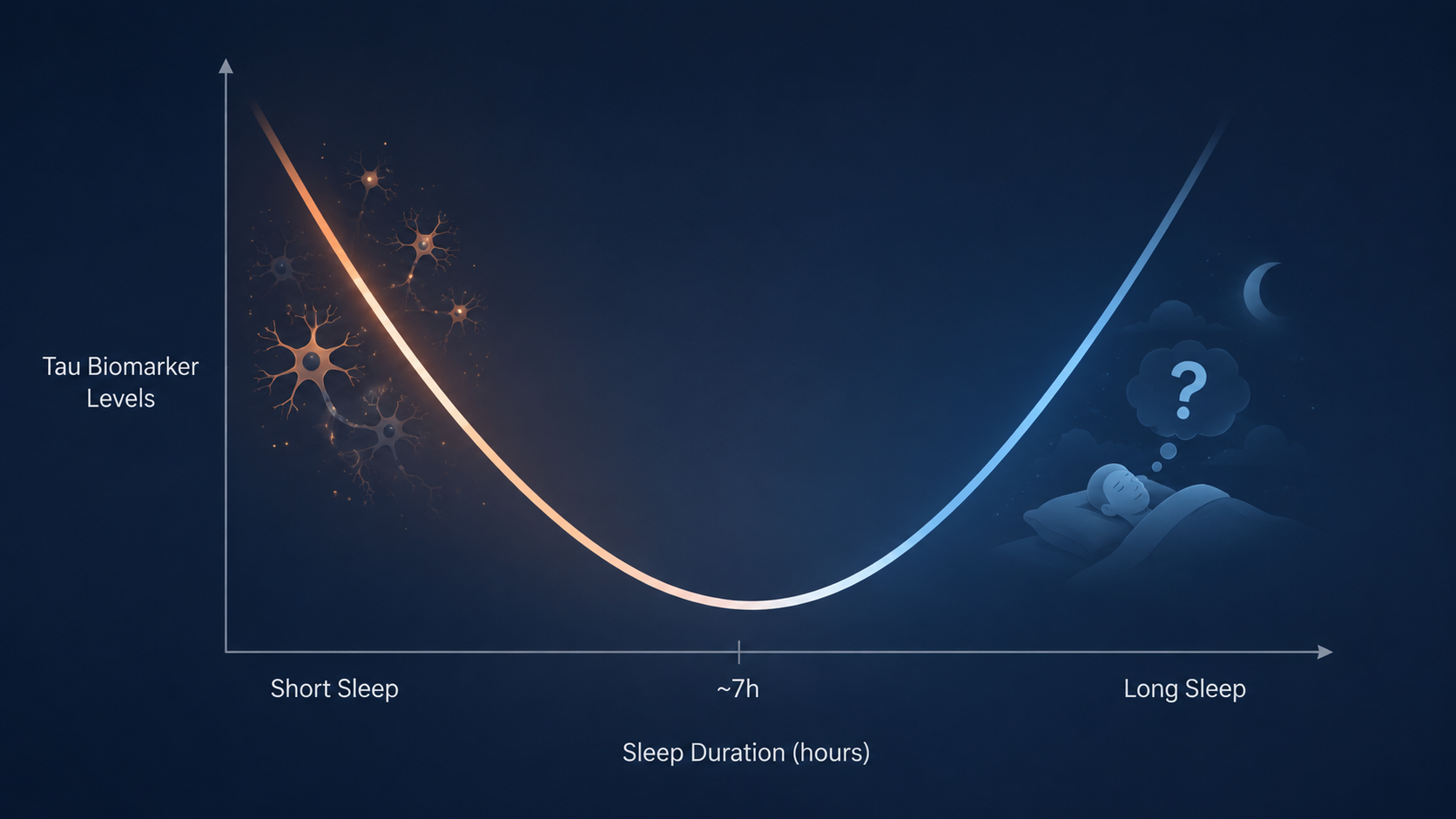
The U-shape is real enough to take seriously, but not simple enough to turn into a rule
Tau is not a sleep score. It is a protein involved in neuronal structure, and abnormal tau changes are part of Alzheimer’s pathology. Blood p-tau181, CSF tau, total tau, phosphorylated tau, and tau PET are related research signals, not interchangeable home readings. That distinction matters because the sleep literature does not measure the same tau marker in every study.
The Framingham finding is important because it is large, population-based, and focused on long sleep in relation to blood p-tau181. It also lands where many readers are most vulnerable to overinterpretation. Someone sleeping 9 or 10 hours in later life may worry that they have somehow harmed their brain by sleeping too much. Dr. Vanessa Young, the study’s lead researcher, framed the result more carefully: long sleep is best understood as a potential behavioral marker of early neurodegeneration, not as evidence that long sleep directly causes Alzheimer’s-related protein changes.[1]
That caution is not a footnote. It is the difference between paying attention and assigning blame. A rising need for sleep can travel with many changes: medical illness, medication effects, depression, sleep apnea, reduced daytime activity, circadian rhythm changes, or early brain changes. The Framingham analysis adjusted for several major factors, including sleep apnea, depression, and kidney function, but adjustment cannot turn a cross-sectional association into a cause.
Why short sleep has the stronger causal story
The short-sleep side of the curve is not built on one dramatic number. It is a chain of converging evidence, much of it experimental, though often in small samples or animal models. In mice, tau levels in brain interstitial fluid were about 90% higher during wakefulness than during sleep, and in seeded mice, tau tangles spread farther through the brain over four weeks when animals were kept awake compared with rested controls.[2]
Human deprivation studies point in the same direction, while also reminding us to be precise about the marker. In one study reported by the American Academy of Neurology, a single night of total sleep deprivation raised blood total tau by 17% in healthy young men.[3] Total tau in blood is not the same as Alzheimer’s-specific p-tau, and a brief laboratory deprivation is not the same as years of poor sleep. Still, it supports the basic idea that extended wakefulness can move tau-related signals.
Another human study found that 36 hours of sleep deprivation produced an approximately 51.5% increase in CSF tau in healthy adults.[2] CSF is closer to the central nervous system than blood, but the sample was small, so the result is better read as mechanistic evidence than as a population risk estimate.
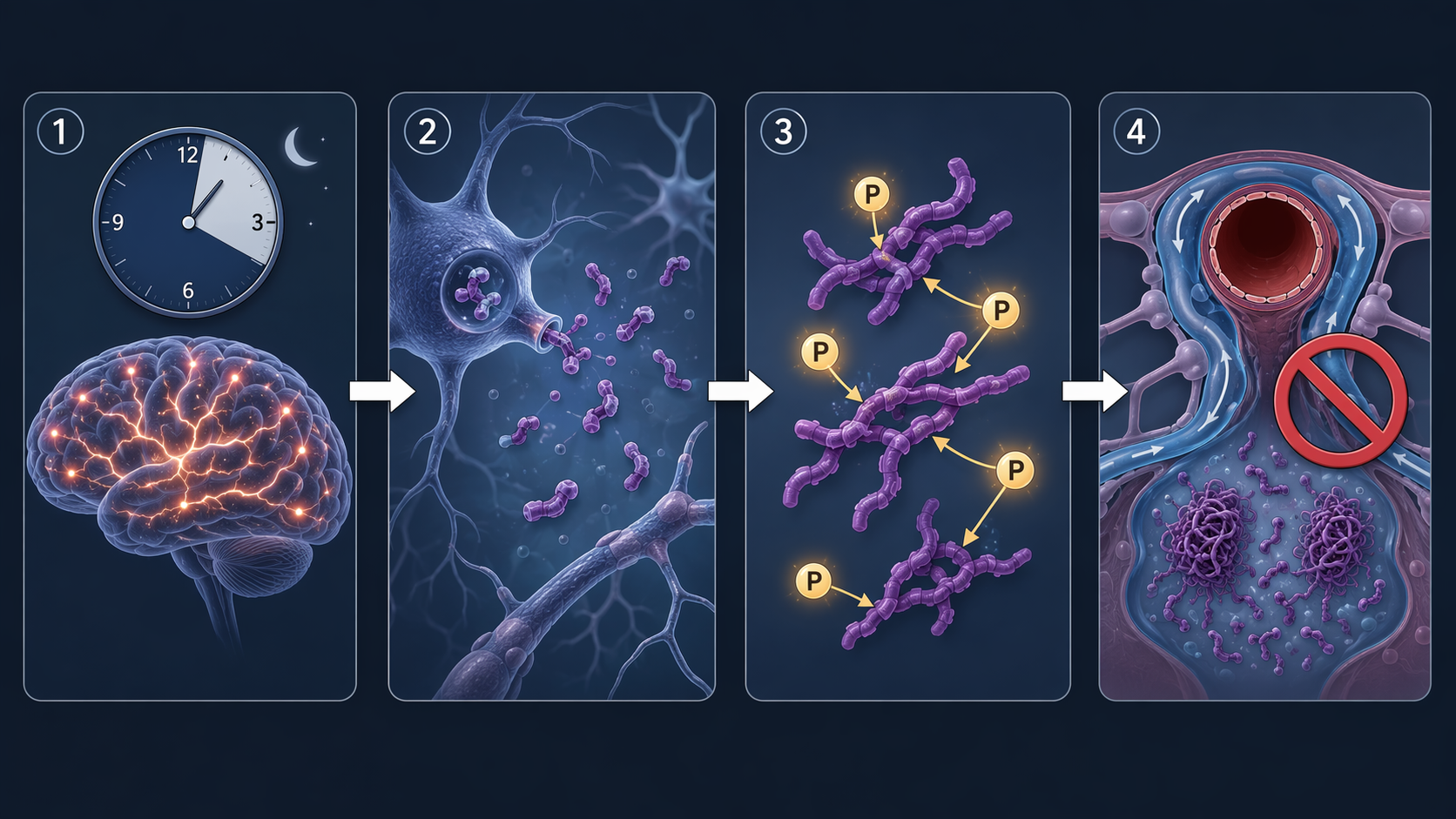
The phosphorylation findings add a more specific layer. In a small sleep-deprivation study, pT217 rose by 60% to 80%, while pS202 did not change, suggesting that sleep loss may alter tau phosphorylation in a site-specific way rather than simply raising every tau-related marker uniformly.[4] That is the sort of detail that makes the short-sleep story biologically interesting, even before it becomes clinically decisive.
There is also a plausible clearance route. During sleep, the glymphatic system increased convective flow between cerebrospinal fluid and interstitial fluid about twofold in the work cited by the WashU Medicine report, offering a mechanism by which sleep could help clear waste proteins from the brain.[2] If wakefulness raises tau release while curtailed sleep reduces clearance opportunity, the short-sleep arm of the U has a coherent biological shape.
Long sleep asks a different question
The long-sleep side is where neat health advice can do the most damage. The Framingham data show that p-tau181 began to rise at 8.5 hours and rose more sharply beyond 10 hours.[1] Those thresholds are useful for researchers because they describe where the curve changed in that dataset. They are not a diagnosis for a person who sleeps 8 hours and 40 minutes, and they are not a reason for an older adult who naturally sleeps longer to set an alarm in fear.
A behavioral marker is not the same thing as a cause. If early neurodegeneration changes sleep-wake regulation, daytime energy, inflammation, mood, or activity level, longer sleep could appear alongside higher p-tau without being the force that raised p-tau. That possibility fits Dr. Young’s caution and the cross-sectional design of the Framingham analysis.[1]
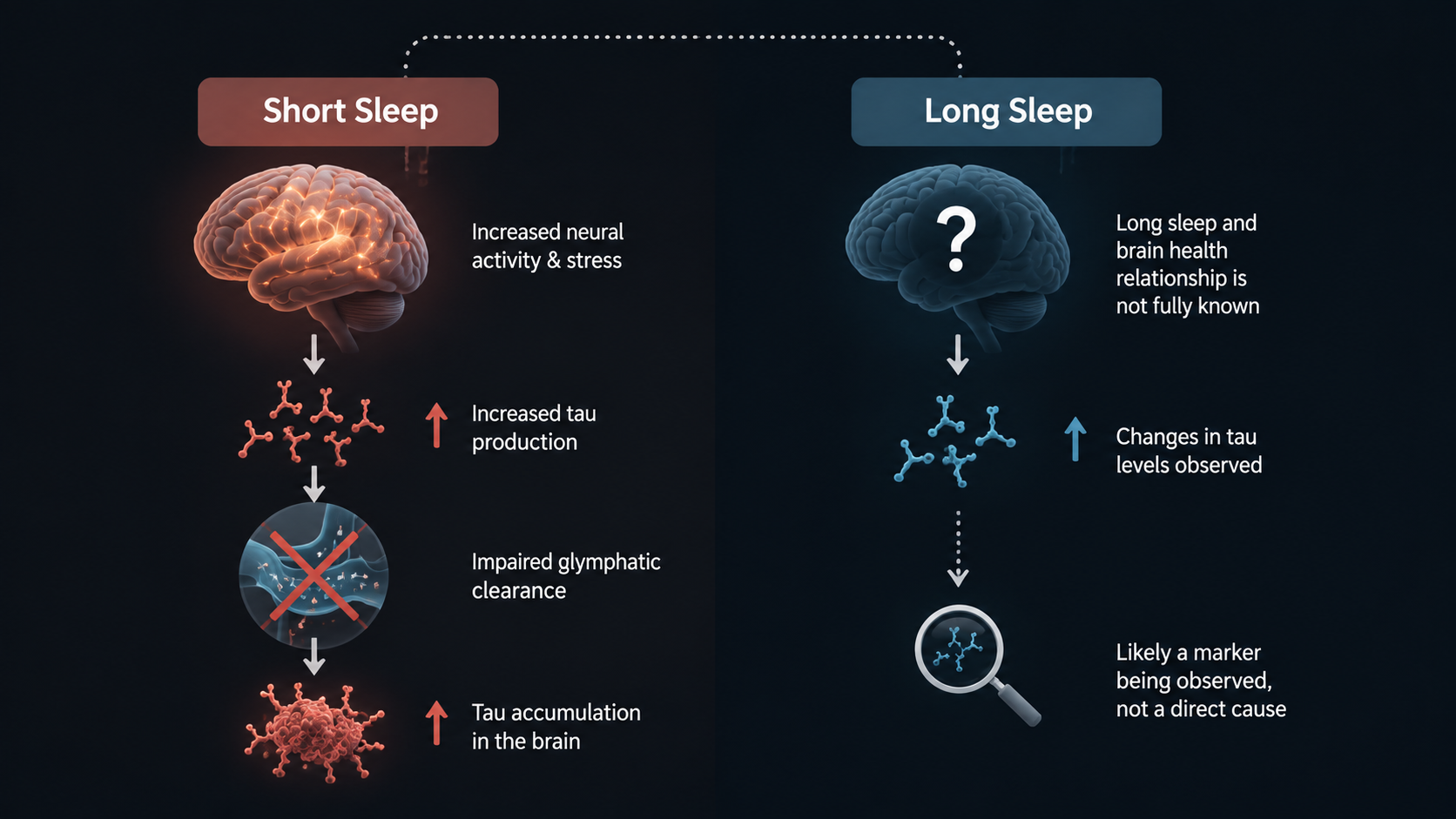
This is also why the adjustment factors matter but do not settle the matter. The researchers accounted for several obvious confounders, including sleep apnea and depression.[1] That makes the association harder to dismiss as a simple artifact. But many life and health changes can cluster with both longer sleep and biomarker change, and a one-time snapshot cannot show which came first.
The practical interpretation is therefore asymmetrical. Consistently short sleep is a modifiable exposure with plausible mechanisms connecting it to tau release and clearance. Newly long, increasing, or unusually heavy sleep in later life is more a signal to place in context: What else has changed? Is sleep refreshing? Is there snoring or breathing disruption? Has mood, medication, mobility, or memory changed? The sleep duration itself does not carry the whole answer.
What the evidence can and cannot prove
The most tempting version of this story is also the least accurate: sleep too little and tau rises; sleep too much and tau rises; therefore everyone should force themselves into one exact duration. The evidence is not built for that conclusion.
| Evidence area | What it supports | What it does not prove |
|---|---|---|
| Short sleep deprivation studies | Wakefulness and sleep loss can raise tau-related signals in experimental settings. | That a single bad night meaningfully changes an individual’s long-term Alzheimer’s risk. |
| Animal mechanism studies | Wakefulness can increase extracellular tau and may promote spread under experimental conditions. | That the same magnitude or timeline applies directly to typical human sleep patterns. |
| 2026 Framingham long-sleep analysis | Longer sleep, especially beyond 8.5 hours and more sharply beyond 10 hours, is associated with higher blood p-tau181. | That long sleep causes tau elevation or Alzheimer’s disease. |
| Tau biomarker studies | Different tau measures can reveal different pieces of the sleep-brain relationship. | That blood total tau, CSF tau, p-tau181, pT217, and tau PET should be treated as identical signals. |
The short-sleep studies also have limits that should stay visible. The blood tau study involved healthy young men and measured total tau, not phosphorylated tau.[3] The CSF and phosphorylation studies were small and involved controlled deprivation in healthy participants, not the messy, long-term sleep patterns of older adults.[2][4] These studies are valuable because they clarify mechanisms, not because they give a personal risk percentage.
The Framingham study has the opposite strength and weakness. It gives a much larger human population signal and includes relevant adjustments, but it is cross-sectional.[1] Cross-sectional research can show that sleep duration and p-tau181 travel together at one point in time. It cannot tell whether long sleep preceded the biomarker change, followed it, or reflected some third process.
A small women’s study adds nuance, not a new rule
One study in older women at elevated Alzheimer’s risk complicates the instinct to treat longer sleep as uniformly bad. In 45 women, longer sleep duration completely attenuated the association between APOE ε4 genetic risk and tau PET signal across all Braak regions; longer sleep also weakened tau’s negative association with memory performance, supporting possible resistance and resilience pathways.[5]
That finding is worth keeping, but not stretching. The cohort was small, 86.7% non-Latinx white, and highly educated.[5] It does not cancel the Framingham long-sleep association, and it does not prove that sleeping longer protects everyone. It does show why sleep duration is a poor standalone verdict. In some contexts, longer sleep may reflect vulnerability; in others, it may travel with compensatory or protective processes.
Where the “about seven hours” idea fits
If one number emerges from the U-shaped pattern, it is not as a command but as the middle of an observational curve. Around seven hours looks like a reasonable center for many adults when researchers compare shorter and longer sleep against brain-health measures. The important word is “around.” People vary, and a naturally stable pattern is different from a sudden change.
A person who usually sleeps five to six hours because of work, caregiving, insomnia, pain, or late-night screen time has a different problem from a retired person who has gradually moved from seven hours to ten and wakes unrefreshed. The first situation points toward protecting sleep opportunity and quality. The second asks for context, especially if it comes with daytime sleepiness, mood change, breathing symptoms, medication changes, or memory concerns.
The most reasonable action is modest: do not treat sleep as a biomarker you must control minute by minute. Treat it as a pattern worth noticing. If your sleep is consistently short, improving sleep opportunity is one of the more plausible brain-health steps because the mechanism is not just motivational advice; it has experimental support. If your sleep is newly long or steadily increasing, especially later in life, it is worth discussing as part of a broader health picture rather than fighting sleep itself.
For the person awake at 5 a.m. after one bad night, this research is not saying that you damaged your brain overnight. For the person sleeping ten hours and frightened by a headline, it is not saying that sleep caused Alzheimer’s pathology. The better reading is narrower and more useful: short sleep has a plausible pathway to higher tau burden, while long sleep may sometimes be an early sign that something else in the brain or body deserves attention.
References
- UT Health San Antonio study links sleeping long hours with higher levels of an Alzheimer’s-related protein — UT Health San Antonio
- Sleep deprivation accelerates Alzheimer’s brain damage — WashU Medicine
- Sleep Deprived? Study Finds Losing a Night of Sleep May Increase Alzheimer’s Biomarker — American Academy of Neurology
- Sleep deprivation affects tau phosphorylation in human cerebrospinal fluid — Annals of Neurology
- Sleep duration promotes resistance and resilience to tau in older women at risk for Alzheimer’s disease — Alzheimer’s & Dementia
Back to the exam this applies to
Target exam not specified — see all exam hubs.
Comments
Join the discussion with an anonymous comment.