
Comparison
Severe Thunderstorm Safety Tips Every Dorm Student Should Know
Most thunderstorm safety guides assume you live in a house with a basement. This guide explains what to do when you're in a dorm or apartment — where to shelter, what to avoid, and how to build a compact emergency kit that fits your closet.
Verdict panel
- Compared
- not specified
- Target exam
- not specified
- Best for
- not specified
- Pricing last reviewed
- pricing currency unconfirmed
A severe thunderstorm alert hits differently when you are on the fourth floor of a residence hall, in an off-campus apartment, or halfway across campus in a card-access academic building. The usual advice to “go to the basement” may not answer the actual question in front of you: where can you get away from windows, glass-heavy lounges, big open rooms, and elevators quickly enough to make the warning useful, and what should you avoid once you are there?
The safest default for students is simple: move to an interior, windowless room on the lowest floor you can reach safely. In a dorm or apartment building, that may be a bathroom, closet, stairwell landing, or interior hallway. It is usually not the lounge with the best view, the dining hall, the gym, the lobby, or the study room with a wall of glass. The National Weather Service advises people to move into a sturdy building or hard-topped vehicle during severe thunderstorms and, once indoors, to stay away from windows; campus guidance translates that into lower-level interior spaces for residence halls and campus buildings.[1][2]
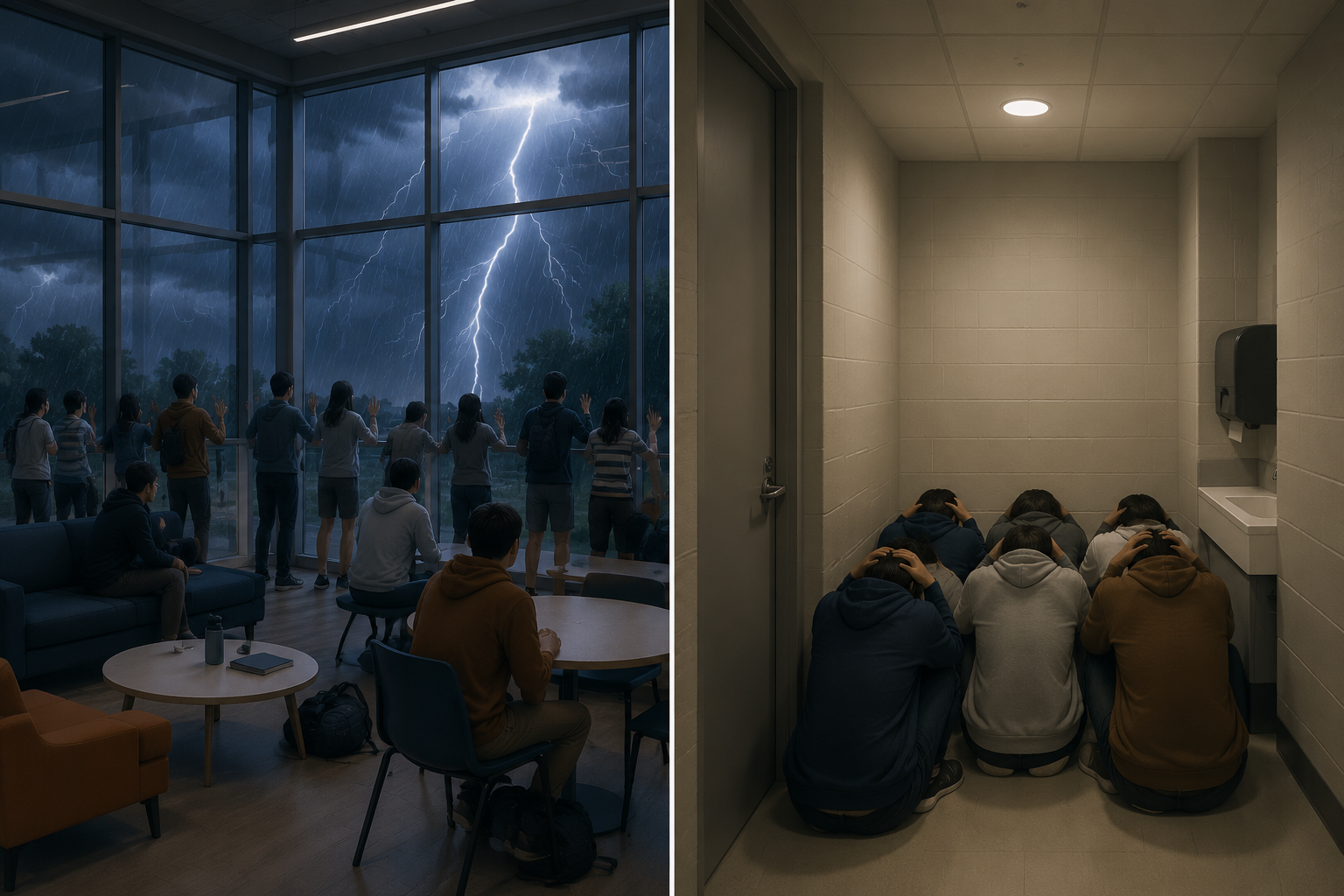
Before the next alert, pick the room you will actually use
Preparedness starts before the sky turns dark. Not with a dramatic kit, not with memorizing cloud shapes, but with removing one decision from a stressful moment: when your phone goes off, where are you going?
Start with your school’s official alert system. Florida State University, for example, tells students to sign up for FSU ALERT and follow campus instructions during thunderstorms.[2] Your school may call its system something different, but the point is the same: do not rely on a roommate’s weather app, a group chat rumor, or someone yelling in the hallway as your first warning.
Then walk your building when nothing is happening. Find the lowest floor you can reach without using an elevator. Look for a space that has no exterior windows, no large glass doors, and no big open span above you. In a residence hall, that may be an interior first-floor hallway, a windowless bathroom, a laundry-area corridor away from windows, or a stairwell landing if your campus guidance allows it. In an apartment building, it may be an interior bathroom, closet, or hallway shared by bedrooms. In an academic building, Lone Star College points students toward interior hallways, restrooms, or small interior rooms and away from windows, glass, and large open rooms.[3]
- Best first choice: lowest-floor, interior, windowless room with solid walls.
- Usually acceptable: interior hallway away from glass, doors, and exterior walls.
- Usually poor choice: lobby, lounge, dining hall, gym, atrium, or study room with large windows.
- Avoid during the warning: elevators, balconies, exterior stairways, courtyards, and covered outdoor walkways.
Speed matters, but it should not turn into improvisation. The National Weather Service’s school preparedness guidance recommends that students be able to reach shelter areas within about three minutes, a planning benchmark rather than a guarantee for every campus layout.[4] If your chosen shelter is across a courtyard, through a locked door, or dependent on an elevator, choose another one.
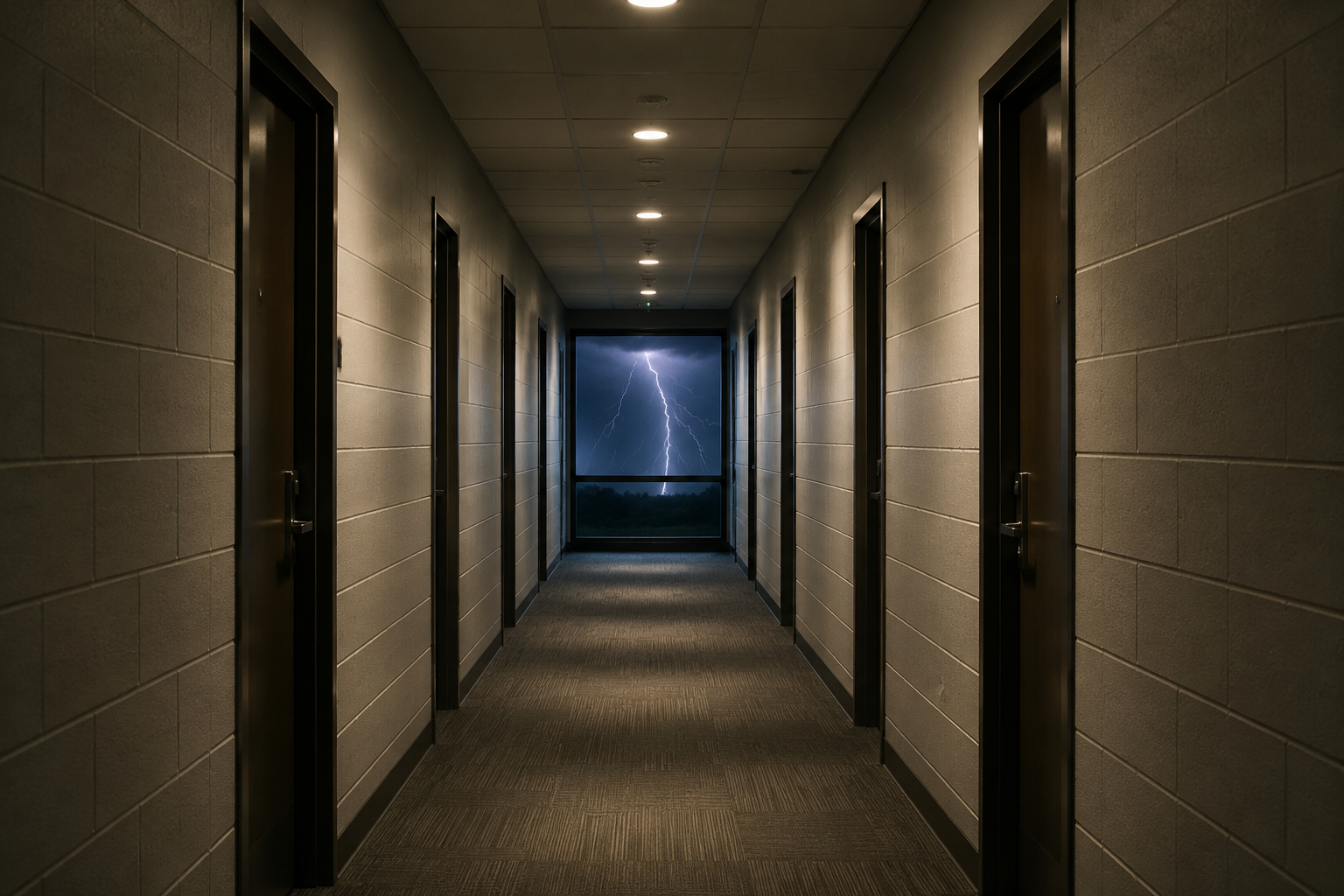
How to choose shelter in a dorm, apartment, or campus building
A good thunderstorm shelter is not chosen by comfort. It is chosen by what it keeps between you and the outside. Severe thunderstorms can bring damaging wind, hail, lightning, falling branches, and flash flooding. Indoors, the main student mistake is drifting toward the largest shared space because that is where everyone else is gathering. Crowding by glass is not safer because it feels communal.
| Where you are | Better shelter choice | What to avoid |
|---|---|---|
| Residence hall room | Interior bathroom, closet, stairwell landing, or lowest-floor interior hallway approved by campus guidance | Window-facing bed area, lounge, lobby, glass doors, elevator |
| Off-campus apartment | Interior bathroom, closet, or hallway on the lowest level available | Balcony, room with large windows, top-floor exterior wall, plugged-in electronics |
| Academic building | Interior hallway, restroom, or small interior room away from glass | Atrium, gym, lecture hall with glass, exterior walkway |
| Dining hall or student center | Interior corridor or restroom away from windows if staff direct you there | Large seating area, window wall, entrance lobby |
Lowest floor does not always mean basement. Many residence halls do not have student-accessible basements, and some lower spaces may be mechanical rooms or locked service areas. Use the lowest safe, reachable, public or permitted interior space. If your building has posted severe weather shelter signs, follow them. If it does not, ask your RA, residence life office, building manager, or campus safety office before storm season. That question is not overreacting; it is basic building literacy.
Large-span rooms deserve special suspicion. Dining halls, gyms, auditoriums, and big lounges may be convenient meeting points, but they often include high ceilings, broad roof spans, exterior walls, or large windows. Campus severe weather instructions commonly direct people away from windows and into interior protected areas, not toward the room with the most chairs.[2][3]
What to do when the warning is active
When a severe thunderstorm warning or campus alert arrives, do not wait in the lobby to see whether other people move first. Put on shoes, grab your phone and keys, take your compact kit if it is within reach, and go to the shelter location you already chose. If you are responsible for others as an RA, club officer, lab assistant, or the only roommate who read the emergency page, give short directions: “Interior hallway, away from the windows, now.”
- Move inside a sturdy building if you are outdoors.
- Go to the lowest interior windowless space you can reach safely.
- Stay away from windows, glass doors, balconies, and exterior walls.
- Do not use elevators during the storm.
- Avoid plumbing, corded electronics, and plugged-in devices until the lightning risk has passed.
The elevator point is easy to miss in tall residence halls. FSU’s thunderstorm guidance tells people not to use elevators during thunderstorms.[2] A power outage or building alarm can make an elevator a very bad place to wait out a storm. Use stairs if you can do so safely, and choose a shelter you can reach without depending on a lift.
Lightning also changes normal dorm behavior. The CDC advises avoiding plumbing during a thunderstorm, including sinks, showers, and baths, and staying off corded phones and electrical equipment because lightning can travel through plumbing and electrical systems.[5] That means do not take a shower while the storm is overhead, do not stand at the sink brushing your teeth during the worst of it, and do not keep using a laptop that is plugged into the wall because you want to finish a paragraph.
Unplugging devices before the storm is fine if you have time and can do it safely. During active lightning, do not make a project out of crawling behind a desk, touching multiple cords, or reaching near a window to save a power strip. A charged power bank in your kit is a cleaner solution than turning the outlet area into a last-minute task.
Use the 30-30 rule without turning it into a debate
The National Weather Service uses the 30-30 rule for lightning: if the time between seeing lightning and hearing thunder is 30 seconds or less, go inside; after the storm, wait 30 minutes after the last thunder before resuming outdoor activities.[1] UCAR explains the same rule as a simple way to judge when lightning is close enough to be dangerous.[6]
For students, the practical version is this: if you hear thunder, stop treating the quad, parking lot, bus stop, stadium steps, or covered walkway as a waiting room. Get inside a substantial building. Once inside, stay there long enough. The quiet five-minute gap that makes everyone restless is not the same as the all-clear.
Build a dorm-closet emergency kit, not a bunker
A student thunderstorm kit has one job: keep you functional if the power goes out, the building gets noisy, your phone battery drops, or you need to wait in a hallway longer than expected. It should fit in a small bag or bin you can grab from a closet. The American Red Cross and Ready.gov both recommend emergency supplies such as water, food, flashlight, batteries, first aid supplies, medications, and a way to receive alerts.[7][8]
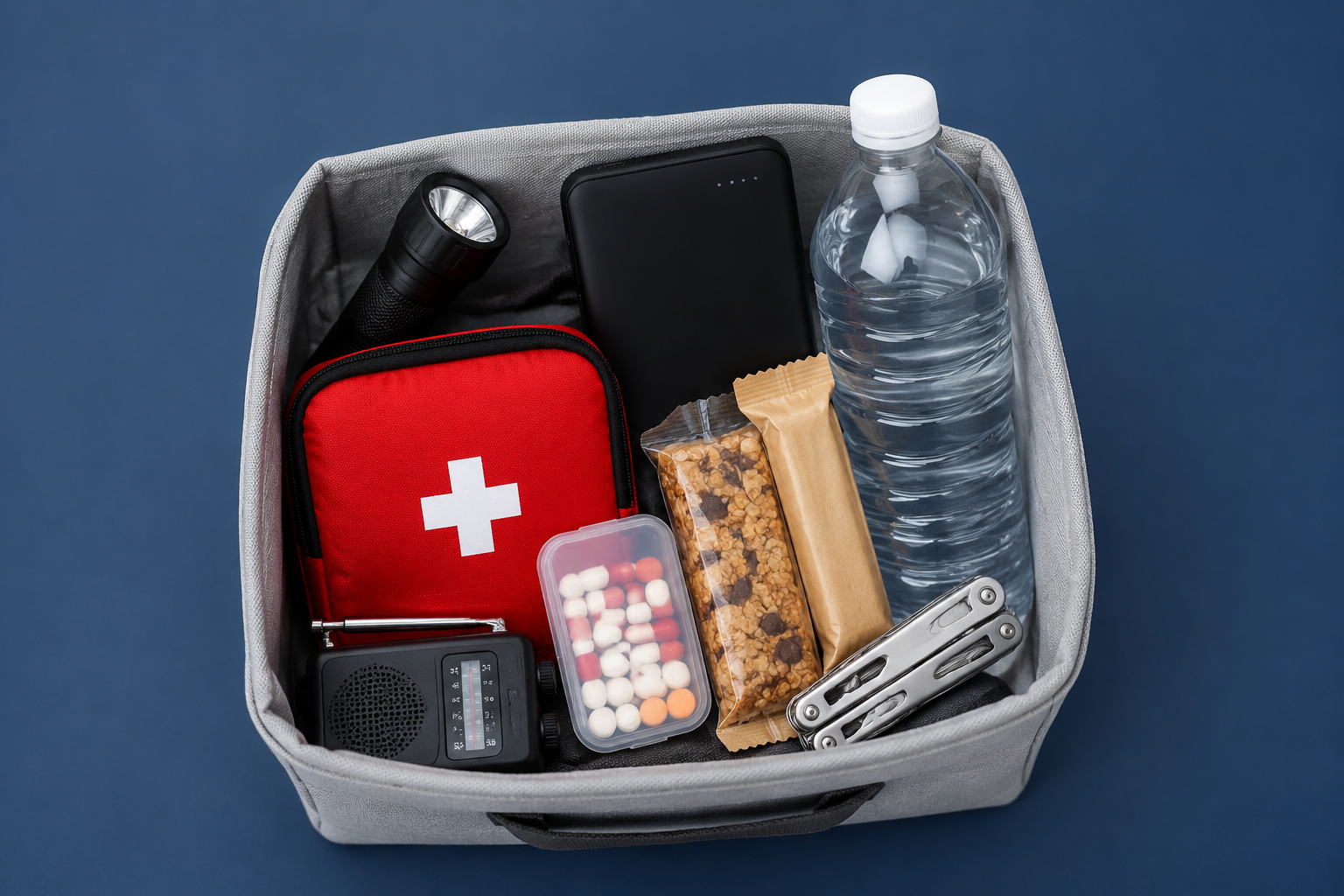
| Item | Why it belongs in a student kit |
|---|---|
| Small flashlight or headlamp | Lets you move through a dark hallway or room without draining your phone |
| Portable phone power bank and charging cable | Keeps alerts, texts, campus updates, and rideshare access available during an outage |
| Bottled water | Covers short disruptions when fountains, vending areas, or kitchens are inconvenient or unavailable |
| Shelf-stable snacks | Helps if dining halls close early, delivery stops, or you are stuck waiting |
| Basic first aid kit | Handles small cuts, scrapes, and headaches without searching the building |
| Personal medications | Prevents a short building disruption from becoming a health problem |
| Small battery radio or alert-capable device | Gives another information source if Wi-Fi or cell service becomes unreliable |
| Copies or photos of key contacts and insurance information | Useful if your phone is dead, lost, or locked |
Keeping this under $75 is realistic if you avoid specialty gear and buy ordinary items: a basic LED flashlight, a modest power bank, a few bottles of water, snacks, a small first aid kit, and a pouch for medications and documents. The exact price will vary by store and what you already own, so treat the number as a budget ceiling, not a required shopping list.
The kit should live where you can reach it without crossing the room in the dark or digging under laundry. A closet shelf, under-bed bin near the aisle, or backpack hook is better than a mystery box in storage. If you share a room, tell your roommate where it is. If you are in an apartment, agree on one shared flashlight and one shared power bank that do not migrate into someone’s everyday bag.
If you are caught away from your room
Students are not always in their assigned building when weather moves in. You may be in a library, lab, dining hall, parking garage, bus stop, or evening class. The same shelter logic still works: get inside a substantial building, move away from glass, choose an interior lower-level space, and follow staff or campus safety instructions.
Do not run across campus to reach your preferred dorm shelter if the storm is already on top of you. The closer safe interior space is usually the better choice. An academic building restroom away from windows beats a five-minute sprint through lightning and wind. A dining hall interior corridor beats standing by the entrance doors watching rain blow sideways.
Cars are sometimes mentioned in thunderstorm guidance because hard-topped vehicles can provide lightning protection, but they are not a good target destination if you are already inside a safe building.[1] Do not leave a residence hall or library to sit in a parking lot because it feels private. Privacy is not the safety criterion.
After the storm, wait before you wander
The end of the loudest rain is not automatically the end of the hazard. Keep following campus alerts, wait until lightning has moved away, and avoid going outside just to film damage, check your car, or see whether the dining hall line is shorter. The National Weather Service advises people to stay away from storm-damaged areas and avoid flooded roadways after severe thunderstorms.[1]
Downed power lines are a hard stop. Ready.gov warns people to stay away from fallen power lines and report them immediately.[8] On a campus or apartment property, that means do not step over a line, drive over it, move branches touching it, or assume a quiet line is safe. Call campus police, local emergency services, or the utility number your property provides.
Watch for flash flooding, especially around underpasses, parking lots, low campus roads, creeks, and basement-level entrances. Severe thunderstorms can create water problems even after the lightning has passed. If flooding becomes the main issue, use a separate plan; Study Tools has a dedicated guide to flash flood preparation tips for college students.
A student protocol that actually fits campus life
Severe thunderstorm safety tips for students have to fit the places students actually occupy. A dorm room is not a ranch house. A seventh-floor apartment is not a basement. A student center full of glass is not safer because it has more people in it.
The useful protocol is short enough to remember: enable campus alerts, choose a reachable interior windowless shelter on the lowest safe floor, avoid large shared spaces and glass, stay off elevators during the storm, respect lightning risks around plumbing and electronics, keep a compact kit where you can grab it, and do not rush outside afterward. That is not disaster obsession. It is a way to keep one weather alert from turning into a hallway full of people waiting for someone else to decide.
References
- Thunderstorm Safety, National Weather Service
- Thunderstorms, Florida State University Emergency Management
- Tornadoes/Severe Thunderstorms, Lone Star College
- Schools Preparedness, National Weather Service
- Lightning Safety, Centers for Disease Control and Prevention
- Safe During a Thunderstorm, UCAR Center for Science Education
- Thunderstorm Safety, American Red Cross
- Thunderstorms & Lightning, Ready.gov
Back to the exam this applies to
Target exam not specified — see all exam hubs.
Comments
Join the discussion with an anonymous comment.