Comparison
How Much Coffee Is Safe for Students? It Depends on Your Age
Most students don't know that safe caffeine limits change with age. This article explains the evidence-based guidelines for high school and college students, and why timing and hidden sources matter just as much as the total number.
Verdict panel
- Compared
- not specified
- Target exam
- not specified
- Best for
- not specified
- Pricing last reviewed
- pricing currency unconfirmed
One more coffee before studying can be perfectly ordinary, or it can be the thing that keeps a student awake long after the laptop closes. The first question is not whether coffee is “good” or “bad.” It is whether the student is under 18.
For students under 18, the practical limit to work from is 100 mg of caffeine per day, roughly the amount in one small cup of brewed coffee. Riley Children’s Health describes this as the American Academy of Pediatrics’ recommended maximum for adolescents, while also noting that the FDA does not set a formal caffeine limit for children or teens.[1] For healthy adults, the commonly cited upper limit is much higher: up to 400 mg per day, according to the FDA, and Mayo Clinic gives the same figure for most healthy adults.[2][3]

That age split is the cleanest answer to the safe coffee limit for students: a high school student and a college student should not be using the same caffeine rulebook. Still, neither number is a personal guarantee. A 17-year-old who feels shaky after half a coffee should not force the rest of the cup because a guideline allows it. A 20-year-old who technically stays under 400 mg can still wreck tonight’s sleep with a late-afternoon energy drink.
The Student Caffeine Limit Starts With Age
| Student group | Daily caffeine guideline | What that often means in real life | Important caveat |
|---|---|---|---|
| Under 18 | No more than 100 mg/day | About one small brewed coffee, or less if other caffeine is in the day | Expert pediatric guidance, not an FDA regulation |
| 18+ healthy adults | Up to 400 mg/day | Often about 2-3 twelve-ounce coffees, depending on strength | Not a guarantee for every student, especially with anxiety, sleep problems, medications, or high sensitivity |
The under-18 number deserves special attention because many students hear the adult limit first. A teenager who reads that 400 mg is acceptable for “healthy adults” may assume the same number applies before first period. It does not. For high school students, 100 mg is already a full-day target, not a warm-up.
For college students, 400 mg is better understood as a ceiling for healthy adults than as a study strategy. It leaves room for ordinary coffee use, but it does not make caffeine harmless. The body still has to clear it, and the next morning still has to be lived in.
What 100 mg and 400 mg Look Like in Student Drinks
Counting caffeine is harder than counting cups. A “coffee” can mean a small home-brewed mug, a large campus cafe drink, espresso shots added to something sweet, or a bottled drink that looks more like dessert than a stimulant. The FDA’s examples show why the serving size matters.[2]
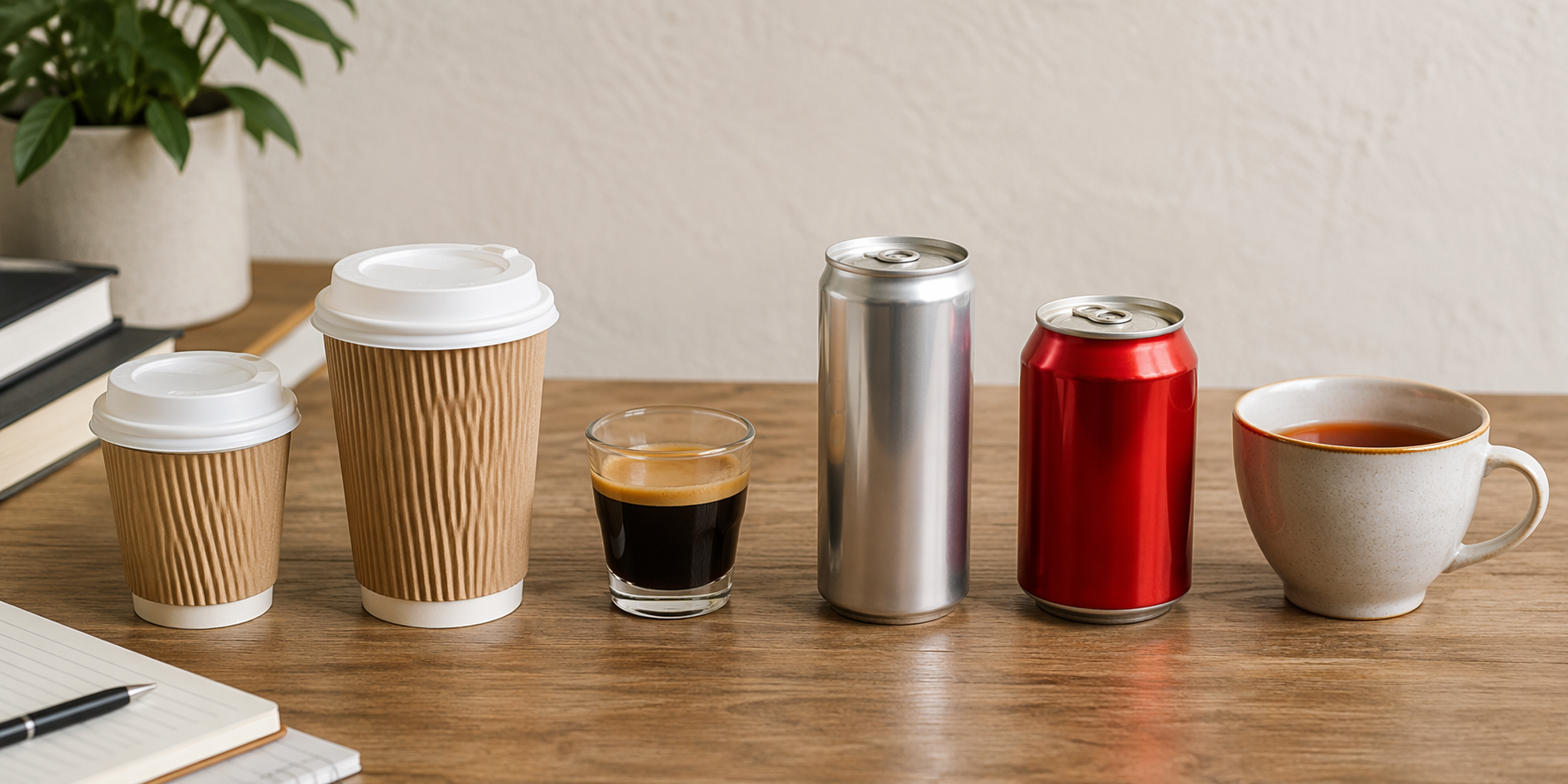
| Drink or source | Typical caffeine amount from research brief | What to notice |
|---|---|---|
| Brewed coffee | About 113-247 mg per 12 oz | One 12-oz coffee can already put a teen over the 100 mg/day guideline |
| Espresso | About 63 mg per shot | Two shots can exceed a teen’s daily guideline before any soda, tea, or chocolate-flavored coffee drink is counted |
| Energy drink | About 100-300 mg per can | One can may be a full teen day or a large part of an adult day |
| Soda | About 34-55 mg per 12 oz | Easy to miss when it is not treated as a study drink |
| Tea | About 26-47 mg per 8 oz | Usually lower than coffee, but still counts |
| Decaf coffee | About 2-15 mg | Not caffeine-free, though usually a much smaller source |
For a high school student, this math gets tight quickly. One 12-oz brewed coffee may contain more caffeine than the 100 mg/day guideline. One energy drink may do the same. Add a soda at lunch or tea after school, and the student may cross the line without ever feeling like they had “a lot.”
For a college student, the adult limit gives more room, but not as much as campus folklore suggests. A strong 12-oz coffee, an espresso drink, and an energy drink can push the day upward fast. This is why “I only had one can” is not a useful safety check unless the label has been read.
A 2025 Grand Canyon University survey of more than 1,500 students across all 50 states found that 95% reported consuming caffeine, 75% reported negative effects, 38% considered themselves addicted, and respondents averaged 5.3 all-nighters powered by caffeine.[4] That survey is useful student context, not clinical proof. It does, however, match what many learning-support offices see during exam weeks: caffeine is not an occasional detail in student life; it is part of the study culture.
The Time of Day Can Matter as Much as the Total
A student can stay under the daily limit and still make a poor caffeine choice. The usual problem is timing. A Monmouth University Outlook interview advised students to stop caffeine around 2-3 p.m., a simple cutoff that is easier to use than trying to calculate metabolism during a busy day.[5]

The sleep evidence gives that cutoff real weight. In a study testing caffeine taken 0, 3, or 6 hours before bedtime, caffeine consumed even 6 hours before bed reduced total sleep time by 41-45 minutes.[6] That is not a tiny trade for a student who has class, practice, work, or an exam the next morning.
This is the part students often underestimate. Caffeine can help with alertness for a while, but it does not disappear when the study session ends. If it delays sleep or makes sleep lighter, tomorrow’s focus pays the bill. A late coffee may feel like extra study time and still steal attention from the next day.
When the afternoon slump hits, the better first move is often a reset that does not add more caffeine: food, water, a walk, a shower, or a short structured break. A light puzzle-style pause, such as using NYT Strands as a productive study break, can work better than dragging a tired brain through another caffeinated hour.
Hidden Caffeine Is Where Students Lose Track
Coffee is visible. Hidden caffeine is the harder problem. Energy drinks, caffeine pills, pre-workout supplements, some flavored waters, soda, tea, and decaf coffee can all contribute to the day’s total. The FDA’s drink ranges make energy drinks especially easy to misjudge because one can may contain 100-300 mg of caffeine.[2]
Labels matter most when a product is marketed as performance, focus, or energy. A student may think of pre-workout as a gym product and an energy drink as a late-night study product, but the body counts them together. For a teen, that combination can pass the 100 mg guideline before coffee even enters the day. For an adult student, it can turn a normal morning coffee into a high-caffeine day.
The safest counting habit is plain: add every source, not just coffee. If the label lists caffeine, count it. If the drink is sold for energy and the caffeine amount is unclear, treat it cautiously rather than assuming it is small.
Warning Signs Beat Perfect Math
The numbers are useful because students need a starting point. They are not a reason to ignore the body’s warning signs. Mayo Clinic lists effects such as headache, insomnia, nervousness, irritability, frequent urination, fast heartbeat, and muscle tremors among signs that caffeine may be too much for a person.[3]
- Lower the day’s caffeine if sleep is getting shorter, lighter, or later.
- Lower it if caffeine brings jitters, a racing heart, stomach trouble, or a panicky feeling.
- Lower it if the day feels impossible to start without caffeine.
- Lower it before raising it when stress, exams, illness, or medication changes are already affecting the body.
Anxiety deserves careful wording. A study by Bertasi and colleagues of 114 college students, 82.5% of whom were female, found an association between caffeine intake and higher anxiety scores in data from a single university.[7] That does not prove caffeine causes anxiety disorders. It does support a practical caution: if caffeine reliably makes a student feel wired, tense, or unable to settle, the student should not wait for a formal threshold to call it too much.
Some students also process caffeine differently. Variants in CYP1A2 can affect caffeine metabolism, and ADORA2A is discussed in relation to caffeine sensitivity and anxiety response. The everyday result is familiar: two students can drink the same coffee, and one goes back to reading while the other feels trapped inside their own heartbeat. The second student does not need to “build tolerance” to prove anything.
A Practical Rule for Study Days
For under-18 students, start with a 100 mg daily cap and remember that one ordinary brewed coffee may already be the whole day. For healthy students 18 and older, treat 400 mg as the upper daily ceiling, not a target. In both cases, count energy drinks, espresso, soda, tea, decaf, caffeine pills, pre-workout, and any “focus” product that includes caffeine.
Then add the timing rule: stop around 2-3 p.m. if sleep matters tonight. If caffeine is being used to compensate for a study plan that only starts when panic arrives, the better fix is not another drink; it is closing the planning-versus-execution gap before the next deadline.
A good student caffeine decision is not dramatic: know the age-based limit, count all sources, stop early enough to protect sleep, and choose a lower number when the body is already giving warnings.
References
- How much caffeine is safe for your teen?, Riley Children’s Health
- Spilling the Beans: How Much Caffeine is Too Much?, FDA
- Caffeine: How much is too much?, Mayo Clinic
- How Caffeinated Are College Students in 2025?, Grand Canyon University, 2025
- How much coffee can college students safely consume?, Monmouth University Outlook, 2025
- Caffeine Effects on Sleep Taken 0, 3, or 6 Hours before Going to Bed, PMC
- Caffeine Intake and Mental Health in College Students, PMC
Back to the exam this applies to
Target exam not specified — see all exam hubs.
Comments
Join the discussion with an anonymous comment.