
Comparison
How Relationships Beat Instant Gratification for Happiness
The famous marshmallow test has been largely debunked—willpower alone doesn't predict life outcomes. Drawing on 80 years of Harvard research, this article explains why the quality of your close relationships matters far more for long-term happiness and health.
Verdict panel
- Compared
- not specified
- Target exam
- not specified
- Best for
- not specified
- Pricing last reviewed
- pricing currency unconfirmed

The marshmallow story has always been a little too neat. A child sits at a table. One treat now, two treats later. The child who waits is treated as a tiny adult in training: disciplined, future-oriented, already rehearsing success. The child who eats is quietly assigned a different future, one supposedly shaped by impulse, weakness, and the inability to think ahead.
That is why the question of instant gratification vs long term happiness psychology matters so much to students. It is rarely presented as a narrow question about one experimental task. It becomes a moral weather report. If you scroll instead of studying, snack instead of planning, or avoid the assignment until the pressure gets embarrassing, the lesson seems to arrive already written: your future self is losing because your present self is soft.
The evidence does not support that verdict. Delaying gratification can be useful. Closing the tab, finishing the practice set, and going to sleep on time are not fake virtues. But the marshmallow test was asked to carry far more meaning than its data could bear. Once researchers looked more carefully at family background, early ability, and the reliability of a child’s environment, the old willpower prophecy became much less impressive.
What the Marshmallow Test Actually Proved—and What It Did Not
The popular version of the marshmallow test says that a preschooler’s ability to wait predicts later success. The cleaner research question is smaller: does performance on a delay-of-gratification task independently predict later academic, behavioral, and adult outcomes once other advantages are taken into account?
In 2018, Tyler Watts, Greg Duncan, and Haonan Quan published a conceptual replication using a much larger and more diverse sample than the famous original work: 918 children. The initial relationship between waiting and later outcomes looked familiar. Children who waited longer tended to do better later. But after the researchers controlled for family background, socioeconomic status, and early cognitive ability, the association between delay of gratification and later academic or behavioral outcomes was substantially reduced and no longer carried the sweeping meaning usually attached to the test.[1]
That matters because a child’s waiting time was never floating free from the rest of the child’s life. A preschooler with stable routines, well-resourced parents, less household stress, and stronger early language or cognitive skills is not simply displaying purer willpower. The child is also arriving at the table with a history. Treating the waiting time as a private character measurement stripped away the very conditions that helped produce it.
The original Stanford sample deserves to be remembered here, not as a footnote but as a warning label. Those early participants came from the Bing Nursery School at Stanford, a campus preschool serving children from relatively educated and affluent families. That does not make the study worthless. It does make it a poor foundation for a national morality tale about children, poverty, achievement, and self-control.
A 2020 follow-up, co-authored by Walter Mischel, tracked 113 original marshmallow test participants into midlife, when they were about 52 years old. It found no evidence that preschool delay of gratification predicted the adult outcomes people often associate with the test: educational attainment, income, net worth, credit score, or forward-looking behavior.[2]
That finding should cool down the whole mythology. It does not mean self-control has no place in life. It means the preschool marshmallow task did not function as a crystal ball for adult flourishing. The old story took a small behavioral measure, mixed it with class advantage, and then sold the result as destiny.
Waiting Is Also a Judgment About the World
There is another reason the marshmallow scene was overread. Waiting is not only a test of inner strength. It is also a bet on whether promises are kept.
In the University of Rochester experiment by Celeste Kidd, Holly Palmeri, and Richard Aslin, children first experienced either a reliable or unreliable environment. In the reliable condition, an adult followed through on a promise. In the unreliable condition, the adult did not. When the marshmallow-style waiting task came later, children in the reliable environment waited about four times longer than children in the unreliable environment.[3]
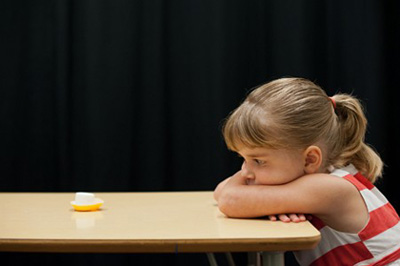
That is not a cute add-on to the marshmallow literature. It changes the emotional meaning of the child’s choice. If adults have just shown you that waiting may not be rewarded, eating the treat is not necessarily irrational. It may be an accurate reading of your environment.
Students recognize this pattern even when no candy is involved. A student who has seen effort rewarded consistently may find it easier to study early, ask for help, and trust the slow payoff of practice. A student whose schedule is unstable, whose work hours change, whose family needs are urgent, or whose school support is unreliable is being asked to delay gratification under different psychological conditions. The same unfinished assignment can come from laziness, exhaustion, confusion, fear, overwork, or the simple fact that no one has built a dependable structure around the student.
This is where a lot of study advice becomes careless. It sees the behavior and rushes to character. The evidence asks for more patience. Before turning procrastination into a confession of personal failure, it is worth asking what the student believes will happen if they wait, work, ask, trust, or try again.
The Better Long-Term Evidence Points Toward Relationships
If the marshmallow test does not answer the question of long-term happiness, another body of evidence gets closer. The Harvard Study of Adult Development began in 1938 and has followed lives for more than 80 years. It started with 268 Harvard men and later expanded to include additional groups, including inner-city participants, wives, and more than 1,300 offspring.[4][5]
The study has its own limits. Its original sample was white, male, and unusually privileged. No honest reading should pretend that a study beginning with Harvard undergraduates can automatically speak for everyone. The later expansions help, but they do not erase the shape of the beginning.
Still, the study has something the marshmallow myth lacked: the slow accumulation of a life-course view. Instead of asking a preschool task to predict everything, it watched people move through work, marriage, illness, disappointment, success, aging, and loss. The clearest lesson was not that the most restrained people won. It was that close relationships were deeply tied to long-term well-being.
One of the study’s most striking findings is that relationship satisfaction at age 50 predicted physical health at age 80 better than cholesterol levels did.[4] That sentence should make any achievement-obsessed student pause. It does not say friendships magically prevent disease or that love substitutes for medical care. It says the quality of close relationships was a stronger predictor of later physical health than a biomarker people are accustomed to treating as serious.
Robert Waldinger, a director of the study, put the lesson bluntly: “Loneliness kills. It’s as powerful as smoking or alcoholism.”[4] The force of that line is not in making loneliness sound dramatic. It is in refusing to treat social connection as decoration, something nice to have after the real work of success is finished.
For students, that distinction matters. If long-term happiness is imagined mainly as the reward for years of private restraint, relationships become optional or postponable. You study now, optimize now, achieve now, and reconnect later. The Harvard findings make that bargain look much less wise. Relationships are not just a pleasant outcome of a good life. They are part of the maintenance system that helps a life stay good.
The “Cult of Delayed Gratification” Gets the Problem Half Right
Contemporary criticism of delayed gratification has become sharper. In a 2026 essay in The Atlantic, Ian Bogost describes a “cult of delayed gratification” and argues that gratification itself is too often treated as a vice rather than as a form of sensory contact with the world.[6]
That essay is commentary, not primary evidence. It should not be used as a substitute for the replication studies or the Harvard data. But it names a cultural habit that students know well: the suspicion that any immediate pleasure is morally suspect unless it has been earned through visible sacrifice.
The correction is not to baptize every impulse as wisdom. Some immediate rewards are designed to capture attention and keep it. A student who intends to review one lecture and loses an hour to algorithmic video has not discovered a philosophy of pleasure. They have run into an environment built to make stopping difficult.
But the opposite mistake is just as damaging: treating rest, food, conversation, laughter, and ordinary enjoyment as threats to ambition. A healthy student does not need a life where every pleasure is delayed until the final exam, the internship offer, the graduate admission, or the job. That is not discipline. It is a fragile arrangement that asks achievement to repay debts it cannot cover.
What This Means for Studying Without Shame
A student still has to study. Evidence against the marshmallow myth does not complete the problem set, write the lab report, or prepare the presentation. The practical lesson is more modest and more useful: stop treating self-control as a personality exam, and start designing conditions that make the next good action easier.
That begins with friction. If your study plan depends on heroic resistance every night, it will probably fail on the nights when you are tired, lonely, or already ashamed. Put the phone in another room before the session starts. Use the same study location when possible. Open the document before you take a break so returning has a lower cost. Choose a small first task that makes beginning less theatrical: five practice questions, one paragraph outline, one reviewed slide deck.
Tools can help when they reduce switching costs rather than create novelty. A stable, simple study setup usually beats a rotating cast of apps that feel productive because they are new. If your current system is scattered, a cohesive learning toolkit can reduce the number of decisions required before work begins. For students comparing options, a smarter 3–4 app study stack or a cohesive online learning toolkit is more useful than chasing another motivational reset.
The relational part is just as practical. Accountability is not a confession booth. It is a way of making effort visible to someone who will notice whether you showed up. A study partner, office-hours routine, group chat with actual norms, or weekly check-in can change the emotional texture of work. You are no longer alone at the table, trying to prove that you deserve a future.
For some students, the best intervention is not a stricter timer but a more reliable social structure. That may mean joining a recurring study group, pairing with someone for quiet co-working, or choosing a tool designed around accountability rather than solo optimization. A comparison of study buddy apps and accountability styles can be useful if the real problem is not knowing what to do, but not having anyone dependable in the loop.
This does not excuse every avoided task. It changes the response. Instead of asking, “What is wrong with me that I chose the immediate reward?” ask more specific questions: Was the task clear? Was the next step small enough? Did I sleep? Did I have help? Did I believe the effort would matter? Is there someone I can study near, report to, or ask before I disappear into avoidance?
That last question may be the most neglected. Students are often told to protect their future by saying no to pleasure. They are less often told to protect their future by answering a friend’s message, eating with people who know them, asking for help before panic sets in, and keeping relationships alive during ambitious seasons. The evidence for long-term happiness gives those acts more dignity than productivity culture usually allows.
Discipline Still Matters, But It Is Not the Master Key
Delaying gratification can help in specific situations. Studying often requires tolerating boredom before understanding arrives. Skill-building requires repetition before reward. A student who can pause, plan, and choose a longer-term benefit has a real advantage in many academic settings.
The mistake is turning that useful capacity into a master explanation for happiness, health, or adult success. The replication evidence weakens the old marshmallow prophecy. The reliability experiment shows that waiting is shaped by what children learn about the world. The Harvard Study points toward something larger and less flattering to the culture of solo optimization: close relationships are central to well-being over time.
So the healthier framework is not instant gratification versus long-term happiness as if every pleasure now steals from every joy later. It is this: build enough structure to do difficult work, enough trust to believe effort can pay off, and enough connection that success does not require becoming isolated on the way there.
References
- Revisiting the Marshmallow Test: A Conceptual Replication Investigating Links Between Early Delay of Gratification and Later Outcomes, Psychological Science, 2018.
- Predicting Adolescent Cognitive and Self-Regulatory Competencies from Preschool Delay of Gratification: Identifying Diagnostic Conditions, 2020.
- Rational snacking: Young children’s decision-making on the marshmallow task is moderated by beliefs about environmental reliability, University of Rochester, 2012.
- Over nearly 80 years, Harvard study has been showing how to live a healthy and happy life, Harvard Gazette, April 11, 2017.
- What the Longest Happiness Study Reveals About Finding Fulfillment, Greater Good Magazine.
- The Cult of Delayed Gratification Is a Lie, The Atlantic, June 2026.
Back to the exam this applies to
Target exam not specified — see all exam hubs.
Comments
Join the discussion with an anonymous comment.